

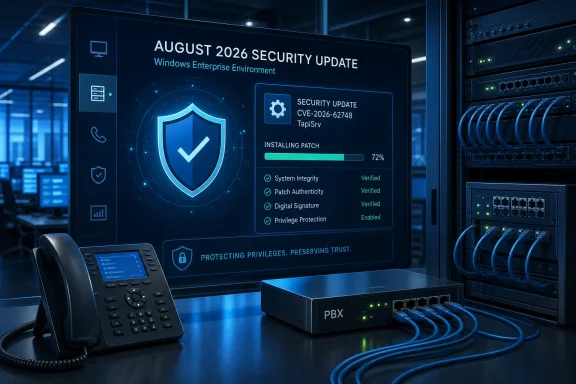
Microsoft’s Security Update Guide lists the issue as “Windows Telephony Service Elevation of Privilege Vulnerability” and records a publication time of 7:00 a.m. Pacific time on August 11, or 14:00 UTC. The entry establishes that Microsoft has issued a fix. It does not, from the material presently available, establish the attack path, the affected Windows releases, the precise privilege level gained, the underlying weakness type, or whether attackers have used it in the wild.
That lack of detail changes how this should be handled. CVE-2026-62748 is a patching priority because it is a Windows privilege-escalation flaw with an official fix, but administrators should not inflate it into an internet-facing remote compromise or an actively exploited zero-day without evidence. Microsoft’s naming convention tells us the vulnerable component and the impact category; it does not tell us the preconditions for exploitation.
The Telephony Service Has More Reach Than Its Name Suggests
The affected component is the Windows Telephony Service, commonly associated with the service name TapiSrv and the Telephony API, or TAPI. Microsoft’s Windows documentation describes the TAPI server as the central repository for telephony data on a machine, tracking local and remote telephony resources, registered applications, and communications with telephony service providers.
That means this is not solely a concern for desks still connected to traditional telephone hardware. TAPI has long existed as a compatibility layer for business calling software, PBX integrations, contact-center clients, dialers, fax products, and applications that control local or LAN-connected telephony resources. Its presence is therefore more likely in managed enterprise estates than a quick look at the word “telephony” would imply.
Microsoft documentation also says TapiSrv provides TAPI support for applications controlling telephony devices locally and, through a LAN, on servers that run the same service. That architecture is worth noting, but it must not be mistaken for proof that CVE-2026-62748 is network-exploitable. The vulnerability is classified as elevation of privilege, and Microsoft has not publicly supplied an attack-vector description in the material available at publication.
The practical risk profile is likely to depend on whether the vulnerable service is installed and running, which applications can reach it, and what access an attacker already holds. A local privilege escalation is often the second stage of an intrusion: an attacker first obtains a foothold as a standard user or within a constrained application context, then uses a vulnerable Windows component to obtain broader control. That makes patch coverage more important than exposure-management shortcuts such as asking whether a workstation has an attached telephone device.
The Report-Confidence Text Is Not a Vulnerability Rating
The text accompanying the advisory explains CVSS Report Confidence: a temporal scoring metric that reflects confidence in the existence of a vulnerability and the credibility of available technical detail. It is explanatory boilerplate from Microsoft’s Security Update Guide, not a disclosed score or a statement that CVE-2026-62748 has been publicly proven, demonstrated with an exploit, or observed in attacks.
This distinction is important because the language can easily be read as if Microsoft had declared the flaw “Confirmed.” The submitted advisory material does not include the actual Report Confidence value, CVSS vector, base score, exploitability assessment, or the “Exploited” and “Publicly disclosed” status fields that Microsoft normally uses to communicate more concrete risk information.
As of August 11, no independent technical write-up, proof of concept, incident report, or public exploit claim for CVE-2026-62748 surfaced in searches of the CVE and NVD indexes. That is not evidence that an exploit cannot exist; it means the public record presently supports a narrower conclusion: Microsoft has patched a Telephony Service privilege-escalation vulnerability, while the mechanics remain undisclosed.
This is normal on Patch Tuesday. Microsoft often releases a CVE entry before security researchers, vulnerability databases, asset-management vendors, and endpoint-security platforms have fully ingested the data. But it leaves administrators with an operational problem: a scanner may identify the CVE before it provides a useful affected-build range, while a patch-management console may provide the update before a vulnerability dashboard displays the corresponding finding.
Treat update compliance as the source of truth for the first patch cycle. Do not wait for a scanner’s CVE mapping or a third-party severity label before deploying the relevant Microsoft security update.
Why Disabling TapiSrv Is Not a General Fix
Some administrators will be tempted to reduce exposure by disabling the Telephony service. That can be reasonable on tightly controlled systems where an inventory confirms no TAPI-dependent software is installed, but it is not a universal workaround and should not substitute for installing Microsoft’s update.
The service may support old but operationally important line-of-business software. In environments with PBX links, call recording, dispatch systems, front-desk applications, or legacy CRM dialers, turning off TapiSrv can cause failures that only emerge when a call workflow is needed. A service shutdown can also become a false assurance if the vulnerability is patched by changes outside the service’s normal start state or if another process can activate the relevant functionality.
The safer sequence is:
- Deploy the August 11 security update to a representative pilot group that includes any systems with telephony, call-center, or TAPI-integrated software.
- Confirm that the cumulative update installed successfully and that the device is on the expected post-update build for its Windows release.
- Test critical calling and line-of-business workflows before broadening a service-hardening change.
- Disable or restrict TapiSrv only where the service is demonstrably unnecessary and where the operational owner accepts the application impact.
For Windows Server, this needs an extra level of care. A server may appear to have no telephony role while still hosting an application that depends on TAPI through an installed vendor component. Asset inventories that only track Windows roles and features will miss that relationship; application-owner validation is more reliable.
August Patch Compliance Is the Measurable Outcome
The current advisory does not provide a credible basis for making fine-grained claims such as “only Windows 11 is affected,” “servers are unaffected,” or “the flaw requires remote access.” Those statements need the product and build table from Microsoft’s advisory record or corroborating technical analysis. Until that record is fully available to management tools and public databases, patching supported Windows versions is the defensible response.
Microsoft’s own release-health material shows that Windows servicing is now split across several current branches, including Windows 11 versions 24H2 and 25H2, while Windows Server 2025 has separate KB identifiers and build numbers from Windows 11. Administrators should therefore verify the update against the exact operating system and servicing channel rather than assume a Windows 11 KB also covers an equivalent server deployment.
Windows 10 remains another point of caution. Standard support ended for most consumer editions in October 2025, and organizations relying on Windows 10 after that date need to confirm that their edition and Extended Security Updates entitlement actually deliver the August 2026 security package. An unsupported Windows installation cannot be considered remediated merely because the CVE has a Microsoft patch somewhere in the catalogue.
What to Watch After the Initial Rollout
The next useful information will be Microsoft’s completed advisory metadata: the affected product list, KB mappings, fixed build numbers, CVSS vector, weakness classification, and exploitability assessment. The National Vulnerability Database and CVE.org record will normally follow with a standardized description and product configuration data, but neither should be assumed to be complete on the day a Microsoft CVE is published.
For now, the evidence supports a clear operational conclusion. CVE-2026-62748 is a newly disclosed Windows Telephony Service elevation-of-privilege issue with a vendor-issued fix, and the right response is to complete August 11 patch deployment and verify it by build number. The missing technical detail is a reason to avoid speculation, not a reason to defer the update.