

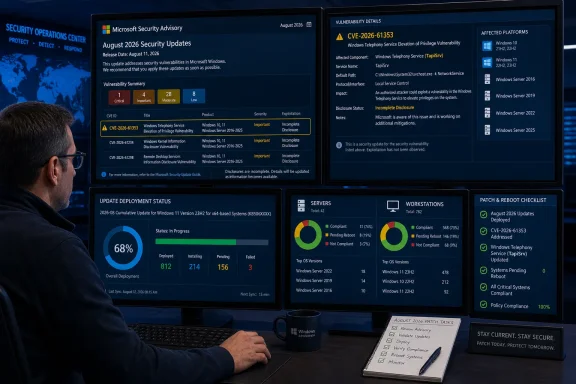
What is unusual here is how little Microsoft has disclosed. The MSRC entry identifies the affected component and impact but, at publication, does not provide the vulnerability class, a CVSS score, affected Windows versions or build ranges, a technical attack path, a workaround, or a public-exploitation finding. Searches of the public CVE record and NVD on August 11 likewise did not return a corresponding independently populated entry. That leaves the vendor’s advisory as the only primary record currently available.
The patch is real; the exposure details are not yet public
Microsoft’s publication establishes that a flaw was fixed in the Windows Telephony Service. It does not establish that the issue is remotely exploitable, that it is being exploited in the wild, or that every supported Windows release is affected. Those distinctions matter, especially because “elevation of privilege” is often compressed into the shorthand “local-to-SYSTEM,” even though Windows privilege-escalation bugs can have very different prerequisites and scope.
The supplied advisory material includes an explanation of exploit code maturity, a standard CVSS temporal metric that describes confidence in a vulnerability’s existence and the availability of technical knowledge. But the disclosure does not actually provide a maturity value. It should not be read as evidence that exploit code exists, that exploit code is public, or that attacks have been observed.
Microsoft also has not named a researcher or research organization credited with discovering the issue. That omission is not proof that the flaw came from internal testing rather than external reporting, but it removes one of the usual clues administrators use to assess whether a vulnerability has a public technical trail.
For now, the justified conclusion is narrower: a security defect exists in a Windows service component, Microsoft fixed it in the August 2026 update set, and the company has withheld the technical specifics that would allow defenders to independently model the attack chain.
Why Telephony Service still deserves attention
The service behind the advisory is generally known as TapiSrv, the Windows Telephony service. Microsoft’s TAPI documentation describes the TAPI server as the central repository for telephony data on a user computer, while its Windows Server service guidance says the service supports applications controlling local telephony devices and, through a LAN, telephony services on other servers.
That history makes it tempting to dismiss the component as a relic of analog modems. That would be a mistake. Telephony APIs remain relevant to legacy PBX integrations, contact-center software, call-control applications, modem-backed workflows and vendor-specific telephony service providers. A Windows device does not need to be a conventional desktop “phone system” to carry the service or software that interacts with it.
At the same time, the presence of TapiSrv on a device is not proof that CVE-2026-61353 is exploitable there. Microsoft has not published the affected product list or configuration conditions. Administrators should avoid two equally unhelpful reactions: assuming every system is exposed because the service exists, or assuming that systems without an obvious telephony role are safe.
The practical risk of an elevation-of-privilege flaw depends on the missing details. If exploitation requires an authenticated local user to invoke a vulnerable API, it may function as a post-compromise tool—useful to malware or an intruder who already has a foothold. If it involves a reachable service interface, a network path or a specific third-party telephony provider, the affected population could be materially different. Microsoft has not said which model applies.
August’s cumulative updates are the remediation path
Windows servicing does not ordinarily deliver a stand-alone “Telephony Service” package for issues like this. Microsoft’s servicing documentation confirms that supported Windows clients and servers use cumulative updates: the relevant fix is incorporated into the August 11 monthly security update for each supported version rather than distributed as a separate component patch.
That means the operational task is update compliance, not a manual replacement of a service binary. Organizations should use their usual Windows Update, WSUS, Microsoft Configuration Manager, Intune, or Microsoft Update Catalog process, but validate actual installation state rather than treating a successful deployment assignment as proof of remediation.
A basic response should include the following:
- Deploy the August 11, 2026 cumulative security update to supported Windows workstations and servers on an expedited but controlled schedule.
- Confirm the installed OS build after the maintenance window, because cumulative-update approval alone does not show whether a device downloaded, installed and rebooted successfully.
- Include Windows systems with older application stacks, PBX connectors, contact-center clients, modem workflows and custom TAPI integrations in the deployment inventory rather than filtering only for devices labeled as voice infrastructure.
- Review update exceptions, paused rings, disconnected laptops and servers that are deliberately held back on prior quality updates; these are the systems most likely to remain exposed after broad deployment reports turn green.
- Do not disable
TapiSrvas a blanket emergency measure solely on the basis of this CVE. Microsoft has published no workaround recommending that action, and its own service guidance notes that Windows Update and WSUS have dependencies on the Telephony service in at least some Windows Server configurations.
The final point deserves emphasis. Disabling an unfamiliar Windows service is often presented as a universal mitigation, but it can convert a patch-management problem into an availability problem. In this case, the service’s documented relationship to Windows update infrastructure makes indiscriminate disabling particularly risky.
The missing affected-build list complicates triage
Normally, Microsoft’s Security Update Guide gives administrators a clear product matrix: affected Windows releases, corresponding KB packages, severity, exploitability assessment, and whether an update supersedes the vulnerable state. CVE-2026-61353’s public page was published without enough of that information to build a clean vulnerability query or prioritize by operating-system family.
That is more than a documentation inconvenience. Endpoint-security platforms and vulnerability scanners often depend on CVE metadata, NVD enrichment, CPE mappings, or Microsoft’s product mappings to determine exposure. When those downstream records lag or are absent, a dashboard may show no finding even while the required cumulative update is available. Conversely, it may mark broad groups of devices based only on component detection rather than a verified affected-build range.
For this release, the more reliable operational measure is therefore patch currency: whether a system has the latest August security cumulative update for its actual Windows servicing branch. Security teams should preserve the CVE identifier in their change records and compliance reporting, but should not wait for scanners to produce a fully enriched vulnerability finding before deploying the update.
This is also a reminder that “no published exploit details” is not a mitigation. It lowers the amount of information available to both attackers and defenders, but it does not remove the flaw. A local privilege-escalation weakness becomes valuable once an attacker obtains code execution through phishing, stolen credentials, unpatched third-party software, or a compromised management tool.
Watch for a revised MSRC record, not a separate fix
The next meaningful development is likely to be a revision to Microsoft’s CVE-2026-61353 entry or the associated August Security Update Guide data, not a new patch. Microsoft often enriches advisories after initial publication with severity data, affected-product mappings, exploitability assessments, acknowledgments, or mitigation guidance.
Until that happens, there is no basis to assign this bug a specific severity score, describe it as a zero-day, claim it is actively exploited, or characterize it as a remote compromise path. Those are all claims administrators will see repeated quickly in vulnerability feeds; none is supported by the record currently available.
The defensible response is to treat CVE-2026-61353 as a patched Windows privilege-escalation issue with incomplete public triage data. Apply the August 11 cumulative update, verify installation on every supported Windows branch in use, and keep systems that rely on TAPI or telephony integrations under closer change-control observation during rollout.