

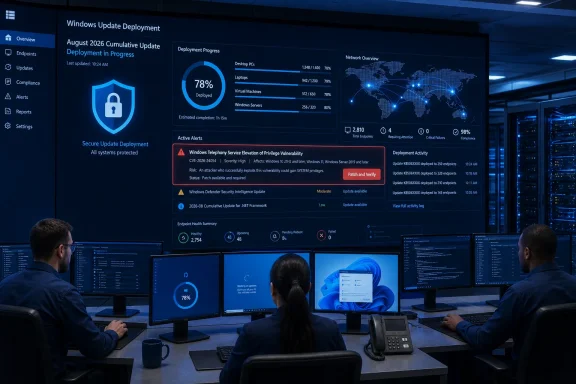
The Microsoft Security Response Center lists the issue as “Windows Telephony Service Elevation of Privilege Vulnerability” and dates its publication to August 11 at 7:00 a.m. Pacific time. That timestamp places it squarely in this month’s Patch Tuesday release, meaning the practical remediation is the current security update for each supported Windows build, not a separate Telephony package.
What Microsoft has not publicly supplied in the material available so far is as important as the title. The advisory disclosure does not identify the root-cause weakness, affected function, required access path, affected Windows versions, or the level of privilege an attacker could obtain. It also does not provide a workaround. For patch-management teams, the immediate job is therefore straightforward but less elegant than a CVE-specific deployment plan: bring every supported Windows installation to its August 2026 security baseline and verify the resulting build numbers through the normal servicing reports.
The vulnerability is local, but its value is post-compromise
“Elevation of privilege” does not mean an unauthenticated attacker can reach a workstation directly over the internet and take it over. It means an attacker who already has some ability to run code — through a malicious attachment, stolen credentials, a compromised application, an insider account, or another vulnerability — may be able to obtain permissions they should not have.
That distinction should govern the response. CVE-2026-62729 is not a reason to expose an emergency internet-facing service; it is a reason to close a route that can make other intrusions much worse. Local escalation vulnerabilities are routinely paired with initial-access techniques because the first process an attacker gains is often confined to a standard user, application sandbox, or restricted service account.
The affected component compounds that concern. The Windows Telephony Service is a legacy-facing Windows subsystem that supports the Telephony API, or TAPI, and remains present across a broad range of Windows deployments even where organizations no longer think of their endpoints as “telephony” systems. Its presence can be easy to overlook in a modern fleet that uses Teams, third-party softphones, Remote Desktop, VPN software, call-center agents, fax tooling, or older line-of-business applications.
There is no basis yet to conclude that every machine with the service installed is exploitable in a useful configuration. Microsoft has not published that level of technical detail. But a service’s apparent lack of daily business use is not a substitute for patching it: Windows components often remain installed because they support dependencies that are not obvious from the Services console.
Microsoft’s disclosure is thin, and external corroboration has not caught up
Microsoft is the primary authority for the existence of CVE-2026-62729 and its August 11 publication. Searches of public vulnerability indexes and independent security reporting on August 12 did not surface a detailed record, exploit analysis, researcher write-up, or a separate report identifying the vulnerable code path.
That absence is normal during the first day of a monthly release, particularly for bugs reported privately and fixed before public disclosure. It does mean that security teams should resist filling gaps with assumptions. Neither a CVSS score nor a severity rating should be inferred from other Windows Telephony Service CVEs, even when those older issues carried similar titles. The component has received several different fixes over time for materially different flaws, including memory-safety errors and race conditions; CVE-2026-62729 needs to be treated as its own issue.
The supplied MSRC material also includes Microsoft’s explanation of the Exploit Code Maturity metric, which measures both confidence that a vulnerability exists and the credibility of known technical details. The explanatory text alone is not evidence of public exploit code, in-the-wild exploitation, or a working proof of concept. Until Microsoft, CISA, or a credible researcher says otherwise, organizations should not describe this flaw as exploited or weaponized.
That may sound procedural, but the distinction matters in incident response. “Published CVE” means patch it; “actively exploited” changes patch precedence, detection work, and the urgency of containment. The public record currently supports the first conclusion, not the second.
The August cumulative update is the practical fix
For Windows administrators, the most reliable response is to use the August 2026 security cumulative update applicable to each supported release in the estate. That includes Windows 11 feature versions still in servicing, Windows 10 editions covered by their support or Extended Security Updates entitlement, and supported Windows Server releases.
Do not rely on a statement that a device is “up to date” without checking when the last quality update installed. Devices paused from Windows Update, managed through an update ring with a deferred deadline, isolated from update infrastructure, or built from an older image may still be missing the August security payload. Offline systems, virtual desktop pools, lab machines, gold images, recovery environments, and seldom-used jump hosts are where routine monthly security gaps tend to persist.
A sensible deployment sequence is:
- Patch internet-exposed administration systems, privileged-access workstations, Remote Desktop hosts, application servers, and shared multi-user systems first, because a local privilege escalation has more value where an attacker may already obtain a limited session.
- Patch endpoint-management servers and their administrative workstations promptly, because privileged tooling is an attractive target for attackers seeking to widen an initial compromise.
- Update virtual desktop master images and test images, then force or schedule recomposition so that an old image does not keep reintroducing the vulnerable build.
- Confirm that update reporting identifies the installed August 2026 cumulative update or its resulting OS build, rather than treating a successful deployment job as proof of installation.
Microsoft has not published a mitigation in the available advisory material, and disabling the Telephony service should not be treated as a universal answer. Doing so can break calling, modem, remote-access, assistive, or vendor-specific functionality, while leaving a device unpatched against other vulnerabilities. If a high-risk system cannot be patched immediately, organizations can assess whether Telephony is required in that specific environment and test service restrictions as a short-term compensating control. It is not a replacement for the Microsoft update.
What defenders should watch while details emerge
The lack of a published exploitation path limits precise detection guidance. Security teams should avoid writing brittle rules around an imagined vulnerable file, RPC interface, or child process. Instead, use this disclosure to reinforce detection around the behavior a successful local escalation is likely to enable: unexpected service creation, scheduled-task registration, modifications to protected directories or registry locations, new local administrator memberships, credential-dumping attempts, and suspicious execution from user-writable paths.
Endpoint detection platforms should also be checked for telemetry gaps on systems where the Telephony service is active. The objective is not to alert every time svchost.exe hosts a Windows service; it is to preserve enough process, token, service-control, and privilege-change telemetry to investigate a suspicious transition from a low-privilege process to administrative activity.
CVE-2026-62729 is currently a patch-and-verify event rather than a public emergency driven by known exploitation. Microsoft has confirmed the Windows Telephony Service flaw and released the fix; the missing technical detail does not weaken the case for deploying August’s updates. It simply means administrators should prioritize the remedial action they can verify today, while keeping their vulnerability records open for the affected-build and exploitability details Microsoft or independent researchers may publish next.