

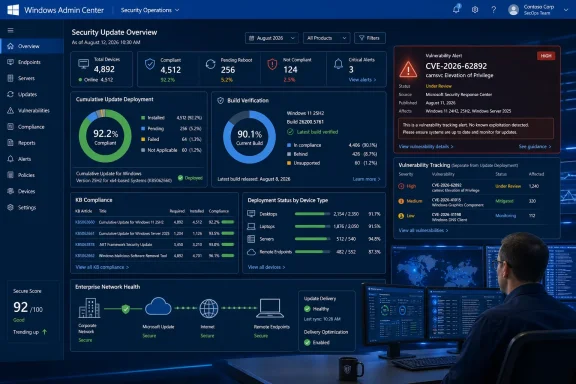
Microsoft’s Security Update Guide identifies the issue as “Capability Access Management Service (camsvc) Elevation of Privilege Vulnerability.” It was published on August 11, 2026. The public entry, however, leaves several details that administrators normally need for risk triage either unavailable or insufficiently surfaced: a concrete vulnerable-build range, a named KB mapping, a root-cause description, and a clear statement of whether exploitation has been observed.
That is more than a documentation annoyance. camsvc is a local Windows service tied to capability and privacy-access management, so an elevation-of-privilege flaw there belongs in the second stage of an attack chain, after an intruder or malicious program already has code execution or an account on a machine. Whether the risk is an emergency depends on the missing facts: the privileges required before exploitation, attack complexity, the systems affected, and Microsoft’s exploitability assessment.
The CVE entry confirms the issue, but not the exposure boundary
CVE-2026-62892 is vendor-confirmed: Microsoft is the assigning CNA and has put the advisory in its Security Update Guide. That settles the basic question of whether Microsoft recognizes the vulnerability. It does not establish a reliable public answer to which Windows client and server releases are affected, what build closes the issue, or whether every supported version carries the vulnerable code path.
As of August 12, the CVE number has not been independently mirrored with substantive technical detail in the National Vulnerability Database, the CVE Program’s public record, or mainstream security reporting. That may simply reflect the ordinary delay between Microsoft’s Patch Tuesday publication and downstream database ingestion. But it means teams should not fill the gap with assumptions drawn from similarly named camsvc flaws.
The advisory material supplied with the record includes the generic definition of CVSS Report Confidence. That is explanatory text describing how a vulnerability’s existence and technical details can be assessed; it is not evidence that Microsoft has published a proof of concept, exploitation telemetry, or a complete technical explanation for CVE-2026-62892. Treating that boilerplate as a “confirmed exploit” signal would be a category error.
For practical purposes, this is a patch-first item, not an incident-response declaration. There is currently no independently corroborated public evidence that CVE-2026-62892 is under active exploitation, publicly disclosed before patching, remotely reachable, or usable without a local foothold.
Reused camsvc titles make CVE-level tracking essential
The Capability Access Management Service has appeared in Microsoft security advisories before, and the repetition creates an easy trap for vulnerability-management teams. CVE-2025-49690, for example, carried the same broad “Capability Access Management Service (camsvc) Elevation of Privilege Vulnerability” title. The CVE Program and NIST’s National Vulnerability Database describe that earlier flaw as a race condition involving concurrent use of a shared resource, with a CVSS 3.1 score of 7.4.
Microsoft also published CVE-2026-21221 under the same service-and-impact naming pattern in January 2026. Third-party product-security notices that catalogued Microsoft’s January fixes included it as a camsvc elevation-of-privilege issue, but the public technical footprint around that CVE was similarly sparse.
Those prior disclosures provide useful context, but they do not describe CVE-2026-62892. A repeated service name is not a repeated vulnerability, and an older CVSS score is not a severity rating for the August flaw. The bug could be in a different code path, affect a different Windows generation, require a different attacker position, or be resolved through different cumulative updates.
That distinction matters especially for automated vulnerability scanners and ticketing systems that use titles as deduplication keys. If an organization previously closed a camsvc finding by recording CVE-2025-49690 or CVE-2026-21221 as remediated, it should ensure CVE-2026-62892 opens a new finding tied to August 2026 update compliance. Deduplicating it based on the service name risks converting a new Microsoft fix into a false “already remediated” result.
Local privilege escalation still has a high operational value
A local elevation-of-privilege vulnerability is rarely the first door into an enterprise, but it can be the door that changes the incident. Malware delivered through phishing, a browser exploit, a compromised software installer, a malicious local user, or an abused remote-access account may initially run with limited user rights. A successful privilege-escalation exploit can turn that limited position into administrator or SYSTEM-level control, depending on the bug and the target configuration.
At that point, attackers can commonly do things that standard-user execution makes harder: tamper with endpoint security controls, create or modify privileged accounts, access protected credential material, install persistence that survives user-profile cleanup, or interfere with logging and remediation tools. The vulnerability’s title does not prove all of those outcomes for this specific CVE, but it identifies the class of risk that the August update is intended to reduce.
The fact that camsvc is a local service also argues against improvised mitigations. Disabling or force-stopping Windows services to “remove” a security exposure can have unpredictable effects on app privacy prompts, capability access, and operating-system behavior. It may also fail to remove the vulnerable code from disk. Microsoft has not published a workaround for CVE-2026-62892 in the advisory material currently available, so the supported fix is the security update, not service surgery.
What administrators should verify during the August rollout
The lack of public build-level specificity shifts the burden to ordinary patch-management evidence. Organizations should confirm that their August 2026 Windows cumulative update deployment actually reached the systems they intend to protect, including remote devices that may have missed their usual update window.
A useful validation pass should include the following:
- Confirm that each supported Windows client and server fleet has installed its applicable August 2026 security update, rather than merely reporting that Windows Update scanned successfully.
- Record the post-installation OS build number and compare it with Microsoft’s Windows release-health and update-history records for the relevant servicing channel.
- Keep CVE-2026-62892 as a separate tracking item from CVE-2025-49690 and CVE-2026-21221, even though all three name camsvc.
- Prioritize endpoints where untrusted code is most likely to execute locally, including shared workstations, developer machines, administrative jump hosts, virtual desktop pools, and systems used to open downloaded files.
- Do not disable the Capability Access Management Service as a substitute for patching unless Microsoft later issues a specific, supported mitigation.
For managed environments, the most meaningful evidence is the installed cumulative-update package and post-reboot build number, not an inventory entry that merely detects the existence of camsvc. The service is part of Windows; its presence does not indicate vulnerability, and its absence would not demonstrate that the August flaw was remediated.
The missing technical record should not slow patching
Microsoft’s August 11 publication gives defenders enough to act: a vendor-confirmed Windows local privilege-escalation vulnerability has a security update path. What it does not yet give them is enough public evidence to rank CVE-2026-62892 above every other August item solely on the basis of its name.
The responsible posture is to patch it in the normal August security-update wave, verify installation by build and KB compliance, and retain the CVE as its own record rather than closing it against an older camsvc advisory. If Microsoft later adds exploitability status, affected builds, CVSS metrics, or a technical description, those details may justify changing the priority. Until then, the concrete consequence is simpler: any Windows device left outside the August 2026 update deployment remains an unverified exception for a newly disclosed privilege-escalation fix.