

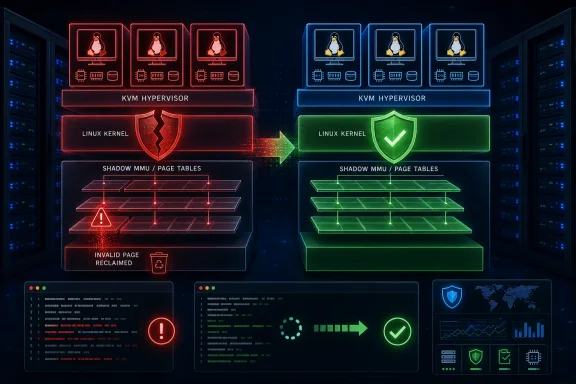
The immediate operational point is narrower than the score suggests but more important than a routine housekeeping fix: this is an x86 KVM bug in the host kernel, not a vulnerability in a guest operating system alone. A Windows PC using Hyper-V is not in the affected code path, and neither Windows nor Hyper-V appears in the CVE’s affected-product data. The systems to prioritize are Linux KVM hosts—QEMU/KVM virtualization servers, Linux-based appliances, self-hosted cloud nodes, and lab hosts—that run potentially untrusted or strongly isolated x86 workloads.
The NVD published the record on August 4, 2026, and its entry was updated again on August 9. NVD has not assigned its own CVSS assessment. That leaves kernel.org’s 8.8 score as the only published severity rating in the record, and administrators should avoid treating it as proof of a demonstrated guest-to-host escape. The official description establishes a correctness and memory-lifecycle flaw; it does not publish a working exploit, attack prerequisites, or confirmed in-the-wild exploitation.
The check occurs before the operation that can invalidate it
KVM’s shadow MMU is the part of the x86 virtualization stack that builds and maintains host-side page-table structures representing a guest’s virtual-memory translations. Its pages are not ordinary guest memory. They are kernel-managed structures that the hypervisor uses to map guest activity safely onto host pages.
CVE-2026-64561 centers on the order of two operations in the KVM page-fault path. KVM first determines whether the current root page is stale—either invalid or obsolete—and then calls the routine that makes MMU pages available. That availability routine can reclaim memory by zapping older shadow pages. Under the problematic sequence, reclaim can invalidate the very root KVM is still about to use.
The patch moves the stale-root check after KVM has made MMU pages available. If reclamation has invalidated the root, KVM retries the page fault instead of continuing to populate page-table structures beneath a root it has already discarded.
That sounds like a small ordering change. It protects a hard KVM invariant: invalid shadow pages must never be present on the list of active MMU pages. The reason is inheritance. A child shadow page created while its parent root is marked invalid inherits the invalid role. KVM can therefore create an invalid child and simultaneously account for it as active—the state the subsystem says should be impossible.
Linux kernel documentation explains why root validity is consequential in this area. KVM uses MMU-generation tracking and invalid-root state to make stale translations unusable after memory-map changes and to force vCPUs onto a new valid root before guest execution resumes. The CVE is about a hole in that lifecycle: a root can change state in the interval between the first validation and memory reclamation.
The vulnerable history is older than the exploitable condition
Kernel.org’s description says the underlying failure to account for invalid roots dates back to 2008, when KVM began tracking zapped roots. But it also says the “true badness” arrived with Linux 5.9 in 2020, when KVM adopted the invariant forbidding invalid shadow pages from the active MMU-page list.
That distinction matters for patch management. “The code has existed since 2008” does not mean every KVM deployment since 2008 has the same vulnerability condition. The published affected-version data starts at Linux 5.9, and describes versions before 5.9 as unaffected. An estate running a genuinely older kernel should still follow its distributor’s support guidance, but it should not be swept into the affected population simply because the root-handling code has long ancestry.
There is also a useful technical parallel in the public KVM development record. A 2021 patch discussion addressed stale roots during page faults after a memslot update, warning that inserting shadow page-table entries into an obsolete root could lead to leaked shadow pages or reuse of inappropriate structures. A 2025 KVM patch series separately discussed freeing obsolete roots before reload paths encounter them. Those earlier fixes show that stale-root handling has been an active maintenance area, but they are not substitutes for the CVE-2026-64561 commit. The current issue is specifically the root invalidation that can happen while KVM reclaims pages to satisfy MMU allocation pressure.
“KVM installed” is not enough for a sound exposure assessment
The CVE names the x86 KVM shadow MMU and identifies arch/x86/kvm/mmu/mmu.c plus arch/x86/kvm/mmu/paging_tmpl.h as affected files. That confines the defect to Linux’s x86 KVM implementation. It does not establish exposure for every product that can launch a virtual machine.
The record does not publish a tested matrix for processor vendors, nested-virtualization settings, QEMU versions, libvirt configurations, cloud control planes, or distributions. It also does not say that every Intel EPT or AMD NPT deployment follows the same vulnerable path at the same frequency. KVM has multiple MMU paths, and the issue description expressly discusses the shadow MMU. The absence of a configuration matrix is material: teams should not claim a host is safe merely because it uses modern second-level translation, nor should they assume a KVM package alone proves reachable exposure.
Administrators should instead establish three facts:
- The host is an x86 Linux system using KVM for production or tenant workloads.
- The running kernel includes the affected KVM code and does not contain the relevant stable backport.
- The organization permits guests that a lower-privileged party can influence, including customer VMs, CI runners, nested labs, or workloads separated by KVM as a security boundary.
Kernel.org’s CVSS vector sets attack complexity to low, user interaction to none, and attacker privileges to low, while rating confidentiality, integrity, and availability impact as high with changed scope. Those are serious assumptions. But the record does not explain how the CVSS privileges map onto a real-world deployment or provide a proof of exploitation. Treat the score as a strong reason to patch promptly, not a license to fill in an exploit narrative the advisory has not supplied.
The patch status is clearer than the disclosure status
The good news is that the CVE record names concrete upstream fixed releases. The less convenient news is that kernel version labels are not reliable proof of remediation in enterprise Linux. Red Hat Enterprise Linux, Ubuntu LTS, Debian stable, SUSE products, Proxmox, appliance vendors, and cloud images commonly ship security fixes as backports while retaining an older-looking base version.
For that reason, a host reporting a version below 6.6.148 should not automatically be classified vulnerable, and a host reporting a superficially newer version should not automatically be classified fixed if it uses a vendor kernel. The decisive evidence is the distributor’s advisory or changelog tying its kernel package to CVE-2026-64561 or to the applicable upstream stable commit. Kernel.org lists five stable-tree commit references because the repair was backported across maintained branches; that is the evidence a downstream package maintainer should preserve.
The record’s release data also deserves a careful reading. It identifies 6.6.148, 6.12.101, 6.18.42, 7.1.6, and 7.2-rc5 as unaffected endpoints. Those are branch-specific repair points, not a promise that every distribution using a numerically comparable kernel has received the change. An Ubuntu 6.8 build, for example, may be fixed through a downstream patch even though it does not resemble any upstream version listed in the CVE.
The public “Zapscape” reference is not usable evidence
One detail in the August 9 change history deserves restraint. Kernel.org added a reference named “ZapscapeCVE,” apparently intended to point to a GitHub repository. At the time this record was checked, that repository address returned a GitHub 404 response.
That does not invalidate the CVE or the upstream code fix. The kernel.org record and stable-tree references are sufficient to establish that the maintainers resolved a defect. It does mean there is no publicly accessible proof-of-concept at the referenced location for administrators or reporters to independently inspect.
No independent technical reporting located for this disclosure establishes a working exploit chain, affected hosting products, or observed attacks. Claims that this CVE is a confirmed guest-to-host escape should therefore be treated as unverified unless and until a reproducible technical analysis or a vendor advisory supplies the missing evidence. The distinction is operationally useful: do not delay patching, but do not escalate an unsubstantiated exploit claim into an incident declaration.
For KVM operators, the practical response is to patch the host kernel through the supported distribution channel, reboot into the updated kernel, and confirm the running—not merely installed—kernel package includes the CVE-2026-64561 fix. Where maintenance windows delay that work, treat guest access to vulnerable x86 KVM hosts as a tighter trust boundary than usual and avoid placing untrusted workloads on those nodes.
The unresolved point is not whether there is a fix; kernel.org has published one and named the stable release points. It is whether the incomplete public exploit reference will be restored and whether distributors will publish product-specific advisories. Until then, the credible conclusion is straightforward: this is a serious KVM host-kernel flaw with a defined upstream repair, but the public record does not yet support claims of confirmed exploitation or a documented guest-escape technique.