
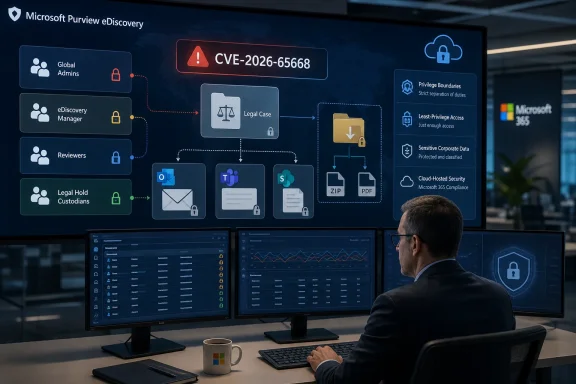
Microsoft has published CVE-2026-65668, an elevation-of-privilege vulnerability in Microsoft Purview eDiscovery, a Microsoft 365 compliance service whose approved users can search, preserve, review, and export some of an organization’s most sensitive content. The Security Update Guide entry went live on August 6, 2026, at 7:00 a.m. Pacific time. For administrators, the immediate issue is not a Windows patch deployment: it is confirming who can reach eDiscovery workflows and what those identities can already do.
Microsoft’s advisory confirms the CVE identifier, product area, and impact classification. It does not, in the information currently public, establish the vulnerable feature, the prerequisite permissions, the affected tenant configurations, a CVSS score, whether exploitation has been observed, or a customer-deployed update. Searches of the National Vulnerability Database, CVE.org, and independent security reporting did not surface a corresponding public technical record at publication time.
That thin public record is itself the operational fact to act on. CVE-2026-65668 is an acknowledged flaw in a hosted Microsoft 365 compliance surface, but there is not enough evidence to conclude that it is remotely reachable by anonymous attackers, usable by every Microsoft 365 user, or tied to a specific Windows, Office, or Microsoft Edge version.
Microsoft Purview eDiscovery is designed to let authorized investigators collect material across Microsoft 365 services. Depending on the role assignments and case configuration, that can include Exchange Online mailboxes, Microsoft Teams conversations, SharePoint Online and OneDrive content, Microsoft 365 Groups, Viva Engage data, legal holds, review sets, and export packages.
Microsoft’s own Purview documentation makes clear that eDiscovery separates access through role groups and case membership. The eDiscovery Manager role group, for example, is not a blanket permission to every case; users must also be added to individual cases before they can work within them. Other granular roles control case management, searches, previewing, review sets, holds, exports, decryption of rights-protected content, and search-and-purge operations.
An elevation-of-privilege flaw in this area matters because the intended controls are deliberately layered. A user who can create a case should not automatically be able to export all search results. A user who can search should not necessarily be able to preview content, decrypt protected files, place a legal hold, alter case membership, or remove data matching a search. CVE-2026-65668 raises the possibility that one of those boundaries can be crossed; Microsoft has not said which one.
The distinction is important for Windows administrators because endpoint patch compliance alone cannot demonstrate that the tenant is safe. Purview eDiscovery runs as a Microsoft-hosted service. Unless Microsoft later identifies a browser component, management tool, local export client, or on-premises dependency, there is no basis to treat this as a conventional WSUS, Microsoft Configuration Manager, Intune, or monthly cumulative-update problem.
A flaw requiring an authenticated eDiscovery user with access to a particular case presents a different risk from one that can be reached by any tenant user. A defect allowing a reviewer to obtain export rights within an existing case has a different impact from a defect that could grant tenant-wide compliance administration. And a service-side authorization issue can be remediated by Microsoft without producing a visible tenant setting, KB article, or downloadable package.
Microsoft also has not publicly stated whether the vulnerability was publicly disclosed before the advisory, whether it has been exploited in the wild, or who reported it. Those are not minor gaps. They mean organizations should avoid inventing indicators of compromise, assuming a known exploit chain exists, or treating any routine Purview audit event as evidence of an attack.
No independent outlet has reported technical mechanics or exploitation tied specifically to CVE-2026-65668 as of August 6. Security teams should therefore separate the confirmed fact — Microsoft has acknowledged an elevation-of-privilege issue affecting Purview eDiscovery — from the unconfirmed assumptions that often attach themselves to newly issued CVEs.
Administrators should identify all members of Purview role groups that include eDiscovery permissions, particularly accounts holding eDiscovery Administrator, eDiscovery Manager, Organization Management, Compliance Administrator, Case Management, Compliance Search, Export, Hold, Preview, Review, RMS Decrypt, and Search And Purge capabilities. Role group membership that was acceptable during a one-time investigation often remains in place long after the matter has closed.
Case-level membership needs separate scrutiny. Microsoft documents that adding a role group to a case can extend access to each member of that group, while changes to roles can remove the group from cases as a safeguard against accidental permission expansion. Organizations using custom role groups should check both the roles assigned to the group and the cases in which the group is a member; looking only at one view misses the effective access path.
Export permissions deserve particular attention. Purview documentation shows that exports can include mailbox items, Teams and Viva Engage conversations, SharePoint and OneDrive documents, and review-set content. In certain configurations, a user without the Export role can download results after a separately authorized user initiates an export, subject to documented timing and feature conditions. That is legitimate product behavior, but it means audit reviews should examine both who initiates exports and who downloads the resulting packages.
Tenant teams should also preserve and review audit records for eDiscovery role changes, case membership changes, case administration actions, searches, holds, previews, export creation, and export downloads. The CVE advisory does not name a detection pattern, so these records cannot establish exploitation on their own. They can, however, establish a clean baseline and expose unusual privilege changes or data-extraction activity while Microsoft’s technical details remain limited.
That possibility has two consequences. First, endpoint teams should not delay their review while waiting for Windows Update or an Intune quality update to appear. Second, compliance and security teams should record the advisory date, retain their role and case-membership snapshots, and watch the Security Update Guide for revisions that clarify the remediation status, scope, and any required customer action.
Microsoft’s publication of CVE-2026-65668 establishes that Purview eDiscovery has had an elevation-of-privilege weakness. Until the company says more, the defensible course is straightforward: reduce standing eDiscovery access, verify case-level membership, monitor exports and role changes, and treat any claim about an exploit path, affected Windows build, or active exploitation as unconfirmed.
That thin public record is itself the operational fact to act on. CVE-2026-65668 is an acknowledged flaw in a hosted Microsoft 365 compliance surface, but there is not enough evidence to conclude that it is remotely reachable by anonymous attackers, usable by every Microsoft 365 user, or tied to a specific Windows, Office, or Microsoft Edge version.
The exposed boundary is eDiscovery permission, not the Windows desktop
Microsoft Purview eDiscovery is designed to let authorized investigators collect material across Microsoft 365 services. Depending on the role assignments and case configuration, that can include Exchange Online mailboxes, Microsoft Teams conversations, SharePoint Online and OneDrive content, Microsoft 365 Groups, Viva Engage data, legal holds, review sets, and export packages.Microsoft’s own Purview documentation makes clear that eDiscovery separates access through role groups and case membership. The eDiscovery Manager role group, for example, is not a blanket permission to every case; users must also be added to individual cases before they can work within them. Other granular roles control case management, searches, previewing, review sets, holds, exports, decryption of rights-protected content, and search-and-purge operations.
An elevation-of-privilege flaw in this area matters because the intended controls are deliberately layered. A user who can create a case should not automatically be able to export all search results. A user who can search should not necessarily be able to preview content, decrypt protected files, place a legal hold, alter case membership, or remove data matching a search. CVE-2026-65668 raises the possibility that one of those boundaries can be crossed; Microsoft has not said which one.
The distinction is important for Windows administrators because endpoint patch compliance alone cannot demonstrate that the tenant is safe. Purview eDiscovery runs as a Microsoft-hosted service. Unless Microsoft later identifies a browser component, management tool, local export client, or on-premises dependency, there is no basis to treat this as a conventional WSUS, Microsoft Configuration Manager, Intune, or monthly cumulative-update problem.
Microsoft has not provided the details needed to rank the threat
The current advisory does not publicly name a weakness category such as improper authorization, authentication bypass, insecure direct object reference, server-side request forgery, or a role-assignment error. It also does not identify an attack vector or a privilege requirement. Those omissions prevent defenders from accurately placing CVE-2026-65668 into the usual triage buckets.A flaw requiring an authenticated eDiscovery user with access to a particular case presents a different risk from one that can be reached by any tenant user. A defect allowing a reviewer to obtain export rights within an existing case has a different impact from a defect that could grant tenant-wide compliance administration. And a service-side authorization issue can be remediated by Microsoft without producing a visible tenant setting, KB article, or downloadable package.
Microsoft also has not publicly stated whether the vulnerability was publicly disclosed before the advisory, whether it has been exploited in the wild, or who reported it. Those are not minor gaps. They mean organizations should avoid inventing indicators of compromise, assuming a known exploit chain exists, or treating any routine Purview audit event as evidence of an attack.
No independent outlet has reported technical mechanics or exploitation tied specifically to CVE-2026-65668 as of August 6. Security teams should therefore separate the confirmed fact — Microsoft has acknowledged an elevation-of-privilege issue affecting Purview eDiscovery — from the unconfirmed assumptions that often attach themselves to newly issued CVEs.
Existing eDiscovery access deserves an immediate review
The practical response is a least-privilege review focused on eDiscovery roles, case membership, and high-impact actions. This is not a Microsoft-issued workaround for CVE-2026-65668; Microsoft has not published one. It is the sensible containment step for a vulnerability whose stated impact is privilege elevation in a service built to handle sensitive investigative material.Administrators should identify all members of Purview role groups that include eDiscovery permissions, particularly accounts holding eDiscovery Administrator, eDiscovery Manager, Organization Management, Compliance Administrator, Case Management, Compliance Search, Export, Hold, Preview, Review, RMS Decrypt, and Search And Purge capabilities. Role group membership that was acceptable during a one-time investigation often remains in place long after the matter has closed.
Case-level membership needs separate scrutiny. Microsoft documents that adding a role group to a case can extend access to each member of that group, while changes to roles can remove the group from cases as a safeguard against accidental permission expansion. Organizations using custom role groups should check both the roles assigned to the group and the cases in which the group is a member; looking only at one view misses the effective access path.
Export permissions deserve particular attention. Purview documentation shows that exports can include mailbox items, Teams and Viva Engage conversations, SharePoint and OneDrive documents, and review-set content. In certain configurations, a user without the Export role can download results after a separately authorized user initiates an export, subject to documented timing and feature conditions. That is legitimate product behavior, but it means audit reviews should examine both who initiates exports and who downloads the resulting packages.
Tenant teams should also preserve and review audit records for eDiscovery role changes, case membership changes, case administration actions, searches, holds, previews, export creation, and export downloads. The CVE advisory does not name a detection pattern, so these records cannot establish exploitation on their own. They can, however, establish a clean baseline and expose unusual privilege changes or data-extraction activity while Microsoft’s technical details remain limited.
Do not wait for a KB number that may never appear
The most consequential omission in Microsoft’s public advisory is the lack of a named customer remediation. There is presently no Windows KB number, Office build number, downloadable update, tenant configuration change, or administrator command publicly associated with CVE-2026-65668. That strongly suggests — though Microsoft has not explicitly said so — that the fix may be deployed or deployable on Microsoft’s side of the service boundary.That possibility has two consequences. First, endpoint teams should not delay their review while waiting for Windows Update or an Intune quality update to appear. Second, compliance and security teams should record the advisory date, retain their role and case-membership snapshots, and watch the Security Update Guide for revisions that clarify the remediation status, scope, and any required customer action.
Microsoft’s publication of CVE-2026-65668 establishes that Purview eDiscovery has had an elevation-of-privilege weakness. Until the company says more, the defensible course is straightforward: reduce standing eDiscovery access, verify case-level membership, monitor exports and role changes, and treat any claim about an exploit path, affected Windows build, or active exploitation as unconfirmed.
References
- Primary source: MSRC
Published: 2026-08-06T07:00:00-07:00
Security Update Guide - Microsoft Security Response Center
msrc.microsoft.com
- Related coverage: msrc.microsoft.com
Security Update Guide - Microsoft Security Response Center
msrc.microsoft.com
- Related coverage: aha.org
- Related coverage: caloes.ca.gov
- Related coverage: windowsforum.com
CVE-2026-26150 Purview eDiscovery EoP: Privilege & Least-Priv
Microsoft’s latest Security Update Guide entry for CVE-2026-26150 is a reminder that cloud-era vulnerabilities are increasingly about privilege boundaries...windowsforum.com - Related coverage: support.microsoft.com
Description of the security update for Office 2016: May 12, 2026 (KB5002866) | Microsoft Support
Description of the security update for Office 2016: May 12, 2026 (KB5002866)support.microsoft.com - Related coverage: windowsforum.com
Microsoft Purview CVE-2026-26139: Elevation of Privilege Risk
Microsoft’s CVE-2026-26139 entry for Microsoft Purview is a textbook example of how modern cloud-era vulnerability reporting can be both precise and...windowsforum.com - Related coverage: threats.kaspersky.com
Kaspersky Threats — KLA91002
threats.kaspersky.com
- Related coverage: cve.imfht.com
Microsoft Purview eDiscovery Vulnerabilities (1 CVEs) | Shenlong CVE Platform
All 1 CVE vulnerabilities found in Microsoft Purview eDiscovery, with AI-generated Chinese analysis, references, and POCs.
cve.imfht.com
- Related coverage: cvepremium.circl.lu
Vulnerability-Lookup
Vulnerability-Lookup - Fast vulnerability lookup correlation from different sources.cvepremium.circl.lu - Related coverage: stack.watch
- Related coverage: cve.imfht.com
microsoft Vulnerabilities (9344 CVEs) | Shenlong CVE Platform
Browse all 9344 CVE security advisories affecting microsoft. AI-powered Chinese analysis, POCs, and references for each vulnerability.
cve.imfht.com
- Related coverage: download.microsoft.com
Microsoft Security Intelligence Report volume 11 Key Findings Summary English
PDF documentdownload.microsoft.com
- Related coverage: download.microsoft.com
- Related coverage: learn.microsoft.com
Export items from a review set in eDiscovery | Microsoft Learn
Learn about exporting items from a review set with eDiscovery in the Microsoft Purview portal.learn.microsoft.com - Related coverage: learn.microsoft.com
Learn about access and permission settings in eDiscovery cases | Microsoft Learn
Learn about access and permission settings in eDiscovery cases.learn.microsoft.com - Related coverage: github.com
GitHub - microsoft/MSRC-Microsoft-Security-Updates-API: Repo with getting started projects for the Microsoft Security Updates API (msrc.microsoft.com/update-guide) · GitHub
Repo with getting started projects for the Microsoft Security Updates API (msrc.microsoft.com/update-guide) - microsoft/MSRC-Microsoft-Security-Updates-API
github.com
- Related coverage: evs.com
- Related coverage: cirt.gy
- Related coverage: cert.europa.eu
- Related coverage: nvd.nist.gov
Vulnerability APIs
nvd.nist.gov
- Related coverage: nvd.nist.gov
NVD - Data Feeds
nvd.nist.gov
- Related coverage: cve.mitre.org
- Related coverage: cve.org
- Related coverage: nist.gov
National Vulnerability Database
NIST maintains the National Vulnerability Database (NVD), a repository of information on software and hardware flaws that can compromise computer security. This is a key piece of the nation’s cybersecurity infrastructure.www.nist.gov - Related coverage: cve.mitre.org
- Related coverage: cve.org
- Related coverage: first.org
Temporarily Unavailable For Review
www.first.org