

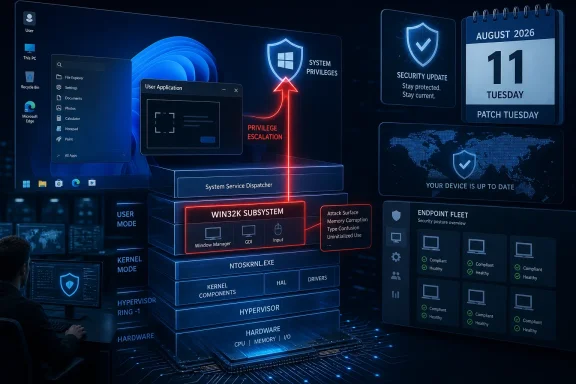
Microsoft’s Security Update Guide is the primary record for this CVE. As of its initial publication, however, the public material supplied with the advisory establishes the vulnerability’s category while leaving several operationally important details unreported: the affected Windows releases and build ranges, the underlying weakness class, the CVSS vector and severity score, whether exploitation has been detected, and whether Microsoft has evidence of public disclosure before the patch release.
That absence is consequential. “Win32k” tells defenders the affected surface sits in the Windows graphical kernel subsystem, a long-standing boundary between ordinary desktop applications and privileged kernel code. It does not reveal the vulnerable function, whether the issue depends on a particular graphics, window-management, or input path, or whether affected systems must have a logged-in interactive user.
What an elevation-of-privilege flaw in Win32k means
Win32k is part of Windows’ kernel-mode implementation of the user-interface stack. Applications routinely interact with its functionality through the window manager, graphics infrastructure, input handling, fonts, display operations, and related system calls. Because the component operates with kernel privileges, a weakness there can be valuable after an attacker already has code running as a standard user.
That is the practical danger of elevation-of-privilege bugs: they commonly serve as the second stage of an intrusion rather than the initial entry point. A malicious attachment, browser compromise, stolen low-privilege account, software installer, or existing malware foothold may provide the first stage. A local privilege-escalation vulnerability can then turn that restricted foothold into administrative or system-level control.
The CVE title alone does not establish that CVE-2026-65678 can deliver full SYSTEM privileges, bypass a particular mitigation, or be reliably combined with a known initial-access technique. Those are details Microsoft has not publicly described in the material available at publication. Administrators should resist filling in the blanks with assumptions based on earlier Win32k vulnerabilities; the subsystem has hosted multiple bug classes over the years, and exploitability can vary sharply between them.
Still, organizations should not downplay the issue merely because it is classified as local. On enterprise Windows fleets, local escalation is frequently the difference between an endpoint incident that remains contained to one user profile and one that can disable security tooling, dump credentials, alter services, create privileged accounts, or establish durable persistence.
The advisory leaves the deployment scope unclear
The most notable gap in the initial CVE record is the lack of a clearly published affected-product list in the supplied material. That means there is not yet a verified public basis for saying that CVE-2026-65678 affects Windows 11, Windows 10, Windows Server 2025, Windows Server 2022, or any particular Server Core deployment.
This distinction matters for patch teams. Win32k flaws have historically appeared across a broad range of Windows client and server releases, but that history is not evidence that every supported build is vulnerable to this specific issue. The actual deployment mapping must come from Microsoft’s August 2026 security-update entries and the CVE’s product table, not from the component name.
Microsoft also has not publicly disclosed a workaround or configuration-based mitigation in the advisory material provided here. In the absence of a documented workaround, the credible response is to apply the relevant Microsoft security update rather than attempting to disable broad Windows user-interface functionality or relying on unsupported registry changes.
For WSUS, Microsoft Configuration Manager, Intune, and third-party patch-management users, the proper workflow is to identify the August 11, 2026 Windows cumulative or security-only update applicable to each supported operating-system branch, deploy to a representative pilot ring, and move quickly into production once ordinary compatibility checks pass. Organizations using hotpatch-capable Windows Server configurations should verify that the update is actually offered for their servicing channel rather than assuming a rebootless package covers the vulnerability.
Do not use the publication date as an exploitability verdict
Microsoft published CVE-2026-65678 at 7:00 a.m. Pacific time on August 11, 2026, as part of the monthly Patch Tuesday release window. A fresh CVE entry is not, by itself, evidence of active exploitation, public proof-of-concept code, or an emergency out-of-band security event.
Conversely, a lack of public exploit details at launch is not a reason to defer patching. Microsoft’s disclosure process intentionally withholds root-cause and exploitation specifics for many Windows flaws, particularly kernel issues, because granular technical detail can accelerate exploit development among attackers who can diff patched and unpatched code.
The supplied advisory text includes Microsoft’s explanation of the CVSS report confidence concept: it measures confidence that a vulnerability exists and the credibility of the technical evidence behind it. That explanatory text should not be confused with a disclosure of this CVE’s exact confidence value, exploit maturity, or attacker knowledge. Those fields need to be read from the actual CVE record when Microsoft exposes them, and they should be tracked for changes after the initial release.
No independent security research or reporting describing CVE-2026-65678’s technical mechanism was available in the material reviewed for this report. There is therefore no evidence yet to connect it to a named campaign, malware family, exploit broker listing, proof-of-concept, or bypass of a specific Windows defense such as VBS, HVCI, Credential Guard, or Microsoft Defender.
Patch priority should follow endpoint exposure, not the word “local”
CVE-2026-65678 belongs high in the normal Windows endpoint patch queue because privilege escalation increases the blast radius of other compromises. Priority should be greatest for systems where users routinely open untrusted files, browse the web, run development tools, install third-party software, handle removable media, or use local accounts with administrative pathways.
Administrators should also verify the conditions that turn an elevation-of-privilege event into a broader incident:
- Ensure users do not operate persistently with local administrator rights.
- Confirm endpoint detection and response agents are healthy before and after August servicing.
- Review whether local administrator password rotation and privileged-access controls limit post-escalation movement.
- Check that Windows Update reporting distinguishes successful installation from mere update approval or download.
- Reboot systems where the applicable Windows servicing package requires it, because a staged but uncommitted kernel update is not a completed remediation.
There is no basis yet to label CVE-2026-65678 a zero-day or an actively exploited vulnerability. There is also no defensible basis to treat it as routine simply because it is an elevation-of-privilege issue. Until Microsoft publishes the affected-build matrix and fuller exploitability assessment, the sound operational position is to deploy the applicable August 2026 Windows security update, confirm installation across the fleet, and watch the CVE record for revisions that clarify its scope.