

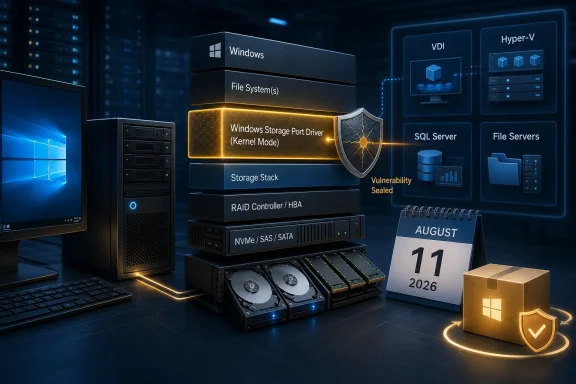
Microsoft Security Response Center published the CVE on August 11, while the company’s Windows servicing pages confirm that the August security cumulative updates are now available through Windows Update, Windows Update for Business, WSUS, and the Microsoft Update Catalog. For Windows 11, those include KB5121003 for versions 24H2 and 25H2, KB5120240 for version 23H2, and KB5121000 for version 26H1. Microsoft’s Windows 10 update listings identify KB5120249 for version 21H2 and 22H2, alongside separate packages for the still-serviced LTSC-era releases.
The important operational point is that this is a Windows kernel-adjacent storage-stack issue. It should be treated as a normal but meaningful local privilege-escalation fix—not as a remotely reachable storage attack, and not as evidence that an SSD, RAID controller, or third-party storage driver is itself defective.
The vulnerable layer sits beneath ordinary disk access
The Windows Storage Port Driver is part of the operating system’s storage I/O architecture. It provides the lower-level connection between Windows storage class drivers—such as the components handling disks, tape drives, and optical devices—and hardware-specific miniport drivers used by controllers and host bus adapters.
Microsoft’s Windows driver documentation describes the storage port layer as the component that takes standardized storage requests from higher in the stack and turns them into bus-specific commands for the hardware path. That placement matters. A flaw here is below the applications and file systems that users ordinarily see, and it operates in a privileged area of Windows.
CVE-2026-65814 is classified as an elevation-of-privilege vulnerability. In plain terms, the risk is that an attacker who already has a foothold on a Windows machine could potentially turn limited execution into more powerful execution. Depending on the flaw and the attacker’s starting privileges, the destination can be administrator-level control or code running in the kernel’s security context.
Microsoft has not described a network entry point, an email-based trigger, or a malicious-file scenario for this CVE. Administrators should therefore avoid translating the “storage” label into a claim that a user can be compromised merely by plugging in a drive or browsing a network share. The advisory does not establish either scenario.
What it does establish is more than sufficient for patch management: a bug exists in a highly privileged Windows subsystem, and Microsoft has shipped a security correction.
Microsoft’s cumulative-update model hides the exact file-level fix
The August 11 Windows release notes do not call out CVE-2026-65814 by name. They broadly state that the releases include security improvements and direct readers to the Security Update Guide for the vulnerability inventory. That is ordinary Windows servicing practice, but it makes verification harder for organizations that want to know exactly which binary changed and whether a narrow remediation is possible.
There is no supported standalone “Storage Port Driver update” for this flaw. The remediation is delivered through the cumulative operating-system update. That means the correct deployment question is not whether a particular storage driver package needs to be replaced; it is whether the relevant August Windows cumulative update has successfully installed and the endpoint has restarted if required.
For the current Windows 11 lines, Microsoft’s update pages identify these August packages:
- Windows 11 version 24H2 and version 25H2 receive KB5121003, taking the builds to 26100.9168 and 26200.9168 respectively.
- Windows 11 version 23H2 receives KB5120240, build 22631.7517.
- Windows 11 version 26H1 receives KB5121000, build 28000.2704.
- Windows 10 version 21H2 and 22H2 receive KB5120249, bringing the builds to 19044.7663 and 19045.7663 where the edition remains entitled to security servicing.
Those package identifiers establish the patch vehicle, but they do not independently establish the full affected-product matrix for CVE-2026-65814. Microsoft’s Security Update Guide is the primary record for that determination. A generic cumulative-update page saying “security improvements” should not be mistaken for a component-by-component applicability table.
This distinction affects inventory work. Do not mark a device remediated simply because it runs “Windows 11” or because it received an August feature rollout. Confirm the device’s build and the successful installation state of the August security cumulative update for its specific servicing branch.
The lack of public exploit detail changes triage, not the patch decision
The public record currently leaves several questions unanswered: the underlying bug class, the precise attack preconditions, whether exploitation requires existing local code execution, whether a sandbox escape is involved, and whether Microsoft has detected exploitation in the wild. No independent outlet has yet reported a proof of concept or a real-world campaign specifically tied to CVE-2026-65814.
That absence should not be inflated into a clean bill of health. It does, however, place this issue in a different response category from a publicly exploited, wormable, or unauthenticated remote-code-execution vulnerability. There is no basis in the published information to tell users to disconnect storage devices, disable Storport, remove vendor miniport drivers, or halt business workloads.
There is also no safe, supported way to disable the Windows storage port subsystem as a mitigation. Storport and related storage drivers are foundational to ordinary disk I/O on modern Windows systems. Attempts to neutralize the component through driver-service changes, registry modifications, or binary replacement are much more likely to create boot failures or inaccessible storage than to meaningfully reduce risk.
The right conclusion is narrower: CVE-2026-65814 belongs in the August patch cycle with a priority appropriate for local privilege escalation in a privileged OS component. It deserves faster attention on shared workstations, Remote Desktop hosts, virtual desktop infrastructure, jump servers, developer endpoints, and servers where untrusted or semi-trusted users can execute code. Those are the places where an initial low-privilege foothold has the most obvious path to becoming a full-system compromise.
Storage-heavy systems need validation after patching, not storage-driver replacement
Because the vulnerable component is in the storage path, organizations operating SQL Server hosts, Hyper-V clusters, VDI farms, backup servers, file servers, SAN-connected systems, or machines using vendor RAID and NVMe controller drivers should include an appropriate post-install health check. That is a stability measure, not a workaround for the CVE.
The August Windows 11 24H2 and 25H2 package, KB5121003, is also bundled with servicing-stack changes and Secure Boot certificate-targeting work. Microsoft says it is not currently aware of issues with that update, but the July release cycle included availability restrictions for some Dell systems using Intel processors. That earlier incident is a reminder that “no known issue” in a fresh release note is not the same as broad production validation.
A sensible deployment sequence for managed estates is:
- Patch a pilot group that represents systems with vendor storage drivers, RAID adapters, encrypted volumes, virtual disks, and business-critical workloads.
- Confirm the post-reboot Windows build, update-installation success, event logs, BitLocker state, disk visibility, and application service health.
- Expand through the normal ring structure rather than attempting to target the Windows Storage Port Driver separately.
- Treat machines that remain on an unsupported Windows release as unremediated until they are moved to a supported servicing path or enrolled in the applicable extended-security program.
For virtualized environments, validate both layers. The guest OS needs its own August update even when the Hyper-V host or cloud fabric has been patched, while the host requires its own relevant cumulative update. Patching one does not repair the other’s Windows kernel components.
Unsupported Windows remains the larger exposure
CVE-2026-65814 also underscores a less visible problem in many inventories: the endpoint that cannot take the update is often more dangerous than the endpoint waiting a few days for a tested deployment ring.
Microsoft’s August notes say Windows 11 24H2 Home and Pro editions reach end of updates on October 13, 2026, while Enterprise and Education support continues until October 12, 2027. Windows 10’s standard support has already ended for most editions, leaving security coverage dependent on LTSC status or Extended Security Updates. A Windows device outside a supported channel cannot rely on August’s cumulative packages as a durable remediation path.
For now, the immediate checkpoint is simple: identify devices missing the August 11 cumulative update, prioritize systems where lower-privilege users can run code, and verify successful restart and build advancement. CVE-2026-65814 does not call for a storage-controller panic; it calls for disciplined Windows patching before public technical detail gives attackers a clearer map of the flaw.