
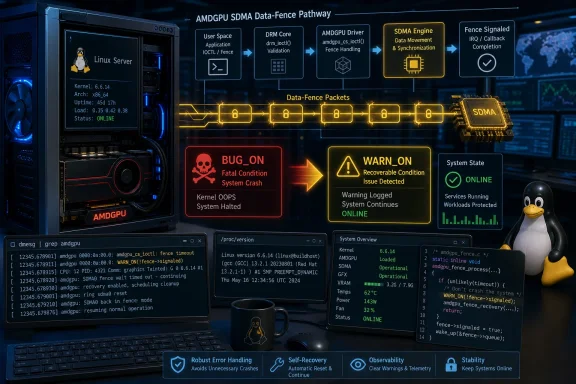
The CVE record, supplied by kernel.org and published in the NVD, covers one small but consequential source change in
drivers/gpu/drm/amd/amdgpu/sdma_v4_4_2.c: two
BUG_ON()checks become
WARN_ON()checks. Linux kernel documentation explicitly discourages new
BUG()and
BUG_ON()uses because they can destabilize or entirely break a machine; the project’s preferred policy is to warn and attempt to continue where recovery is possible.
That is precisely what this patch does. It prevents an alignment failure in the SDMA fence-emission routine from unconditionally taking down the kernel.
 The fault is in SDMA fence handling
AMDGPU uses fences to track when GPU work has completed. In the affected
sdma_v4_4_2_ring_emit_fence()function, the driver builds an SDMA fence packet containing a GPU memory address and a completion sequence number. The target address must be aligned to four bytes, meaning its lowest two bits must be zero.
Before the fix, the code asserted that condition with
BUG_ON(addr & 0x3)before writing the low 32 bits of the address. The same assertion appeared again for the high half of a 64-bit fence. If either condition evaluated true, the kernel’s old behavior was fatal rather than recoverable.
After the patch, each assertion is
WARN_ON(addr & 0x3). The driver still records a warning, but it does not deliberately crash the operating system at that point. The kernel documentation’s language is unusually direct on this class of change: a
BUG()can leave a system impossible to debug or obtain usable crash data from, while a warning preserves a chance to diagnose the underlying fault.
The important limitation is that this patch changes the failure policy, not the condition that produces an invalid address. The code continues submitting the fence packet after emitting the warning. In other words, the patch turns a kernel panic into a logged driver error and a potentially failed or reset GPU job; it does not add validation or rejection of the bad address earlier in the submission path.
That is a sound availability fix, but it should not be mistaken for full input sanitization.
The CVE tracks a panic path, not a scored exploit
NVD currently lists no CVSS 4.0, CVSS 3.x, or CVSS 2.0 assessment for CVE-2026-68110, and it has assigned no CWE. The description is also sparse: “There’s no need to crash the kernel for these cases.” Neither NVD nor the Linux kernel record identifies an exploit method, affected Radeon product names, privilege requirement, remote attack scenario, or evidence of exploitation.
The practical reading is narrower than the word “vulnerability” can imply in automated scanners. This is a local availability hardening fix in the AMDGPU kernel driver. An affected machine has a path where a fence address reaches an invariant the driver considered impossible; the prior response was to force a fatal kernel failure. The updated response keeps the host alive long enough to log the event and let the wider GPU scheduling and recovery machinery handle what follows.
AMDGPU’s own kernel documentation describes a ring-buffer model in which user space continually supplies commands for GPU engines, including SDMA. That makes a defensive response to a bad state valuable even without public proof that unprivileged software can directly manufacture this exact condition. A workstation, render node, or CI host should not lose the entire kernel merely because a GPU-driver invariant has been violated.
But there is no record evidence that CVE-2026-68110 enables code execution, data disclosure, elevation of privilege, or remote compromise. Security teams should track it and patch it through normal kernel maintenance, while resisting the temptation to assign it a severity that the responsible project and NVD have not supplied.
Linux 7.2 received the upstream change first
The original upstream patch was included in the AMD DRM fixes pull request for Linux 7.2, sent by AMD’s Alex Deucher on July 2, 2026. That pull request described a broader effort to remove unnecessary
BUG()and
BUG_ON()calls from AMDGPU error paths, and this SDMA 4.4.2 change appeared alongside equivalent fixes for several other AMD graphics and SDMA IP blocks.
That context matters. CVE-2026-68110 is not evidence of a newly discovered flaw isolated to one accidental line of code. It is part of a deliberate upstream cleanup of fatal assertions in AMD’s graphics driver. The CVE is specific to the SDMA 4.4.2 file and must be remediated as such, but it belongs to a wider engineering decision: a GPU-driver error path should preferentially report trouble and preserve host availability rather than decide for the system owner that the entire kernel must die.
The NVD’s affected-version data shows the fix was backported to four maintained stable lines:
- Linux 6.6 is fixed at 6.6.148 or later.
- Linux 6.12 is fixed at 6.12.101 or later.
- Linux 6.18 is fixed at 6.18.42 or later.
- Linux 7.1 is fixed at 7.1.6 or later.
- The upstream fixed baseline is Linux 7.2-rc2.
The first three lines are particularly relevant to enterprise distributions and long-lived appliances, but the version numbers are upstream kernel numbers, not guaranteed distribution package labels. Red Hat, SUSE, Canonical, Debian, and other vendors frequently backport individual fixes into a kernel package whose visible version does not match the upstream stable release. Conversely, a distribution can ship a newer-looking package while carrying a vendor-specific configuration or patch set.
Administrators should therefore use
uname -ronly as an initial check, then consult their distribution’s kernel changelog or security tracker for CVE-2026-68110. Systems built from a custom tree should verify the presence of the two
WARN_ON(addr & 0x3)substitutions in
sdma_v4_4_2.c, or confirm that the relevant stable backport has been applied.
A warning can still panic hardened Linux systems
Replacing
BUG_ON()with
WARN_ON()reduces the normal risk of a machine-wide crash, but it does not guarantee that every Linux configuration will survive the condition. The kernel’s own documentation notes that system owners can enable the
panic_on_warnsetting, which escalates a warning into a panic.
That setting is commonly used on some hardened, test, appliance, and fleet-validation systems where continuing after a supposedly unreachable condition is considered riskier than forcing a reboot. On those hosts, CVE-2026-68110 can still result in a kernel panic if the warning fires. The fix remains useful because it restores the policy decision to the operator rather than hard-coding it into the AMDGPU driver, but it changes neither the warning nor a locally enforced panic-on-warning policy.
For operational teams, the distinction changes incident handling. A pre-fix crash could identify as an AMDGPU
BUG_ONin the SDMA 4.4.2 fence-emission path. A patched system may instead leave a kernel warning, a GPU reset, failed acceleration workload, or application-level error. Monitoring rules that treat kernel warnings as actionable should retain those events rather than regarding the update as a reason to ignore them.
Windows systems are mostly outside the affected path
This CVE is in the Linux kernel’s open-source AMDGPU driver, not Windows’ WDDM display stack. On a conventional Windows 10 or Windows 11 system using AMD Adrenalin Edition drivers, the relevant kernel-mode graphics components are AMD’s Windows driver and Microsoft’s DirectX graphics kernel subsystem, not
drivers/gpu/drm/amd/amdgpu/sdma_v4_4_2.c. Updating Windows or Radeon Software does not patch this CVE because those packages do not contain this Linux source path.
Windows users should care when their machines also run Linux: in dual boot, a Linux virtual machine with direct GPU assignment, a physical Linux host, a live environment used for GPU compute, or a custom WSL 2 kernel. Microsoft documents that WSL 2 runs a Linux kernel and supports updating that component through
wsl --update; it also permits a custom kernel through
.wslconfig.
Still, standard WSL usage is not automatically equivalent to native AMDGPU use. WSL graphics acceleration normally relies on Windows’ GPU virtualization and host driver model, and a stock Microsoft WSL kernel may not be on one of the affected upstream lines or include this specific AMDGPU path. The users most likely to need a direct check are those who deliberately run a recent or self-built WSL kernel, load AMDGPU inside a custom Linux environment, or pass an AMD GPU through to a Linux guest.
The date record deserves one final note. NVD lists CVE-2026-68110 as published on August 10, 2026, and its change history says kernel.org submitted the record that day. The supplied publication metadata says August 11, 2026 at 1:09 a.m. Pacific time. Those dates do not align cleanly, and neither record explains the difference; it has no bearing on remediation, but it is a reminder that the authoritative technical facts here are the fixed kernel versions and source change, not the page timestamp.
For affected Linux installations, the operational conclusion is straightforward: move to the vendor kernel package carrying Linux 6.6.148, 6.12.101, 6.18.42, 7.1.6, or the corresponding backport, then keep kernel-warning telemetry enabled. The update prevents an invalid SDMA fence alignment from being treated as an automatic decision to crash the whole machine.
