
The underlying patch,
drm/amdgpu/sdma7.0: replace BUG_ON() with WARN_ON(), was included in AMD’s DRM fixes submitted for Linux 7.2. Alex Deucher’s AMDGPU pull request groups it with twelve related edits across GFX and SDMA implementations that remove or soften fatal
BUG()and
BUG_ON()checks in driver error paths. That grouping matters: this is part of a deliberate cleanup of assertions reachable after a graphics job has entered the driver, rather than a standalone redesign of AMDGPU command validation.
For Linux desktop and server administrators, the practical response is to track the kernel package rather than look for a new Radeon Software package or a Windows update. This is a Linux kernel AMDGPU issue, not a Windows AMD display-driver advisory.
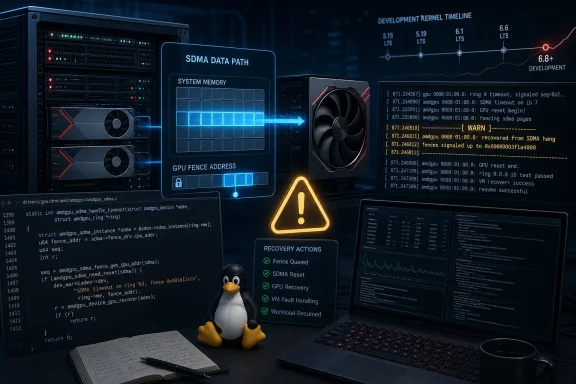 The code path turns an alignment check into a system-wide crash
The affected code is
sdma_v7_0_ring_emit_fence()in
drivers/gpu/drm/amd/amdgpu/sdma_v7_0.c. It builds a fence packet for AMD’s System DMA engine, which writes completion information to memory after GPU work finishes. The function expects the fence writeback address to be aligned on a 32-bit boundary.
Before the patch, the function used
BUG_ON(addr & 0x3)before emitting the fence address. If either of the low two address bits was set, that assertion invoked the kernel’s fatal BUG handling. In a production Linux build, that can mean an oops, a stopped scheduler worker, or a full kernel panic depending on configuration and runtime policy. The critical failure is that a condition local to a graphics submission path could turn into a machine-level availability failure.
The patched code calls
WARN_ON(addr & 0x3)instead. That still records the condition in the kernel log and reports it to the usual debugging machinery, but it does not deliberately crash the OS. The driver then continues through the fence-emission sequence.
This is a mitigation of the fatal response, not evidence that a misaligned address is safe or expected. The warning means something invalid reached a low-level ring-emission routine where recovery options are limited. The correct long-term control point is earlier in the command-submission validation path, before the driver writes commands into a GPU ring buffer.
The available CVE material does not yet say whether CVE-2026-68252 has a demonstrated unprivileged trigger through
DRM_IOCTL_AMDGPU_CS, whether it requires a particular application or compute stack, or whether the practical result before the patch is consistently a panic. Those details are documented for the earlier SDMA 4.0 CVE-2026-46220, but they must not be imported wholesale to SDMA 7.0 merely because both fixes replace
BUG_ON()with
WARN_ON().
Linux 7.2 carries the fix before the CVE metadata is complete
AMD’s July 2 pull request for Linux 7.2 lists the SDMA 7.0 change alongside matching edits for SDMA 4.4.2, 5.0, 5.2, 6.0, and 7.1, plus multiple graphics-engine implementations. The DRM maintainer merged the pull request into the 7.2 development stream, and the change appeared in the Linux 7.2 release-candidate cycle.
As of August 11, 2026, Linux 7.2 itself has not reached its final stable release. The latest broadly indexed upstream snapshot is Linux 7.2-rc5 from July 26, and LWN’s release-cycle reporting had projected a final 7.2 release around August 16. That puts the CVE in an awkward but familiar position: the code-level repair is visible in mainline development, but the version most users can install from conservative enterprise repositories may not include it for some time.
No public vendor advisory located for this CVE identifies stable backports, enterprise distribution errata, container-host impact, or package version thresholds. Administrators should therefore avoid declaring a fleet patched simply because a distributor has released a generic kernel update after July 2. The relevant question is whether the distributor’s kernel changelog includes this specific SDMA 7.0 change or its equivalent backport.
The NVD outage also has a real operational consequence. Vulnerability scanners and patch-management systems commonly enrich Linux kernel findings from NVD metadata, including Common Vulnerability Scoring System ratings and Common Platform Enumeration mappings. With the NVD record unavailable at publication time, automated tooling may show incomplete data, no severity, or delayed matching. Absence from a scanner dashboard today is not evidence that the installed kernel contains the fix.
SDMA 7.0 is the boundary that matters
The CVE name is precise: it concerns the
sdma_v7_0.cimplementation, not every device loaded by the
amdgpukernel module. AMDGPU contains separate code paths for several GPU and DMA-engine generations, and the July cleanup series changed each source file independently.
That means security teams should not treat every Radeon-equipped Linux endpoint as equally exposed, nor assume that a device running a different SDMA implementation is covered by this CVE. Hardware inventory, the loaded AMDGPU driver, and the exact kernel source or distributor backport determine relevance.
For a directly installed Linux system, the useful first checks are:
- Confirm that the system is using the upstream
amdgpuDRM driver rather than a virtual display adapter or a different graphics stack. - Record the running kernel with
uname -rand compare the distribution’s kernel changelog against the SDMA 7.0 fix, not merely against the CVE publication date. - Preserve relevant
dmesgoutput if AMDGPU fence, ring, or scheduler warnings occur after an update, because the replacement warning is designed to leave a diagnostic trail rather than immediately halt the host. - Prioritize update testing on multi-user GPU compute hosts, shared workstations, CI runners, and systems where a local crash has a material availability cost.
There is no evidence in the available record of remote code execution, disclosure of host memory, or privilege escalation. The demonstrated code change is fundamentally about preventing a fatal response to a failed driver assumption. Until the CVE record supplies a formal impact statement and a severity vector, it should be managed as a potentially local availability issue rather than inflated into a broader AMD GPU compromise.
WSL 2 installations are not the obvious target
Windows users running ordinary WSL 2 GPU workloads should not assume their AMD Windows driver is affected. Microsoft documents that WSL GPU access uses the
/dev/dxginterface, which routes GPU calls to Windows, and its GPU-paravirtualization architecture uses a host Windows kernel-mode driver with guest-side Dxgkrnl support. Microsoft’s design documentation explicitly says the guest does not use a conventional vendor kernel-mode display driver in that model.
In other words, standard WSL 2 GPU compute is not normally loading the Linux
amdgpuSDMA 7.0 hardware driver against the physical Radeon GPU. The affected source file belongs to the native Linux DRM stack that drives compatible AMD GPUs directly.
The distinction disappears if a Windows machine is hosting a conventional Linux virtual machine with PCIe GPU passthrough, or if the user dual-boots into Linux. In those arrangements, the guest or bare-metal Linux OS can own the physical GPU and load AMDGPU directly. Those installations should follow the Linux kernel remediation path.
Microsoft’s WSL kernel repository is also currently based on a separate 6.18-series branch rather than the upstream 7.2 development line that carries this particular change. That does not establish either vulnerability or immunity on WSL; it reinforces that the upstream Linux 7.2 patch cannot be used as a proxy for WSL exposure.
Patch status is more important than the new CVE number
The most useful fact about CVE-2026-68252 is not that it now has an identifier. It is that AMD’s upstream change removes a kernel-panic mechanism from SDMA 7.0 fence emission, and it did so as part of a broader audit of fatal assertions in AMDGPU error paths.
Organizations running custom kernels can apply the focused source change while their normal kernel-update process catches up. Everyone else should wait for and install the distributor kernel carrying the backport, then confirm it from the package changelog or source history. Rebuilding a production kernel solely to replace two assertions is usually a worse operational choice than using a supported vendor kernel update—unless the system is a high-value GPU compute host and the distribution has not issued a timely fix.
For now, the unresolved item is not whether upstream Linux has acted; it has. The missing record is the distribution of that repair into supported kernel packages, along with the CVE’s still-unavailable affected-version and severity metadata.
