

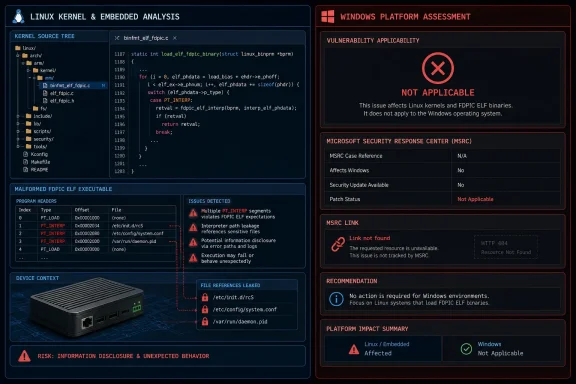
PT_INTERP segments, causing the kernel to retain unintended interpreter-file references and write denials. The upstream fix landed in Linux 7.2-rc5 on July 26, 2026; the CVE record was published on August 11. For Windows administrators, the immediate operational conclusion is straightforward: this is not a Windows kernel vulnerability and it is not a Microsoft Patch Tuesday item, despite the supplied record pointing to Microsoft’s Security Response Center.The cited MSRC URL returns a “not found” response rather than a vulnerability advisory. Microsoft has not published an affected-product list, a CVSS score, a Security Update Guide entry, a KB article, or any Windows build information for CVE-2026-68151. The primary technical record is instead the upstream Linux kernel change, included in Linus Torvalds’s Linux 7.2-rc5 release announcement and attributed to VFS maintainer Christian Brauner.
That mismatch is material. A broken MSRC link is more than a nuisance for vulnerability scanners and patch dashboards: it can incorrectly route a Linux kernel issue into a Windows remediation workflow, where there is no Microsoft update to deploy and no Windows endpoint exposure to verify.
The bug is in a niche Linux executable loader
binfmt_elf_fdpic is the Linux component that loads FDPIC ELF binaries. FDPIC, short for function-descriptor position-independent code, is an ELF variant built for constrained and often memory-management-unit-less Linux systems. It has historically been associated with embedded targets such as Fujitsu FR-V and Analog Devices Blackfin, and can also be enabled in certain other NOMMU-oriented configurations.
It is not the normal ELF loader used by mainstream x86-64 Windows Subsystem for Linux deployments, typical desktop Linux distributions, or the Linux kernel that runs on ordinary Windows PCs through Hyper-V. The conventional Linux ELF loader, binfmt_elf, already stops after the first PT_INTERP program header. That header tells the kernel which dynamic linker or interpreter should load a dynamically linked executable, such as a system’s ld-linux loader.
Before the fix, the FDPIC path kept walking the ELF program-header list after finding a PT_INTERP entry. Each later entry replaced the saved interpreter pointer, but did not release the allocation and file reference associated with the prior one. The upstream pull request describes the result precisely: additional interpreter entries leaked both the interpreter-name allocation and the reference obtained by open_exec(), including the write denial applied to the opened file.
The patch makes FDPIC behave like the ordinary ELF loader: it honors the first PT_INTERP entry and stops.
The practical impact is a local denial-of-service condition, not a Windows takeover path
A malicious ELF file would need to be executed on an affected Linux system. The problem is not a network parser bug, a browser flaw, or a vulnerability reachable merely by receiving a file. An attacker needs a route to convince a user, service, package-install script, build worker, or automated pipeline to invoke the crafted binary.
Once executed, however, a malformed FDPIC binary can name several interpreter paths. The loader opens each successive path and overwrites the pointer to the previous interpreter. Those abandoned references persist, along with their write denials, for the life of the running system. In practice, that can leave selected executable files unavailable for modification until the host reboots.
That is a real integrity and availability problem in embedded Linux scenarios. A locally executed hostile binary could interfere with updates or replacement of files it has managed to keep open under execution-style write protection. Repeated execution may also consume kernel memory through the unreleased pathname allocations and file references. The upstream description does not claim privilege escalation, arbitrary code execution in the kernel, or remote exploitation, and there is no public evidence on August 11 of exploitation in the wild.
The limiting factor is scope. FDPIC is far less common than the standard ELF execution path, and the bug requires a kernel built with the FDPIC loader plus execution of a deliberately malformed FDPIC-format program. Organizations running ordinary Windows endpoints should not treat CVE-2026-68151 as an endpoint emergency.
Linux 7.2-rc5 contains the upstream correction, but release coverage is still incomplete
Linux 7.2-rc5 includes the change under the commit description “binfmt_elf_fdpic: only honour the first PT_INTERP.” Torvalds’s July 26 release announcement lists it among VFS fixes, and the upstream change is concise: after the loader processes the first valid interpreter segment, it exits that search rather than allowing later entries to overwrite the interpreter state.
The important caveat is that Linux 7.2-rc5 is a release candidate, not a stable production kernel line. The published CVE information provided here does not identify the first stable Linux release containing the fix. It also does not name affected kernel version ranges, affected distributions, backported package versions, or a severity score.
That leaves distribution maintainers—not Microsoft—as the parties that must translate the upstream commit into deployable updates. As of August 11, no second public vendor advisory located for this CVE establishes which enterprise Linux releases have backported the fix. Administrators of appliances and embedded products should therefore not assume that “the vendor kernel is older than 7.2” means it is vulnerable, or that “the vendor kernel is newer” means it is fixed. Commercial distributions routinely backport narrowly scoped kernel patches without changing their visible upstream version number.
For teams maintaining custom kernels, the relevant source-level check is whether fs/binfmt_elf_fdpic.c breaks after the first successful PT_INTERP processing. For packaged systems, the relevant check is the vendor’s kernel changelog or security advisory tied to the exact package build.
The Microsoft attribution needs to be removed from remediation queues
The supplied source metadata says the CVE was published at 1:15 a.m. Pacific time on August 11, 2026, but the associated Microsoft vulnerability URL produces a 404-style failure. There is no indication in the available MSRC material that Microsoft assigned the CVE, shipped a fix, or considers a Windows product affected.
This is a common failure mode in automated vulnerability ingestion. A CVE string is valid as an identifier, yet a tool attaches it to the wrong vendor portal, either because a generic template expects every issue to have an MSRC page or because an advisory feed has incomplete product mapping. The result can be misleading tickets such as “apply Microsoft update for Linux kernel CVE,” where neither the update nor the exposure exists.
Windows-focused IT teams should classify the issue as not applicable to Windows, Windows Server, Microsoft Defender, Hyper-V hosts, or standard WSL installations unless they also operate Linux appliances, custom embedded devices, or separate Linux build and deployment infrastructure. Hyper-V virtual machines running an affected custom Linux kernel are a Linux guest patching matter; the Hyper-V host itself is not implicated by this CVE.
What Linux and embedded operators should do now
The response should be proportional to where FDPIC is actually in use. Inventory systems that boot custom Linux kernels, particularly NOMMU devices, industrial equipment, networking appliances, and legacy embedded products whose userland was built around FDPIC. A standard inventory that identifies only “Linux” and a version string is insufficient; configuration and architecture matter here.
- Review whether the kernel has
CONFIG_BINFMT_ELF_FDPICenabled and whether deployed applications or toolchains actually use FDPIC ELF binaries. - Check vendor advisories and package changelogs for a backport of the upstream “only honour the first PT_INTERP” fix rather than relying only on the visible kernel major version.
- Restrict execution of untrusted local binaries on exposed embedded devices, build agents, test infrastructure, and administrative shells until a fixed kernel is available.
- Treat unexplained inability to update or overwrite an executable on a susceptible device as an operational indicator worth investigating, particularly if it clears after reboot.
The missing data remains significant: there is no public severity vector, no confirmed exploitation report, no authoritative affected-version range, and no vendor backport matrix attached to CVE-2026-68151. What the upstream record does establish is narrower but clear: Linux’s FDPIC loader had diverged from normal ELF handling and could be induced to leak interpreter references; Linux 7.2-rc5 corrects that behavior. The MSRC link does not change the ownership of the problem, and Windows patch management should not be carrying it.