

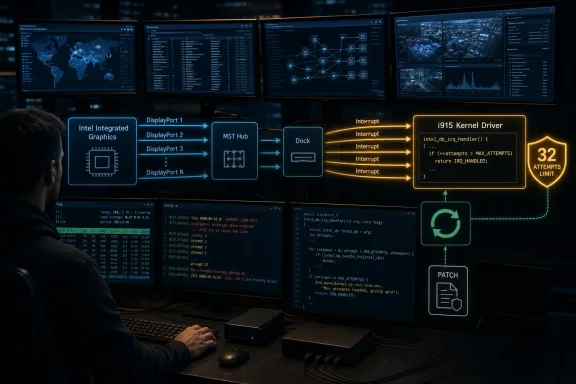
The practical concern is narrower than a typical remotely exploitable Linux kernel issue, but it is real for machines using Intel integrated graphics with DisplayPort MST hardware: docks, daisy-chained displays, MST hubs, and some KVM or adapter arrangements. The vulnerable i915 path could continue handling newly arriving Event Status Indicator, or ESI, notifications with no defined upper limit. A faulty, stuck, or hostile device capable of sustaining that condition could consume display-driver attention indefinitely rather than allowing the handler to complete normally.
Intel’s public i915 mailing-list patch, authored by Jani Nikula and reviewed by Imre Deak, describes the failure directly: intel_dp_check_mst_status() kept servicing interrupts from the DisplayPort sink “without bound.” The change imposes a cap of 32 attempts to clear incoming notifications in a single pass. That is a small code change with a significant operational purpose: it converts an unbounded loop in a hardware-event path into a bounded failure.
For WindowsForum readers, one point deserves emphasis at the start: this is a Linux kernel i915 vulnerability, not a Windows Intel graphics-driver advisory. There is no evidence in the available record that CVE-2026-68241 applies to native Windows 10 or Windows 11 graphics stacks. It matters to dual-boot systems, Linux workstations, developer machines, appliances, and virtualization hosts that use the upstream Intel i915 driver with physical DisplayPort MST equipment.
The patch limits the loop; it does not make a bad dock healthy
The code change replaces an open-ended loop with a counter initialized to 33 and decremented before each pass, allowing 32 service attempts. If the ESI condition remains uncleared at that point, the driver emits a debug message stating that the DisplayPort receiver’s ESI is not clearing and that the device may be stuck.
The distinction matters operationally. The patch does not repair a defective monitor, dock firmware, cable, or MST hub; it prevents one of those devices from monopolizing the driver’s interrupt-processing path. Users may still see a display disconnect, a failed hotplug event, a topology that needs to be reprobed, or a device that remains unreliable. What they should no longer get from this specific condition is an endless attempt to drain the same stream of DisplayPort status interrupts.
The source-level behavior also shows why this is properly handled as a denial-of-service resilience flaw rather than assumed to be an avenue to code execution or privilege escalation. The relevant path reads status from the connected DisplayPort receiver, acknowledges it, and decides whether additional work is needed. The fix limits work performed per interrupt-handling invocation; it does not add memory-safety checks, alter privilege boundaries, or validate a new attacker-controlled buffer.
That does not make it harmless. A display path stuck in interrupt handling can degrade a user session, complicate hotplug and dock behavior, and create difficult-to-diagnose instability on systems where the graphical console is also the local administrative interface. On kiosks, industrial systems, laboratory workstations, or conference-room PCs with shared dock hardware, the difference between “the dock behaves oddly” and “the graphics stack is continuously occupied” can be consequential.
Linux 7.2-rc3 has the upstream fix, but that is not a distribution patch level
The patch cleared Intel’s automated i915 CI in late June and was included in the drm-intel-fixes-2026-07-09 pull request. It then landed in the DRM fixes merged for Linux 7.2-rc3, which Linus Torvalds announced on July 12, 2026. The Linux Kernel Archives still listed 7.2-rc3 as mainline when this CVE was published on August 11.
That timeline produces the most important deployment finding: upstream inclusion does not mean that supported distribution kernels are fixed today. Linux 7.2 remains a release candidate, while most production distributions ship maintained kernels from older release branches with their own backport policies. A workstation on Linux 7.1, an enterprise distribution kernel based on 6.x, or a vendor-customized appliance kernel will not gain this correction simply because the patch is now in the mainline development tree.
The original patch carries a stable-kernel mailing-list copy request marked “v5.8+.” That is useful, but it must not be mistaken for evidence that the patch has actually landed in every stable branch from 5.8 onward. A Cc: stable tag asks stable maintainers to consider a backport. It is not a published record of acceptance, release scheduling, or downstream vendor adoption.
There is a further wrinkle in Nikula’s own patch explanation. The commit cited in the Fixes: tag is 3c0ec2c2d594, “drm/i915: Flatten intel_dp_check_mst_status() a bit,” but the author explicitly says the condition likely predates that commit. The tag was selected because it was about as far back as a viable backport would succeed; older code used a different retry structure.
That makes Linux 5.8 a backport boundary, not a confident historical introduction date. Security teams should not use it to declare older i915 code safe. The exact vulnerable range needs to come from the CVE record or a distribution’s security advisory once those records are available.
NVD’s outage leaves the CVE record incomplete at the moment it is most needed
The NVD entry was published at 1:07:48 a.m. Pacific Daylight Time on August 11, equivalent to 08:07:48 UTC. When checked at approximately 11:27 UTC, the NVD page returned a 502 Bad Gateway error rather than the vulnerability record.
That failure matters because NVD normally supplies the material administrators expect to see when a new CVE appears: a standardized description, CVSS metrics, weakness classification, enumerated affected products, reference links, and revision history. None of that could be independently confirmed from NVD at publication time.
The available primary record is therefore the upstream patch and its merge trail, not an enriched NVD assessment. The patch record identifies the component and mechanism with confidence:
- The affected code is in
drivers/gpu/drm/i915/display/intel_dp.c. - The relevant function is
intel_dp_check_mst_status(). - The failure condition concerns repeated DisplayPort MST ESI interrupts originating from a sink device.
- The upstream mitigation permits 32 clearing attempts before logging that the receiver may be stuck and exiting the service loop.
What remains unconfirmed from the unavailable NVD record is just as important. There is no verified CVSS score, no confirmed CPE applicability list, no NVD-backed declaration of affected kernel versions, and no validated indication of public exploitation. Administrators should resist filling those gaps with assumptions based solely on the CVE label or the existence of an upstream patch.
Who should act now
Linux fleet owners should prioritize this issue based on actual MST exposure, not simply the presence of an Intel GPU. A laptop using its built-in panel, an Intel system attached through ordinary HDMI, or a headless server may have i915 loaded without ever traversing this DisplayPort MST path. A system used with Thunderbolt docks, multi-monitor DisplayPort hubs, daisy-chained panels, or changing desk setups deserves closer attention.
The first task is to establish whether the system runs the Intel i915 driver and whether DisplayPort MST is part of the deployment. The second is to identify the exact vendor kernel package, rather than comparing uname -r mechanically with Linux 7.2-rc3. Distribution kernels commonly carry selected DRM and security fixes long before, or independently of, an upstream major kernel release.
For teams maintaining their own kernels, the upstream patch is concise enough to audit directly. It is a seven-line addition and one-line loop change in intel_dp_check_mst_status(), which makes it substantially easier to backport and validate than a large driver rework. For teams consuming vendor kernels, the relevant question for the supplier is whether its package includes the i915 change titled drm/i915/mst: limit DP MST ESI service loop, not whether it advertises a generic “DisplayPort fix.”
Windows-only organizations do not need to deploy an emergency Windows update for this CVE. They should, however, account for it where their Windows estate includes Linux dual-boot engineering devices, Linux-based VDI or workstation infrastructure with direct Intel graphics, or purpose-built systems connected to shared MST docks and display hardware.
The immediate mitigation is hardware hygiene, but the durable fix is a patched kernel
Until a distribution ships the backport, reducing exposure means avoiding unreliable MST chains on affected systems where practical. Test problematic docks and hubs with updated firmware, remove unnecessary daisy-chain configurations, and isolate recurring display failures from the affected host rather than repeatedly reconnecting equipment in the hope that a hotplug cycle will clear the condition.
Those measures reduce the chance of encountering the trigger; they do not change the flawed loop logic in an unpatched kernel. The durable remediation is a kernel package that carries the upstream limit.
CVE-2026-68241 is a good example of why security triage cannot stop at an NVD page title. The code was identified through AI-assisted static analysis, confirmed by Intel Product Security, tested in Intel’s i915 CI, and merged upstream weeks before NVD’s August 11 publication. Yet the upstream fix is currently sitting in a release candidate, while the public vulnerability database was unavailable for verification. For Intel Linux systems built around DisplayPort MST, the correct action is to check the vendor kernel changelog now and treat Linux 7.2-rc3 as proof of an upstream fix — not proof that the production kernel already installed on the machine contains it.