

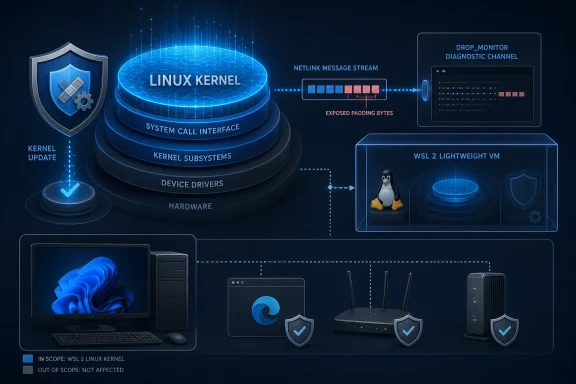
drop_monitor networking diagnostic facility, not a Windows, Chrome, router, or modem vulnerability. The immediate action for Windows-only PCs is none; for Windows machines running WSL 2, Linux virtual machines, containers with a host-managed kernel, or Linux servers, the action is to track the kernel fix through the operating-system vendor rather than troubleshooting network connectivity.
The National Vulnerability Database published the record on August 11, 2026. But the page also carries instructions to check cables, reboot routers, and reauthorize Chrome through a firewall — text with no technical relationship to this CVE. The upstream Linux fix, authored by Yehyeong Lee and merged through the networking tree, describes a kernel-memory leak in a Netlink message generated by drop_monitor; it has nothing to do with browsers, DNS, home networking equipment, or Windows Firewall settings.
That mismatch is more than cosmetic. It is exactly the kind of database-page contamination that can send administrators toward a reboot while leaving a kernel patch unplanned. The remediation is update the affected Linux kernel when your distributor or platform vendor ships the fix.
The leak is in Netlink padding, not network traffic
Linux drop_monitor is a diagnostic component used to report where and why packets are dropped inside the networking stack. In its packet-alert mode, it can export a captured portion of a dropped packet to user space through Generic Netlink, Linux’s structured kernel-to-process messaging interface.
The vulnerable code reserved enough buffer space for the Netlink attribute header, the requested payload, and alignment padding. Netlink attributes are aligned on four-byte boundaries. When the captured payload length was not divisible by four, the kernel copied the requested payload bytes but left between one and three trailing alignment bytes uninitialized.
Those bytes then became part of the message supplied to user space through the NET_DM_ATTR_PAYLOAD attribute.
The upstream patch’s KMSAN — Kernel Memory Sanitizer — report identified an example in which bytes 173 through 175 of a 176-byte message were uninitialized. The finding is narrow but real: a recipient of packet-alert messages could receive a few bytes of stale kernel memory alongside an otherwise legitimate dropped-packet payload.
The repair is correspondingly small. Rather than open-coding the construction of the Netlink attribute, the patch uses the kernel’s __nla_reserve() helper, which initializes the attribute header and zeroes its alignment padding. The important point is that this is a data-hygiene defect at a kernel/user-space boundary, not a packet parsing bug that an Internet host can trigger simply by sending ordinary traffic to a machine.
A local diagnostic path limits the practical exposure
The upstream commit ties the defect to packet-alert functionality added to drop_monitor in 2019, including the later hardware-drop reporting path. The facility was designed for troubleshooting packet loss: it reports packets discarded by software or underlying hardware and can include diagnostic metadata that helps an administrator identify the drop reason.
That design substantially narrows the exposure compared with a remotely reachable network service. An attacker does not exploit CVE-2026-68288 by visiting a website, opening a file, or probing a public IP address. The attacker needs a way to obtain the relevant drop_monitor Netlink output while packet-alert reporting is active.
The earlier upstream work that introduced packet-alert mode also added a CAP_NET_ADMIN requirement for configuring drop monitor. That means the usual activation path is administrative. However, administrators should not reduce the issue to “root only” without checking how a particular distribution, container platform, or monitoring stack exposes Netlink groups and diagnostic data. A privileged monitoring tool can create a data path whose output is later consumed elsewhere, and shared systems deserve a review of who can enable monitoring and who can read its events.
The disclosed data is also limited in size: at most three padding bytes per malformed-length payload attribute. CVE-2026-68288 is therefore not evidence of direct code execution, a crash condition, or a stand-alone privilege-escalation route. It is an information leak that could disclose fragments of uninitialized kernel memory repeatedly under the right circumstances. In kernel security work, even tiny leaks matter because they can sometimes assist a separate exploit by exposing memory contents or addresses. The available upstream record does not document an exploit, a CVSS score, or a demonstrated chain beyond the leak itself.
Windows is outside the affected kernel, but WSL 2 needs attention
A normal Windows 10, Windows 11, or Windows Server installation does not run the Linux drop_monitor subsystem. Microsoft’s Windows networking stack, Chrome, Microsoft Edge, third-party antivirus products, and consumer routers are not affected by this Linux-kernel flaw. Rebooting a cable modem will neither patch nor mitigate it.
WSL 1 is also outside the direct scope because it does not run a full Linux kernel. WSL 2 is different. Microsoft documents that WSL 2 runs a genuine Linux kernel in a managed lightweight virtual machine, and Microsoft maintains a separate WSL kernel source tree and release path.
That makes WSL 2 the meaningful Windows-adjacent case. Microsoft’s current WSL kernel configuration for its linux-msft-wsl-6.18.y branch explicitly enables CONFIG_NET_DROP_MONITOR=y. In other words, the vulnerable subsystem is present in the configuration Microsoft uses for that branch. That does not prove every shipping WSL 2 kernel is vulnerable or that every WSL user is exposed: the exact shipped kernel revision and whether Microsoft backports the correction are what determine status.
It does establish that WSL 2 administrators cannot dismiss CVE-2026-68288 merely because the host operating system is Windows.
Microsoft’s WSL documentation says its kernel is serviced separately from ordinary Windows components. That separation has a practical consequence: a fully current Windows cumulative update is not, by itself, proof that the WSL 2 kernel contains this Linux networking fix. Conversely, a Linux distribution’s package update inside a WSL 2 instance may update user-space tools without replacing the Microsoft-managed kernel beneath it.
For standard WSL 2 installations, check the installed WSL kernel version with wsl --status, apply available WSL updates with wsl --update, and restart the WSL virtual machine with wsl --shutdown after an update. For custom-kernel users, the responsibility is direct: rebuild or replace the custom kernel after the upstream correction is backported to the chosen kernel line.
As of August 11, neither the NVD record nor the upstream Linux commit identifies a Microsoft WSL release containing the fix. Administrators should watch Microsoft’s WSL release information rather than assume that the mainline merge has already arrived on Windows devices.
Kernel versions alone will not settle the question
The upstream fix identifies two 2019 commits as introducing the affected packet-alert behavior. That history means the flaw can exist in long-lived kernel branches that carry the drop_monitor packet-alert implementation, not merely the newest upstream development build.
But uname -r alone is not enough to decide whether a system is patched. Enterprise distributions regularly backport security fixes without changing the apparent upstream major and minor version in a simple way. A kernel labeled 6.1, 6.6, or 6.18 could be protected or vulnerable depending on its vendor revision and patch set. The authoritative answer is the distributor’s CVE advisory or package changelog, preferably tied to the upstream correction titled net: drop_monitor: fix info leak in NET_DM_ATTR_PAYLOAD.
For Linux systems that have not yet received a vendor advisory, the first triage question is whether drop_monitor is compiled and operational. Kernel configuration can be checked through the distribution’s boot configuration file or, where enabled, /proc/config.gz; the relevant setting is CONFIG_NET_DROP_MONITOR. A disabled subsystem removes the affected reporting path. A compiled-in subsystem is not automatically a breach, but it warrants tracking the vendor fix.
The operational priority should be highest for systems where network engineers use drop monitoring, packet-loss analysis, hardware switch offload diagnostics, or automated observability agents. Multi-user systems and shared hosts deserve more scrutiny than a single-user desktop where no one enables packet-alert mode. Containers do not create their own protection here: they share the host kernel, so container hosts must be assessed and patched at the host level.
The bad NVD advice should be ignored, not followed
The most useful finding in this record is the one the CVE title does not spell out: the bundled Chrome-and-router guidance is unrelated and should be treated as erroneous text, not mitigation advice. It offers no protection against a kernel Netlink padding leak and distracts from the only durable remedy.
Windows-only users can safely ignore CVE-2026-68288. Windows developers and administrators using WSL 2 should confirm that the Microsoft-managed WSL kernel is updated once Microsoft publishes a build carrying the fix. Linux administrators should locate their vendor’s advisory, update the kernel package, and reboot into the patched kernel when their maintenance policy permits.