
ath6kl; administrators should identify the running kernel’s backport status rather than assume that a CVE publication means a vendor update is already available.The technical disclosure first appeared in an April 21 Linux wireless patch from Tristan Madani and was later cataloged as CVE-2026-68353. At the time of publication, the National Vulnerability Database page for the identifier was returning a Cloudflare 502 error, so its CVSS rating, formal affected-version ranges, and any NVD-added references could not be independently checked. That missing metadata matters: the upstream code history establishes the bug and its fix, but it does not by itself tell an administrator which shipped distribution kernels contain the correction.
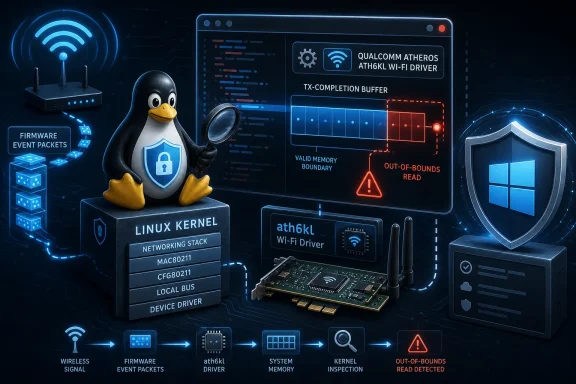 The ath6kl TX-completion handler trusted a firmware count
The defect sits in
ath6kl_wmi_tx_complete_event_rx()in
drivers/net/wireless/ath/ath6kl/wmi.c. This handler receives a WMI TX complete event from the Wi‑Fi firmware. The event header includes
num_msg, an 8-bit field indicating how many transmit-completion entries follow it.
Before the fix, the driver used
num_msgas the loop limit and calculated the address of each entry without first confirming that the received event buffer was long enough to contain that many entries. A malformed event could therefore claim more entries than the buffer actually holds. The kernel would then read beyond the WMI event’s allocated data while processing what it believed were valid completion records.
Madani’s patch description puts the upper bound at 1,020 bytes beyond the event buffer when the firmware supplies an inflated
num_msgvalue. The math follows directly from the field’s 0–255 range and the four-byte
tx_complete_msg_v1record size. The flaw has existed since the ath6kl driver entered the cleaned-up mainline form in the July 2011 commit identified in the patch as
bdcd81707973.
The correction is small but appropriately placed. The handler now rejects an event when it is shorter than the fixed header or shorter than the header plus the number of completion entries declared by
num_msg. In effect, the driver stops treating a firmware-provided count as proof that the matching data exists.
This is a classic trust-boundary failure, but the boundary is worth defining accurately. The vulnerable input is not an ordinary Wi‑Fi management frame delivered straight from a nearby access point. It is an event produced by the ath6kl device firmware and delivered to the host driver. The practical concern is therefore a malformed, buggy, compromised, or otherwise attacker-controlled firmware response—not a demonstrated over-the-air exploit against every laptop using a Qualcomm wireless adapter.
Why the CVE should not be read as a remote Wi‑Fi takeover
The public patch describes an out-of-bounds read, not an out-of-bounds write or a proven code-execution path. In the affected function, the driver reads fields such as transmit status, packet ID, rate index, and acknowledgement-failure count from the completion records. There is no public proof in the patch series that those reads can be converted into privilege escalation, data disclosure to user space, or remote execution.
That does not make the condition harmless. Kernel out-of-bounds reads can produce crashes, kernel warnings, accidental disclosure through later code paths, or behavior shaped by adjacent memory. But the evidence available for CVE-2026-68353 supports a bounded conclusion: an invalid firmware event can cause the ath6kl driver to read beyond its WMI buffer; the upstream patch prevents that condition. It does not support broader claims that a nearby Wi‑Fi attacker can compromise Linux machines simply by sending crafted wireless traffic.
The distinction should influence incident prioritization. A fleet that does not use ath6kl has no exposure from this CVE. A system that has the module installed but never loads it has a materially reduced practical attack surface, although packaging scanners may still flag the vulnerable source. Systems actively using the driver deserve an update, especially where firmware integrity cannot be established or devices operate in physically exposed, lab, industrial, or appliance deployments.
The upstream patch was part of a three-patch ath6kl hardening series. The two companion changes validate a firmware-controlled ADDBA window size and information-element lengths in connect events. They are separate defects; applying one does not silently fix the others. The fact that all three appeared together is useful operational context: this was a focused review of firmware-controlled fields in an older driver, rather than evidence that every ath6kl path has been exhaustively audited.
Mainline gained a slightly more defensive form of the check
The posted version of the CVE-2026-68353 fix used one compound condition: reject a packet if it is smaller than the event header or smaller than the header plus the declared number of records. In the later mainline diff, the logic appears as two checks: first verify that the fixed event header exists, then read
num_msgand verify the variable-length portion.
The behavior is substantively the same, but the split is easier to audit. It makes explicit that the code must not access
evt->num_msguntil it knows the input contains
struct wmi_tx_complete_event. For security teams comparing downstream patches against upstream, that difference should not be mistaken for a different vulnerability. A distributor may backport the original six-line patch, while another may carry the equivalent two-stage form from a later tree.
This is also why version-only scanning is inadequate for kernel CVEs. Linux distributors commonly backport individual security fixes without moving to the upstream release where the change first appears. Conversely, a custom appliance may advertise a newer-looking kernel version while carrying an older vendor tree. The reliable test is the vendor changelog or the actual source diff for
ath6kl_wmi_tx_complete_event_rx(), not the major kernel version alone.
Administrators can verify whether the hardware and driver are in play with tools such as
lspci -nnk,
lsusb -t,
lsmod, and
modinfo ath6kl. On an affected system, inspect the source or vendor patch set for validation before the TX-completion debug output and loop: the fixed code checks the received
lenagainst both the event structure and
num_msgcompletion records, returning
-EINVALfor truncated data.
What Windows and Linux administrators should do now
For most Windows-only estates, this CVE requires no patch deployment.
ath6klis a Linux kernel driver; it is not a Windows WLAN driver, and the disclosed vulnerable function is not part of Windows 10 or Windows 11. The relevant exceptions are operational rather than architectural: Windows administrators may manage Linux appliances, developer workstations that dual-boot, Hyper-V hosts running Linux guests with assigned hardware, or endpoint fleets where the same Qualcomm hardware is used under Linux outside normal Windows sessions.
For Linux operators, the right first step is inventory, followed by the distribution’s kernel advisory. The public record currently does not provide a confirmed list of fixed package versions, and no independent exploit report or vendor-specific remediation bulletin was found alongside the CVE publication. Do not substitute a generic Wi‑Fi driver update for evidence that the ath6kl patch has landed.
The concrete remediation is to install the kernel update from the platform vendor once it includes the ath6kl bounds check, then reboot into that kernel where the driver is used. Until a supported update is available, systems that do not need the device can reduce exposure by preventing
ath6klfrom loading or disabling the adapter. The record shows a long-lived validation gap in a legacy driver; the actionable question is whether that driver is active in your environment, not whether every machine with a Wi‑Fi chip needs an emergency response.
