

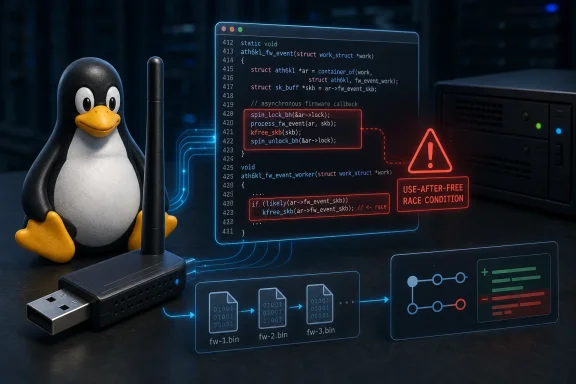
ath9k_htc USB Wi‑Fi driver, affecting systems that use a supported Atheros AR9271 or AR7010-family USB adapter and load the ath9k_hif_usb path. The practical response is straightforward: update to a kernel carrying commit dad9f96945d77ecd4708f730c06ef54dcd8cc057, then wait for your distribution or appliance vendor to publish the corresponding package rather than treating an NVD listing as proof that every supported kernel line has been fixed.The National Vulnerability Database entry was published on August 11, 2026, but NVD was returning a Cloudflare 502 Bad Gateway error when checked. That outage leaves users without the normal NVD enrichment—no visible CVSS score, affected-version range, CWE classification, or mapped fixes. The underlying kernel record is clearer: a patch from Cheng Yongkang was accepted by wireless maintainer Jeff Johnson on July 2, and the change is listed in Linux 7.2-rc5 release material reviewed by LWN.net and the Linux Kernel Mailing List.
This is a narrowly scoped Linux driver defect, not a Windows networking vulnerability. It matters to WindowsForum readers running Linux on bare metal, Linux-based appliances, dual-boot systems, hypervisor hosts, or possibly USB-attached Wi‑Fi hardware passed into a Linux guest. A standard Windows installation using its own Atheros driver stack is outside the vulnerable code path.
The bug sits in asynchronous firmware fallback
The affected code does more than load a firmware blob once. When an ath9k_htc USB adapter is detected, the driver asks the kernel firmware loader to fetch a matching firmware image asynchronously through request_firmware_nowait(). If the requested version is unavailable, the completion routine attempts another firmware filename, stepping through compatible versions before eventually giving up and detaching the driver.
That fallback is where the lifetime error appears. The driver resubmits an asynchronous firmware request and passes its hif_dev device state object as callback context. It then immediately emits an informational log message that reads fields from the same hif_dev structure.
The patch removes that post-submission logging path and changes the error branch so it logs an immediate submission failure without returning early. The code change is small—five lines removed and one brace block simplified—but its purpose is larger: once the second asynchronous request has been armed, the original callback may no longer safely assume hif_dev still exists.
The race requires the new firmware request’s completion path to run quickly enough to reach the terminal failure path while the older callback still executes. On final firmware failure, the driver signals its completion object and calls device_release_driver(). That leads to the USB disconnect flow, which waits for the firmware work to finish and then frees hif_dev. The earlier callback can then return from request_firmware_nowait() and attempt to dereference memory that has already been released.
That is the core issue behind CVE-2026-68363: a stale pointer access caused by an asynchronous callback handoff, not a malformed Wi‑Fi frame or a remote attack over the air.
The affected hardware is older USB Wi‑Fi gear
The ath9k_hif_usb driver supports a long list of Atheros-based USB products, including bare Atheros IDs and devices sold under Netgear, Ubiquiti, AVM, D-Link, AzureWave, Lite-On, Sony, Buffalo, SMC, Toshiba, Philips/NXP, AirTies, and others. Examples listed directly in the driver include the Netgear N150, Netgear WNDA3200, Ubiquiti WifiStation and WifiStation Ext, AVM FRITZ!WLAN 11N v2 USB, and Sony UWA-BR100.
The common point is not the logo on the adapter. It is the driver’s USB ID table and the firmware-loading model used by these ath9k_htc devices. The code identifies two principal firmware families, htc_9271 and htc_7010, corresponding to AR9271- and AR7010-related hardware paths.
That distinction changes the risk assessment. An organization does not need to inventory every Linux machine for “Atheros Wi‑Fi.” It needs to find systems that simultaneously have:
- A USB wireless adapter bound to
ath9k_htcorath9k_hif_usb. - A kernel version that predates the accepted fix.
- Firmware-loading conditions that can force the driver into its fallback and failure sequence.
The last condition is important. A normal adapter with the correct firmware installed and loading successfully does not enter the vulnerable retry path. Conversely, missing, corrupt, unavailable, or deliberately disrupted firmware availability is what sends the driver through the code that resubmits requests.
The driver itself documents the fallback sequence. It first looks for versioned firmware such as ath9k_htc/htc_9271-1.4.0.fw, can descend through minor versions, and eventually tries an older compatibility filename. If it runs out of acceptable candidates, it reports that no suitable firmware was found and detaches the device.
The security impact is real, but the trigger is constrained
“Use-after-free” deserves attention because it means kernel code can operate on memory after its owner has released it. Depending on allocator behavior, build configuration, and what occupies that memory next, the result can range from a warning or crash to potentially more serious memory-safety consequences.
But the public kernel patch and maintainer discussion do not establish a reliable privilege-escalation exploit, remote code execution route, or in-the-wild attack. No public exploit was identified in the records reviewed, and no CVSS assessment was available because NVD’s page was inaccessible. Administrators should therefore avoid translating the CVE’s existence into a claim that any machine with Wi‑Fi enabled can be compromised remotely.
The more realistic security boundary is physical or local access to a machine using one of these adapters, combined with a way to influence the affected device’s initialization or firmware lookup conditions. That may include a malicious or untrusted USB peripheral impersonating a recognized device, a lab setup that repeatedly attaches and detaches hardware while manipulating firmware availability, or an environment where local users can alter firmware files or kernel module behavior.
For most managed endpoints, the operational risk is likely higher as a reliability problem than as a demonstrated intrusion technique: a kernel warning, driver failure, device disappearance, or crash during adapter initialization. That is not a reason to defer updates. Kernel memory-lifetime bugs routinely gain severity when researchers discover a dependable way to shape timing and heap state.
Linux 7.2-rc5 contains the mainline fix, but that is not a backport promise
The strongest verification point is the accepted kernel commit, dad9f96945d77ecd4708f730c06ef54dcd8cc057. Jeff Johnson’s July 2 maintainer reply records the patch as applied, and the fix appears in the Linux 7.2-rc5 change list published later that month.
What the record does not yet show is just as relevant to enterprise administrators: no distribution advisory, stable-kernel backport list, or vendor-specific fixed package version was available in the material reviewed. A mainline acceptance does not automatically mean that Linux 6.6 LTS, 6.12 LTS, Ubuntu’s HWE kernel, Red Hat Enterprise Linux derivatives, OpenWrt, router firmware, NAS appliances, or hypervisor distributions have shipped the correction.
That gap is the key consequence of NVD’s unavailable detail page. Its publication date may alert scanners, but it cannot tell an administrator whether a vendor has backported the patch into a differently numbered kernel package. The kernel commit is the reliable matching artifact until distributors publish advisories.
Administrators can check whether the adapter is relevant before escalating the issue:
lsusb
lsmod | grep ath9k
dmesg | grep -Ei 'ath9k|ath9k_htc|ath9k_hif_usb'
A loaded ath9k_htc module alone is a useful signal, but the most direct evidence is a matching USB device and kernel log entries showing the ath9k_htc driver binding to it. If the driver is not present, or the machine uses an internal PCIe Atheros card through a different driver, this specific CVE does not apply.
What to do while packages catch up
Update first when a vendor package is available. For systems that build their own kernel, include the upstream commit or move to a mainline release containing it. For appliance users, the relevant update will come from the appliance vendor, not from installing firmware files manually.
Until then, remove or disable affected USB adapters where they are unnecessary, especially on shared workstations, kiosk systems, lab hosts, or machines exposed to untrusted physical access. Do not use missing firmware as a mitigation strategy: missing firmware is part of the sequence that exercises the retry logic. Ensuring the correct ath9k_htc firmware is installed can reduce incidental exposure during startup, but it does not replace the code fix.
The immediate question for Linux vendors is no longer whether the flaw exists—the accepted upstream patch establishes that—but which maintained kernel branches will receive it and when. Until those package advisories arrive, commit dad9f96945d77ecd4708f730c06ef54dcd8cc057 is the identifier administrators should use to verify remediation.