

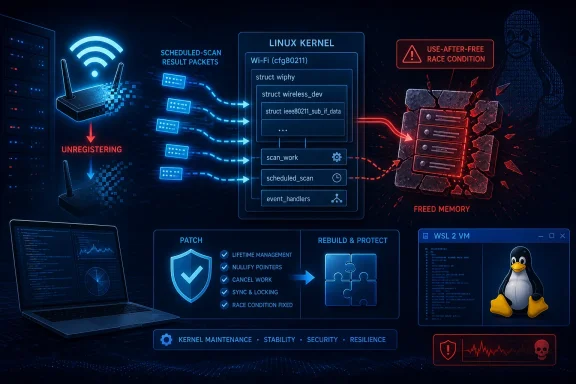
The National Vulnerability Database published the record on August 10, 2026, using the Linux kernel project’s description and five stable-tree fix references. The immediate operational action is straightforward for Linux systems with physical Wi-Fi hardware: take the next vendor kernel update, then reboot into it. Do not try to infer exposure from an upstream version number alone on enterprise distributions; Red Hat, SUSE, Ubuntu, Debian, and appliance vendors routinely backport individual kernel fixes without changing the apparent major/minor kernel line.
For Windows users, this is not a Windows Wi-Fi driver vulnerability. The relevant question is narrower: whether a PC, VM, appliance, or WSL 2 instance is running a Linux kernel that includes the vulnerable cfg80211 code and can receive scheduled-scan notifications from a wireless driver.
The race is between scan-result handling and device destruction
cfg80211 is the Linux kernel subsystem that provides common Wi-Fi configuration and scan-management services to wireless drivers. The vulnerable path involves scheduled scanning: a driver can periodically search for networks and notify the kernel when results are available, rather than requiring a foreground scan started directly by an application.
According to the Linux kernel project’s CVE description, cfg80211_sched_scan_results() queues work named sched_scan_res_wk after a driver reports scheduled-scan results. That work later recovers the relevant registered Wi-Fi device, locks its wiphy object, and walks the scheduled-scan request list.
The failure occurs if the Wi-Fi interface is torn down at the same time. wiphy_unregister() already made the device unreachable and cancelled several other deferred work items before cfg80211_dev_free() released the underlying device structure. It did not cancel sched_scan_res_wk.
That omission creates a classic lifetime race:
- A driver queues scheduled-scan-result work.
- Interface teardown removes the scheduled scan and unregisters the wireless device.
- The queued worker runs after, or overlaps with, object destruction.
- The worker dereferences state that has already been freed.
The kernel report attached to the CVE says KASAN, Linux’s memory-error detector, reproduced a read-after-free in cfg80211_sched_scan_results_wk. That is stronger evidence than a theoretical code review finding: upstream developers observed the bad memory access under instrumentation.
The repair is deliberately small. Upstream adds cancel_work_sync() for sched_scan_res_wk during wiphy_unregister(), alongside the existing cancellation of related work items. The synchronous cancellation either removes queued work or waits for a currently executing callback to finish, preventing cfg80211_dev_free() from freeing the device while the callback retains access to it.
The CVE record’s version data needs careful reading
NVD’s machine-readable affected-product data marks Linux kernels from version 3.0 onward as affected before listing fixed stable points. The listed upstream fixed versions are:
- Linux 6.6.148.
- Linux 6.12.101.
- Linux 6.18.42.
- Linux 7.1.6.
- Linux 7.2-rc4.
Those releases correspond to five kernel maintenance lines rather than five separate bugs. The CVE references five stable-tree commits because Linux stable maintainers backported the same correction into supported branches.
The important caveat is that the record does not say every kernel that identifies itself as, for example, 6.6.x is vulnerable until it reaches 6.6.148. A vendor can ship a 6.6-based package with the backported patch applied and a vendor-specific build number. Conversely, an old long-term-support kernel can remain exposed even when its general release line looks far removed from the upstream versions listed by NVD.
Administrators should check their distribution’s kernel changelog or security tracker for CVE-2026-68414 and the associated wifi: cfg80211: cancel sched scan results work on unregister patch. On a generic upstream-style system, uname -r establishes the running kernel release, but it does not establish patch status on a distribution kernel. On RPM systems, package changelogs and vendor errata are the stronger record; on Debian-family systems, the distribution security tracker and installed package changelog are more useful than the bare uname string.
One conspicuous omission remains: NVD has not assigned a CVSS vector or severity. That means there is no authoritative published statement yet about required privileges, attack complexity, user interaction, or confidentiality/integrity impact. The upstream description establishes a reachable use-after-free under a specific Wi-Fi timing condition; it does not establish remote code execution, privilege escalation, or a reliable exploit chain.
A kernel crash risk does not automatically become a practical exploit
Use-after-free bugs deserve attention because freed memory can sometimes be reused in attacker-controlled ways. But the supplied technical record does not show that here. It documents a race around a scheduled-scan notification and wireless-device unregistering, validated through KASAN—not an exploit, exploitability assessment, or an in-the-wild attack.
This distinction matters in incident triage. A system must have the relevant cfg80211 code enabled, a Wi-Fi driver using scheduled scans, and a timing window in which result-processing work survives device teardown. That is materially different from a flaw reachable through any incoming network packet or a routine service request.
The most credible immediate consequence on an affected system is instability: a kernel warning, memory-safety failure, or crash during Wi-Fi adapter removal, driver reset, USB Wi-Fi disconnect, suspend/resume handling, or interface shutdown. Security impact cannot be ruled out simply because upstream has assigned a CVE, but neither should this record be represented as a confirmed remote compromise path.
No separate independent security research, distribution bulletin, or exploit publication was discoverable at publication time. That does not prove no exploit exists; it means the public record currently supports a focused patching response rather than emergency containment measures such as disabling all Wi-Fi.
WSL 2 users should update the WSL kernel, but the exposure path is limited
Microsoft’s WSL 2 architecture runs a real Linux kernel inside a lightweight utility VM, and Microsoft maintains a dedicated WSL 2 kernel source tree. That puts WSL 2 within the broad universe of Linux kernel consumers, unlike WSL 1, which does not run a Linux kernel.
However, WSL 2 normally uses virtualized Ethernet networking rather than passing the Windows host’s physical Wi-Fi adapter directly through as a Linux wireless device. Microsoft documents WSL 2’s default networking as NAT-based and describes its network interface as a virtual Ethernet adapter. Even mirrored networking is designed to mirror Windows network interfaces for compatibility; the CVE record does not establish that ordinary WSL 2 networking exercises the cfg80211 scheduled-scan path.
That makes a stock WSL 2 installation a poor match for the reported failure conditions. The exposure question changes if an organization uses custom WSL kernels, direct wireless hardware passthrough, USB Wi-Fi devices attached into Linux, specialized Hyper-V configurations, or a development image that enables and uses Linux wireless drivers.
Microsoft has not published a CVE-2026-68414-specific WSL advisory as of August 11, 2026. Still, users who run WSL 2 should install normal WSL updates with wsl --update, then restart WSL with wsl --shutdown when convenient. This is good kernel hygiene, but it should not be confused with confirmation that a particular Microsoft WSL kernel build was exposed or has received this exact backport.
Patch the systems that actually own Wi-Fi hardware
The first systems to review are Linux laptops, desktop workstations, kiosks, edge devices, routers, embedded appliances, and virtual-machine hosts with USB or PCIe wireless adapters assigned to Linux. A server with no wireless hardware and no cfg80211-backed Wi-Fi driver is unlikely to encounter the vulnerable execution path, even if its kernel version falls within NVD’s broad affected range.
For managed fleets, treat CVE-2026-68414 as a kernel maintenance item with a hardware-dependent risk profile. Record the vendor kernel package version, confirm the vendor’s CVE disposition rather than comparing only upstream version strings, schedule the reboot that activates the new kernel, and verify the running release afterward.
The upstream correction is already narrow and mature enough to have landed across five stable branches. What remains unresolved is the public security assessment: NVD has published the bug and the fixes, but has not yet supplied the severity data or vendor-specific deployment status that would turn this from a patch-management task into a more urgent incident-response event.