
snap7.dll can look deceptively close to ordinary OT support activity.The federal advisory covers S7-200, S7-300, S7-400, S7-1200 and S7-1500 families, including S7-1500 F-series safety controllers. It says the activity has focused on U.S. organizations in manufacturing, energy, water and wastewater, chemical, food and agriculture, and commercial facilities. The agencies describe reconnaissance and capability development rather than a publicly named destructive incident, but their conclusion is unambiguous: exposed or weakly segmented controllers are being assessed for future operational effects.
The important operational point is simpler than the advisory’s AI framing. A PLC that can be reached from the public internet, or from an IT network that should not be able to reach it, has already lost the protection that makes old firmware and weak device authentication survivable. AI can reduce the time needed to assemble and alter a tool; it does not create the exposed TCP port, default credentials, or permissive firewall rule that let the tool work.
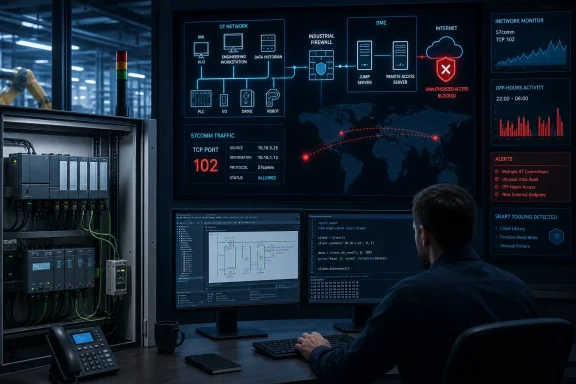 The engineering workstation is part of the attack surface
According to the joint advisory, the suspected tooling combines public Snap7 libraries with AI-generated scripts to read and write Siemens PLC memory, configuration data and ladder logic through S7comm. Snap7 is a legitimate open-source library, and that is precisely why a hunt based only on its presence will produce false positives in a real plant.
The better question for Windows teams is whether the library and associated scripts are running where and when they should not. A Python interpreter importing snap7.dll on a dedicated TIA Portal workstation during an approved commissioning window may be explainable. The same combination on a general-purpose administrator laptop, a jump server, a historian host, or an engineering workstation at 2 a.m. without a change record should be treated as a high-priority investigation.
This shifts some responsibility from OT-only monitoring to endpoint operations. Many industrial environments heavily restrict which users may open a TIA Portal project but have weaker controls around tools that can independently speak S7comm. Application allowlisting, controlled Python installations, endpoint telemetry, and removal of unnecessary local administrator rights on engineering workstations are practical controls here, not generic desktop hygiene.
The advisory’s description of malicious tools masquerading as monitoring software also means filenames and product-like interfaces cannot be accepted as validation. Inventory approved engineering and monitoring tools by publisher, hash, install location, service account, and normal network destinations. Anything outside that baseline needs an owner who can explain why it exists.
Port 102 is the first containment decision
CISA’s most actionable instruction is to block TCP port 102 at internet-facing perimeter firewalls and verify that Siemens PLCs are not internet-accessible. This is S7comm’s usual transport path, and the advisory says actors are using internet scanning services to find reachable or poorly segmented devices.
That direction has an important caveat for plant networks: simply removing a direct public NAT rule is not enough if a remote-access appliance, corporate VPN, vendor jump host, or routed DMZ can still create an untracked path to the controller. The inventory needs to identify indirect exposure as well as public IP addresses. Asset owners should trace every path from IT, remote support networks, and third-party service providers to each S7 CPU.
Siemens’ own historical ProductCERT guidance supports the emphasis on port 102. Product advisories for affected S7 families have repeatedly recommended restricting network access to TCP port 102, including cases where legacy hardware had no planned firmware fix. The joint federal advisory says to patch aggressively, but segmentation is not a temporary substitute to discard after patching; for older S7 estates, it may be the mitigation that remains available.
A useful first-pass validation is to start outside the OT network and work inward:
- Confirm that no public address, remote-management gateway, or exposed VPN route permits unauthenticated or broadly authorized access to TCP port 102.
- Confirm that the IT-to-OT firewall allows only named engineering workstations and approved management paths, rather than an entire corporate subnet.
- Confirm that vendor access terminates through a controlled jump host with multifactor authentication, session logging, and a time-limited approval process.
- Confirm that historians and reporting systems receive only the traffic they require, with unidirectional transfer considered where the process permits it.
The point is to eliminate ambient reachability. A PLC should never be a device that a threat actor can find by scanning, nor should it be a device that any authenticated corporate user can reach after compromising an ordinary Windows endpoint.
“Patch to current” is incomplete advice for legacy S7 fleets
The advisory directs organizations to update PLC firmware and TIA Portal or STEP 7 software, test changes outside production, and consult Siemens ProductCERT notices. That is sound advice, but owners of installed S7-200, S7-300 and S7-400 systems should not interpret it as a promise that every issue has a firmware remedy.
Siemens ProductCERT’s S7-300 denial-of-service advisory, for example, has listed all affected versions of certain S7-300 CPUs as having no fix planned and instead directs customers to protect access to TCP port 102. That distinction matters in plants that treat patch currency as a binary compliance check. A controller can be at its newest available version and still require compensating network controls because its newest firmware is not a comprehensive security resolution.
The same constraint applies to the Windows side. Updating TIA Portal or STEP 7 reduces exposure to defects in the engineering environment, but it does not prevent a separate S7comm-capable tool from communicating with a reachable controller. Administrators should tie every “patched” conclusion to a model, firmware version, Siemens advisory, and documented compensating control rather than relying on a broad statement that the plant is current.
This is also where an accurate asset inventory earns its keep. Record each CPU model, firmware, rack or cell, IP address, owner, production criticality, active communication paths, configured protection level, approved engineering stations, and last validated backup. The advisory recommends comparing firmware to a gold copy; that comparison should extend to the controller’s logic and configuration, not merely the version number.
Hunting needs process context, not only network alerts
The agencies recommend monitoring for non-engineering hosts connecting over S7comm, unusual data-block reads and writes, CPU-property enumeration, sequential scans, off-hours activity, and changes lacking work orders. Those are solid starting signals, but an OT team will only be able to act on them if it has a dependable maintenance baseline.
Create a correlation path between the plant’s change-management system and security telemetry. Every approved logic download, data-block modification, remote vendor session, and planned engineering connection should have a ticket, named operator, source workstation, time window, and target controller. When a write operation falls outside those conditions, responders should presume it is unauthorized until the responsible engineering lead verifies it.
A read-only sequence is not harmless merely because it did not alter a process. The advisory assesses that read access may be used to understand a facility and prepare later writes. PLC program logic, data blocks, process recipes, and controller configuration tell an intruder how a plant behaves; collection is therefore a potential preparation stage, not a benign event by default.
The advisory’s ATT&CK mapping deserves one practical correction in how defenders operationalize it. It associates AI-generated Python scripts using Snap7 with the ICS technique T0834, Native API. MITRE describes T0834 as direct interaction with low-level operating-system APIs. Python scripts using an industrial protocol library are more directly useful to Windows defenders as a scripting and unauthorized-network-tool problem. Do not let the taxonomy label narrow the hunt: collect Python execution, DLL loads, process command lines, source-to-destination S7comm flows, and the corresponding engineering authorization record.
What the advisory does not disclose
The agencies have called this an active threat, but the public advisory does not name a threat actor, identify a malware family, provide domains, IP addresses, file hashes, or publish a victim list. It also does not identify the specific Siemens vulnerabilities believed to be most relevant to the reported targeting.
That omission limits indicator-based detection. Organizations cannot reliably block a known command-and-control address or search endpoint tools for a published hash. The guidance instead requires behavior-based defense: close exposure, restrict permitted engineering hosts, monitor TCP 102, identify unauthorized Snap7/Python activity, and validate ladder logic against known-good backups.
It also means organizations should avoid overclaiming what has happened inside their environments. A port-102 connection or a legitimate copy of Snap7 is not proof of compromise. An unexplained sequence of controller reads or writes from an unapproved Windows host, especially alongside scanning and absent change documentation, is evidence that deserves immediate containment and engineering review.
The first deadline is not the next patch cycle. It is the time required to establish which Siemens PLCs can be reached, from which Windows systems and remote-access paths, and whether every such path has an accountable operational purpose.
