

On July 1, 2026, 10ZiG Technology made 10ZiG Manager v6 and its new Linux Virtual Appliance generally available, moving its endpoint management stack away from a Windows Server-centered deployment model and toward a preconfigured Linux appliance for thin and zero client fleets. The announcement is not just a version bump; it is a statement about where endpoint administration is going in virtual desktop and cloud workspace environments. 10ZiG is betting that the next management fight is less about adding another console and more about stripping away server sprawl, licensing friction, and remote-support complexity. For WindowsForum readers, the interesting part is that a Windows-adjacent endpoint company is using Linux to make Windows, Citrix, Omnissa, SaaS, and browser-first estates easier to operate.
For years, endpoint management in the thin-client world has sat in a slightly awkward place. The endpoint itself may be stripped down, locked down, and purpose-built, but the management layer often still looked like conventional enterprise software: a Windows Server, a database, firewall rules, certificates, service accounts, upgrade windows, and all the quiet maintenance work that tends to disappear from vendor diagrams.
10ZiG Manager v6 is a deliberate break from that pattern. The new Linux Virtual Appliance packages the management environment as a preconfigured appliance, meaning customers are meant to deploy the management plane as infrastructure rather than assemble it like an application stack. That matters because the point of thin and zero clients has always been operational simplicity; if managing the devices requires a traditional server footprint, some of that bargain starts to erode.
The company is framing the shift as a way to reduce deployment time, lower maintenance requirements, and avoid Windows Server licensing costs. That is a vendor-friendly message, but it has real resonance in shops where endpoint teams are trying to avoid becoming part-time server administrators. Every management server carries lifecycle obligations, and every additional Windows Server instance brings patching, licensing, hardening, backup, monitoring, and audit exposure.
The appliance model also fits the way many IT teams now expect infrastructure tools to arrive. Firewalls, hyperconverged management consoles, backup controllers, and identity-adjacent services have trained administrators to think in terms of virtual appliances: import, configure, update through the vendor’s mechanism, and keep the blast radius narrow. 10ZiG is applying that same logic to endpoint management for VDI, DaaS, SaaS, and secure browser use cases.
That is why 10ZiG’s architectural work around scale is the part of the release that deserves attention. The company says Manager v6 includes reduced CPU and memory use, database optimizations, improved web console responsiveness, and a queuing system for endpoint check-ins. Those sound like ordinary release-note ingredients, but they point at the real pain in endpoint management: not whether a console can see a device, but whether it can stay responsive when thousands of devices decide to report in, update, reboot, or request attention.
Check-in behavior is especially important in thin-client environments because the endpoints are often clustered around business rhythms. Devices wake at the start of shifts, reappear after network outages, or reconnect when branch links stabilize. A management system that works well in a lab can behave very differently when an entire site comes online at 8:00 a.m. or when a WAN event causes a wave of reconnects.
The queuing system is therefore more than a performance tweak. It is an admission that endpoint management is a concurrency problem. A modern console has to absorb bursts, serialize work intelligently, and avoid turning device telemetry into its own denial-of-service event.
The broader trend is familiar to anyone who has watched Windows administration evolve. Configuration Manager, Intune, Group Policy, MDM, RMM tools, and security agents all learned that scale is not simply a matter of supporting a large number in a brochure. Scale is about predictable behavior under load, understandable failure modes, and enough observability to know whether the tool is helping or becoming the outage.
But the stronger argument is security and attack surface. A purpose-built Linux appliance is not inherently secure just because it runs Linux, and no serious administrator should treat “Linux-based” as a magic shield. Still, a hardened appliance with a narrower role can be easier to reason about than a general-purpose Windows Server that has accumulated dependencies, agents, local administrator exceptions, and years of operational compromise.
The distinction is subtle but important. Enterprises do not reduce risk by swapping one logo for another; they reduce risk by reducing unnecessary functions, exposed services, privileged accounts, and maintenance variance. If 10ZiG’s appliance delivers a smaller, more controlled footprint, the value comes from that reduced complexity.
This is especially relevant because endpoint management systems are privileged by design. They configure devices, push updates, shadow sessions, apply policies, and often sit near identity, remote access, and support workflows. A compromise of the management plane can become a compromise of operational control, even if the endpoints themselves are relatively locked down.
A management appliance therefore needs to be judged like a security-sensitive control plane. Customers should ask how updates are delivered, how administrative access is logged, how certificates are handled, how backup and recovery work, what ports are exposed, and how the appliance is hardened by default. The Linux foundation may be a better starting point, but the implementation details decide whether it becomes a meaningful security improvement or simply a different maintenance surface.
A responsive web console matters because management tools are now used by more than one type of administrator. The days when a single endpoint specialist quietly maintained a device fleet from a back-office console are fading. Help desk staff, regional IT teams, desktop engineers, security reviewers, and service providers may all need different levels of visibility and control.
That makes the console part of the access-control model. If the interface is slow, confusing, or overly broad, organizations compensate with shared accounts, excessive permissions, or unofficial procedures. A modernized UI does not automatically fix governance, but it can make least-privilege administration more practical.
The web-console emphasis also tracks a larger post-pandemic management reality. IT teams are less likely to sit on the same LAN as the devices they administer, and support workflows increasingly assume browser-based tools that can be reached from managed workstations, jump boxes, or cloud access paths. A web console is not just convenient; it is becoming the normal surface for operational control.
Still, browser-based management raises its own requirements. Session handling, MFA integration, audit trails, and role design become central. A pretty console without strong identity integration is merely a prettier risk.
Identity now defines administrative trust. If a console can change remote-support settings, push policies, or shadow endpoints, then access to that console belongs under the same scrutiny as access to other privileged IT systems. Entra integration gives organizations a route to align 10ZiG administration with existing identity practices, conditional access models, and centralized account lifecycle processes.
Role-based access control and multi-tenancy extend that idea. Multi-tenancy is particularly relevant for managed service providers, large enterprises with semi-autonomous divisions, and organizations that separate device estates by geography, customer, business unit, or security boundary. It lets the management tool reflect organizational reality rather than forcing every administrator into one flat permission universe.
RBAC, meanwhile, is one of those features that sounds boring until it is absent. A help desk technician may need to view a device, restart it, or assist a user, but not change global policy. A regional admin may need control over a site, but not the entire estate. A security team may need audit visibility without operational authority.
These distinctions matter because endpoint management consoles tend to become operationally powerful over time. The more remote support, automation, policy, and cloud-management capability 10ZiG adds, the more important it becomes to prevent the console from turning into an all-or-nothing administrative tool.
VDI and DaaS changed where the desktop lives, but they did not eliminate endpoint incidents. Users still have display problems, peripheral issues, authentication confusion, Wi-Fi faults, local browser problems, headset complaints, and session-launch failures. In many cases, the support technician needs to determine whether the problem belongs to the endpoint, the broker, the network, the virtual desktop, or the application.
Shadowing and remote assistance tools help close that gap. If IT can see the endpoint’s state and assist the user without requiring a VPN into every branch or a third-party remote-control tool on every device, support becomes faster and cleaner. That is especially valuable in regulated or operationally sensitive settings where endpoint access must be controlled and auditable.
The cloud-management angle also reflects the erosion of the old branch-office model. Devices may be in corporate buildings, retail locations, clinical environments, classrooms, warehouses, or homes. A management architecture that assumes flat internal reachability will struggle in that world.
That said, cloud-enabled support creates a trust question. Customers will need to understand what traffic flows through 10ZiG services, what remains direct, how sessions are authenticated, and how remote-control events are logged. The feature category is valuable, but it must be deployed with the same suspicion administrators already apply to RMM platforms and privileged remote-access tools.
Automation is the difference between a management console and an operating model. It is one thing to configure a device; it is another to ensure that a newly shipped endpoint lands in the right group, receives the right broker configuration, inherits the right security policy, reports its compliance state, and can be supported by the correct team. In large environments, manual configuration is not merely inefficient; it is a source of drift.
Policy management is also where thin clients can either fulfill or betray their promise. The appeal of a thin or zero client is consistency. If the management layer cannot enforce that consistency cleanly, administrators end up recreating the same exception culture they were trying to escape from PC fleets.
Reporting and auditing add the accountability layer. Endpoint operations are increasingly pulled into security and compliance conversations, even when the device is not a full Windows desktop. Auditors may care who changed a policy, when a device was last updated, whether remote assistance was used, and whether administrative access follows a defined control model.
Operational visibility is also practical. In a VDI outage, administrators need to know whether endpoints are online, whether they can reach the broker, whether firmware versions are consistent, whether a site is isolated, and whether the issue is local or upstream. A management platform that can answer those questions quickly becomes part of incident response, not just routine administration.
The obvious benefit is budgetary. If an organization is already buying 10ZiG endpoints or using 10ZiG OS-based devices, avoiding a separate management subscription can simplify procurement and reduce recurring costs. For environments with thousands of devices, the difference between bundled management and per-endpoint management can be material.
But “free” in enterprise software is never the entire story. The management platform is free because it supports the hardware and OS ecosystem. That can be a perfectly reasonable trade, but customers should evaluate it as part of the broader vendor commitment. The real question is not whether the console has a line-item price; it is whether the endpoint fleet, OS lifecycle, support quality, firmware cadence, and management roadmap fit the organization’s long-term needs.
There is also a strategic lock-in dimension. A tightly integrated, no-extra-cost management stack makes a single-vendor endpoint strategy more attractive. It also makes switching vendors more consequential, because management workflows, policy models, automation, and support practices become embedded around one platform.
That does not make 10ZiG’s approach bad; in fact, many IT teams prefer tightly integrated systems because they reduce finger-pointing. But it does mean the “free management” claim should be understood as part of a platform economics argument. 10ZiG is not giving away a neutral management layer for the whole endpoint universe; it is strengthening the value of staying inside its endpoint world.
That is why Windows administrators should pay attention. A Linux appliance in this context is not a rejection of Windows; it is an attempt to reduce the number of Windows systems required to deliver and manage Windows experiences. For many organizations, that is a sensible division of labor.
Windows Server remains enormously capable, but it is not free operationally. Even when licensing is handled through enterprise agreements, servers still require patch orchestration, vulnerability management, endpoint protection, backup integration, monitoring, privilege governance, and periodic migration. If an endpoint management server does not need to be a general-purpose Windows workload, removing it from that category can be attractive.
There is also a philosophical shift here. The modern Microsoft estate is already hybrid and heterogeneous. Entra ID governs access to non-Windows applications, Intune manages mobile platforms, Azure runs Linux workloads, and Windows users increasingly interact with cloud services through browsers and remoted sessions. In that world, the question is not whether a component runs Windows; it is whether it integrates cleanly with the identity, security, and operational model the organization already uses.
10ZiG Manager v6 appears designed for that reality. The endpoint may be a thin client, the console may run on Linux, the identity provider may be Entra, the desktop may be Windows, and the application may be SaaS. That is not an edge case anymore. It is the shape of enterprise computing.
10ZiG Manager v6 is interesting because its headline improvements are mostly pragmatic. A Linux appliance is easier to deploy. A web console is easier to access. RBAC and Entra integration are easier to govern. Queued check-ins and database optimizations are easier to trust under load. Remote assistance is easier than dispatching someone to a branch office.
That pragmatism fits the thin-client market. Organizations do not usually buy thin clients because they want a more exciting endpoint. They buy them because the endpoint should become more predictable, less user-modifiable, and easier to replace. The management platform has to reinforce that decision, not undermine it with complexity of its own.
The release also lands at a moment when many organizations are rethinking endpoint refresh cycles. Windows 10’s end-of-support pressure, Windows 11 hardware requirements, hybrid work, cloud desktops, and secure browser strategies have all pushed IT teams to consider alternatives to traditional PC replacement. 10ZiG’s pitch is that purpose-built endpoints plus no-extra-cost management can be part of that answer.
That will not fit every environment. Some organizations need full Windows endpoints for local applications, peripherals, offline workflows, or specialized drivers. Others are already standardized on Intune-managed PCs and see thin clients as too narrow. But for the segment that has committed to VDI, DaaS, SaaS, or controlled browser access, the management layer is where the operational savings either appear or vanish.
Administrators evaluating the release should focus less on the announcement language and more on operational proof. How quickly can the appliance be deployed into a real virtual environment? How are upgrades handled? What does backup and restore look like? Can the system recover cleanly from database issues? How granular is RBAC in practice? How well does Entra integration map to existing administrative groups and conditional access policies?
The remote-support features also deserve scrutiny. Secure Endpoint shadowing and remote assistance can be powerful, but they should be accompanied by clear controls, consent options where appropriate, session logging, and auditability. In sensitive environments, remote-control capability is both a support tool and a governance concern.
Scale claims should be tested against local realities. “Thousands of endpoints” is useful only if the platform remains responsive during firmware rollouts, mass policy changes, site outages, and morning check-in storms. The new queuing architecture sounds promising, but administrators should validate it before assuming that architectural language translates into predictable production behavior.
The move to Linux also changes the skills conversation. Many Windows-heavy teams are comfortable importing virtual appliances, but they may still need clarity on patch responsibility, shell access, vendor support boundaries, logging, monitoring, and security scanning. A good appliance hides unnecessary complexity; a bad one hides the information administrators need when something breaks.
The Linux Virtual Appliance is the symbolic center of that strategy, but the rest of the release matters just as much. A rebuilt web console, Entra integration, multi-tenancy, RBAC, cloud management, remote assistance, automation, reporting, auditing, and performance work all point toward the same goal: make the fleet easier to run when the fleet is no longer sitting neatly inside one building.
For customers already invested in 10ZiG hardware or OS-based endpoints, the upgrade argument is straightforward. The platform promises lower overhead, better scale, stronger administrative controls, and no added management subscription. For customers comparing endpoint vendors, the release sharpens 10ZiG’s pitch as a single-vendor endpoint stack with bundled management as a differentiator.
The caveat is that endpoint management is judged in production, not in launch copy. The most important improvements in Manager v6 are the ones administrators will notice only when nothing dramatic happens: the console stays fast, check-ins do not swamp the server, remote support works without a separate toolchain, and access controls keep junior admins away from global mistakes.
That makes the stakes larger than 10ZiG’s customer base. Enterprise endpoint management is moving toward fewer locally maintained servers, more identity-aware administration, more cloud-capable support, and more appliance-style deployment. 10ZiG Manager v6 is one vendor’s implementation of that pattern, but the pattern itself is becoming hard to ignore.
Near the close, the practical read for IT teams is simple:
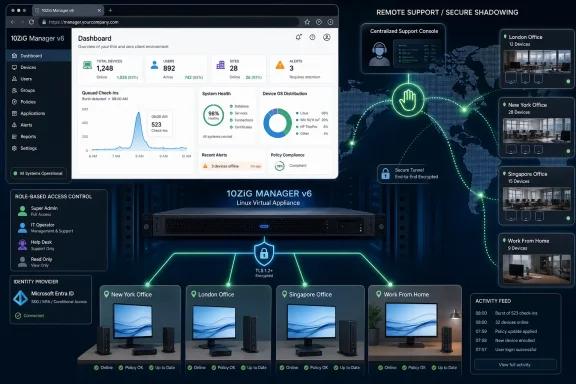 10ZiG Moves the Management Plane Off Windows Server
For years, endpoint management in the thin-client world has sat in a slightly awkward place. The endpoint itself may be stripped down, locked down, and purpose-built, but the management layer often still looked like conventional enterprise software: a Windows Server, a database, firewall rules, certificates, service accounts, upgrade windows, and all the quiet maintenance work that tends to disappear from vendor diagrams.10ZiG Manager v6 is a deliberate break from that pattern. The new Linux Virtual Appliance packages the management environment as a preconfigured appliance, meaning customers are meant to deploy the management plane as infrastructure rather than assemble it like an application stack. That matters because the point of thin and zero clients has always been operational simplicity; if managing the devices requires a traditional server footprint, some of that bargain starts to erode.
The company is framing the shift as a way to reduce deployment time, lower maintenance requirements, and avoid Windows Server licensing costs. That is a vendor-friendly message, but it has real resonance in shops where endpoint teams are trying to avoid becoming part-time server administrators. Every management server carries lifecycle obligations, and every additional Windows Server instance brings patching, licensing, hardening, backup, monitoring, and audit exposure.
The appliance model also fits the way many IT teams now expect infrastructure tools to arrive. Firewalls, hyperconverged management consoles, backup controllers, and identity-adjacent services have trained administrators to think in terms of virtual appliances: import, configure, update through the vendor’s mechanism, and keep the blast radius narrow. 10ZiG is applying that same logic to endpoint management for VDI, DaaS, SaaS, and secure browser use cases.
The Endpoint Is Simple; The Estate Is Not
Thin clients are often sold as an antidote to PC complexity, but that framing can become too neat. A locked-down endpoint does reduce local software drift, user tampering, and the endless personality quirks of full Windows desktops. But a fleet of several hundred or several thousand devices across offices, hospitals, call centers, factories, classrooms, and home networks is still a distributed computing estate.That is why 10ZiG’s architectural work around scale is the part of the release that deserves attention. The company says Manager v6 includes reduced CPU and memory use, database optimizations, improved web console responsiveness, and a queuing system for endpoint check-ins. Those sound like ordinary release-note ingredients, but they point at the real pain in endpoint management: not whether a console can see a device, but whether it can stay responsive when thousands of devices decide to report in, update, reboot, or request attention.
Check-in behavior is especially important in thin-client environments because the endpoints are often clustered around business rhythms. Devices wake at the start of shifts, reappear after network outages, or reconnect when branch links stabilize. A management system that works well in a lab can behave very differently when an entire site comes online at 8:00 a.m. or when a WAN event causes a wave of reconnects.
The queuing system is therefore more than a performance tweak. It is an admission that endpoint management is a concurrency problem. A modern console has to absorb bursts, serialize work intelligently, and avoid turning device telemetry into its own denial-of-service event.
The broader trend is familiar to anyone who has watched Windows administration evolve. Configuration Manager, Intune, Group Policy, MDM, RMM tools, and security agents all learned that scale is not simply a matter of supporting a large number in a brochure. Scale is about predictable behavior under load, understandable failure modes, and enough observability to know whether the tool is helping or becoming the outage.
Linux Is the Cost Story, but Security Is the Better One
It is tempting to reduce the move to Linux to licensing. 10ZiG explicitly argues that the appliance eliminates Windows Server licensing costs associated with older management infrastructure. For some customers, that will be the line item that wins the internal conversation.But the stronger argument is security and attack surface. A purpose-built Linux appliance is not inherently secure just because it runs Linux, and no serious administrator should treat “Linux-based” as a magic shield. Still, a hardened appliance with a narrower role can be easier to reason about than a general-purpose Windows Server that has accumulated dependencies, agents, local administrator exceptions, and years of operational compromise.
The distinction is subtle but important. Enterprises do not reduce risk by swapping one logo for another; they reduce risk by reducing unnecessary functions, exposed services, privileged accounts, and maintenance variance. If 10ZiG’s appliance delivers a smaller, more controlled footprint, the value comes from that reduced complexity.
This is especially relevant because endpoint management systems are privileged by design. They configure devices, push updates, shadow sessions, apply policies, and often sit near identity, remote access, and support workflows. A compromise of the management plane can become a compromise of operational control, even if the endpoints themselves are relatively locked down.
A management appliance therefore needs to be judged like a security-sensitive control plane. Customers should ask how updates are delivered, how administrative access is logged, how certificates are handled, how backup and recovery work, what ports are exposed, and how the appliance is hardened by default. The Linux foundation may be a better starting point, but the implementation details decide whether it becomes a meaningful security improvement or simply a different maintenance surface.
The Web Console Becomes the Product
10ZiG also says Manager v6 brings a rebuilt web console, and that deserves more weight than “new UI” usually gets. In endpoint administration, the console is not decoration. It is where policy intent becomes action, where failures become visible, and where stressed support teams either move quickly or make mistakes.A responsive web console matters because management tools are now used by more than one type of administrator. The days when a single endpoint specialist quietly maintained a device fleet from a back-office console are fading. Help desk staff, regional IT teams, desktop engineers, security reviewers, and service providers may all need different levels of visibility and control.
That makes the console part of the access-control model. If the interface is slow, confusing, or overly broad, organizations compensate with shared accounts, excessive permissions, or unofficial procedures. A modernized UI does not automatically fix governance, but it can make least-privilege administration more practical.
The web-console emphasis also tracks a larger post-pandemic management reality. IT teams are less likely to sit on the same LAN as the devices they administer, and support workflows increasingly assume browser-based tools that can be reached from managed workstations, jump boxes, or cloud access paths. A web console is not just convenient; it is becoming the normal surface for operational control.
Still, browser-based management raises its own requirements. Session handling, MFA integration, audit trails, and role design become central. A pretty console without strong identity integration is merely a prettier risk.
Entra Integration Pulls Thin Clients Into the Identity Era
The inclusion of Microsoft Entra integration is one of the clearest signs that 10ZiG is positioning Manager v6 for modern enterprise governance. Thin-client management used to be largely device-centric: group the endpoints, push settings, update firmware, and keep users out of local configuration. That model still matters, but it is no longer enough.Identity now defines administrative trust. If a console can change remote-support settings, push policies, or shadow endpoints, then access to that console belongs under the same scrutiny as access to other privileged IT systems. Entra integration gives organizations a route to align 10ZiG administration with existing identity practices, conditional access models, and centralized account lifecycle processes.
Role-based access control and multi-tenancy extend that idea. Multi-tenancy is particularly relevant for managed service providers, large enterprises with semi-autonomous divisions, and organizations that separate device estates by geography, customer, business unit, or security boundary. It lets the management tool reflect organizational reality rather than forcing every administrator into one flat permission universe.
RBAC, meanwhile, is one of those features that sounds boring until it is absent. A help desk technician may need to view a device, restart it, or assist a user, but not change global policy. A regional admin may need control over a site, but not the entire estate. A security team may need audit visibility without operational authority.
These distinctions matter because endpoint management consoles tend to become operationally powerful over time. The more remote support, automation, policy, and cloud-management capability 10ZiG adds, the more important it becomes to prevent the console from turning into an all-or-nothing administrative tool.
Remote Support Is Now a Core Endpoint Feature
The release also expands cloud-enabled management and support through Secure Connector cloud management, Secure Endpoint shadowing, and remote assistance capabilities. That is not surprising, but it is revealing. Remote support is no longer an add-on in endpoint management; it is a central feature of the product category.VDI and DaaS changed where the desktop lives, but they did not eliminate endpoint incidents. Users still have display problems, peripheral issues, authentication confusion, Wi-Fi faults, local browser problems, headset complaints, and session-launch failures. In many cases, the support technician needs to determine whether the problem belongs to the endpoint, the broker, the network, the virtual desktop, or the application.
Shadowing and remote assistance tools help close that gap. If IT can see the endpoint’s state and assist the user without requiring a VPN into every branch or a third-party remote-control tool on every device, support becomes faster and cleaner. That is especially valuable in regulated or operationally sensitive settings where endpoint access must be controlled and auditable.
The cloud-management angle also reflects the erosion of the old branch-office model. Devices may be in corporate buildings, retail locations, clinical environments, classrooms, warehouses, or homes. A management architecture that assumes flat internal reachability will struggle in that world.
That said, cloud-enabled support creates a trust question. Customers will need to understand what traffic flows through 10ZiG services, what remains direct, how sessions are authenticated, and how remote-control events are logged. The feature category is valuable, but it must be deployed with the same suspicion administrators already apply to RMM platforms and privileged remote-access tools.
Automation Is the Only Way the Free Console Scales
10ZiG highlights improved endpoint onboarding, policy management, workflow administration, reporting, auditing, and operational visibility. These additions do not have the marketing glamour of a Linux appliance, but they are what determine whether the platform can support large estates without adding headcount.Automation is the difference between a management console and an operating model. It is one thing to configure a device; it is another to ensure that a newly shipped endpoint lands in the right group, receives the right broker configuration, inherits the right security policy, reports its compliance state, and can be supported by the correct team. In large environments, manual configuration is not merely inefficient; it is a source of drift.
Policy management is also where thin clients can either fulfill or betray their promise. The appeal of a thin or zero client is consistency. If the management layer cannot enforce that consistency cleanly, administrators end up recreating the same exception culture they were trying to escape from PC fleets.
Reporting and auditing add the accountability layer. Endpoint operations are increasingly pulled into security and compliance conversations, even when the device is not a full Windows desktop. Auditors may care who changed a policy, when a device was last updated, whether remote assistance was used, and whether administrative access follows a defined control model.
Operational visibility is also practical. In a VDI outage, administrators need to know whether endpoints are online, whether they can reach the broker, whether firmware versions are consistent, whether a site is isolated, and whether the issue is local or upstream. A management platform that can answer those questions quickly becomes part of incident response, not just routine administration.
Free Management Is a Competitive Weapon With Strings Attached
10ZiG is emphasizing that Manager v6 and the Linux Virtual Appliance remain available at no additional cost to existing customers. In a market accustomed to per-device pricing, subscription tiers, cloud-management add-ons, and feature gating, that is not a small claim. It changes the economics of the endpoint decision.The obvious benefit is budgetary. If an organization is already buying 10ZiG endpoints or using 10ZiG OS-based devices, avoiding a separate management subscription can simplify procurement and reduce recurring costs. For environments with thousands of devices, the difference between bundled management and per-endpoint management can be material.
But “free” in enterprise software is never the entire story. The management platform is free because it supports the hardware and OS ecosystem. That can be a perfectly reasonable trade, but customers should evaluate it as part of the broader vendor commitment. The real question is not whether the console has a line-item price; it is whether the endpoint fleet, OS lifecycle, support quality, firmware cadence, and management roadmap fit the organization’s long-term needs.
There is also a strategic lock-in dimension. A tightly integrated, no-extra-cost management stack makes a single-vendor endpoint strategy more attractive. It also makes switching vendors more consequential, because management workflows, policy models, automation, and support practices become embedded around one platform.
That does not make 10ZiG’s approach bad; in fact, many IT teams prefer tightly integrated systems because they reduce finger-pointing. But it does mean the “free management” claim should be understood as part of a platform economics argument. 10ZiG is not giving away a neutral management layer for the whole endpoint universe; it is strengthening the value of staying inside its endpoint world.
Windows Still Matters Even When the Appliance Runs Linux
The irony of this release is that it moves a management component away from Windows while remaining deeply relevant to Windows-centric shops. Thin and zero clients are often front doors into Windows environments: Azure Virtual Desktop, Windows 365, Remote Desktop Session Host, Citrix-delivered Windows apps, Omnissa Horizon desktops, and browser access to Microsoft 365 or line-of-business systems. The local endpoint may be Linux-based, but the user’s workday often still depends on Microsoft infrastructure.That is why Windows administrators should pay attention. A Linux appliance in this context is not a rejection of Windows; it is an attempt to reduce the number of Windows systems required to deliver and manage Windows experiences. For many organizations, that is a sensible division of labor.
Windows Server remains enormously capable, but it is not free operationally. Even when licensing is handled through enterprise agreements, servers still require patch orchestration, vulnerability management, endpoint protection, backup integration, monitoring, privilege governance, and periodic migration. If an endpoint management server does not need to be a general-purpose Windows workload, removing it from that category can be attractive.
There is also a philosophical shift here. The modern Microsoft estate is already hybrid and heterogeneous. Entra ID governs access to non-Windows applications, Intune manages mobile platforms, Azure runs Linux workloads, and Windows users increasingly interact with cloud services through browsers and remoted sessions. In that world, the question is not whether a component runs Windows; it is whether it integrates cleanly with the identity, security, and operational model the organization already uses.
10ZiG Manager v6 appears designed for that reality. The endpoint may be a thin client, the console may run on Linux, the identity provider may be Entra, the desktop may be Windows, and the application may be SaaS. That is not an edge case anymore. It is the shape of enterprise computing.
The VDI Market Needed Boring Improvements
There is a tendency in end-user computing to chase grand narratives: cloud PCs will replace desktops, VDI will finally go mainstream, SaaS will make the desktop irrelevant, AI PCs will redraw the endpoint. Those stories are not useless, but they often miss what IT departments actually need from endpoint vendors. They need fewer moving parts, better remote support, clearer policy, and management systems that do not fall over at scale.10ZiG Manager v6 is interesting because its headline improvements are mostly pragmatic. A Linux appliance is easier to deploy. A web console is easier to access. RBAC and Entra integration are easier to govern. Queued check-ins and database optimizations are easier to trust under load. Remote assistance is easier than dispatching someone to a branch office.
That pragmatism fits the thin-client market. Organizations do not usually buy thin clients because they want a more exciting endpoint. They buy them because the endpoint should become more predictable, less user-modifiable, and easier to replace. The management platform has to reinforce that decision, not undermine it with complexity of its own.
The release also lands at a moment when many organizations are rethinking endpoint refresh cycles. Windows 10’s end-of-support pressure, Windows 11 hardware requirements, hybrid work, cloud desktops, and secure browser strategies have all pushed IT teams to consider alternatives to traditional PC replacement. 10ZiG’s pitch is that purpose-built endpoints plus no-extra-cost management can be part of that answer.
That will not fit every environment. Some organizations need full Windows endpoints for local applications, peripherals, offline workflows, or specialized drivers. Others are already standardized on Intune-managed PCs and see thin clients as too narrow. But for the segment that has committed to VDI, DaaS, SaaS, or controlled browser access, the management layer is where the operational savings either appear or vanish.
The Hard Questions Start After General Availability
General availability is a milestone, not a verdict. The real test for 10ZiG Manager v6 will come as customers deploy the Linux Virtual Appliance into varied production environments and discover how the new architecture behaves under their specific conditions. Endpoint management is full of edge cases: odd network topologies, inherited device models, broker-specific quirks, regional support teams, certificate policies, proxy requirements, and security controls that look simple only in vendor labs.Administrators evaluating the release should focus less on the announcement language and more on operational proof. How quickly can the appliance be deployed into a real virtual environment? How are upgrades handled? What does backup and restore look like? Can the system recover cleanly from database issues? How granular is RBAC in practice? How well does Entra integration map to existing administrative groups and conditional access policies?
The remote-support features also deserve scrutiny. Secure Endpoint shadowing and remote assistance can be powerful, but they should be accompanied by clear controls, consent options where appropriate, session logging, and auditability. In sensitive environments, remote-control capability is both a support tool and a governance concern.
Scale claims should be tested against local realities. “Thousands of endpoints” is useful only if the platform remains responsive during firmware rollouts, mass policy changes, site outages, and morning check-in storms. The new queuing architecture sounds promising, but administrators should validate it before assuming that architectural language translates into predictable production behavior.
The move to Linux also changes the skills conversation. Many Windows-heavy teams are comfortable importing virtual appliances, but they may still need clarity on patch responsibility, shell access, vendor support boundaries, logging, monitoring, and security scanning. A good appliance hides unnecessary complexity; a bad one hides the information administrators need when something breaks.
The Real News Is a Smaller Management Burden
The most concrete reading of 10ZiG Manager v6 is that 10ZiG wants endpoint management to feel less like another server project and more like a built-in part of the endpoint platform. That is the right direction for this market. Thin-client customers are not looking to add another management empire; they are trying to remove entropy from the edge.The Linux Virtual Appliance is the symbolic center of that strategy, but the rest of the release matters just as much. A rebuilt web console, Entra integration, multi-tenancy, RBAC, cloud management, remote assistance, automation, reporting, auditing, and performance work all point toward the same goal: make the fleet easier to run when the fleet is no longer sitting neatly inside one building.
For customers already invested in 10ZiG hardware or OS-based endpoints, the upgrade argument is straightforward. The platform promises lower overhead, better scale, stronger administrative controls, and no added management subscription. For customers comparing endpoint vendors, the release sharpens 10ZiG’s pitch as a single-vendor endpoint stack with bundled management as a differentiator.
The caveat is that endpoint management is judged in production, not in launch copy. The most important improvements in Manager v6 are the ones administrators will notice only when nothing dramatic happens: the console stays fast, check-ins do not swamp the server, remote support works without a separate toolchain, and access controls keep junior admins away from global mistakes.
A Thin-Client Release With Very Windows Consequences
This release should not be read as a niche Linux appliance story. It is a Windows endpoint operations story in disguise. The device on the desk may be a thin client, the management appliance may be Linux, and the console may be browser-based, but the business service being protected is often a Windows desktop or application delivered from somewhere else.That makes the stakes larger than 10ZiG’s customer base. Enterprise endpoint management is moving toward fewer locally maintained servers, more identity-aware administration, more cloud-capable support, and more appliance-style deployment. 10ZiG Manager v6 is one vendor’s implementation of that pattern, but the pattern itself is becoming hard to ignore.
Near the close, the practical read for IT teams is simple:
- 10ZiG Manager v6 replaces the older Windows Server-centered management approach with a Linux Virtual Appliance intended to reduce deployment and maintenance overhead.
- The release adds governance features that matter in real estates, including multi-tenancy, role-based access control, and Microsoft Entra integration.
- The scale improvements target common pain points in large endpoint fleets, including check-in bursts, database performance, web console responsiveness, and resource consumption.
- The remote-support additions make the platform more useful for distributed offices, home-based endpoints, and sites where local IT presence is limited.
- The no-additional-cost model strengthens 10ZiG’s single-vendor pitch, but customers should evaluate it alongside hardware lifecycle, support, OS strategy, and long-term platform lock-in.
- The move to Linux reduces one category of Windows Server dependency, but administrators still need to validate update, backup, security, monitoring, and recovery procedures before treating the appliance as low-touch infrastructure.
References
- Primary source: IT Brief UK
Published: 2026-07-03T08:40:21.216471
10ZiG launches Linux-based Manager v6 for endpoints
Customers will avoid Windows Server licensing costs as 10ZiG shifts endpoint management to a Linux appliance with tighter controls and lower overhead. itbrief.co.uk
- Related coverage: 10zig.com
10ZiG Announces General Availability of 10ZiG Manager v6 and Linux Virtual Appliance | 10ZiG
10ZiG Announces General Availability of 10ZiG Manager v6 and Linux Virtual Appliance 10ZiG Announces General Availability of 10ZiG Manager v6 and Linux Virtual Appliance New program delivers sales, technical, and enablement resources to help partners simplify endpoint management, address...www.10zig.com - Related coverage: 10zigbucket.s3-us-west-2.amazonaws.com
- Related coverage: distilogix.com
10ZiG Thin & Zero Client Solutions | UAE & GCC — Distilogix
10ZiG managed thin and zero client endpoints for Citrix, AVD, and VMware Horizon across UAE and GCC. Centralised NOS management, secure boot, and energy-efficient. Distributed by Distilogix. distilogix.com
- Related coverage: itbrief.news
10ZiG Manager v5.5 boosts scale for large deployments
10ZiG Manager v5.5 brings major server, web console and database upgrades to scale thin client management to many thousands of endpoints. itbrief.news
- Related coverage: thinclients.10zig.com
Thin Clients - 10ZiG Technology
 thinclients.10zig.com

