

National Gas worked with Capgemini after its 2023 separation from National Grid to build a greenfield Microsoft Azure environment using Azure Virtual Desktop, giving developers, data scientists, vendors, and later thousands of users secure cloud desktops without waiting for traditional laptop provisioning. The story is not simply that another enterprise moved to Azure. It is that a utility with a hard corporate deadline treated desktop virtualization as a separation tool, a developer platform, and an operating model all at once. For Windows administrators, the interesting part is the architectural bet: Capgemini chose a simplified single-session AVD model first, then automated nearly everything around it.
Most virtual desktop projects begin with a familiar premise: reduce endpoint cost, centralize apps, or support remote work. National Gas had a more severe problem. Its separation from National Grid created a time-boxed need for its own cloud environment, its own security boundaries, and its own way to let technical staff keep building software before the usual endpoint supply chain could catch up.
That distinction matters. In many organizations, VDI is still treated as a second-class workplace technology, something deployed to contractors, call centers, or temporary workers. In this case, Azure Virtual Desktop became part of the core carve-out machinery for a critical national infrastructure company.
National Gas operates Great Britain’s major gas transmission network, a system with obvious availability, security, and regulatory sensitivity. A rushed migration in that context is not merely an IT inconvenience. It can become an operational risk if developers and data teams cannot access tools, environments, repositories, and internal systems cleanly after a corporate split.
Capgemini’s account describes a deadline-driven migration in which National Gas needed rapid application assessment and user profiling, but also had a small internal team that could not absorb excessive operational complexity. That is the tension at the center of the project: move fast, but do not create a bespoke monster that needs an army to maintain.
That is a subtle but meaningful shift in how enterprises use virtual desktops. In the old VDI world, the remote desktop was often a workaround for endpoint weakness. In the modern cloud desktop model, it can become the point where identity, access, policy, application delivery, and data locality converge.
National Gas considered Windows 365, Microsoft Dev Box, and Azure Virtual Desktop before Capgemini recommended AVD. That short list is revealing because the products overlap in user experience but differ sharply in operating model. Windows 365 is the more packaged Cloud PC offering; Dev Box is aimed specifically at developer workstations; AVD is the more flexible virtualization fabric, with greater architectural control and more responsibility placed on the customer or integrator.
For a company building a new environment from scratch, control appears to have won. AVD allowed National Gas and Capgemini to combine desktop access with Azure security capabilities such as conditional access, location awareness, multifactor authentication, and Privileged Identity Management. In practical terms, the desktop became less a machine and more a governed access plane.
National Gas and Capgemini initially went the other way. They chose a simplified single-session AVD model instead of the more typical multi-session route, at least for the developer and data-science use cases described in the first phase. That sounds counterintuitive until the constraints come into focus.
Developers are rarely ideal candidates for tightly standardized shared desktops. They install tools, update SDKs, run local services, test dependencies, and sometimes need elevated rights or unusual configurations. Data scientists can be just as variable, with notebooks, libraries, model tooling, and data access requirements that do not always fit neatly into a locked-down pooled image.
A single-session desktop gives each user a cleaner personal workspace while still keeping the environment inside Azure and under central management. It may be less efficient on raw compute density, but it can reduce friction in profiling, packaging, troubleshooting, and user acceptance. In a deadline-driven carve-out, that trade may be rational.
The cleverness of the project was not that single-session AVD is new. It is that Capgemini wrapped it in automation so that the operational penalty of many individual desktops was reduced. That is where the case becomes more interesting for IT pros than a standard migration success story.
That is the part administrators should pay attention to. Traditional VDI operations often drift toward image sprawl: gold images, departmental variants, emergency snapshots, manual fixes, and long testing cycles whenever a dependency changes. The more specialized the workforce, the worse the image problem becomes.
National Gas’ model appears to have pushed the intelligence outward into code, policy, and app delivery rather than treating the desktop image as the master artifact. That does not eliminate complexity; it relocates it. But the relocation is important because pipelines, configuration policies, and declarative infrastructure can be reviewed, versioned, repeated, and rolled back in ways that hand-tuned images cannot.
This is the broader Azure story Microsoft has been trying to sell for years. The value is not simply that the VM runs in Microsoft’s cloud. The value is that the surrounding control plane can make desktops behave more like disposable, governed infrastructure than irreplaceable endpoints.
National Gas did not have that luxury. Capgemini says the AVD approach reduced the need for deep user application profiling and customization. That sentence should make some architects nervous, because skipping profiling can create hidden support debt. But in a separation scenario, exhaustive rationalization can be its own failure mode if it delays access to the tools people need to do their jobs.
The National Gas deployment suggests a more pragmatic sequencing. First, create a secure and scalable place for users to work. Then refine, optimize, and introduce more efficient host models as use cases become better understood. The company is now exploring multi-session machines for specific scenarios, which is exactly the kind of second-phase optimization that makes sense after the urgent business transition is complete.
This is not an argument against planning. It is an argument against pretending that planning and execution always occur in neat order. Sometimes the platform must be built while the organization is still discovering what it needs from the platform.
Capgemini says National Gas and Capgemini developed automation that starts machines when an employee signs on and deallocates them when the employee logs off. That is a simple sentence with large operational consequences. If single-session desktops are going to compete economically with denser pooled models, start-stop discipline is not optional.
This is where the AVD story departs from the old “thin client” pitch. The endpoint may be simpler, but the cloud bill is always watching. A personal virtual desktop that sits powered on all weekend is not inherently more efficient than a laptop; it is just expensive in a different column.
The project also avoided some traditional profile and application delivery costs. Capgemini says local profiles supported by OneDrive helped avoid more expensive storage options, while Winget, Microsoft Store apps, and self-updating applications simplified deployment. That combination is not glamorous, but it reflects a modern Windows management reality: the best app strategy is often the one that avoids repackaging everything.
But AVD managed with Intune points toward a cleaner model: identity-driven policy, app deployment from cloud-aware sources, compliance enforcement, and endpoint configuration that applies whether the “device” is physical or virtual. In that sense, National Gas’ AVD estate is not just a remote access platform. It is part of Microsoft’s long campaign to make Windows management less dependent on the old LAN-bound assumptions.
That shift is not frictionless. Anyone who has managed Windows multi-session with modern tools knows that support matrices, policy applicability, app behavior, and profile handling can still produce surprises. AVD can be elegant in diagrams and messy in production.
Still, the direction is clear. If an organization can describe a developer desktop as code, deploy it through a pipeline, govern it through Entra ID and Intune, and retire it when no longer needed, the operational unit changes. The “PC” becomes a service instance.
That scale changes the interpretation. A few hundred developer desktops can be explained as a tactical workaround during a carve-out. Four thousand users suggest that the model solved a broader workplace and access problem for the new National Gas organization.
It also raises the stakes. At that size, every operational shortcut compounds. Poor patching processes become security exposure. Weak cost governance becomes budget pain. Bad application assumptions become help desk volume. Identity misconfiguration becomes a business interruption.
Capgemini’s case study is naturally promotional, and readers should treat it as a curated account rather than a forensic postmortem. But the move from a few hundred technical users to thousands of users is the kind of adoption curve that indicates the platform met a real organizational need. Enterprises rarely expand painful desktop platforms voluntarily.
Critical infrastructure organizations face a difficult balance. They need modern cloud practices because software delivery, analytics, security monitoring, and collaboration now depend on them. They also cannot casually blur boundaries between operational systems, corporate IT, third-party vendors, and inherited environments from a previous parent company.
A cloud desktop can help by centralizing data and applications while reducing dependence on unmanaged or inconsistently managed endpoints. But it is not a magic shield. Identity becomes more important, conditional access policies must be accurate, privileged access must be tightly governed, and logging must be good enough to reconstruct what happened when something goes wrong.
The National Gas example shows why AVD is attractive in this context. It allows an organization to say, in effect, “Bring the user to a controlled workspace, not the data to whatever device the user happens to have.” That is a powerful posture during a divestiture, especially when conventional laptops are unavailable or delayed.
Even so, the architecture choices are concrete enough to analyze. The project used AVD rather than Windows 365 or Dev Box. It began with single-session desktops rather than making multi-session the default. It leaned on Terraform, DevOps pipelines, Intune, Winget, Microsoft Store apps, self-updating applications, OneDrive-backed profiles, and automated start-deallocate behavior.
Those choices form a coherent pattern. They reduce dependency on hand-built endpoint logistics. They favor repeatable infrastructure over manual desktop engineering. They use Microsoft’s identity and management stack as the policy layer. They accept potentially higher per-user compute overhead in exchange for speed, isolation, and lower customization friction.
That is not the right answer for every organization. A stable call center with predictable apps may be better served by pooled multi-session hosts and aggressive image optimization. A developer team with heavy compute needs may prefer Dev Box or specialized cloud workstations. A lightly managed knowledge-worker environment may find Windows 365 simpler. The point is that National Gas had a specific business event, and AVD was used as a tool for that event rather than as a generic cloud fashion statement.
That bundling is exactly why competitors sometimes describe Microsoft’s cloud ecosystem as gravitational. Once a customer solves an urgent problem by combining these services, the next decision often starts inside the same ecosystem. The customer may not be “locked in” in a crude sense, but the operational muscle memory becomes Microsoft-shaped.
For WindowsForum readers, the practical implication is obvious. Windows administration is no longer primarily about the physical endpoint. It is about the user session, the identity boundary, the policy assignment, the app source, the automation pipeline, and the cost controls around compute. The endpoint still matters, but it is no longer the only place where the desktop lives.
That shift will not eliminate traditional PC management. Laptops are not going away, and many workloads still belong on local hardware. But the National Gas case shows how quickly a business event can turn cloud desktops from an optional modernization project into a board-level dependency.
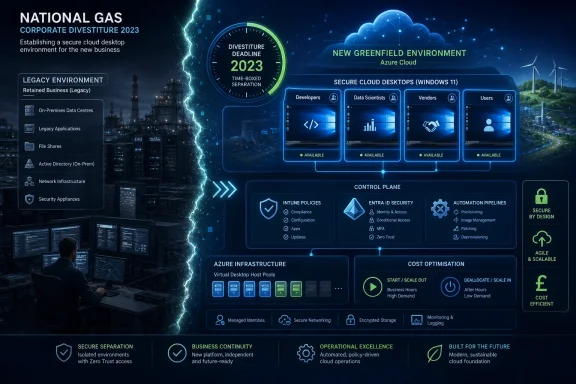 The Divestiture Clock Turned VDI Into Business Infrastructure
Most virtual desktop projects begin with a familiar premise: reduce endpoint cost, centralize apps, or support remote work. National Gas had a more severe problem. Its separation from National Grid created a time-boxed need for its own cloud environment, its own security boundaries, and its own way to let technical staff keep building software before the usual endpoint supply chain could catch up.That distinction matters. In many organizations, VDI is still treated as a second-class workplace technology, something deployed to contractors, call centers, or temporary workers. In this case, Azure Virtual Desktop became part of the core carve-out machinery for a critical national infrastructure company.
National Gas operates Great Britain’s major gas transmission network, a system with obvious availability, security, and regulatory sensitivity. A rushed migration in that context is not merely an IT inconvenience. It can become an operational risk if developers and data teams cannot access tools, environments, repositories, and internal systems cleanly after a corporate split.
Capgemini’s account describes a deadline-driven migration in which National Gas needed rapid application assessment and user profiling, but also had a small internal team that could not absorb excessive operational complexity. That is the tension at the center of the project: move fast, but do not create a bespoke monster that needs an army to maintain.
Microsoft’s Cloud Desktop Became the New Corporate Border
The most important phrase in the case study is not “cloud migration” or even “Azure Virtual Desktop.” It is “security separation.” National Gas needed a clean boundary between National Grid’s legacy environment and its own emerging estate, and AVD gave the company a way to draw that line without waiting for every physical endpoint to be procured, built, shipped, and managed.That is a subtle but meaningful shift in how enterprises use virtual desktops. In the old VDI world, the remote desktop was often a workaround for endpoint weakness. In the modern cloud desktop model, it can become the point where identity, access, policy, application delivery, and data locality converge.
National Gas considered Windows 365, Microsoft Dev Box, and Azure Virtual Desktop before Capgemini recommended AVD. That short list is revealing because the products overlap in user experience but differ sharply in operating model. Windows 365 is the more packaged Cloud PC offering; Dev Box is aimed specifically at developer workstations; AVD is the more flexible virtualization fabric, with greater architectural control and more responsibility placed on the customer or integrator.
For a company building a new environment from scratch, control appears to have won. AVD allowed National Gas and Capgemini to combine desktop access with Azure security capabilities such as conditional access, location awareness, multifactor authentication, and Privileged Identity Management. In practical terms, the desktop became less a machine and more a governed access plane.
The Single-Session Choice Was a Bet Against Conventional AVD Economics
Azure Virtual Desktop’s headline advantage is often multi-session Windows. Microsoft’s platform can run multiple users on a single Windows 10 or Windows 11 Enterprise multi-session host, which is a major reason AVD is attractive for cost-conscious enterprises. More users per VM generally means better utilization and fewer operating system instances to patch, monitor, and pay for.National Gas and Capgemini initially went the other way. They chose a simplified single-session AVD model instead of the more typical multi-session route, at least for the developer and data-science use cases described in the first phase. That sounds counterintuitive until the constraints come into focus.
Developers are rarely ideal candidates for tightly standardized shared desktops. They install tools, update SDKs, run local services, test dependencies, and sometimes need elevated rights or unusual configurations. Data scientists can be just as variable, with notebooks, libraries, model tooling, and data access requirements that do not always fit neatly into a locked-down pooled image.
A single-session desktop gives each user a cleaner personal workspace while still keeping the environment inside Azure and under central management. It may be less efficient on raw compute density, but it can reduce friction in profiling, packaging, troubleshooting, and user acceptance. In a deadline-driven carve-out, that trade may be rational.
The cleverness of the project was not that single-session AVD is new. It is that Capgemini wrapped it in automation so that the operational penalty of many individual desktops was reduced. That is where the case becomes more interesting for IT pros than a standard migration success story.
Automation Did the Work That Image Management Usually Does
The project team used Terraform infrastructure as code and DevOps pipelines to deploy infrastructure and single-session virtual desktops. Microsoft Intune handled policies, application deployments, and updates. The result, according to Capgemini, was an almost zero-touch model in which machines could be spun up on demand with the right policies, applications, and security tooling.That is the part administrators should pay attention to. Traditional VDI operations often drift toward image sprawl: gold images, departmental variants, emergency snapshots, manual fixes, and long testing cycles whenever a dependency changes. The more specialized the workforce, the worse the image problem becomes.
National Gas’ model appears to have pushed the intelligence outward into code, policy, and app delivery rather than treating the desktop image as the master artifact. That does not eliminate complexity; it relocates it. But the relocation is important because pipelines, configuration policies, and declarative infrastructure can be reviewed, versioned, repeated, and rolled back in ways that hand-tuned images cannot.
This is the broader Azure story Microsoft has been trying to sell for years. The value is not simply that the VM runs in Microsoft’s cloud. The value is that the surrounding control plane can make desktops behave more like disposable, governed infrastructure than irreplaceable endpoints.
Developers Needed Speed More Than a Perfectly Rationalized App Estate
Enterprise migration playbooks tend to worship assessment. Inventory every application, map every dependency, group every persona, test every workflow, then migrate. That approach is defensible when time is abundant and the estate is stable.National Gas did not have that luxury. Capgemini says the AVD approach reduced the need for deep user application profiling and customization. That sentence should make some architects nervous, because skipping profiling can create hidden support debt. But in a separation scenario, exhaustive rationalization can be its own failure mode if it delays access to the tools people need to do their jobs.
The National Gas deployment suggests a more pragmatic sequencing. First, create a secure and scalable place for users to work. Then refine, optimize, and introduce more efficient host models as use cases become better understood. The company is now exploring multi-session machines for specific scenarios, which is exactly the kind of second-phase optimization that makes sense after the urgent business transition is complete.
This is not an argument against planning. It is an argument against pretending that planning and execution always occur in neat order. Sometimes the platform must be built while the organization is still discovering what it needs from the platform.
Cost Control Came From Turning Machines Off, Not Just Sharing Them
Because AVD is consumption-based, cloud desktop cost is a behavioral problem as much as an architectural one. Idle machines cost money. Overprovisioned machines cost money. Overly customized support models cost money. Storage-heavy profile designs cost money.Capgemini says National Gas and Capgemini developed automation that starts machines when an employee signs on and deallocates them when the employee logs off. That is a simple sentence with large operational consequences. If single-session desktops are going to compete economically with denser pooled models, start-stop discipline is not optional.
This is where the AVD story departs from the old “thin client” pitch. The endpoint may be simpler, but the cloud bill is always watching. A personal virtual desktop that sits powered on all weekend is not inherently more efficient than a laptop; it is just expensive in a different column.
The project also avoided some traditional profile and application delivery costs. Capgemini says local profiles supported by OneDrive helped avoid more expensive storage options, while Winget, Microsoft Store apps, and self-updating applications simplified deployment. That combination is not glamorous, but it reflects a modern Windows management reality: the best app strategy is often the one that avoids repackaging everything.
Intune Is Quietly Becoming the Desktop Control Plane
One of the more telling details is the use of Microsoft Modern Management through Intune. For years, enterprise Windows management was split across Configuration Manager, Group Policy, imaging tools, scripts, third-party deployment systems, and whatever emergency process a desktop team invented under pressure. Cloud desktops do not magically remove that history.But AVD managed with Intune points toward a cleaner model: identity-driven policy, app deployment from cloud-aware sources, compliance enforcement, and endpoint configuration that applies whether the “device” is physical or virtual. In that sense, National Gas’ AVD estate is not just a remote access platform. It is part of Microsoft’s long campaign to make Windows management less dependent on the old LAN-bound assumptions.
That shift is not frictionless. Anyone who has managed Windows multi-session with modern tools knows that support matrices, policy applicability, app behavior, and profile handling can still produce surprises. AVD can be elegant in diagrams and messy in production.
Still, the direction is clear. If an organization can describe a developer desktop as code, deploy it through a pipeline, govern it through Entra ID and Intune, and retire it when no longer needed, the operational unit changes. The “PC” becomes a service instance.
The 4,000-User Expansion Is the Real Proof Point
The first phase reportedly covered a couple of hundred AVDs for developers and data scientists. That would already be a meaningful deployment, but it would still fit the pattern of a specialized engineering environment. The larger claim is that the service has since become the solution for more than 4,000 users.That scale changes the interpretation. A few hundred developer desktops can be explained as a tactical workaround during a carve-out. Four thousand users suggest that the model solved a broader workplace and access problem for the new National Gas organization.
It also raises the stakes. At that size, every operational shortcut compounds. Poor patching processes become security exposure. Weak cost governance becomes budget pain. Bad application assumptions become help desk volume. Identity misconfiguration becomes a business interruption.
Capgemini’s case study is naturally promotional, and readers should treat it as a curated account rather than a forensic postmortem. But the move from a few hundred technical users to thousands of users is the kind of adoption curve that indicates the platform met a real organizational need. Enterprises rarely expand painful desktop platforms voluntarily.
The Energy Sector Is a Harsh Test Bed for Cloud Desktops
National Gas is not a generic office business. It sits inside the energy infrastructure ecosystem, where reliability, cyber risk, vendor access, engineering workflows, and regulatory expectations all collide. That makes the AVD deployment more instructive than a routine corporate desktop refresh.Critical infrastructure organizations face a difficult balance. They need modern cloud practices because software delivery, analytics, security monitoring, and collaboration now depend on them. They also cannot casually blur boundaries between operational systems, corporate IT, third-party vendors, and inherited environments from a previous parent company.
A cloud desktop can help by centralizing data and applications while reducing dependence on unmanaged or inconsistently managed endpoints. But it is not a magic shield. Identity becomes more important, conditional access policies must be accurate, privileged access must be tightly governed, and logging must be good enough to reconstruct what happened when something goes wrong.
The National Gas example shows why AVD is attractive in this context. It allows an organization to say, in effect, “Bring the user to a controlled workspace, not the data to whatever device the user happens to have.” That is a powerful posture during a divestiture, especially when conventional laptops are unavailable or delayed.
The Vendor Story Is Polished, but the Architecture Lessons Are Real
Capgemini’s narrative understandably emphasizes speed, innovation, and success. It includes glowing remarks from National Gas executives and positions the deployment as going beyond what was commonly thought possible for AVD. That is the language of a client story, not an independent audit.Even so, the architecture choices are concrete enough to analyze. The project used AVD rather than Windows 365 or Dev Box. It began with single-session desktops rather than making multi-session the default. It leaned on Terraform, DevOps pipelines, Intune, Winget, Microsoft Store apps, self-updating applications, OneDrive-backed profiles, and automated start-deallocate behavior.
Those choices form a coherent pattern. They reduce dependency on hand-built endpoint logistics. They favor repeatable infrastructure over manual desktop engineering. They use Microsoft’s identity and management stack as the policy layer. They accept potentially higher per-user compute overhead in exchange for speed, isolation, and lower customization friction.
That is not the right answer for every organization. A stable call center with predictable apps may be better served by pooled multi-session hosts and aggressive image optimization. A developer team with heavy compute needs may prefer Dev Box or specialized cloud workstations. A lightly managed knowledge-worker environment may find Windows 365 simpler. The point is that National Gas had a specific business event, and AVD was used as a tool for that event rather than as a generic cloud fashion statement.
Microsoft Wins When the Desktop Becomes Part of the Azure Estate
For Microsoft, stories like this are strategically valuable because they collapse several product narratives into one. Azure provides the compute fabric. Azure Virtual Desktop provides the Windows experience. Intune provides modern management. Entra identity features provide conditional access, MFA, and privileged access controls. DevOps tooling and Terraform make the environment repeatable.That bundling is exactly why competitors sometimes describe Microsoft’s cloud ecosystem as gravitational. Once a customer solves an urgent problem by combining these services, the next decision often starts inside the same ecosystem. The customer may not be “locked in” in a crude sense, but the operational muscle memory becomes Microsoft-shaped.
For WindowsForum readers, the practical implication is obvious. Windows administration is no longer primarily about the physical endpoint. It is about the user session, the identity boundary, the policy assignment, the app source, the automation pipeline, and the cost controls around compute. The endpoint still matters, but it is no longer the only place where the desktop lives.
That shift will not eliminate traditional PC management. Laptops are not going away, and many workloads still belong on local hardware. But the National Gas case shows how quickly a business event can turn cloud desktops from an optional modernization project into a board-level dependency.
National Gas Shows the New Rules for a Windows Estate Under Pressure
The useful lesson from this deployment is not that every enterprise should copy National Gas. It is that the old desktop decision tree is too slow for organizations undergoing mergers, divestitures, regulatory change, or rapid operating-model shifts. When the deadline is fixed, the winning platform is often the one that can be secured, automated, and scaled before the perfect endpoint plan exists.- National Gas used Azure Virtual Desktop as part of a greenfield Azure environment after its separation from National Grid.
- Capgemini recommended AVD after assessing Windows 365, Microsoft Dev Box, and Azure Virtual Desktop against National Gas’ requirements.
- The initial design favored single-session AVD to reduce profiling and customization complexity for developers, data scientists, vendors, and other users.
- Terraform, DevOps pipelines, and Intune were used to automate infrastructure deployment, policy assignment, application delivery, and updates.
- Automated start and deallocation helped make the single-session model more cost-conscious by reducing idle compute consumption.
- The platform reportedly expanded from a couple of hundred technical users to more than 4,000 users, with multi-session use cases now being explored.
References
- Primary source: Capgemini
Published: Wed, 17 Jun 2026 01:36:50 GMT
Transforming National Gas’ in-house development capabilities with a scalable, flexible Microsoft Azure cloud environment
National Gas partnered with Capgemini to develop a fully automated cloud environment in which to build out development platforms and tools while contending with tight deadlines, scalability imperatives, and operational requirementswww.capgemini.com - Official source: learn.microsoft.com
Azure Virtual Desktop documentation | Microsoft Learn
Azure Virtual Desktop securely delivers virtual desktops and applications remotely and provides users with the only multi-session Windows 11 and Windows 10 experience.learn.microsoft.com - Official source: azure.microsoft.com
- Official source: azure-int.microsoft.com
- Related coverage: techtarget.com
Azure Virtual Desktop sizing guide for IT | TechTarget
The AVD sizing process presents a lot of questions. Learn how to find out whether to go pooled or personal, how to plan for resources and more.www.techtarget.com - Related coverage: epcgroup.net
Azure Virtual Desktop (AVD): Deployment Guide 2026
Complete enterprise deployment guide for Azure Virtual Desktop (AVD) in 2026. Learn host pool architecture, image management, FSLogix profiles.www.epcgroup.net
- Official source: techcommunity.microsoft.com
Azure Virtual Desktop | Quick Setup
Find what you need to get started with the fastest way to deploy Azure Virtual Desktop with a step-by-step guide. techcommunity.microsoft.com
- Official source: microsoft.com
- Related coverage: assets.applytosupply.digitalmarketplace.service.gov.uk
- Related coverage: getnerdio.com
- Related coverage: nationalgrid.com
- Related coverage: nationalgas.com
Our history: National Gas
The story of National Gas as a stand-alone organisation began in March 2022, when National Grid plc announced its intention to sell a 60% equity stake in its Gas Transmission and Metering business. The buyers were a consortium led by Macquarie Asset Management and British Columbia Investment...www.nationalgas.com
- Related coverage: linklaters.com
News and Deals
 www.linklaters.com
- Related coverage: enerdata.net
- Related coverage: hl.co.uk
National Grid - sells majority NGG stake
National Grid has agreed to sell 60% of its UK gas transmission and metering business (NGG)...www.hl.co.uk - Related coverage: investegate.co.uk
Investegate | Company Announcement
Comprehensive and timely details of regulatory and non regulatory announcements from FTSE 100, 250, AIM and techMARK quoted companieswww.investegate.co.uk - Related coverage: bci.ca
National Gas Launches as Owner of Britain’s Gas Network
National Gas now owns and operates Britain’s gas transmission network, covering the 60% acquisition, metering assets and hydrogen plans for net zero.www.bci.ca - Related coverage: lse.co.uk
National Grid completes GBP2.2 billion gas business sale | Financial News
National Grid completes GBP2.2 billion gas business sale | Financial Newswww.lse.co.uk - Related coverage: nguk.pensions.nationalgrid.com
- Related coverage: morningstar.co.uk
- Related coverage: newpower.info

