

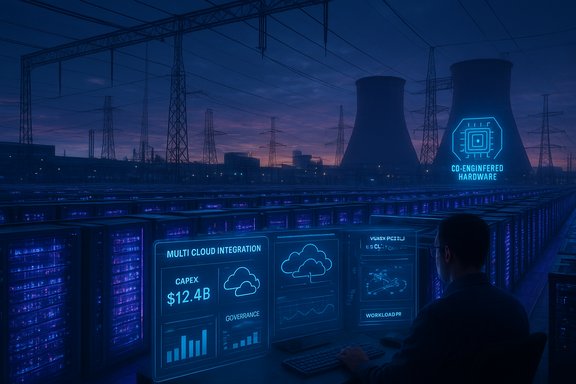
2025 closed as the year the AI race left the labs and reshaped markets, governments and enterprise roadmaps—massive capital plans met with dazzling technical advances, and a handful of corporate bargains and alliances rewired who controls compute, models and customer access in the Age of Generative AI. What started as model improvements and research prototypes in 2022 became an industrial-scale buildout: hyperscalers poured hundreds of billions into data centers, chip vendors rode a historic valuation wave, and strategic deals locked models to clouds and silicon in ways that will define enterprise AI for years to come. The result was an unprecedented mix of economic stimulus, concentration risk, and technical progress that IT leaders and Windows-focused organisations cannot ignore.
Background
The headlines that dominated 2025 are familiar now—but their scale still demands restating. A concentrated group of technology companies spent at-scale on AI infrastructure, driving a surge in capital expenditures that analysts say materially boosted GDP growth for the first half of the year. NVIDIA’s rise to a multi‑trillion‑dollar valuation underscored how central accelerators became to modern compute stacks. At the same time, startups and labs made multiyear commitments to cloud providers that reshape procurement, while established firms issued record volumes of debt to finance massive builds and power-grid upgrades. Those same pressures exposed tight talent markets and fresh governance gaps as models moved into mission‑critical workflows. These dynamics created clear winners, glaring vulnerabilities, and hard operational questions for organisations running Windows in 2026 and beyond.The CapEx Tsunami: How AI Spending Rewired the Economy
The size and shape of the spending wave
2025’s single biggest structural fact was scale: major cloud providers and tech platforms committed hundreds of billions to data centers, networking and power. Estimates vary by firm and methodology, but mainstream coverage and bank reports converge on the same conclusion—hyperscaler capex ballooned into the high hundreds of billions, with Big Tech capital investment cited repeatedly as the dominant driver of private fixed investment growth for the year. That spending materially added to GDP growth in the first half of the year and kept supply chains humming when consumer demand was otherwise muted. Bank and market research placed the largest, near‑term capex figures against a handful of firms—Microsoft, Amazon, Alphabet and Meta—as they raced to provision racks, build substations and secure long‑term energy and real‑estate contracts. Analysts at Bank of America and Barclays flagged that these four alone were responsible for a very large share of the year’s incremental gross investment, measured in the hundreds of billions, and predicted continued elevated spend into 2026. Those same reports noted that much of the spending shows up as construction and procurement rather than immediate revenue, so the macro effects are front‑loaded and capital‑intensive.What that meant for IT and Windows environments
- Shortages and lead times for enterprise‑grade GPUs, high‑bandwidth memory and rack‑scale networking pushed procurement cycles longer and inventories thinner for server, workstation and AI appliance buyers.
- On the Windows client side, OEMs accelerated Copilot‑oriented hardware refreshes; on the datacenter side, customers had to renegotiate pricing and scheduling with cloud vendors as capacity was pre‑booked under long‑term compute contracts.
- For CIOs, the practical implication was simple: expect higher and stickier infrastructure costs for AI workloads, and plan migrations and budget cycles at least 12–24 months earlier than traditional refresh cadences.
The Big Deals: Anthropic, Microsoft and NVIDIA Redraw the Stack
The headlines and the mechanics
Late‑year strategic alliances crystallised a new pattern: model owners locking long‑term compute capacity with cloud and silicon partners in exchange for investment, co‑engineering and distribution commitments. The biggest public example was the multilateral agreement connecting Anthropic, Microsoft and NVIDIA—an arrangement that included a multi‑billion‑dollar compute commitment by Anthropic to Azure and staged investments from both Microsoft and NVIDIA. Public filings and corporate blogs made the central facts clear: Anthropic committed to purchase tens of billions in Azure compute capacity and to reserve initial dedicated capacity at very large scale, while NVIDIA and Microsoft pledged material investment and co‑engineering support. The package signalled that frontier labs and cloud/silicon suppliers are now negotiating package deals that combine capital, capacity and product distribution in a single commercial instrument.Why the deal matters for enterprises and Windows shops
- Model choice inside enterprise clouds became an enterprise procurement lever: the Anthropic‑Azure channel means customers running Microsoft Foundry or Microsoft 365 Copilot can access alternative frontier models without migrating away from Azure, intensifying model‑choice competition inside single clouds.
- Co‑engineering commitments mean that future hardware families (and the software stacks that target them) will feature optimizations tailored to the models those labs run—raising the economic and technical value of interoperability and vendor co‑design expertise.
- For Windows administrators, the near‑term outcome is less exotic and more operational: expect new SKU and instance types in Azure catalogues tuned for Claude variants, plus updated guidance on VM sizing, drivers and GPU firmware to fully benefit from co‑engineered stacks.
NVIDIA: From Chip Vendor to Infrastructure Linchpin
Market cap, momentum and implications
NVIDIA’s 2025 trajectory—culminating in multi‑trillion‑dollar valuations—was both a symptom and engine of 2025’s AI industrialisation. The company’s GPUs and full‑stack systems powered the bulk of large‑model training and increasingly pervasive inference deployments. NVIDIA’s market capitalization milestones (brief intraday touches of $4 trillion and later peaks even higher) reflected investor belief that the firm’s accelerators are the scarce resource of this cycle. That concentration of value carries real systemic effects: chip roadmaps, OEM inventories, and data‑center architectures increasingly orbit NVIDIA design targets, raising bar for any competitor or customer looking to diversify at scale.The practical impact on Windows and enterprise AI
- Server procurement strategies must assume NVIDIA‑centric availability constraints for large‑scale LLM training and many inference workloads.
- Organisations serious about on‑prem or hybrid AI will have to evaluate GPU leasing, managed racks and secondary markets (e.g., specialised cloud providers) to avoid vendor concentration risk.
- Software teams should track NVIDIA’s stack (drivers, CUDA toolchain, RAPIDS, Triton) as first‑class dependencies when porting or certifying models for Windows server environments.
OpenAI’s Spending Spree and the Financial Tension
The numbers—and why they matter
OpenAI’s strategy in 2025 was aggressively growth‑first: the company disclosed expansive multi‑year compute deals and internal forecasts that implied catastrophic capital commitments relative to current revenue. Public reporting and leaked investor materials suggested multi‑year commitments in the hundreds of billions to over a trillion dollars range, and discrete filings and investor decks detailed short‑term guidance that showed massive expected losses as OpenAI scaled capacity ahead of monetisation. Those figures sparked intense debate about whether such commitments are credible at face value or more properly interpreted as contractual caps and optionalities that can be restructured, renegotiated or never fully deployed.Public finance, bailouts and credibility questions
- The scale of OpenAI’s announced commitments prompted analysts and commentators to model worst‑case funding gaps measured in the low‑hundreds of billions if growth stalled—scenarios that raised rhetorical talk of backstops, government involvement, or creative financing through partners.
- OpenAI’s finance leadership briefly provoked controversy when a comment about government “backstops” was interpreted as openness to public support; that remark was walked back and the company emphasised market solutions. Regardless, the episode amplified concerns about who shoulders the tail risk when private labs sign gigantic long‑term capacity deals.
For IT buyers and Windows administrators
- Treat headline compute commitments as commercial signalling rather than guaranteed consumption. Expect contracts to be heavily contingent and to include termination, usage and repricing clauses—so procurement teams must insist on granular usage rights, auditability and exit options.
- Operationally, prefer flexible consumption plans and staged rollouts rather than full‑capacity long‑term reservations unless the vendor can prove sustained ROI on the specific workload.
Capital Markets: Bond Issuance, Debt, and the Funding Loop
How the buildout touched credit markets
2025’s AI buildout was largely financed through familiar levers: equity and debt. Corporations with strong ratings tapped bond markets to lock in funding for data centers and power projects. Financial press coverage documented multiple multi‑decal bond deals—Alphabet, Meta, Oracle and others issued very large offerings that, when aggregated, ran into the tens of billions and helped push corporate credit issuance toward record volumes for the year. That new supply altered spreads and drew the attention of fixed‑income desks that track long maturity paper and balance‑sheet risk.What managers must watch
- More borrowing to fund capex increases leverage exposure in technology balance sheets—even for companies with large cash hoards. Credit investors priced that risk through narrowing or widening spreads, depending on the buyer appetite for long‑duration corporate debt.
- Utilities and grid upgrades—needed to power hundreds of megawatts of GPU clusters—also became a source of long‑dated debt issuance and project finance, meaning IT projects are now entangled with local energy policy and long procurement timelines.
Talent Wars, Hiring Spree and the Cost of Engineers
The year’s labour market war was more than compensation; it was about control of institutional knowledge. Tech giants and labs paid outsized offers—cash, equity and retention packages—to secure teams with model‑engineering experience. The churn reshaped organisational charts and had clear downstream effects: product timelines accelerated for those that won the recruitment battles, while talent scarcity raised risk for smaller firms and traditional enterprise teams. Meta, OpenAI, Microsoft and others were reported to have dangled multimillion and even nine‑figure packages to key engineers and researchers. The effect for enterprises: expect higher labour costs for in‑house ML ops and a tougher vendor selection environment as service providers competed for the same people.The Model Race: Gemini 3, Competitive Momentum and Product Dynamics
Google’s comeback and why model performance matters
Google’s Gemini 3 launch was a watershed for the “model wars.” The release delivered step‑function improvements in multimodal reasoning and latency characteristics that were widely praised across industry observers. The reaction pushed Alphabet’s market value higher and re‑energised confidence that competition at the model level remains alive—where ‘winning’ is now measured by multimodal fluency, tool‑use, and integration into broad productivity suites. Sundar Pichai’s public remarks—joking that teams “need some sleep” after the release—captured how intense, company‑wide the effort had been.Why enterprises should care beyond the headlines
- Model parity reshapes procurement: a single cloud can now offer multiple frontier LLMs, making model selection and governance the new procurement battleground.
- Operational integration matters more than raw benchmark wins: model latency, cost-per-query, and safety/guardrail behaviour are the practical metrics that determine ROI for Windows‑anchored workflows.
Strengths, Weaknesses and Clear Risks
Notable strengths from 2025
- Real capability gains: multimodal models, improved reasoning and agent frameworks matured from demo to production pilot in many enterprises.
- Productivity impact: early Copilot integrations and domain‑specific agents delivered concrete time‑savings across knowledge work, engineering and customer support.
- Industrialisation of AI supply chains: co‑designed hardware/software partnerships improved energy efficiency and lowered TCO in some deployments.
Persistent weaknesses and systemic risks
- Concentration risk: a small set of cloud providers, silicon vendors and model owners now control the lion’s share of frontier compute, raising systemic vendor risk.
- Financial sustainability: headline commitments by labs and the surge in debt issuance create solvency and liquidity scenarios that depend on near‑perfect revenue trajectories.
- Governance gap: agentic systems and multimodal outputs widened the verification gap; enterprises still lack robust, standardised frameworks for explainability, incident handling and auditability at scale.
Practical Guidance for Windows IT Leaders
- Reassess procurement timelines: move capital approvals forward and model budgets conservatively to account for higher unit costs and longer lead times.
- Prioritise hybrid deployments: maintain multicloud or on‑prem fallback paths for mission‑critical workloads to mitigate vendor lock‑in and supply shocks.
- Harden governance: require model cards, dataset provenance statements and transparent incident response SLAs from suppliers.
- Monitor energy costs and resilience: tie AI rollouts to power and UPS plans, and collaborate with facilities teams on staged deployments to avoid overtaxing local grids.
- Embrace staged pilots: validate vendor performance on your data and edge cases before committing large, long‑term capacity reservations.
What to Watch in 2026
- How long the bond market will absorb new issuance tied to AI capex without a material repricing of risk.
- Whether OpenAI and other labs moderate headline commitments and shift to more flexible consumption economics, or whether those numbers prove persistent and enforceable in contracts.
- Competition at the silicon level: if alternative architectures or foundries meaningfully chip away at NVIDIA’s per‑workload efficacy, procurement dynamics will change rapidly.
- Regulatory and energy policy responses: as GPU clusters stress local grids, expect novel permitting, tax incentives and regional cooperation to determine where the next wave of data centers land.
Conclusion
2025 was a decisive year in the AI race: technical advances were real and meaningful, but they arrived wrapped in a complex financial and industrial story. Massive capex helped bolster GDP and created immediate productivity gains, while market concentration, long‑dated compute commitments, and record corporate borrowing introduced new systemic vulnerabilities. For IT leaders, Windows administrators and enterprise decision makers, the takeaway is pragmatic: treat this moment as a long transition from research to industrial deployment. Insist on contractual clarity, design for hybrid resilience, and budget for rising infrastructure and talent costs. The AI race is no longer just a competition between models; it is a competition over who controls compute, networks, power and governance. The winners will be the organisations that balance ambition with operational discipline—and build systems that can safely absorb rapid model change without betting the firm on a single vendor or a single forecast.Source: Business Insider The top 5 things that happened in the AI race this year
