

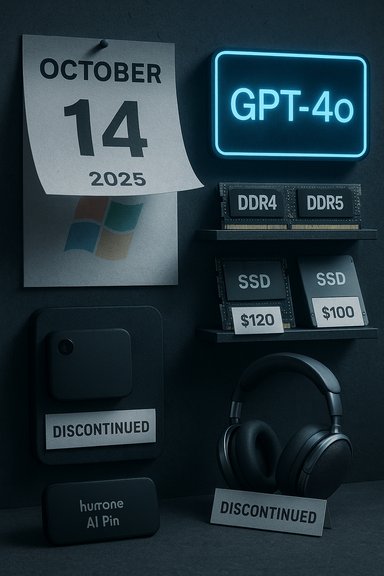
2025 closed the books on a surprising number of products, platforms, and experiments — from the calendar-driven death of an operating system that powered millions of PCs to the quiet collapse of trend-chasing AI gadgets and the wholesale reallocation of hardware supply toward data‑center customers. The list of what “died” this year reads less like a funeral procession and more like a strategic pruning: Microsoft’s Windows 10 reached end-of-support, OpenAI retired GPT‑4 from the ChatGPT front end, legacy consumer hardware and quirky AI wearables were wound down, and vendors tightened control over purchased digital content — all moves that reshaped what users own, what they must replace, and how institutions plan migrations. This feature synthesizes the major closures of 2025, verifies key dates and claims against primary sources, and offers practical, evidence‑based guidance for Windows users, IT pros, and PC builders navigating the fallout.
2025’s retirements fall into four connected themes: scheduled lifecycle endings, strategic consolidation, failed hardware experiments, and supply-side realignments driven by AI demand. Each theme has predictable consequences.
Two enduring tensions will shape the next phase:
Appendix — Key verifications and authoritative dates (selected)
The closures of 2025 were not merely nostalgic footnotes. They represent an industry periodically forced to choose where to invest finite engineering and manufacturing resources. For users, the lesson is operational: expect churn, demand portability and lifecycle transparency, and plan migrations proactively. The tech obituaries of 2025 are a warning and an instruction — design and buy systems that can survive the next set of endings with minimal friction and maximum dignity.
Source: PCMag Connection Lost: The Tech That Died in 2025
 Background / Overview
2025’s retirements fall into four connected themes: scheduled lifecycle endings, strategic consolidation, failed hardware experiments, and supply-side realignments driven by AI demand. Each theme has predictable consequences.- Scheduled lifecycle endings force mass migrations and raise security risk exposure.
- Strategic consolidation shrinks consumer choice while simplifying vendor stacks.
- Hardware experiments that deliver novelty without everyday utility are trimmed quickly.
- Component supply reallocation toward AI infrastructure alters the economics of the consumer PC market.
The tectonic moments
Windows 10: the calendar that forced millions to choose
Microsoft formally ended mainstream support for Windows 10 on October 14, 2025 — a hard lifecycle date with immediate consequences for security, compliance, and device procurement. After that date Microsoft stopped providing routine feature updates and security updates for most editions unless a device was enrolled in the consumer Extended Security Updates (ESU) program. The company’s own lifecycle documentation is explicit about the date and migration options, including Windows 11 and a temporary ESU bridge. Why this mattered in practical terms:- Millions of devices remained functional but unsupported, increasing exposure to unpatched vulnerabilities.
- Windows 11’s hardware gating (TPM 2.0, Secure Boot, UEFI/firmware expectations, and a constrained list of supported CPU families) meant many otherwise serviceable PCs could not take a simple in-place upgrade — turning a software lifecycle into a hardware replacement decision.
- Schools, small businesses, and refurbishers faced tight deadlines and spending pressure, with e‑waste and equity issues surfacing in procurement discussions.
- Inventory and categorize endpoints by business criticality and upgrade feasibility.
- Prioritize high‑value, internet‑facing systems for ESU or hardware refresh.
- Where Windows 11 is not feasible, evaluate ChromeOS Flex or modern Linux as pragmatic stopgaps.
GPT‑4 retired from ChatGPT — model churn at internet scale
OpenAI removed GPT‑4 from ChatGPT’s model picker on April 30, 2025, replacing it with GPT‑4o as the default interactive model in the ChatGPT front end while leaving GPT‑4 accessible via the API for developers needing continuity. OpenAI framed the move as an iterative upgrade: GPT‑4o offered better performance, lower latency, and wider multimodal capabilities. Multiple independent outlets reported the deprecation and the company’s changelog and blog confirm the timing and rationale. Why this matters beyond headline drama:- Model deprecation at web scale imposes real operational cost on businesses that hardcode specific models into products or safety pipelines; migrations require assessment, testing, and often retraining or prompt redesign.
- The incident underscores that AI services can change underfoot more quickly than traditional software lifecycles — expect change and treat model access and portability as part of your operational risk register.
- Treat model selection like any dependency: maintain a compatibility matrix, automated tests against successor models, and contingency fallbacks in case a model’s availability or behavior changes.
- If compliance or reproducibility is critical, keep API access to older model versions (where offered) and pin dependencies instead of relying solely on front‑end defaults.
Micron’s Crucial consumer exit — supply shifts that touch every PC builder
In December, Micron announced that it would withdraw consumer‑facing SSD and DRAM products from retail under the Crucial brand by February 2026 to prioritize high‑bandwidth memory and enterprise customers feeding AI data centers. Reuters and multiple industry outlets corroborated the pivot: memory production and pricing are being recalibrated around AI data‑center demand, which yields higher margins and long‑term contracts. This decision has immediate implications for PC component prices, hobbyist availability, and the dynamics of the retail market. Practical implications:- Expect higher DDR prices and tighter SKU availability for mainstream consumer RAM and SATA/NVMe SSDs.
- Builders should consider stocking strategy adjustments: contract with multiple distributors, consider pre‑ordering, and evaluate switching to vendor-managed procurement for longer runs.
- For procurement teams, incorporate supply risk into TCO for hardware refresh cycles.
The failed experiments and the economics of novelty
Humane AI Pin: how starry promise met market reality
Humane’s star‑shaped AI Pin — a wearable “always‑listening” assistant — flopped in the market and the company sold much of its IP and talent to HP in February 2025. HP acquired Humane’s AI platform, patents, and engineers, and Humane discontinued sales of the device and turned off major online services for existing units at the end of February. The coverage from TechCrunch, The Verge, and Axios documented the asset sale and the device shutdown timeline. This is the archetype of a 2025 trend: consumers already carry superset devices (smartphones and smartwatches), so single‑purpose AI hardware must clear a very high bar to survive. Lessons from Humane:- Novelty without daily utility, or that requires high ongoing cloud costs, is economically fragile.
- Patents and software talent can be more valuable than consumer hardware revenue — and acquirers will frequently buy IP and people rather than sustain unprofitable device lines.
Dyson Zone and other oddities: a year when Bane‑adjacent headphones and other high‑concept ideas folded
Dyson’s Zone — an air‑purifying headphone with a visor — and Meta’s premium Quest Pro headset were among the high‑profile hardware projects that were discontinued or re‑scoped in 2025. These moves reflect a simple market truth: expensive, cumbersome devices that promise narrow use cases rarely achieve mass adoption when phones already cover most daily needs. Meta’s decision to pause or reallocate Quest Pro efforts toward more mainstream headsets was covered across XR media and matches the broader pattern of trimming premium niche hardware to favor scaleable products.The shifting perimeter of digital ownership and cloud control
Amazon removes “Download & Transfer via USB” for Kindle purchases
On February 26, 2025 Amazon removed the “Download & Transfer via USB” option from Manage Your Content & Devices, tightening the ways customers can archive or move purchased Kindle files via a PC and USB. How‑to and tech outlets documented the change and advised readers to download content before the deadline. The change does not affect the ability to read via the Kindle app or Wi‑Fi‑enabled devices, but it does reduce straightforward offline backup options for purchases accessed through retail Kindle workflows. Why this matters:- It’s a concrete example of vendor tightening of portability. For readers who relied on the USB workflow to archive purchases or migrate to a different e‑reader, the path is now harder.
- The change reignited debates about what constitutes a “purchase” in the digital era and how DRM‑protected content limits practical ownership.
- If you value offline copies of purchased content, take immediate action to archive purchases before a vendor removes a specific export channel.
- Document purchase receipts and keep local metadata; check vendor export policies and use vendor‑sanctioned apps for offline access where available.
Streaming stores, loyalty programs, and app consolidations
2025 saw several consumer‑facing services shutter or fold into larger platforms: Zelle retired its standalone app (users were already doing ~98% of transactions inside bank apps); Dropbox shut down its password‑manager offering to focus on core products; PlayStation ended its PlayStation Stars loyalty program; and Microsoft fully retired the consumer-facing Skype app in May 2025, pointing users toward Microsoft Teams Free. These moves illustrate vendor preference for embedding features inside larger, higher‑stickiness platforms rather than sustaining small, low‑usage standalone apps.Regulatory, environmental, and social consequences
E‑waste and equity: planned obsolescence or lifecycle reality?
Windows 10’s end-of-support and Windows 11’s hardware gating amplified concerns about e‑waste and digital equity. Devices that are functionally capable but fail to meet a vendor’s security‑binding hardware requirements are often retired prematurely. Community refurbishers, nonprofits, and reuse programs saw increased demand — and policy advocates renewed calls for point‑of‑sale lifecycle disclosures and minimum support windows. These are not theoretical problems: when a widely deployed OS loses security updates, institutions must choose between paying for ESU, buying new devices, or accepting increased cyber risk.Supply concentration risk: AI demand reshapes component markets
Micron’s pivot away from consumer Crucial products toward AI‑grade memory is a vivid example of how AI infrastructure demand reshuffles supply and pricing. When a key supplier deprioritizes retail SKUs in favor of enterprise/HBM customers, consumer markets feel the squeeze — higher DDR pricing, SSD shortages, and volatility for boutique PC builders. Regulators and procurement teams should expect ongoing market concentration and plan accordingly.What worked — strengths in market discipline
- Rationalization: Vendors that trimmed low‑usage products freed engineering and capital for higher‑priority projects; this reduced scattershot consumer experiments and focused R&D on core platforms.
- Consolidation can improve integration: Folding redundant features into one platform (Teams, bank apps using Zelle natively) simplifies the user journey and reduces attack surfaces from niche third‑party apps.
- Second‑life initiatives gained traction: Nonprofits and refurbishers played a critical role mitigating damage from hardware gating and lifecycle cuts, offering lower‑cost upgrade paths for communities.
What failed — notable risks and blind spots
- Reduced portability: Protective cloud‑first moves (kindle USB removal, archived stream pruning) erode user control over purchased content and backups.
- Rapid model churn: AI model deprecation poses operational risk for organizations using model‑dependent features; OpenAI’s retirement of GPT‑4 from ChatGPT highlights the need for portability and testing.
- Market concentration: Micron’s consumer exit and chip hoarding by AI players can reduce consumer choice and push up component prices, harming small builders and repair economies.
- Fragile migration tooling: Many retirements lacked seamless migration tools, forcing users into manual, sometimes costly, transitions.
Practical checklist: what to do next (consumer & IT playbooks)
For consumers and hobbyists:- Audit devices for OS and firmware support status; if you’re on Windows 10, schedule an upgrade or enroll eligible devices in ESU before October 14, 2025.
- Back up digital purchases and critical files now where vendor export tools remain available (e.g., Kindle USB download before Feb 26, 2025 deadline).
- For PC builds, plan for higher memory and SSD prices; buy sooner rather than later if a price or part is essential.
- Create a migration timeline tied to vendor lifecycle dates (Windows 10 EOL, app retirements).
- Test alternative models and keep API continuity plans if embedding AI services; plan model‑fallbacks and regression tests.
- Reassess procurement: include supply‑risk clauses, diversification of parts suppliers, and lifecycle guarantees where possible.
- Require clearer lifecycle disclosures at point of sale and minimum supported‑service windows for commonly sold hardware.
- Incentivize refurbishment through procurement credits and reuse programs to reduce e‑waste and support digital equity.
Final analysis — what these obituaries tell us about the decade ahead
2025’s roll call of retirements is a practical stress test of where the industry is headed. The companies that pivoted toward scaleable, enterprise‑grade offerings and AI infrastructure removed distractions and thinly‑adopted consumer novelties. That discipline improves margins and focuses engineering resources, but it also concentrates power and reduces user options for portability and ownership.Two enduring tensions will shape the next phase:
- convenience vs. control: Cloud‑first convenience benefits average users but erodes the technical means for offline ownership and migration.
- scale vs. resilience: Centralized AI and cloud concentration create powerful platforms but amplify single points of failure and supply‑chain risk.
Appendix — Key verifications and authoritative dates (selected)
- Windows 10 mainstream support ended October 14, 2025; Microsoft’s lifecycle pages and support notices document migration options and the ESU bridge.
- GPT‑4 was removed from ChatGPT’s model picker on April 30, 2025 and replaced by GPT‑4o as the ChatGPT default, with GPT‑4 remaining available via the API. OpenAI’s product changelog and independent tech reporting corroborate the timeline.
- Humane sold assets and most of its IP to HP and discontinued the AI Pin device services at the end of February 2025; TechCrunch, The Verge, and Axios reported the acquisition and device shutdown timeline.
- Micron announced withdrawal of Crucial consumer product shipments aiming to prioritize AI data‑center customers, with industry coverage detailing expected exits by February 2026 and supply consequences.
- Amazon removed the “Download & Transfer via USB” option for Kindle purchases effective February 26, 2025; multiple independent how‑to and news sites documented the change and the preservation steps for users.
- AOL discontinued its dial‑up service, including the AOL Dialer and Shield browser, effective September 30, 2025; AOL help pages and mainstream reporting confirm the date.
- Microsoft retired the consumer Skype app in May 2025, directing users to Microsoft Teams Free and offering migration/export windows; Microsoft’s support pages document the timeline and data‑export deadlines.
The closures of 2025 were not merely nostalgic footnotes. They represent an industry periodically forced to choose where to invest finite engineering and manufacturing resources. For users, the lesson is operational: expect churn, demand portability and lifecycle transparency, and plan migrations proactively. The tech obituaries of 2025 are a warning and an instruction — design and buy systems that can survive the next set of endings with minimal friction and maximum dignity.
Source: PCMag Connection Lost: The Tech That Died in 2025
