Rahul Jain’s profile as an engineering leader at Cognizant reads like a blueprint for modern enterprise modernization: a pragmatic emphasis on resilient data platforms, a commitment to explainable AI, and a push toward AI-driven automation that promises measurable cost, performance, and risk improvements. The International Business Times profile presents a coherent narrative of a 16‑year engineering career spanning PostgreSQL, Oracle Exadata, Cassandra, Redis, and multi‑cloud operations — and credits him with high‑impact programs such as a large Exadata modernization that delivered steep operational improvements and an AI‑driven autonomous migration platform that dramatically shortened migration timelines. These claims and the article’s framing set the stage for understanding how engineering leadership, platform design, and explainable AI converge to shape scalable, AI‑ready enterprise architectures.
Enterprise IT leaders are under relentless pressure to scale analytics, reduce downtime, and modernize legacy systems without disrupting core operations. The imperative is practical modernization — not chase technology fads, but produce measurable ROI, reduce operational risk, and enable AI/ML workflows that are auditable and governed. The profile positions Rahul Jain as an exemplar of that approach: a systems‑engineering mindset that pairs database platform expertise with cloud automation and explainability work for AI governance. The article emphasizes three recurring enterprise priorities that are central to modern architecture:
However, the strongest numeric claims in the profile are proprietary and — based on public search — not independently verifiable in full. For procurement teams and technical leaders, the article should be read as a thoughtful exemplar rather than a one‑size‑fits‑all blueprint. The real value of the piece is in the approach it champions: engineering rigor, measurement, cross‑functional collaboration, and responsible AI. When combined with careful due diligence (telemetry, pilot workloads, and documented explainability artifacts), the ideas in the profile can be operationalized into repeatable programs that reduce risk and deliver measurable ROI.
Source: International Business Times, Singapore Edition Engineering the Modern Enterprise: How Rahul Jain Is Shaping Scalable Data and Cloud Transformation
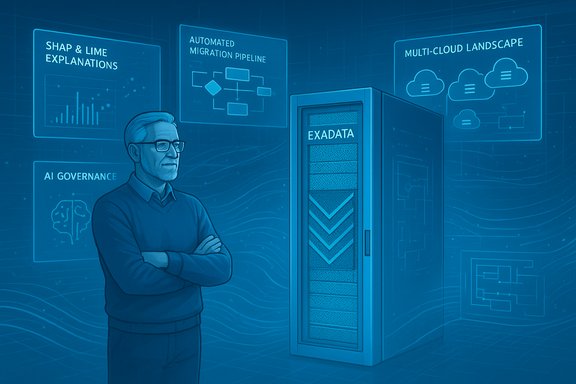 Background: why the story matters for enterprise IT
Enterprise IT leaders are under relentless pressure to scale analytics, reduce downtime, and modernize legacy systems without disrupting core operations. The imperative is practical modernization — not chase technology fads, but produce measurable ROI, reduce operational risk, and enable AI/ML workflows that are auditable and governed. The profile positions Rahul Jain as an exemplar of that approach: a systems‑engineering mindset that pairs database platform expertise with cloud automation and explainability work for AI governance. The article emphasizes three recurring enterprise priorities that are central to modern architecture:- Database modernization and performance optimization for high‑throughput OLTP and analytics workloads.
- AI governance and explainability to meet regulatory and audit requirements while deriving value from models.
- Automated migration and cloud transformation to reduce risk, time, and cost during large platform moves.
Overview of the IBTimes profile (what it claims)
The centerpiece claims in the profile can be summarized as follows:- Rahul Jain is presented as an Associate Director of Projects at Cognizant with ~16 years of experience across PostgreSQL, Oracle, MySQL, Cassandra, Redis, Hazelcast, and major cloud providers.
- He led a flagship Exadata Strategic Engagement that reportedly delivered:
- ~30% reduction in operational costs,
- ~60% reduction in critical incidents,
- ~50% improvement in mean time to resolution (MTTR).
The program emphasized automation, proactive monitoring, and standardized procedures. - An enhanced database performance framework reportedly cut query latency by ~60%, doubled throughput without added hardware, and automated ~70% of routine tuning activities.
- He is said to be building an AI‑driven autonomous database migration platform that claims:
- ~80% reduction in migration timelines,
- near‑zero downtime for critical transitions,
- ~$2 million in annual savings via resource optimization,
- support for 230–250 enterprise users with improved reliability and compliance.
- The profile highlights his academic interest in explainable AI (SHAP, LIME) and practical frameworks for interpretability in heavily regulated sectors.
Technical context: Exadata, explainable AI, and the migration problem
To evaluate the profile credibly, it helps to ground the discussion in the underlying technologies and industry realities.Exadata and engineered database platforms
Oracle Exadata is a purpose‑built, scale‑out database platform that offloads SQL processing into intelligent storage servers and uses RDMA‑enabled fabric for low latency and high throughput. Exadata marketing and documentation emphasize:- Very low read latencies (microsecond‑range optimizations),
- Smart Scan and AI Vector Search offloads that boost analytic throughput,
- Automation and managed options for hybrid and cloud deployments to reduce DBA operational burden.
Explainable AI (SHAP, LIME) — practical tools, real caveats
SHAP (SHapley Additive exPlanations) and LIME (Local Interpretable Model‑Agnostic Explanations) are widely used techniques to make individual predictions interpretable. SHAP unifies several additive attribution methods using Shapley value theory; LIME fits local interpretable surrogates around a prediction to explain model behavior. Both are foundational in responsible AI toolkits used in finance, healthcare, and telecom to support trust and auditability. Real‑world deployments require careful engineering:- Explainers can be unstable under some data perturbations and may produce misleading local explanations if not properly validated.
- Operationalizing explainability at scale demands tooling for batching explanations, versioning models/explainers, and embedding explanation artifacts into compliance workflows.
Migration remains one of the hardest enterprise projects
Even with modern tooling, database and application migrations notoriously encounter scope creep, hidden compatibility issues, performance regressions, and organizational friction. AI‑assisted automation promises to reduce time and human error, but the devil is in the data: schema idiosyncrasies, legacy integrations, and behavioral differences under production load are common sources of surprise. The profile’s claim of an “autonomous migration platform” that cuts timelines by ~80% is plausible as an outcome in specific, well‑scoped engagements, but whether such results generalize broadly depends on platform scope, workload diversity, and the nature of legacy artifacts.What the profile gets right — tangible strengths and realistic practices
The IBTimes profile emphasizes several engineering practices that are widely accepted as effective when executed well:- Measure‑driven modernization: Framing modernization goals in terms of MTTR, incident rates, latency, throughput, and cost reductions aligns architecture work with business KPIs. This measurement orientation is essential for executing modernization without becoming mired in technical vanity projects.
- Automation first: Automating routine DBA tasks, deployment, and performance tuning can yield outsized benefits in operational overhead reduction. The profile’s note that automating routine tuning freed DBAs for strategic work matches industry experience: tool‑driven automation scales repeatable best practices.
- Platform specialization: Choosing engineered platforms (e.g., Exadata) for workloads that demand consistent latency and high throughput is a defensible enterprise choice — particularly when paired with cloud‑native consumption models and managed services to reduce ops burden. Oracle’s Exadata documentation highlights those same tradeoffs: performance and consolidation at the cost of committing to a specific ecosystem.
- Explainable AI for governance: The profile’s emphasis on SHAP and LIME for interpretability is technically sound. These methods are commonly used for model‑level and instance‑level explanations in regulated workflows. The academic literature supports both methods’ relevance while also documenting limitations that must be managed.
- Multi‑cloud and infra automation skills: The combination of Terraform, Kubernetes (EKS), Helm, and containerization is now table stakes for reproducible, multi‑cloud, AI‑ready architectures. This skill set enables hybrid architectures that balance legacy stability with cloud agility.
Where the article’s claims need careful scrutiny (and why)
Journalistic profiles and vendor case studies often distill complex programs into headline ROI numbers. Those numbers are useful but require context. The article’s most impactful quantitative claims — the Exadata engagement percentages and the autonomous migration platform’s 80% timeline reduction and $2 million annual savings — are presented without granular evidence or independent validation. Two practical caveats:- Outcome variability: Migration and optimization results are highly sensitive to baseline conditions: the degree of legacy technical debt, the number of integrations, bespoke stored procedures, custom middleware, and business‑critical availability constraints. A 60% reduction in critical incidents is impressive — and possible — but it hinges on what counted as a “critical incident,” the baseline incident taxonomy, and the monitoring fidelity used to detect incidents.
- Attribution and scope: Cost and time savings in multifaceted transformation programs often result from a blend of automation, process changes, testing discipline, and temporary risk acceptance (e.g., selective scope reduction). Verifying claims requires access to the engagement scope, instrumentation data, and post‑migration audits.
Practical lessons for CIOs, platform owners, and architects
The profile offers concrete, transferable engineering lessons even if individual numeric claims remain proprietary:- Design for observability and early‑warning: The single largest lever to reduce incident counts and MTTR is high‑fidelity observability (instrumented metrics, traces, anomaly detection) tied to runbooks and automated remediation. Investing in synthetic transactions, SLA‑driven alerting, and automated rollback paths yields outsized operational benefits.
- Automate guardrails, not just tasks: Automation must include safety checks — schema validation, data‑consistency verification, performance baselining, and staged cutovers — to make “autonomous” migration safe for business‑critical systems.
- Embed explainability into model lifecycles: Use explanation artifacts (SHAP value snapshots, surrogate model outputs, and counterfactual checks) as part of the model registry and audit trail. These artifacts should be versioned, signed, and stored with the model for compliance reviews. The SHAP and LIME literature is clear on both utility and the need for evaluation of explainer stability.
- Adopt hybrid platform architecture: Balance engineered platforms (where performance is paramount) with cloud‑native services for agility. Exadata and similar platforms offer measurable performance benefits for certain workloads, but architects should quantify the tradeoffs of vendor lock‑in and operational model before wholesale adoption.
- Run migration pilots with measurable KPIs: A staging approach that defines success criteria (throughput, error rates, failover time, compliance tests) prevents scope creep and enables objective measurement of claimed improvements.
Risk register: what to watch for when adopting similar programs
Every modernization project carries predictable risks; the profile indirectly underscores several to monitor:- Over‑automation risk: Automated tuning and migration steps may amplify subtle misconfigurations if escape hatches or human review stages are insufficient. Design automation with guardrails and human‑in‑the‑loop checks for production cutovers.
- Explainability misuse: Relying on off‑the‑shelf explainers without testing for dataset shifts or explainer instability can create a false sense of auditability. Validate explainers periodically and include robustness metrics in governance dashboards.
- Vendor/platform lock‑in: Consolidating on Exadata‑class platforms delivers performance but increases dependence on a single vendor’s operational model. Multi‑cloud strategies should include portability and escape‑path plans.
- Data governance gaps: Migrations and model deployments must preserve data lineage, PII handling, and regulatory controls. Automated migrations that skip deep lineage checks risk compliance breaches.
- Identity ambiguity in public narratives: When profiles use personal names and large ROI numbers, buyers should request detailed case studies, audit artifacts, and references. Public web searches show multiple professionals with the same name; therefore, validating the identity and scope of responsibility for any named individual is a sound procurement practice.
How to evaluate similar modernization offers — a shortlist of due‑diligence steps
- Ask for detailed pre‑ and post‑migration telemetry dashboards showing the exact KPIs used and the time windows for measurement.
- Request a technical appendix describing migration automation logic (schema mapping rules, cutover orchestration, rollback criteria).
- Obtain a reproducible pilot: a representative application slice that demonstrates claimable latency/throughput improvements under load.
- Require explainability artifacts for any production AI model (explanation snapshots, explainer evaluation metrics, and drift detection triggers).
- Confirm legal and compliance checks: data residency, encryption, key management, and audit trails.
Final analysis: why the profile matters and how to use it
The International Business Times profile presents a useful case study to illustrate how a modern engineering leader can combine platform mastery, automation, and responsible AI to drive enterprise outcomes. It captures a pragmatic playbook: pick the right platforms for performance, automate routine tasks to free skilled operators, and embed explainability and governance into AI adoption. Those are precisely the capabilities enterprises need to make data modernization stick.However, the strongest numeric claims in the profile are proprietary and — based on public search — not independently verifiable in full. For procurement teams and technical leaders, the article should be read as a thoughtful exemplar rather than a one‑size‑fits‑all blueprint. The real value of the piece is in the approach it champions: engineering rigor, measurement, cross‑functional collaboration, and responsible AI. When combined with careful due diligence (telemetry, pilot workloads, and documented explainability artifacts), the ideas in the profile can be operationalized into repeatable programs that reduce risk and deliver measurable ROI.
Conclusion: modern engineering is about measurable trust, not mystique
Modern enterprise transformation succeeds when engineering teams translate technical capability into measurable business value while preserving trust and governance. The profile of Rahul Jain captures that ethos: platform engineering married to automation and explainability. Readers should take away three clear imperatives:- Prioritize measurable KPIs and observability when modernizing databases and cloud architectures.
- Treat explainable AI as operational infrastructure — instrumented, versioned, and audited — not a one‑off compliance checkbox.
- Demand reproducible evidence for headline ROI claims and validate them via pilots, telemetry, and independent audits.
Source: International Business Times, Singapore Edition Engineering the Modern Enterprise: How Rahul Jain Is Shaping Scalable Data and Cloud Transformation