

Microsoft, ByteDance, Alibaba, AWS, OpenAI, Anthropic, and Ford are all expanding or rebuilding human-heavy AI deployment teams in 2026, even as the broader industry continues to sell artificial intelligence as a labor-saving technology. The pattern, first assembled this week by 36Kr and echoed in reporting from Bloomberg, TechCrunch, and other outlets, is not a contradiction so much as a correction. AI is not eliminating the hardest parts of enterprise work; it is exposing how much of that work was never captured in software requirements, data schemas, or slide-deck ROI models. The new AI labor market is not just looking for model builders. It is hunting for people who can make models survive contact with reality.
The public version of the AI jobs debate is still stuck on a crude binary: either the machines replace people, or the skeptics were right and the machines disappoint. The corporate version is messier. Companies are trying to automate work while simultaneously hiring expensive humans to translate, supervise, repair, and operationalize that automation.
That is why the same news cycle can contain Microsoft layoff rumors, Microsoft AI hiring, Ford automation failures, and Chinese cloud vendors advertising high salaries for frontline deployment engineers. These stories look inconsistent only if AI is imagined as a shrink-wrapped replacement for labor. In practice, the enterprise AI market is starting to look less like software licensing and more like systems integration with a neural-network accent.
The important shift is not that AI creates jobs in the abstract. Every platform transition creates jobs somewhere. The sharper point is that the jobs being created are close to the customer, close to the factory floor, close to legacy systems, and close to the ugly details vendors once hoped could be hidden behind an API.
That should make WindowsForum readers pay attention. The same pattern already shaped Windows administration, cloud migration, endpoint security, and ERP rollouts. The product is the easy part to buy. The deployment is where the budget goes to die.
Microsoft’s own public messaging this year has leaned into the “frontier” language. In March, Judson Althoff used Microsoft’s official blog to introduce a “Frontier Suite” built around “intelligence and trust,” including broader model choice inside Copilot. The same post emphasized that Claude would be available in Copilot through the Frontier program alongside OpenAI models, which matters because Microsoft’s enterprise AI pitch is no longer simply “buy Copilot and inherit the OpenAI future.”
36Kr goes further, reporting that Althoff has acknowledged Microsoft erred by tying Copilot development too tightly to OpenAI three years ago. Whether one treats that line as an exact admission or a paraphrase of Microsoft’s changing posture, the strategic movement is visible. Microsoft is trying to sell customers not just a chatbot, not just a license, and not just access to a large model, but a managed path through an increasingly fragmented model market.
That is a profound change for a company whose modern enterprise machine was built on repeatable licenses. Windows, Office, Microsoft 365, Azure consumption, and E5 security bundles all share a common dream: build once, sell many times, let partners and customers handle most of the local mess. AI is pushing Microsoft toward a more labor-intensive model because the local mess is not peripheral. It is the product.
The uncomfortable lesson is that enterprise customers have not been able to turn AI licenses into productivity as smoothly as vendors implied. A CIO can approve Copilot seats. A department head can run a pilot. But useful AI inside a real company requires permissions, clean data, workflow redesign, auditability, employee training, prompt governance, integration with legacy systems, and some politically dangerous decisions about who is allowed to automate whose work.
That is not a software install. That is organizational surgery.
What is new is that Microsoft, ByteDance, Alibaba, AWS, OpenAI, and Anthropic appear to be moving toward similar patterns. 36Kr reports that ByteDance is offering monthly salaries of 35,000 to 70,000 yuan for frontline deployment engineers, with 15 months of pay per year, putting maximum annual compensation above 1 million yuan. It also reports that Alibaba Cloud Intelligence is advertising 20,000 to 50,000 yuan per month with 16 months of pay.
Those numbers should not be read merely as salary trivia. They are market signals. Vendors are discovering that the scarce resource is not always another model researcher, another benchmark run, or another API endpoint. The scarce resource is a person who can sit with a manufacturing manager, finance controller, hospital administrator, or procurement lead and translate “we want AI” into a workflow that does not collapse under compliance, data quality, or human resistance.
That translation role is technical, but it is not only technical. It requires enough engineering judgment to understand systems architecture, enough business fluency to detect fake use cases, enough product sense to avoid overbuilding, and enough political awareness to know when a customer’s stated requirement is not the real requirement. The work sounds glamorous only until one remembers that it happens in conference rooms, test tenants, broken data pipelines, and integration meetings that never end.
This is where the AI jobs debate becomes more interesting than the AI jobs slogan. The new high-value roles are not simply “AI engineers” in the model-training sense. They are deployment engineers, solutions architects, AI transformation leads, data-quality fixers, workflow redesigners, and domain experts who know why a process exists even when the documentation says nothing useful.
The frontier is not the model. The frontier is the customer’s building.
Charles Poon, Ford’s vice president of vehicle hardware engineering, put the issue plainly in comments reported by Bloomberg and repeated by several outlets: Ford mistakenly believed that introducing AI and feeding it design requirements would produce a high-quality product. He also stressed that AI is only as good as the information used to train it. That sounds obvious, but it is the kind of obvious that becomes expensive only after an organization has acted as though it were false.
Ford did not abandon AI. That is important. The company’s response was not to throw away automation but to bring back the people who knew what the systems did not know. Veteran engineers were needed to identify failure patterns, train younger staff, improve the automated tools, and restore judgment that had not been fully encoded into Ford’s processes.
This is the real lesson. AI did not fail because it lacked magic. It failed because the company overestimated how much of its engineering knowledge existed in machine-readable form. The missing information was not always in a database, a design rule, or a quality checklist. Some of it lived in the minds of people who had seen enough production cycles to know when a technically valid design would become a warranty headache.
Manufacturing is full of that kind of knowledge. A veteran engineer may know that a particular joint needs extra attention because a past model failed in a specific climate. A supplier specialist may remember that a tolerance looks safe in CAD but causes trouble when a part is produced at scale. A quality inspector may hear a noise or see a fitment issue that does not fit neatly into a labeled training set.
None of this makes AI useless. It makes AI incomplete. The tool can accelerate detection, comparison, simulation, and testing, but it cannot conjure missing institutional memory from a blank space in the data.
Most organizations do not have one clean body of knowledge. They have SharePoint sites no one trusts, file shares with ancient naming conventions, ERP customizations maintained by two people, Teams chats that contain the real decisions, PDFs exported from systems that no longer exist, and tribal knowledge held by employees who are one reorg away from disappearing. The company is not in the database. The database is a partial fossil record of the company.
That is why the human “last mile” keeps reappearing. A model can summarize a policy, but someone has to know whether the policy is current. A coding assistant can generate a patch, but someone has to know that the legacy service breaks if a field name changes. A factory AI can flag anomalies, but someone has to know which anomalies matter and which ones are normal scars from production reality.
The vendors know this, even if their marketing departments prefer not to dwell on it. Microsoft’s move toward embedded deployment teams is a concession that AI value often depends on work outside the model. Ford’s rehiring of experienced engineers is a concession that automation without institutional memory becomes brittle. ByteDance and Alibaba’s salary signals suggest the Chinese market is reaching the same conclusion.
The broader industry has spent two years asking whether AI can reason. Enterprise customers are asking a different question: can AI understand our mess? So far, the answer is: not without people.
For a large enterprise, the true cost of AI includes data cleanup, access control, compliance review, workflow redesign, user training, support, integration, model evaluation, security testing, and governance. It includes the meetings required to decide which processes should change and the cultural resistance that appears when employees suspect “productivity” means headcount reduction. It includes the risk of an enthusiastic pilot producing a demo that cannot be safely deployed.
That is why vendors are creating deployment organizations. If customers cannot reach value, they will not renew. If they cannot show measurable returns, AI spending becomes another innovation-budget bonfire. If they cannot trust outputs, they will restrict usage or force employees into lower-cost, narrower tools.
36Kr argues that some companies are already controlling use of flagship models because computing cost is only one part of the equation. The more durable point is that model access alone is not enough. A cheaper model may reduce the cloud bill, but it does not eliminate the human work required to make the system useful, safe, and accountable.
This is particularly familiar in the Microsoft ecosystem. Buying Microsoft 365 E5 does not automatically produce a mature security program. Deploying Intune does not automatically produce endpoint hygiene. Turning on Defender, Purview, or Entra features does not automatically create governance. The license grants capability; the organization must still do the work.
AI is following the same path, only faster and with more hype. The difference is that vendors sold AI as a shortcut around work that now appears unavoidable. That makes the backlash sharper.
This role is not merely “prompt engineering,” a phrase that already feels like a relic from the first wave of generative AI enthusiasm. Prompting matters, but enterprise deployment is more durable because it touches architecture, operations, security, and accountability. A good deployment engineer must know whether the model has the right context, whether the data source is authoritative, whether the output can be audited, and whether the workflow still has a human checkpoint where one is legally or operationally required.
That is why these jobs command serious salaries. They sit at the intersection of scarcity and liability. A bad consumer chatbot answer is embarrassing. A bad enterprise AI workflow can create compliance exposure, production defects, financial misstatements, medical risk, or customer harm.
The highest-value workers in this layer are not the ones who worship the tools. They are the ones who know when to say no. They can distinguish between a flashy demo and a deployable system. They can tell a customer that the data is not ready, that the process is too ambiguous, or that the ROI case is imaginary.
In a healthier market, that skepticism becomes valuable. In a hype market, it gets ignored until the pilot fails.
That means AI readiness is increasingly Windows estate readiness by another name. If identity is messy, permissions are overbroad, data classification is weak, endpoints are unmanaged, and old file shares remain the source of truth, Copilot-style systems inherit those problems. Worse, they may make them easier to query.
This is why “just turn it on” is such dangerous advice. A generative AI assistant connected to enterprise data can reveal sensitive information not because it hacks anything, but because the organization’s permissions already allowed access. It can accelerate bad processes as easily as good ones. It can make obsolete documents feel current and unofficial workarounds feel authoritative.
The deployment engineer’s work therefore overlaps with classic IT hygiene. Before an organization can safely ask AI to reason across its knowledge, it must decide what its knowledge is, who owns it, who can access it, and how stale information gets retired. That is not a model problem. That is an administration problem.
The irony is that AI may increase the value of unglamorous IT work. Directory cleanup, retention policies, data labeling, endpoint management, change control, and documentation have never made for exciting keynote demos. But they are exactly the foundations that determine whether enterprise AI is useful or reckless.
This does not mean every veteran employee becomes untouchable or every legacy process deserves preservation. Some tribal knowledge is just accumulated workaround debt. Some “we’ve always done it this way” arguments are excuses for stagnation. But companies need experienced humans to distinguish between wisdom and residue.
AI can help with that distinction if it is used as an investigative tool rather than an oracle. It can compare procedures, surface inconsistencies, summarize incident histories, and help map dependencies. But people still have to validate the map. They must know which bridge is safe to cross and which one only exists because the diagram was never updated.
The best deployment teams will therefore behave less like software installers and more like anthropologists with admin rights. They will study how work actually happens, not how the process document says it happens. They will ask why employees avoid a system, why data is duplicated, why approvals happen in chat, and why the official workflow is bypassed at quarter-end.
That kind of work is slow, local, and deeply human. It is also where AI projects either become valuable or become another abandoned pilot.
That is why the deployment labor boom matters. Vendors are implicitly admitting that customers need help converting demos into operating results. If AI were already a self-service productivity revolution, Microsoft would not need thousands of people embedded with customers, and vendors would not be bidding up salaries for deployment roles.
The phrase “AI transformation” now risks becoming the new “digital transformation”: broad enough to sell almost anything, vague enough to hide failure, and expensive enough to create a consulting economy. The difference is that AI systems can produce plausible outputs even when the underlying business process is rotten. That makes failure harder to detect early.
A conventional failed software rollout is often visibly broken. Users cannot log in, data does not sync, reports are wrong, workflows stall. A failed AI rollout may look successful in a demo while quietly producing low-trust outputs no one uses for real decisions. That is worse, because it allows organizations to declare progress while employees route around the tool.
The deployment engineer is partly there to prevent that theater. The job is to force specificity. Which workflow changes? Which decision gets faster? Which error rate drops? Which support queue shrinks? Which compliance control remains intact? Without those answers, enterprise AI is just expensive autocomplete wearing a business case.
But the Microsoft-ByteDance-Ford pattern suggests the labor market is not simply collapsing into machine substitution. It is reorganizing around supervision, integration, judgment, and domain translation. The humans closest to repeatable execution may be under pressure; the humans who understand systems, exceptions, constraints, and consequences may become more valuable.
That creates a skills problem. If junior employees lose the low-level tasks through which expertise is traditionally built, where do the next veteran engineers come from? Ford can rehire “gray beard” engineers today because decades of product cycles produced them. A company that automates away the apprenticeship layer may discover later that it has no one left who knows what good looks like.
This is one of the least discussed risks of AI adoption. Institutional knowledge is not a static asset that can be uploaded once. It is regenerated through practice, failure, mentoring, and repetition. Remove too much of that human learning loop, and the organization becomes dependent on yesterday’s expertise without producing tomorrow’s.
The smartest companies will use AI to compress drudgery without eliminating apprenticeship. The dumbest will treat experienced workers as temporary scaffolding until the model is “trained,” then repeat Ford’s mistake in another form.
This is where many ROI claims become suspect. If a vendor says a tool saves 20 percent of employee time but the organization needs months of consulting, integration, governance, and process redesign to achieve that saving, the payback period changes. If employees do not trust the output, the theoretical efficiency never materializes. If the model requires constant expert supervision, the automation case must include the supervisor.
Microsoft’s reported $2.5 billion deployment bet is a market-level admission of this reality. ByteDance and Alibaba’s high salaries for FDE-style roles show that the same logic is not confined to Redmond. Ford’s engineering reversal shows what happens when a company underprices the human knowledge embedded in its own operations.
For buyers, the lesson is not to avoid AI. It is to demand a more honest cost model. Ask what data must be cleaned, what systems must be connected, what policies must change, what users must be trained, and who owns the output when the model is wrong. Ask whether the vendor is selling a capability or a result.
For vendors, the lesson is harsher. If the product requires an army of deployment specialists to become useful, then the product is not as productized as the pitch implies. That may still be a good business. But it is a different business from frictionless SaaS.
Those moves tell a clearer story than the slogans. AI is powerful, but it is not self-executing. It can generate, classify, summarize, detect, and recommend, but it still needs humans to frame the problem, validate the result, and absorb responsibility when the output meets the real world.
The companies that understand this will treat AI as a capability layered into human systems. The companies that misunderstand it will treat AI as a substitute for the human systems themselves. The first group may get productivity. The second group will get pilots, rework, and expensive lessons in tacit knowledge.
The industry’s favorite phrase has been “human in the loop.” The emerging reality is bigger than that. Humans are not merely in the loop as a safety switch. They are building the loop, explaining the loop, debugging the loop, and deciding whether the loop should exist at all.
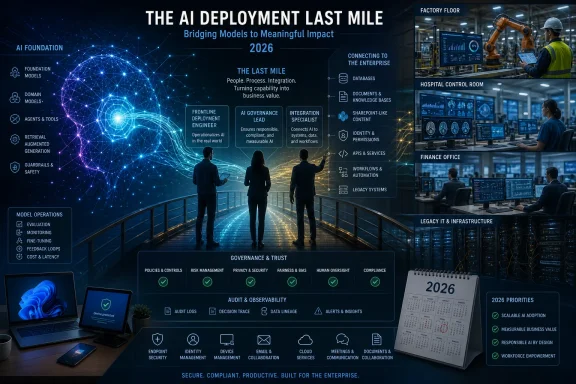 The AI Labor Story Has Split in Two
The public version of the AI jobs debate is still stuck on a crude binary: either the machines replace people, or the skeptics were right and the machines disappoint. The corporate version is messier. Companies are trying to automate work while simultaneously hiring expensive humans to translate, supervise, repair, and operationalize that automation.That is why the same news cycle can contain Microsoft layoff rumors, Microsoft AI hiring, Ford automation failures, and Chinese cloud vendors advertising high salaries for frontline deployment engineers. These stories look inconsistent only if AI is imagined as a shrink-wrapped replacement for labor. In practice, the enterprise AI market is starting to look less like software licensing and more like systems integration with a neural-network accent.
The important shift is not that AI creates jobs in the abstract. Every platform transition creates jobs somewhere. The sharper point is that the jobs being created are close to the customer, close to the factory floor, close to legacy systems, and close to the ugly details vendors once hoped could be hidden behind an API.
That should make WindowsForum readers pay attention. The same pattern already shaped Windows administration, cloud migration, endpoint security, and ERP rollouts. The product is the easy part to buy. The deployment is where the budget goes to die.
Microsoft Rediscovers the Human Installer
According to 36Kr, Microsoft is putting roughly 6,000 engineers, technical consultants, and sales specialists into a new “Frontier Company” effort backed by a reported $2.5 billion investment. The article says the team is being deployed to enterprise customers including Unilever and Novo Nordisk, with a mission that sounds less like classic software sales and more like embedded transformation consulting.Microsoft’s own public messaging this year has leaned into the “frontier” language. In March, Judson Althoff used Microsoft’s official blog to introduce a “Frontier Suite” built around “intelligence and trust,” including broader model choice inside Copilot. The same post emphasized that Claude would be available in Copilot through the Frontier program alongside OpenAI models, which matters because Microsoft’s enterprise AI pitch is no longer simply “buy Copilot and inherit the OpenAI future.”
36Kr goes further, reporting that Althoff has acknowledged Microsoft erred by tying Copilot development too tightly to OpenAI three years ago. Whether one treats that line as an exact admission or a paraphrase of Microsoft’s changing posture, the strategic movement is visible. Microsoft is trying to sell customers not just a chatbot, not just a license, and not just access to a large model, but a managed path through an increasingly fragmented model market.
That is a profound change for a company whose modern enterprise machine was built on repeatable licenses. Windows, Office, Microsoft 365, Azure consumption, and E5 security bundles all share a common dream: build once, sell many times, let partners and customers handle most of the local mess. AI is pushing Microsoft toward a more labor-intensive model because the local mess is not peripheral. It is the product.
The uncomfortable lesson is that enterprise customers have not been able to turn AI licenses into productivity as smoothly as vendors implied. A CIO can approve Copilot seats. A department head can run a pilot. But useful AI inside a real company requires permissions, clean data, workflow redesign, auditability, employee training, prompt governance, integration with legacy systems, and some politically dangerous decisions about who is allowed to automate whose work.
That is not a software install. That is organizational surgery.
The Palantir Model Moves From Edge Case to Center Stage
The phrase forward-deployed engineer has long been associated with Palantir, which embedded technical staff inside customer environments before the current generative AI boom made the model fashionable. Palantir’s customers often had messy data, sensitive missions, and requirements that could not be reduced to a clean SaaS onboarding wizard. In other words, Palantir built a business around the fact that the hard part of software is often not software.What is new is that Microsoft, ByteDance, Alibaba, AWS, OpenAI, and Anthropic appear to be moving toward similar patterns. 36Kr reports that ByteDance is offering monthly salaries of 35,000 to 70,000 yuan for frontline deployment engineers, with 15 months of pay per year, putting maximum annual compensation above 1 million yuan. It also reports that Alibaba Cloud Intelligence is advertising 20,000 to 50,000 yuan per month with 16 months of pay.
Those numbers should not be read merely as salary trivia. They are market signals. Vendors are discovering that the scarce resource is not always another model researcher, another benchmark run, or another API endpoint. The scarce resource is a person who can sit with a manufacturing manager, finance controller, hospital administrator, or procurement lead and translate “we want AI” into a workflow that does not collapse under compliance, data quality, or human resistance.
That translation role is technical, but it is not only technical. It requires enough engineering judgment to understand systems architecture, enough business fluency to detect fake use cases, enough product sense to avoid overbuilding, and enough political awareness to know when a customer’s stated requirement is not the real requirement. The work sounds glamorous only until one remembers that it happens in conference rooms, test tenants, broken data pipelines, and integration meetings that never end.
This is where the AI jobs debate becomes more interesting than the AI jobs slogan. The new high-value roles are not simply “AI engineers” in the model-training sense. They are deployment engineers, solutions architects, AI transformation leads, data-quality fixers, workflow redesigners, and domain experts who know why a process exists even when the documentation says nothing useful.
The frontier is not the model. The frontier is the customer’s building.
Ford Shows What Happens When Tacit Knowledge Leaves the Room
Ford’s recent reversal is the more visceral story because it gives the abstract labor argument a physical form. According to Bloomberg reporting summarized by TechCrunch, Computerworld, Fortune, and others, Ford has hired, promoted, or brought back roughly 350 experienced engineers after automated systems and AI tools failed to deliver the desired quality improvements. Some were former Ford employees; others came from suppliers.Charles Poon, Ford’s vice president of vehicle hardware engineering, put the issue plainly in comments reported by Bloomberg and repeated by several outlets: Ford mistakenly believed that introducing AI and feeding it design requirements would produce a high-quality product. He also stressed that AI is only as good as the information used to train it. That sounds obvious, but it is the kind of obvious that becomes expensive only after an organization has acted as though it were false.
Ford did not abandon AI. That is important. The company’s response was not to throw away automation but to bring back the people who knew what the systems did not know. Veteran engineers were needed to identify failure patterns, train younger staff, improve the automated tools, and restore judgment that had not been fully encoded into Ford’s processes.
This is the real lesson. AI did not fail because it lacked magic. It failed because the company overestimated how much of its engineering knowledge existed in machine-readable form. The missing information was not always in a database, a design rule, or a quality checklist. Some of it lived in the minds of people who had seen enough production cycles to know when a technically valid design would become a warranty headache.
Manufacturing is full of that kind of knowledge. A veteran engineer may know that a particular joint needs extra attention because a past model failed in a specific climate. A supplier specialist may remember that a tolerance looks safe in CAD but causes trouble when a part is produced at scale. A quality inspector may hear a noise or see a fitment issue that does not fit neatly into a labeled training set.
None of this makes AI useless. It makes AI incomplete. The tool can accelerate detection, comparison, simulation, and testing, but it cannot conjure missing institutional memory from a blank space in the data.
The Database Never Contained the Company
Enterprise AI sales pitches tend to treat the company as a data problem. If the data is gathered, indexed, vectorized, secured, and connected to a model, intelligence supposedly appears. Anyone who has administered real enterprise systems knows that this is fantasy with a purchase order attached.Most organizations do not have one clean body of knowledge. They have SharePoint sites no one trusts, file shares with ancient naming conventions, ERP customizations maintained by two people, Teams chats that contain the real decisions, PDFs exported from systems that no longer exist, and tribal knowledge held by employees who are one reorg away from disappearing. The company is not in the database. The database is a partial fossil record of the company.
That is why the human “last mile” keeps reappearing. A model can summarize a policy, but someone has to know whether the policy is current. A coding assistant can generate a patch, but someone has to know that the legacy service breaks if a field name changes. A factory AI can flag anomalies, but someone has to know which anomalies matter and which ones are normal scars from production reality.
The vendors know this, even if their marketing departments prefer not to dwell on it. Microsoft’s move toward embedded deployment teams is a concession that AI value often depends on work outside the model. Ford’s rehiring of experienced engineers is a concession that automation without institutional memory becomes brittle. ByteDance and Alibaba’s salary signals suggest the Chinese market is reaching the same conclusion.
The broader industry has spent two years asking whether AI can reason. Enterprise customers are asking a different question: can AI understand our mess? So far, the answer is: not without people.
The License Is Cheap Compared With the Change
The economics of AI adoption are also shifting. In the first phase of the boom, the industry obsessed over token costs, GPU supply, inference margins, and per-seat pricing. Those costs matter. But they are not the whole bill.For a large enterprise, the true cost of AI includes data cleanup, access control, compliance review, workflow redesign, user training, support, integration, model evaluation, security testing, and governance. It includes the meetings required to decide which processes should change and the cultural resistance that appears when employees suspect “productivity” means headcount reduction. It includes the risk of an enthusiastic pilot producing a demo that cannot be safely deployed.
That is why vendors are creating deployment organizations. If customers cannot reach value, they will not renew. If they cannot show measurable returns, AI spending becomes another innovation-budget bonfire. If they cannot trust outputs, they will restrict usage or force employees into lower-cost, narrower tools.
36Kr argues that some companies are already controlling use of flagship models because computing cost is only one part of the equation. The more durable point is that model access alone is not enough. A cheaper model may reduce the cloud bill, but it does not eliminate the human work required to make the system useful, safe, and accountable.
This is particularly familiar in the Microsoft ecosystem. Buying Microsoft 365 E5 does not automatically produce a mature security program. Deploying Intune does not automatically produce endpoint hygiene. Turning on Defender, Purview, or Entra features does not automatically create governance. The license grants capability; the organization must still do the work.
AI is following the same path, only faster and with more hype. The difference is that vendors sold AI as a shortcut around work that now appears unavoidable. That makes the backlash sharper.
AI’s New Job Class Is Really a Governance Layer
The rise of the frontline deployment engineer should not be understood as a quirky new title. It is part of a broader governance layer forming around AI. Enterprises need people who can decide where AI belongs, where it does not belong, and how to measure the difference.This role is not merely “prompt engineering,” a phrase that already feels like a relic from the first wave of generative AI enthusiasm. Prompting matters, but enterprise deployment is more durable because it touches architecture, operations, security, and accountability. A good deployment engineer must know whether the model has the right context, whether the data source is authoritative, whether the output can be audited, and whether the workflow still has a human checkpoint where one is legally or operationally required.
That is why these jobs command serious salaries. They sit at the intersection of scarcity and liability. A bad consumer chatbot answer is embarrassing. A bad enterprise AI workflow can create compliance exposure, production defects, financial misstatements, medical risk, or customer harm.
The highest-value workers in this layer are not the ones who worship the tools. They are the ones who know when to say no. They can distinguish between a flashy demo and a deployable system. They can tell a customer that the data is not ready, that the process is too ambiguous, or that the ROI case is imaginary.
In a healthier market, that skepticism becomes valuable. In a hype market, it gets ignored until the pilot fails.
Windows Shops Will Feel This Before the Board Does
For Windows administrators and IT pros, the lesson lands close to home. Microsoft’s enterprise AI push is not happening in a vacuum. It sits on Microsoft 365, Entra ID, SharePoint, Teams, OneDrive, Windows endpoints, Defender, Purview, Power Platform, Dynamics, Azure, and a sprawling partner ecosystem.That means AI readiness is increasingly Windows estate readiness by another name. If identity is messy, permissions are overbroad, data classification is weak, endpoints are unmanaged, and old file shares remain the source of truth, Copilot-style systems inherit those problems. Worse, they may make them easier to query.
This is why “just turn it on” is such dangerous advice. A generative AI assistant connected to enterprise data can reveal sensitive information not because it hacks anything, but because the organization’s permissions already allowed access. It can accelerate bad processes as easily as good ones. It can make obsolete documents feel current and unofficial workarounds feel authoritative.
The deployment engineer’s work therefore overlaps with classic IT hygiene. Before an organization can safely ask AI to reason across its knowledge, it must decide what its knowledge is, who owns it, who can access it, and how stale information gets retired. That is not a model problem. That is an administration problem.
The irony is that AI may increase the value of unglamorous IT work. Directory cleanup, retention policies, data labeling, endpoint management, change control, and documentation have never made for exciting keynote demos. But they are exactly the foundations that determine whether enterprise AI is useful or reckless.
The Automation Winners Will Be the Documentation Realists
The companies that benefit most from AI will not necessarily be the ones with the most aggressive automation mandates. They will be the ones that know where their processes are documented, where they are not, and which humans hold the missing knowledge. Ford’s experience is a warning against treating undocumented expertise as inefficiency.This does not mean every veteran employee becomes untouchable or every legacy process deserves preservation. Some tribal knowledge is just accumulated workaround debt. Some “we’ve always done it this way” arguments are excuses for stagnation. But companies need experienced humans to distinguish between wisdom and residue.
AI can help with that distinction if it is used as an investigative tool rather than an oracle. It can compare procedures, surface inconsistencies, summarize incident histories, and help map dependencies. But people still have to validate the map. They must know which bridge is safe to cross and which one only exists because the diagram was never updated.
The best deployment teams will therefore behave less like software installers and more like anthropologists with admin rights. They will study how work actually happens, not how the process document says it happens. They will ask why employees avoid a system, why data is duplicated, why approvals happen in chat, and why the official workflow is bypassed at quarter-end.
That kind of work is slow, local, and deeply human. It is also where AI projects either become valuable or become another abandoned pilot.
The Hype Cycle Has Reached the Invoice Stage
The AI industry is entering a less forgiving phase. In 2023 and 2024, many organizations bought AI because the strategic risk of doing nothing seemed greater than the cost of experimentation. By 2026, the question is no longer whether an enterprise has tried AI. The question is whether it can prove that AI changed anything important.That is why the deployment labor boom matters. Vendors are implicitly admitting that customers need help converting demos into operating results. If AI were already a self-service productivity revolution, Microsoft would not need thousands of people embedded with customers, and vendors would not be bidding up salaries for deployment roles.
The phrase “AI transformation” now risks becoming the new “digital transformation”: broad enough to sell almost anything, vague enough to hide failure, and expensive enough to create a consulting economy. The difference is that AI systems can produce plausible outputs even when the underlying business process is rotten. That makes failure harder to detect early.
A conventional failed software rollout is often visibly broken. Users cannot log in, data does not sync, reports are wrong, workflows stall. A failed AI rollout may look successful in a demo while quietly producing low-trust outputs no one uses for real decisions. That is worse, because it allows organizations to declare progress while employees route around the tool.
The deployment engineer is partly there to prevent that theater. The job is to force specificity. Which workflow changes? Which decision gets faster? Which error rate drops? Which support queue shrinks? Which compliance control remains intact? Without those answers, enterprise AI is just expensive autocomplete wearing a business case.
The Human Jobs Are Moving Upstream
There is still a real labor threat here. It would be foolish to pretend otherwise. AI will automate portions of writing, coding, support, analysis, testing, design, and administration. Some roles will shrink. Some entry-level tasks will disappear. Some organizations will use AI as political cover for cuts they wanted to make anyway.But the Microsoft-ByteDance-Ford pattern suggests the labor market is not simply collapsing into machine substitution. It is reorganizing around supervision, integration, judgment, and domain translation. The humans closest to repeatable execution may be under pressure; the humans who understand systems, exceptions, constraints, and consequences may become more valuable.
That creates a skills problem. If junior employees lose the low-level tasks through which expertise is traditionally built, where do the next veteran engineers come from? Ford can rehire “gray beard” engineers today because decades of product cycles produced them. A company that automates away the apprenticeship layer may discover later that it has no one left who knows what good looks like.
This is one of the least discussed risks of AI adoption. Institutional knowledge is not a static asset that can be uploaded once. It is regenerated through practice, failure, mentoring, and repetition. Remove too much of that human learning loop, and the organization becomes dependent on yesterday’s expertise without producing tomorrow’s.
The smartest companies will use AI to compress drudgery without eliminating apprenticeship. The dumbest will treat experienced workers as temporary scaffolding until the model is “trained,” then repeat Ford’s mistake in another form.
The New AI Budget Is Measured in Person-Days
The practical takeaway from these stories is that enterprise AI should be budgeted less like a software subscription and more like a transformation program. Licenses and tokens are visible costs. Human deployment time is the cost that determines whether the visible spend produces value.This is where many ROI claims become suspect. If a vendor says a tool saves 20 percent of employee time but the organization needs months of consulting, integration, governance, and process redesign to achieve that saving, the payback period changes. If employees do not trust the output, the theoretical efficiency never materializes. If the model requires constant expert supervision, the automation case must include the supervisor.
Microsoft’s reported $2.5 billion deployment bet is a market-level admission of this reality. ByteDance and Alibaba’s high salaries for FDE-style roles show that the same logic is not confined to Redmond. Ford’s engineering reversal shows what happens when a company underprices the human knowledge embedded in its own operations.
For buyers, the lesson is not to avoid AI. It is to demand a more honest cost model. Ask what data must be cleaned, what systems must be connected, what policies must change, what users must be trained, and who owns the output when the model is wrong. Ask whether the vendor is selling a capability or a result.
For vendors, the lesson is harsher. If the product requires an army of deployment specialists to become useful, then the product is not as productized as the pitch implies. That may still be a good business. But it is a different business from frictionless SaaS.
The Companies Hiring Humans Are Telling the Truth by Accident
The most revealing thing about the current AI market is not what executives say in keynotes. It is where they put headcount. Microsoft is reportedly sending thousands of people toward customer sites. ByteDance and Alibaba are paying heavily for people who can turn AI ambition into working deployments. AWS, OpenAI, and Anthropic are building similar enterprise-facing muscles. Ford is bringing back experienced engineers to teach automation what the organization forgot to preserve.Those moves tell a clearer story than the slogans. AI is powerful, but it is not self-executing. It can generate, classify, summarize, detect, and recommend, but it still needs humans to frame the problem, validate the result, and absorb responsibility when the output meets the real world.
The companies that understand this will treat AI as a capability layered into human systems. The companies that misunderstand it will treat AI as a substitute for the human systems themselves. The first group may get productivity. The second group will get pilots, rework, and expensive lessons in tacit knowledge.
The industry’s favorite phrase has been “human in the loop.” The emerging reality is bigger than that. Humans are not merely in the loop as a safety switch. They are building the loop, explaining the loop, debugging the loop, and deciding whether the loop should exist at all.
The Real AI Hiring Boom Is Hiding in the Last Mile
The cleanest reading of this moment is that AI has made certain kinds of human work more visible, not less necessary. The winners will be the people and organizations that can bridge models and messy operations.- Enterprise AI projects increasingly fail or succeed on deployment work rather than on model access alone.
- Microsoft’s reported Frontier push suggests major software vendors are moving toward embedded service models for large customers.
- Ford’s rehiring of experienced engineers shows that undocumented institutional knowledge can be a production asset, not just a labor cost.
- Frontline deployment engineers are valuable because they combine technical fluency with business diagnosis and organizational translation.
- Windows and Microsoft 365 environments need stronger identity, permissions, governance, and data hygiene before AI assistants can be safely useful.
- The real cost of AI adoption must include person-days, process change, training, validation, and accountability, not just licenses and tokens.
References
- Primary source: 36Kr
Published: 2026-07-04T03:50:32.397903
Loading…
eu.36kr.com - Related coverage: tomsguide.com
Ford replaced hundreds of engineers with AI — now it's bringing them back after quality problems | Tom's Guide
Ford’s push to implement more AI into its infrastructure has seemingly fallen short, as the company has now rehired its veteran staff to improve its productswww.tomsguide.com - Related coverage: techcrunch.com
Loading…
techcrunch.com - Related coverage: computerworld.com
Disappointed with AI, Ford moves to re-hire 350 former workers – Computerworld
The automaker tried the technology for automated quality control, but it was unable to detect enough problems. www.computerworld.com
- Related coverage: 36kr.com
Loading…
www.36kr.com - Official source: blogs.microsoft.com
Introducing the First Frontier Suite built on Intelligence + Trust - The Official Microsoft Blog
Today Microsoft is announcing: Wave 3 of Microsoft 365 Copilot Expanded model diversity with Claude and next-gen OpenAI models available today General availability of Agent 365 on May 1 for $15 per user General availability of the new Microsoft 365 E7: The Frontier Suite on May 1 for $99 per...blogs.microsoft.com
- Related coverage: gigazine.net
Loading…
gigazine.net - Related coverage: fortune.com
Loading…
fortune.com - Related coverage: carscoops.com
Loading…
www.carscoops.com - Related coverage: businesschief.com
Loading…
businesschief.com - Related coverage: news.designrush.com
Loading…
news.designrush.com - Related coverage: techtimes.com
Loading…
www.techtimes.com - Related coverage: dexerto.com
Loading…
www.dexerto.com