

In 2026, the best free and paid AI tools are led by ChatGPT, Claude, Midjourney, Kling AI, Perplexity, Microsoft Copilot, Google Gemini, Leonardo AI, ElevenLabs, and DeepL Pro, each winning a different slice of daily work rather than one model replacing the rest. That is the real story behind this year’s AI rankings: the market has stopped behaving like a single chatbot race. The useful comparison is no longer “which AI is smartest,” but which tool has earned a permanent place in a browser tab, Office workflow, creative pipeline, or developer console. For Windows users and IT departments, that shift matters because AI is moving from novelty software into infrastructure.
The first wave of generative AI rewarded spectacle. A chatbot could write a poem, an image model could invent a cyberpunk city, and a voice engine could imitate a podcast host closely enough to make everyone uneasy. By 2026, the spectacle is still there, but it is no longer enough.
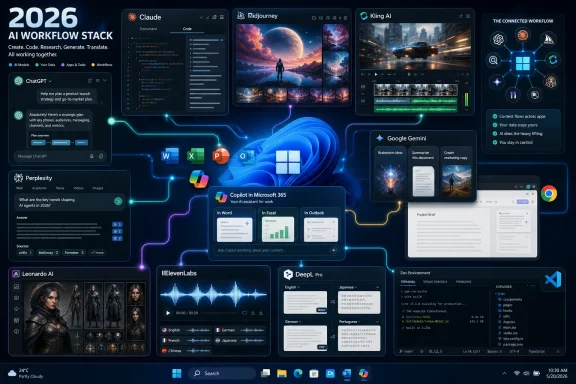
The winning AI platforms now look less like toys and more like utilities. ChatGPT is the general-purpose front door. Claude is the deep-thinking coding and document analyst. Midjourney remains the visual taste engine. Kling AI is chasing the video-production market. Perplexity has turned search into a cited conversation. Copilot and Gemini are ecosystem plays, tied to Microsoft 365 and Google Workspace. Leonardo AI, ElevenLabs, and DeepL Pro each dominate a narrower professional lane.
That specialization is healthy. It means users are learning that “AI” is not one product category but a stack of capabilities: language, reasoning, retrieval, image synthesis, video generation, speech, translation, and automation. A ranking that treats all ten tools as interchangeable misses the point. The more mature view is that each tool answers a different business problem.
For WindowsForum readers, the most important dividing line is integration. A tool that lives in the browser can be powerful, but a tool that lives inside Word, Excel, Visual Studio Code, Teams, Edge, Outlook, or a Windows desktop agent can quietly become harder to remove. That is why Microsoft Copilot deserves special attention even when standalone models sometimes outperform it on raw output quality.
OpenAI’s product has expanded from a chatbot into a broad AI workspace. It can draft, revise, reason through a bug, summarize uploaded files, generate images, interpret data, and serve as a rough assistant for everything from trip planning to shell commands. The interface is familiar enough for casual users and deep enough for professionals who know how to steer it.
The free tier remains central to its reach. For many users, free ChatGPT is already good enough for everyday drafting, rewriting, basic coding, and conceptual explanations. Paid tiers matter when users need larger context windows, better reasoning, faster access, heavier file analysis, or priority capacity, but the product’s mass-market power comes from the fact that millions of people can get real utility without procurement paperwork.
The weakness is the same as the strength: ChatGPT is broad. It can feel like the best second-best tool in many categories. Claude may be more comfortable with dense code and long documents. Perplexity is more transparent for research. Midjourney is more consistent for visual art. Copilot is more native inside Microsoft 365. But breadth is what makes ChatGPT the default, and defaults shape markets.
Claude’s strongest appeal is its temperament. It often feels more methodical than its rivals, especially when handling messy prompts, long documents, or codebases that need explanation before modification. For users who want an assistant that reads before it talks, Claude has become the serious alternative to ChatGPT.
The coding story is especially important. In 2026, coding assistants are no longer just autocomplete tools. They are becoming agents that inspect repositories, propose refactors, write tests, reason about vulnerabilities, and explain architecture. Claude’s reputation in that world has grown because it tends to preserve context and follow complex instructions well.
There is a caveat. Frontier-model benchmarks can be slippery, and vendor-published performance claims should never be treated as final truth. But even allowing for benchmark theater, the market signal is clear: Claude has become one of the few AI brands that technical users recommend without feeling like they are merely echoing hype.
Midjourney’s strength has long been aesthetic consistency. It produces images that often look composed rather than merely assembled. Designers, art directors, game artists, and brand teams keep returning to it because its best outputs require less cleanup and less apology.
The lack of a meaningful free tier limits its mainstream reach. That is not a small issue in a market where free access has become a major adoption engine. But Midjourney’s paid-first stance also clarifies its identity. It is not trying to be the casual image toy bundled into a productivity suite; it is trying to be a professional visual instrument.
The interface history also matters. Midjourney’s Discord roots made it culturally distinct and sometimes awkward for business users. As the broader AI market moves toward polished web apps and embedded workflow tools, Midjourney’s challenge is to keep its creative edge while becoming less strange to teams that do not want their design process living in a chat server.
Text-to-video and image-to-video generation solve a painfully expensive problem. Traditional video production requires cameras, actors, locations, editing, lighting, and post-production. AI video does not eliminate that pipeline for high-end work, but it gives creators a way to produce drafts, concepts, short clips, ads, backgrounds, and social assets at a speed that would have seemed absurd a few years ago.
Kling AI’s appeal comes from temporal coherence, the unglamorous phrase that determines whether an AI video feels usable. A still image can survive a small anatomical mistake. A video cannot survive a face melting between frames, a product changing shape mid-shot, or a camera move that turns physics into soup. The models that win video will be the ones that make motion boringly reliable.
For IT departments, video generation introduces new governance problems. Who owns the generated asset? Can the training data be audited? Are likeness rights respected? Is there watermarking? Can an employee accidentally create regulated or misleading content? The more capable these tools become, the less they can be treated as harmless creative toys.
That has made Perplexity particularly attractive to journalists, students, analysts, consultants, and professionals who need a trail back to source material. The tool does not remove the need to verify. It does, however, reduce the time wasted bouncing between search results, SEO sludge, and half-relevant pages.
The distinction between Perplexity and ChatGPT is instructive. ChatGPT is often the better place to think, draft, and iterate. Perplexity is often the better place to start when the answer depends on recent facts, competing sources, or claims that need inspection. In practice, many power users keep both open.
The risk for Perplexity is that its best idea may become a feature elsewhere. Google, Microsoft, OpenAI, and others all understand that cited retrieval is essential. Perplexity’s long-term success depends on whether it can remain faster, cleaner, and more trusted than the research modes built into larger ecosystems.
That gives Microsoft a structural advantage. Enterprises already manage Microsoft identities, licenses, compliance controls, data retention policies, and endpoint security. If AI adoption is going to pass through procurement, governance, and legal review, Microsoft can package Copilot as an extension of existing infrastructure rather than a wholly separate risk.
The consumer version is more complicated. Windows users have seen Copilot appear, disappear, change shape, move from sidebar to app, and become entangled with Microsoft’s broader push to make AI a front-and-center feature of the operating system. Some users welcome that. Others see it as another example of Microsoft treating the Windows desktop as distribution real estate.
Still, Copilot’s 2026 position is stronger than critics sometimes admit. Inside Microsoft 365, the ability to summarize email threads, draft documents, create presentations, analyze spreadsheet data, and pull context from organizational content can be genuinely useful. The challenge is not whether the demo works. The challenge is whether organizations can measure enough productivity gain to justify the subscription cost at scale.
In practice, Gemini’s story has been uneven. Google has world-class AI research, massive infrastructure, and unmatched consumer reach, but product trust is earned through consistency. Users do not judge an assistant by its architecture diagram. They judge it by whether it gives the right answer, handles the file, respects the prompt, and does not create extra work.
Gemini’s multimodal ability is its clearest differentiator. The capacity to handle text, images, audio, and video in a unified way fits the direction of the market. Users increasingly expect to ask questions about screenshots, meeting recordings, videos, documents, and mixed media without thinking about which model is underneath.
For Windows users, Gemini is less native than Copilot but still unavoidable through Chrome, web apps, Android devices, and Google Workspace. The AI wars are not OS-exclusive. A Windows laptop can easily become a battleground between Microsoft identity, Google services, OpenAI subscriptions, and third-party creative tools.
The generous free tier has helped it build a community among independent creators, hobbyist developers, and small studios. For a solo game developer or concept artist, the ability to generate multiple visual directions quickly can compress days of exploratory work into an afternoon. That does not replace art direction, but it changes the cost of experimentation.
Consistency is the key. AI image generation is easy when every output is a one-off. It becomes much harder when a character must look like the same character across poses, environments, lighting conditions, and scenes. Leonardo AI’s strength lies in giving users more control over that continuity.
The commercial-rights question remains important. Creative professionals need to know whether outputs can be used in paid projects, whether private generation is available, and whether models or styles create legal ambiguity. The best AI art tool is not merely the one that makes the prettiest picture; it is the one whose outputs can survive a client review and a licensing conversation.
The free tier is useful for testing, but the real value appears in production workflows. A creator can maintain consistent narration across episodes, generate multilingual versions, revise a voiceover without booking a studio session, or produce placeholder audio before final recording. For small teams, that can radically lower production costs.
The ethical shadow is just as large. Voice cloning is powerful precisely because human identity is powerful. Consent, disclosure, impersonation, fraud, and political misuse are not side issues; they are the core governance problem of synthetic speech. Any organization adopting voice AI needs rules before it needs a subscription.
Windows users may experience ElevenLabs less as a standalone destination and more as part of the creator toolchain. A script drafted in ChatGPT, edited in Word, voiced in ElevenLabs, illustrated in Midjourney or Leonardo, and assembled in a desktop video editor is now a plausible small-studio workflow. That is the new AI production stack.
The free version handles casual translation well. The paid product matters when users need larger volumes, document translation, data-security commitments, glossary control, and preservation of formatting. Those details are not glamorous, but they are exactly what professional translators, law firms, manufacturers, publishers, and multinational teams care about.
DeepL’s edge is especially visible in European languages, where it often produces more natural phrasing than generic free alternatives. That does not mean human translators disappear. It means their work shifts toward review, localization, terminology management, and quality control.
The broader lesson is that some of the best AI products are not marketed as magic. They solve a known problem, fit into existing workflows, and improve steadily. DeepL Pro may not dominate social media demos, but it has the kind of practical value that survives hype cycles.
Traditional trialware asked users to commit quickly. Modern AI free tiers invite habit formation. A student tries Perplexity for research, a developer tests Claude on a stubborn bug, a marketer uses ChatGPT for copy, a designer experiments with Leonardo, and a small creator generates voice clips in ElevenLabs. If the tool becomes part of the week, payment becomes easier to justify.
This also raises the competitive bar. A weak free tier now feels like a warning sign unless the product is clearly premium, like Midjourney. Users expect to test output quality, latency, interface design, and workflow fit before paying. AI vendors that hide too much behind the paywall risk losing users before the product has a chance to prove itself.
For enterprises, free tiers are both useful and dangerous. They accelerate discovery, but they also encourage shadow AI adoption. Employees will use what helps them, especially if procurement moves slowly. That makes policy, training, and approved-tool lists more important than blanket bans that nobody follows.
The submitted ranking gets the broad shape right: ChatGPT and Claude define general reasoning; Midjourney, Kling AI, and Leonardo cover the creative stack; Perplexity owns research; Copilot and Gemini represent ecosystem AI; ElevenLabs and DeepL Pro dominate speech and translation niches. That is a credible map of the market.
But the order should not be mistaken for universal truth. A software engineer might put Claude first. A Microsoft 365 administrator might put Copilot above everything else. A journalist may value Perplexity more than image tools. A YouTube creator might consider Kling AI and ElevenLabs indispensable while barely touching Claude.
The right question is not “which AI is best in the world?” The right question is which AI produces the most leverage for a specific user, under a specific budget, with a specific tolerance for risk. That is less catchy than a ranking, but it is how mature technology markets work.
 The AI Race Has Become a Workflow Race
The first wave of generative AI rewarded spectacle. A chatbot could write a poem, an image model could invent a cyberpunk city, and a voice engine could imitate a podcast host closely enough to make everyone uneasy. By 2026, the spectacle is still there, but it is no longer enough.The winning AI platforms now look less like toys and more like utilities. ChatGPT is the general-purpose front door. Claude is the deep-thinking coding and document analyst. Midjourney remains the visual taste engine. Kling AI is chasing the video-production market. Perplexity has turned search into a cited conversation. Copilot and Gemini are ecosystem plays, tied to Microsoft 365 and Google Workspace. Leonardo AI, ElevenLabs, and DeepL Pro each dominate a narrower professional lane.
That specialization is healthy. It means users are learning that “AI” is not one product category but a stack of capabilities: language, reasoning, retrieval, image synthesis, video generation, speech, translation, and automation. A ranking that treats all ten tools as interchangeable misses the point. The more mature view is that each tool answers a different business problem.
For WindowsForum readers, the most important dividing line is integration. A tool that lives in the browser can be powerful, but a tool that lives inside Word, Excel, Visual Studio Code, Teams, Edge, Outlook, or a Windows desktop agent can quietly become harder to remove. That is why Microsoft Copilot deserves special attention even when standalone models sometimes outperform it on raw output quality.
ChatGPT Remains the Default Because Defaults Matter
ChatGPT is still the obvious number-one recommendation for most people, not because it wins every benchmark, but because it wins the first stop test. When a user does not know whether they need writing help, code help, spreadsheet logic, brainstorming, summarization, or research scaffolding, ChatGPT is where they are most likely to begin. That habit is a moat.OpenAI’s product has expanded from a chatbot into a broad AI workspace. It can draft, revise, reason through a bug, summarize uploaded files, generate images, interpret data, and serve as a rough assistant for everything from trip planning to shell commands. The interface is familiar enough for casual users and deep enough for professionals who know how to steer it.
The free tier remains central to its reach. For many users, free ChatGPT is already good enough for everyday drafting, rewriting, basic coding, and conceptual explanations. Paid tiers matter when users need larger context windows, better reasoning, faster access, heavier file analysis, or priority capacity, but the product’s mass-market power comes from the fact that millions of people can get real utility without procurement paperwork.
The weakness is the same as the strength: ChatGPT is broad. It can feel like the best second-best tool in many categories. Claude may be more comfortable with dense code and long documents. Perplexity is more transparent for research. Midjourney is more consistent for visual art. Copilot is more native inside Microsoft 365. But breadth is what makes ChatGPT the default, and defaults shape markets.
Claude Wins Where Patience and Precision Matter
Claude’s rise is not just about being “another chatbot.” Anthropic has positioned Claude as the model family for long-form reasoning, safer enterprise use, code assistance, and careful document analysis. That positioning has resonated with developers, researchers, lawyers, analysts, and technical writers who care less about flash and more about sustained attention.Claude’s strongest appeal is its temperament. It often feels more methodical than its rivals, especially when handling messy prompts, long documents, or codebases that need explanation before modification. For users who want an assistant that reads before it talks, Claude has become the serious alternative to ChatGPT.
The coding story is especially important. In 2026, coding assistants are no longer just autocomplete tools. They are becoming agents that inspect repositories, propose refactors, write tests, reason about vulnerabilities, and explain architecture. Claude’s reputation in that world has grown because it tends to preserve context and follow complex instructions well.
There is a caveat. Frontier-model benchmarks can be slippery, and vendor-published performance claims should never be treated as final truth. But even allowing for benchmark theater, the market signal is clear: Claude has become one of the few AI brands that technical users recommend without feeling like they are merely echoing hype.
Midjourney Proves That Taste Is Still a Product Feature
Midjourney remains the premium answer for image generation because it understands something many AI tools still miss: output quality is not only about prompt accuracy. It is about taste. A technically correct image can still be ugly, uncanny, incoherent, or unusable in a professional design workflow.Midjourney’s strength has long been aesthetic consistency. It produces images that often look composed rather than merely assembled. Designers, art directors, game artists, and brand teams keep returning to it because its best outputs require less cleanup and less apology.
The lack of a meaningful free tier limits its mainstream reach. That is not a small issue in a market where free access has become a major adoption engine. But Midjourney’s paid-first stance also clarifies its identity. It is not trying to be the casual image toy bundled into a productivity suite; it is trying to be a professional visual instrument.
The interface history also matters. Midjourney’s Discord roots made it culturally distinct and sometimes awkward for business users. As the broader AI market moves toward polished web apps and embedded workflow tools, Midjourney’s challenge is to keep its creative edge while becoming less strange to teams that do not want their design process living in a chat server.
Kling AI Turns Video Generation Into the Next Platform Fight
If 2023 was the year of chatbot adoption and 2024 was the year of AI images becoming normal, 2025 and 2026 have pushed video generation into the center of the conversation. Kling AI’s rapid growth reflects a simple reality: video is where the money is, especially for marketing, social media, advertising, education, and entertainment.Text-to-video and image-to-video generation solve a painfully expensive problem. Traditional video production requires cameras, actors, locations, editing, lighting, and post-production. AI video does not eliminate that pipeline for high-end work, but it gives creators a way to produce drafts, concepts, short clips, ads, backgrounds, and social assets at a speed that would have seemed absurd a few years ago.
Kling AI’s appeal comes from temporal coherence, the unglamorous phrase that determines whether an AI video feels usable. A still image can survive a small anatomical mistake. A video cannot survive a face melting between frames, a product changing shape mid-shot, or a camera move that turns physics into soup. The models that win video will be the ones that make motion boringly reliable.
For IT departments, video generation introduces new governance problems. Who owns the generated asset? Can the training data be audited? Are likeness rights respected? Is there watermarking? Can an employee accidentally create regulated or misleading content? The more capable these tools become, the less they can be treated as harmless creative toys.
Perplexity Makes Search Feel Like It Finally Got the Memo
Perplexity’s value is not that it is the most powerful AI model in the world. Its value is that it attacks a specific failure mode of chatbots: confident answers with unclear sourcing. By combining conversational answers with citations and current web retrieval, it gives users a more research-oriented interface than a general chatbot.That has made Perplexity particularly attractive to journalists, students, analysts, consultants, and professionals who need a trail back to source material. The tool does not remove the need to verify. It does, however, reduce the time wasted bouncing between search results, SEO sludge, and half-relevant pages.
The distinction between Perplexity and ChatGPT is instructive. ChatGPT is often the better place to think, draft, and iterate. Perplexity is often the better place to start when the answer depends on recent facts, competing sources, or claims that need inspection. In practice, many power users keep both open.
The risk for Perplexity is that its best idea may become a feature elsewhere. Google, Microsoft, OpenAI, and others all understand that cited retrieval is essential. Perplexity’s long-term success depends on whether it can remain faster, cleaner, and more trusted than the research modes built into larger ecosystems.
Microsoft Copilot Is Less a Tool Than a Distribution Strategy
Microsoft Copilot is not always the best AI assistant in isolation, but isolation is the wrong test. Copilot matters because it is being placed where work already happens: Windows, Edge, Microsoft 365, Teams, Outlook, Word, Excel, PowerPoint, GitHub, and enterprise admin surfaces. Microsoft does not need every user to choose Copilot in a beauty contest. It needs Copilot to become the AI layer people encounter by default at work.That gives Microsoft a structural advantage. Enterprises already manage Microsoft identities, licenses, compliance controls, data retention policies, and endpoint security. If AI adoption is going to pass through procurement, governance, and legal review, Microsoft can package Copilot as an extension of existing infrastructure rather than a wholly separate risk.
The consumer version is more complicated. Windows users have seen Copilot appear, disappear, change shape, move from sidebar to app, and become entangled with Microsoft’s broader push to make AI a front-and-center feature of the operating system. Some users welcome that. Others see it as another example of Microsoft treating the Windows desktop as distribution real estate.
Still, Copilot’s 2026 position is stronger than critics sometimes admit. Inside Microsoft 365, the ability to summarize email threads, draft documents, create presentations, analyze spreadsheet data, and pull context from organizational content can be genuinely useful. The challenge is not whether the demo works. The challenge is whether organizations can measure enough productivity gain to justify the subscription cost at scale.
Gemini Shows the Power and Burden of Owning the Stack
Google Gemini has one obvious advantage: Google owns an enormous amount of the modern knowledge-work stack. Search, Gmail, Docs, Sheets, Slides, Drive, Android, Chrome, YouTube, and Google Cloud all give Gemini potential context that rivals cannot easily replicate. In theory, that should make Gemini one of the most powerful AI products on the market.In practice, Gemini’s story has been uneven. Google has world-class AI research, massive infrastructure, and unmatched consumer reach, but product trust is earned through consistency. Users do not judge an assistant by its architecture diagram. They judge it by whether it gives the right answer, handles the file, respects the prompt, and does not create extra work.
Gemini’s multimodal ability is its clearest differentiator. The capacity to handle text, images, audio, and video in a unified way fits the direction of the market. Users increasingly expect to ask questions about screenshots, meeting recordings, videos, documents, and mixed media without thinking about which model is underneath.
For Windows users, Gemini is less native than Copilot but still unavoidable through Chrome, web apps, Android devices, and Google Workspace. The AI wars are not OS-exclusive. A Windows laptop can easily become a battleground between Microsoft identity, Google services, OpenAI subscriptions, and third-party creative tools.
Leonardo AI Finds a Practical Niche in Game and Asset Creation
Leonardo AI is a reminder that not every successful AI product has to become a universal assistant. Its appeal is specific: game assets, concept art, character consistency, style control, and creative production workflows. That focus makes it more useful to some artists than a broader image generator with fewer production controls.The generous free tier has helped it build a community among independent creators, hobbyist developers, and small studios. For a solo game developer or concept artist, the ability to generate multiple visual directions quickly can compress days of exploratory work into an afternoon. That does not replace art direction, but it changes the cost of experimentation.
Consistency is the key. AI image generation is easy when every output is a one-off. It becomes much harder when a character must look like the same character across poses, environments, lighting conditions, and scenes. Leonardo AI’s strength lies in giving users more control over that continuity.
The commercial-rights question remains important. Creative professionals need to know whether outputs can be used in paid projects, whether private generation is available, and whether models or styles create legal ambiguity. The best AI art tool is not merely the one that makes the prettiest picture; it is the one whose outputs can survive a client review and a licensing conversation.
ElevenLabs Turns Synthetic Voice Into a Production Tool
ElevenLabs has become the name many people associate with realistic AI voice generation. Its tools can create narration, clone voices, localize content, and generate speech that avoids the robotic stiffness that defined earlier text-to-speech systems. For podcasters, video creators, educators, and audiobook producers, that is a major leap.The free tier is useful for testing, but the real value appears in production workflows. A creator can maintain consistent narration across episodes, generate multilingual versions, revise a voiceover without booking a studio session, or produce placeholder audio before final recording. For small teams, that can radically lower production costs.
The ethical shadow is just as large. Voice cloning is powerful precisely because human identity is powerful. Consent, disclosure, impersonation, fraud, and political misuse are not side issues; they are the core governance problem of synthetic speech. Any organization adopting voice AI needs rules before it needs a subscription.
Windows users may experience ElevenLabs less as a standalone destination and more as part of the creator toolchain. A script drafted in ChatGPT, edited in Word, voiced in ElevenLabs, illustrated in Midjourney or Leonardo, and assembled in a desktop video editor is now a plausible small-studio workflow. That is the new AI production stack.
DeepL Pro Reminds Everyone That Translation Was Always AI’s Killer App
DeepL Pro is easy to overlook in a list filled with flashier tools, but that would be a mistake. Translation remains one of the most practical uses of machine learning, and DeepL has built its reputation on nuance, idiom, and professional-grade document handling. In business, “mostly understandable” is not always good enough.The free version handles casual translation well. The paid product matters when users need larger volumes, document translation, data-security commitments, glossary control, and preservation of formatting. Those details are not glamorous, but they are exactly what professional translators, law firms, manufacturers, publishers, and multinational teams care about.
DeepL’s edge is especially visible in European languages, where it often produces more natural phrasing than generic free alternatives. That does not mean human translators disappear. It means their work shifts toward review, localization, terminology management, and quality control.
The broader lesson is that some of the best AI products are not marketed as magic. They solve a known problem, fit into existing workflows, and improve steadily. DeepL Pro may not dominate social media demos, but it has the kind of practical value that survives hype cycles.
Free Tiers Are Becoming the New Trialware
One of the most important changes in 2026 is the generosity of free AI access. With the notable exception of tools that remain paid-first, most major platforms now offer enough free capacity for real evaluation. That changes how users adopt software.Traditional trialware asked users to commit quickly. Modern AI free tiers invite habit formation. A student tries Perplexity for research, a developer tests Claude on a stubborn bug, a marketer uses ChatGPT for copy, a designer experiments with Leonardo, and a small creator generates voice clips in ElevenLabs. If the tool becomes part of the week, payment becomes easier to justify.
This also raises the competitive bar. A weak free tier now feels like a warning sign unless the product is clearly premium, like Midjourney. Users expect to test output quality, latency, interface design, and workflow fit before paying. AI vendors that hide too much behind the paywall risk losing users before the product has a chance to prove itself.
For enterprises, free tiers are both useful and dangerous. They accelerate discovery, but they also encourage shadow AI adoption. Employees will use what helps them, especially if procurement moves slowly. That makes policy, training, and approved-tool lists more important than blanket bans that nobody follows.
The Ranking Is Useful, but the Category Is Still Unstable
A top-ten list gives the market a sense of order, but AI in 2026 is still too volatile for false certainty. Model rankings can change in a single release. Pricing can shift. Free tiers can tighten. A tool that leads one benchmark can disappoint in a real workflow. Another that looks ordinary in a demo can become essential once integrated into company data.The submitted ranking gets the broad shape right: ChatGPT and Claude define general reasoning; Midjourney, Kling AI, and Leonardo cover the creative stack; Perplexity owns research; Copilot and Gemini represent ecosystem AI; ElevenLabs and DeepL Pro dominate speech and translation niches. That is a credible map of the market.
But the order should not be mistaken for universal truth. A software engineer might put Claude first. A Microsoft 365 administrator might put Copilot above everything else. A journalist may value Perplexity more than image tools. A YouTube creator might consider Kling AI and ElevenLabs indispensable while barely touching Claude.
The right question is not “which AI is best in the world?” The right question is which AI produces the most leverage for a specific user, under a specific budget, with a specific tolerance for risk. That is less catchy than a ranking, but it is how mature technology markets work.
The 2026 AI Shortlist Is Really a Stack, Not a Podium
The practical lesson from this ranking is that most serious users will not pick one AI tool and ignore the rest. They will assemble a stack: one general assistant, one research engine, one creative generator, one productivity-suite integration, and one or two specialist tools for voice, translation, coding, or video. That is how AI moves from novelty to work.- ChatGPT remains the best default starting point for general writing, coding, brainstorming, and everyday AI assistance.
- Claude is the strongest alternative for users who prioritize long-context reasoning, technical analysis, and coding workflows.
- Midjourney and Kling AI show that creative AI has split into premium image generation and fast-moving video production.
- Perplexity is the most compelling choice when current information and visible sourcing matter more than conversational polish.
- Microsoft Copilot and Google Gemini are ecosystem bets whose value depends heavily on whether a user lives in Microsoft 365 or Google Workspace.
- Leonardo AI, ElevenLabs, and DeepL Pro prove that specialized AI tools can beat general-purpose assistants when the workflow is narrow and professional.
References
- Primary source: Nubia Magazine!
Published: 2026-06-20T13:34:08.401547
Top 10 Best Free & Paid AI In The World 2026 | Nubia Magazine
The artificial intelligence landscape has shifted dramatically over the past year. What was once a race for novelty has become a battle for everyday utility.nubiapage.com
