

That distinction matters because AI adoption in advisory firms has moved past the experimental phase. A few years ago, the risk was that a curious advisor would paste a client email into a chatbot and hope for the best. In 2026, the larger risk is that firms standardize too casually, turning a convenience tool into shadow infrastructure before compliance, operations, and finance have decided what they are actually buying.
The RIA AI Decision Is Really a Governance Decision
The most important thing to understand about AI in a registered investment adviser is that the model is not just software. It is a place where client information may be processed, retained, logged, permissioned, retrieved, summarized, and transformed into communications that could become books and records. That makes vendor selection part of the firm’s supervisory system, not a productivity perk.
For RIAs, the attractive demo is easy to imagine. An advisor uploads a portfolio statement, an investment policy statement, several fund documents, a recent tax note, and a transcript from a client meeting. The AI system produces a plain-English retirement-plan summary, flags drift from the target allocation, drafts an email, and suggests follow-up tasks for the CRM.
That workflow is also a compliance trap if nobody has answered the basic questions. Was client information used to train the model? Where was the data processed? Who can retrieve prompts and outputs? Can the firm preserve records? Are advisors allowed to rely on generated summaries? Has anyone tested the model’s handling of numerical data, restrictions, and document conflicts?
The fiduciary issue is not that AI sometimes makes things up. Humans make errors too. The problem is that AI can make errors with polished fluency, at scale, and inside a process that staff may mistake for review rather than drafting. A wrong fund characteristic in a client recommendation is not merely a bad chatbot answer; it can become unsuitable advice, misleading communication, or a supervisory failure.
That is why the best firms are not asking, “Which model is smartest?” They are asking a more operational question: which platform belongs in which workflow, under which controls, for which data, with which review standard?
ChatGPT Remains the Generalist Everyone Has to Beat
OpenAI’s ChatGPT remains the broadest AI platform in the market, and that breadth matters. For many advisory firms, it is the tool staff already know how to use, the one junior analysts quietly tested first, and the platform with the widest ecosystem of templates, connectors, custom assistants, and third-party integrations.
For day-to-day advisory work, that makes ChatGPT hard to ignore. It is good at drafting client letters, turning meeting notes into summaries, preparing first-pass investment commentary, generating planning explanations, and helping analysts structure research. It is also relatively easy to standardize around firm-approved prompts, custom instructions, and internal drafting assistants.
The practical advantage is not just model quality. It is adoption friction. A tool that staff will actually use under policy is often safer than a technically superior tool they avoid because it feels cumbersome. For firms trying to move from random experimentation to supervised usage, ChatGPT is often the easiest bridge.
Its weakness is consistency on long, multi-step workflows. ChatGPT can perform impressively on discrete tasks that a human reviews: summarize this earnings call, draft this email, compare these fund expenses, rewrite this explanation for a retiree client. But once the task becomes an extended chain of reasoning across documents, calculations, exceptions, and action steps, firms need to test carefully rather than assume the model will maintain the thread.
That does not make ChatGPT unsuitable for RIAs. It means its best role is as a supervised drafting and analysis workhorse, not an unsupervised fiduciary agent. If a human professional remains accountable for the result, ChatGPT can save real time. If the model is expected to execute a complete client workflow without review, the risk profile changes sharply.
For cost-conscious firms, ChatGPT also has a strong argument. Its mainstream paid tiers are cheaper than many enterprise productivity bundles, and its breadth can reduce the temptation to buy five niche AI tools. But firms should not confuse a cheap subscription with a cheap implementation. The real cost includes training, policy design, review procedures, prompt governance, archiving, and vendor due diligence.
Claude Is the Model for Firms That Live in Documents
Anthropic’s Claude has become the serious contender for advisory practices that spend their lives inside documents. Investment policy statements, ADV brochures, fund prospectuses, trust documents, estate-planning summaries, custodial forms, compliance manuals, and client letters are precisely the kind of dense professional material where careful reading matters more than clever phrasing.
Claude’s appeal is its restraint. It tends to produce measured, careful prose, and it is often strong at synthesizing long documents without turning the result into marketing copy. That tone is not cosmetic for fiduciary advisors. Client communication needs to be clear, accurate, and appropriately cautious, especially when discussing risks, recommendations, tax issues, or plan assumptions.
For compliance-sensitive drafting, Claude often feels less like a sales assistant and more like a careful associate. It can help compare an IPS against an actual allocation, summarize plan documents, identify inconsistencies in disclosures, and produce correspondence that does not sound as if it escaped from a product launch. That makes it particularly useful for firms trying to improve documentation quality without increasing headcount.
The caveat is quantitative work. Claude can reason through numbers, but firms should be careful about relying on it as the primary tool for portfolio modeling, scenario analysis, or spreadsheet-heavy review. AI systems are increasingly capable at math, but advisory firms should still treat calculations as governed processes, ideally performed in auditable systems and then explained by AI, rather than invented inside a chat window.
Claude’s other limitation is operational. Enterprise procurement may be less instant than buying individual seats, and firms with complex governance needs will likely need a direct vendor conversation. That is not necessarily a negative. For a regulated firm, friction at the purchasing stage may be healthier than letting everyone expense a consumer-grade account.
For RIAs that handle complex planning cases, multi-document review, or compliance-sensitive correspondence, Claude deserves a central role. It may not be the only AI platform a firm uses, but it is arguably the one that best matches the document-heavy reality of fiduciary advice.
Gemini Makes the Most Sense When Google Workspace Is Already the Office
Google Gemini’s strongest case is not that it is the obvious best model for advisory work. Its strongest case is that many firms already live inside Gmail, Google Drive, Docs, Sheets, and Meet. If the operating system of the business is Google Workspace, embedded AI can be more useful than a separate chatbot that requires staff to copy material back and forth.
That workflow advantage should not be underestimated. AI that appears inside email, documents, meetings, and shared files can reduce context switching and make adoption feel natural. For firms with distributed teams, heavy document collaboration, and Google-native operations, Gemini can support everyday work without creating a parallel universe of AI-generated files.
Gemini also has a credible argument around multimodal inputs. RIAs still deal with scanned statements, PDFs, handwritten notes, slide decks, image-heavy reports, and mixed-format client materials. A model that handles messy document formats well can be valuable in onboarding and research workflows, especially when staff are trying to extract structure from unstructured material.
The issue is whether Gemini is the right platform for the hardest fiduciary tasks. Advisory firms should be cautious about assigning deep document reasoning, regulatory interpretation, or multi-document suitability analysis to a system simply because it is conveniently embedded. Integration is not the same thing as judgment.
That does not mean Gemini is a bad choice. It means the firm needs to separate office productivity from professional reasoning. Gemini may be excellent for summarizing meetings, drafting internal notes, searching Workspace content, producing first-pass correspondence, and organizing research materials. It may be less compelling as the primary tool for high-stakes document interpretation unless the firm’s testing shows it performs reliably in its own workflows.
The broader lesson is that ecosystem gravity is powerful. Microsoft firms will be pulled toward Copilot; Google firms will be pulled toward Gemini. The prudent RIA will acknowledge that gravity without pretending it answers every question.
Microsoft Copilot Is an Infrastructure Bet Disguised as a Seat License
For WindowsForum readers, Microsoft 365 Copilot is the most interesting platform because it is not really a chatbot competing on a blank page. It is Microsoft’s attempt to put AI into the productivity fabric of the business: Outlook, Word, Excel, Teams, SharePoint, OneDrive, and the Microsoft Graph.
That makes Copilot uniquely attractive for advisory firms already standardized on Microsoft 365. If permissions, identity, retention, eDiscovery, and security policies are already built around Microsoft’s stack, Copilot can inherit much of that architecture. From a governance perspective, that is a major advantage over staff copying client data into disconnected tools.
The Excel angle is especially important. Many advisory firms still run meaningful parts of planning, portfolio review, fee analysis, billing checks, and operational reporting through spreadsheets. An AI assistant that can work where the data already sits has a different risk profile from one that requires exporting the spreadsheet into another environment.
Copilot’s usefulness grows when firms think in workflows rather than prompts. A prospect email becomes a summarized opportunity. A Teams meeting becomes notes, tasks, and a draft follow-up. A Word document becomes a revised client memo. A SharePoint library becomes searchable institutional memory. For a high-volume practice, those small efficiencies can compound.
But Copilot’s price deserves scrutiny. Microsoft has a habit of making its strategic products feel inevitable and then attaching them to licensing structures that only reveal their full cost during renewal season. A $30 AI add-on is not the same thing as a $30 all-in AI strategy if the firm also needs qualifying Microsoft 365 plans, premium security, additional agent capacity, or consulting help to deploy it properly.
There is also the adoption problem. Copilot can be underwhelming if a firm’s Microsoft environment is messy. Bad permissions, chaotic SharePoint sites, stale files, inconsistent naming, and poor Teams hygiene all become AI problems. Copilot does not magically fix information architecture; it exposes it.
For Microsoft-centric RIAs, Copilot may be the safest default for governed productivity. But it should not automatically displace Claude or ChatGPT for specialized research, drafting, or document reasoning. Its best argument is infrastructure, not model purity.
Grok Belongs Near the News Desk, Not the Client File
xAI’s Grok occupies a different category. Its value proposition is current awareness: live market chatter, public web material, regulatory developments, and the fast-moving information stream around public companies, policy, and financial markets. For an advisor trying to understand what changed this morning, that can be useful.
This is a real gap in many AI systems. Models trained on older data may be excellent at explaining a regulation, a planning concept, or a product structure, but poor at knowing what happened today. In markets, timing matters. A Fed communication, SEC release, cybersecurity incident, earnings surprise, or litigation development can change the context around a client conversation.
Grok’s usefulness, then, is closer to an intelligence terminal than a planning engine. It can help staff monitor current developments, generate research leads, identify public commentary, and produce quick situational summaries. Used that way, it may complement more governed tools that handle client data and formal work product.
The danger is importing that live-wire culture into fiduciary workflows. Public web data and social streams are noisy. They are valuable precisely because they are fast, and risky for the same reason. An RIA should not treat a real-time AI summary as a substitute for primary-source verification, especially when the topic is regulation, securities, taxes, or client-specific advice.
There is also a vendor maturity issue. xAI is younger than OpenAI, Anthropic, Google, and Microsoft as an enterprise platform. A firm can reasonably experiment with Grok for market awareness while deciding that it has not yet earned a central place in client-data workflows.
That distinction is the governance line. Grok may be useful for knowing what the world is saying. It should not be the first place an RIA uploads a household’s financial plan.
DeepSeek Is a Cost Temptation With a Data-Sovereignty Problem
DeepSeek is the awkward entry in any serious AI buying guide because its performance-to-cost ratio is hard to ignore. Open and low-cost models can be appealing to firms tired of per-seat subscriptions, API charges, and enterprise sales cycles. For back-office experimentation, coding support, or locally hosted workflows, they may have a place.
But for U.S. RIAs handling client data, the public DeepSeek service raises a problem that is not subtle. Client financial information is among the most sensitive data a firm holds, and data location, legal jurisdiction, government access, and vendor controls matter. A low-cost model is not low-cost if it creates an indefensible privacy and supervision issue.
The local-deployment argument is more serious. A technically capable firm could run open models inside its own controlled infrastructure, keeping data within its environment and applying internal security controls. That may become more common as AI inference costs fall and firms seek alternatives to large cloud vendors.
Most advisory practices are not there yet. They do not have the engineering staff, security maturity, monitoring, model-evaluation process, or incident-response capability to operate their own AI stack responsibly. For them, “we can run it ourselves” is less a strategy than a slogan.
The sensible answer is therefore narrow. DeepSeek and similar models may belong in non-client, non-confidential experimentation, or in carefully controlled local deployments by firms that know what they are doing. They do not belong in the public-interface workflow of a typical fiduciary advisory practice.
The Hidden Cost Is Not the Subscription
The pricing table is the least interesting part of AI procurement, even though it is where most conversations begin. The real cost comes after purchase: training staff, writing policies, mapping workflows, configuring retention, auditing usage, and deciding which outputs require review. A firm that spends $20 per user and governs nothing has not saved money; it has deferred risk.
This is especially true for RIAs because AI touches functions that are usually separated. Compliance cares about advertising, books and records, privacy, supervision, and disclosures. Operations cares about onboarding, CRM hygiene, reporting, and task completion. Advisors care about client communication and plan quality. Finance cares about vendor sprawl and seat utilization.
AI collapses those boundaries. A single prompt can include client data, produce a planning conclusion, create a communication, and trigger a workflow. That is why firms need an AI policy that is more specific than “do not paste sensitive information into public tools.”
The policy should identify approved platforms, allowed data types, prohibited uses, review requirements, recordkeeping procedures, and escalation paths. It should also say which tasks AI may assist and which tasks remain human-only. The point is not to scare staff away from AI; it is to make safe use easier than unsafe use.
Vendor due diligence should be similarly practical. Firms should ask whether prompts and outputs are used for training, how long data is retained, what administrative controls exist, whether logs can be exported, how enterprise permissions work, what security certifications apply, and how the vendor handles subpoenas or government requests.
None of this is glamorous. It is also the difference between AI as a professional tool and AI as an unmanaged liability.
The Best RIA Stack Is Boring on Purpose
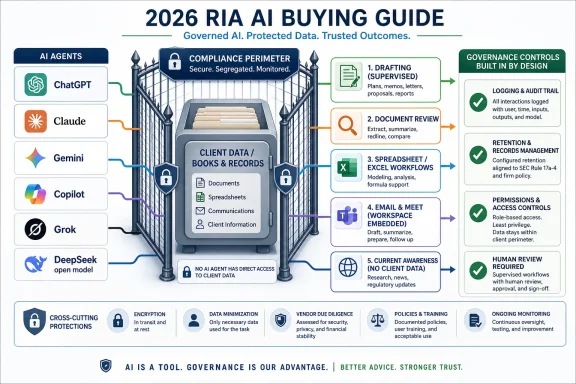
The no-hype answer for 2026 is that most RIAs should not standardize on a single AI platform for everything. They should standardize on a governed stack with clear boundaries. That may sound less satisfying than naming a winner, but it reflects how advisory firms actually work.
A Microsoft 365 firm might use Copilot for internal productivity, meeting summaries, document drafting inside Word, spreadsheet assistance, and governed search across SharePoint. It might use Claude for complex client-document review and compliance-sensitive correspondence. It might use ChatGPT for general drafting, research, explanation, and quick analytical support. It might use Grok only for current market and regulatory monitoring, with no client data permitted.
A Google Workspace firm might make Gemini the embedded productivity layer while still using Claude for high-stakes document synthesis and ChatGPT for broader drafting or quantitative support. A smaller firm might start with ChatGPT Teams or Claude Teams, then add Microsoft or Google integration later once usage patterns are clear.
The point is to assign jobs deliberately. AI platforms are not interchangeable if the work involves sensitive data, long documents, live information, spreadsheets, or client communications. Each platform has a center of gravity, and the firm’s job is to keep it there.
The biggest mistake is letting individual preference become architecture. If one advisor prefers ChatGPT, another prefers Claude, a third uses Gemini, and operations quietly builds Copilot workflows, the firm may wake up with four AI systems and no coherent policy. That is not innovation. It is unmanaged infrastructure.
A boring AI stack is a virtue. It means staff know what to use, compliance knows what to supervise, finance knows what it costs, and clients are not unknowingly funding an experiment in vendor sprawl.
The Fiduciary AI Playbook Starts With Boundaries, Not Benchmarks
Benchmarks are useful, but they should not be treated like league tables for fiduciary judgment. A model that performs well on a legal-document benchmark may still fail on a firm’s particular IPS format. A model that writes beautifully may still mishandle calculations. A model embedded in Microsoft 365 may still surface the wrong file if permissions are sloppy.
The practical evaluation should start with real firm workflows. Take anonymized or synthetic versions of actual client materials and test the models against tasks the firm performs every week. Ask them to summarize a portfolio statement, compare an allocation to policy limits, draft a client email, identify missing onboarding documents, explain a Roth conversion tradeoff, and produce a compliance review memo.
Then grade the outputs like work product, not magic. Did the model cite the right source document internally? Did it distinguish facts from assumptions? Did it refuse to guess when information was missing? Did it preserve tone? Did it make math errors? Did it invent regulatory requirements? Did it create a record the firm can retain?
This is where many firms will discover that the best model for one job is not the best model for another. Claude may win on document synthesis. ChatGPT may win on flexible drafting and scenario explanation. Copilot may win on secure internal workflow. Gemini may win inside Google-native collaboration. Grok may win on current-awareness prompts that require today’s public information.
That is not a failure of the market. It is the normal shape of enterprise software. No serious firm expects one system to be its CRM, portfolio accounting platform, document archive, email system, and financial planning engine. AI should not be held to a fantasy standard just because the interface is conversational.
The Firms That Win Will Treat AI Like Supervised Staff
The best mental model for AI in an RIA is not a search engine, calculator, intern, or oracle. It is a supervised staff member with unusual strengths, no professional license, no fiduciary duty, imperfect judgment, and endless stamina. That framing immediately clarifies both the opportunity and the risk.
You would not let a new associate send client recommendations without review. You would not let them decide which records to preserve. You would not let them invent assumptions for a financial plan because the file was incomplete. But you would let them draft, summarize, organize, compare, and prepare materials for a senior professional.
AI should be treated the same way. It can reduce low-value writing, speed document review, improve consistency, and help advisors spend more time on judgment rather than formatting. But it should remain inside a supervisory structure that assumes mistakes will happen.
This also reframes the fear that AI will replace advisors. In the RIA world, the more immediate threat is not replacement; it is uneven leverage. Firms that govern AI well will deliver faster responses, cleaner documentation, more consistent client communication, and better internal workflows. Firms that ban it reflexively will fall behind. Firms that adopt it casually will create avoidable risk.
The winning firms will not be the ones with the flashiest AI demo. They will be the ones that make AI ordinary, supervised, auditable, and useful.
A 2026 Buying Map for Advisory Firms That Cannot Afford a Toy
The platform choice becomes clearer once the firm stops asking for a universal winner and starts assigning jobs. RIAs should think in terms of workflow ownership, data sensitivity, and review standards rather than model fandom. The following map is deliberately practical because the real test is not whether an AI system can impress a conference audience; it is whether it can survive contact with client files, regulators, and renewal invoices.
- Claude is the strongest candidate for complex document review, planning-file synthesis, IPS comparison, and compliance-sensitive client correspondence.
- ChatGPT is the strongest general-purpose platform for drafting, research support, explanation, custom assistants, and flexible supervised analysis.
- Microsoft 365 Copilot is the strongest fit for firms already committed to Microsoft 365 that want AI inside Outlook, Word, Excel, Teams, SharePoint, and governed internal workflows.
- Gemini is the most natural choice for Google Workspace firms that want AI embedded in Gmail, Docs, Drive, Meet, and collaborative office processes.
- Grok is best treated as a current-awareness and market-intelligence tool, not as the system of record for client data or formal recommendations.
- DeepSeek and similar low-cost open models should stay out of public client-data workflows unless the firm has the technical capacity to deploy and govern them locally.
The firms that get AI right in 2026 will not be the ones chasing the highest benchmark score or the newest model name. They will be the firms that decide, soberly and in writing, where client data may go, which outputs require review, which platform owns which workflow, and when convenience must yield to fiduciary control. AI will become part of the advisory stack, but in a serious RIA it should enter the way every durable system does: governed first, scaled second, and trusted only after it has earned the work.
References
- Which AI platform should RIAs actually be using? A no-hype guide for 2026 InvestmentNews · 2026-06-22T13:25:14.144256
- cdn-dynmedia-1.microsoft.com cdn-dynmedia-1.microsoft.com