

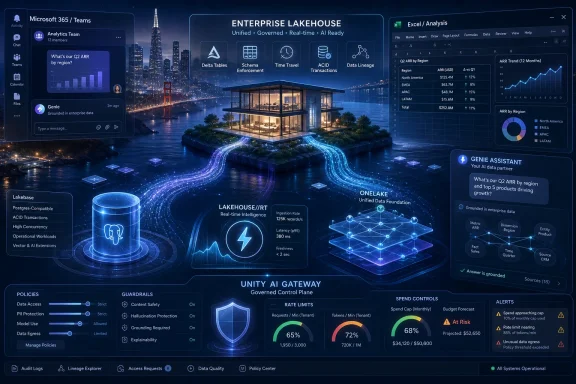
Databricks Is Selling the Control Plane Before the Agents Run Wild
The phrase agentic era has already been stretched thin by vendors eager to rename automation as artificial intelligence. Databricks’ Azure announcements are interesting because they acknowledge the part of the story many AI demos still avoid: agents are only useful when they can act on fresh, trusted data, and they are only deployable when administrators can constrain what they see, spend, and change.
That makes this announcement a governance story disguised as a productivity story. Genie in Teams is the easy demo. A sales leader asks a question in Microsoft 365 Copilot, Databricks supplies an answer from the lakehouse, and the meeting moves on. But the harder enterprise question is what happens when that same interface becomes a gateway to write-backs, campaign actions, database branches, and automated workflows.
Databricks is trying to answer that by pushing the lakehouse deeper into operational territory. Lakebase brings Postgres-flavored transactions into the platform. Lakehouse//RT aims to make low-latency serving plausible without copying data into yet another specialized system. OneLake integration tightens the Azure and Fabric story. Unity Catalog, Genie Ontology, and Unity AI Gateway are positioned as the administrative spine.
The result is a familiar Databricks move with a new AI wrapper. The company is again arguing that fragmentation is the enemy: fragmented data, fragmented tools, fragmented governance, fragmented AI bills. The difference in 2026 is that fragmentation no longer merely slows analysts down. It can cause autonomous software to act on the wrong context at machine speed.
The Lakehouse Wants to Become Operational Infrastructure
For years, the lakehouse pitch was that data lakes and warehouses should converge. Databricks now wants to extend that convergence into a tougher category: transactional applications and real-time agent workflows. The new label is LTAP, or Lake Transactional/Analytical Processing, and it is meant to suggest that the old divide between operational databases and analytical platforms is becoming less defensible.
Lakebase is the centerpiece. It is described as a fully managed, serverless Postgres database with decoupled compute and storage, autoscaling behavior, branching, and integration back into Unity Catalog-managed lakehouse data. That matters because Postgres remains the lingua franca of modern application development. If Databricks can offer a credible Postgres-compatible transactional engine inside the same governance and data fabric as analytics, it gets a cleaner story for AI agents that need to both read and act.
The most revealing detail is not simply that Lakebase exists. It is the emphasis on copy-on-write database branching for debugging production AI agents. Databricks is imagining a workflow where a developer can branch a live production database, aim GitHub Copilot agent mode or another AI-assisted development loop at the branch, reproduce a failure, and fix the issue without giving the AI tool direct access to production state.
That is a very 2026 problem. Traditional applications fail because humans write bugs, systems overload, or integrations break. Agentic applications add a new failure mode: the system may behave incorrectly because an automated planner misunderstood context, called tools in the wrong order, or encountered a data edge case the developer never anticipated. Debugging that safely requires realism without recklessness.
The catch is that transactional systems are unforgiving. Enterprises adopted separate operational databases and analytics systems not only because vendors drew boxes on architecture diagrams, but because each workload has different expectations around latency, isolation, concurrency, durability, and failure recovery. Databricks can collapse parts of that stack, but it still has to prove that the abstraction holds under messy production use.
That proof will not come from launch slides. It will come from customers discovering whether Lakebase behaves like a comfortable operational substrate, or like an analytics platform wearing a database jacket. The difference matters to sysadmins and architects who will be paged when an automated workflow stops behaving like a demo.
Real-Time Analytics Is the Price of Admission for Useful Agents
Lakehouse//RT attacks a related bottleneck: the stale-dashboard problem. Agents that answer business questions or trigger actions are only as useful as the data they can retrieve quickly. If the agent must wait on batch pipelines, warehouse refresh windows, or replicated serving stores, it becomes another interface on top of latency.
Databricks says Lakehouse//RT is powered by a vectorized engine called Reyden and is designed for sub-second, high-concurrency analytical serving directly on lakehouse data. The strategic point is clear. Databricks does not want customers to create a separate real-time serving tier simply because dashboards, Power BI reports, or agent responses need lower latency.
This is where the announcement speaks directly to the Microsoft estate. Power BI, Microsoft Teams, Excel, Microsoft 365 Copilot, SharePoint, OneLake, Azure Databricks, and Fabric are all parts of the same enterprise sprawl. Customers do not want a separate data movement project every time a business workflow crosses product boundaries. They want the data to appear governed, fast, and current wherever the work is happening.
The technical claim is ambitious because the scale-latency tradeoff has always been real. Specialized real-time databases and serving engines exist because general-purpose platforms historically struggled to handle large analytical datasets, many concurrent users, and very low response times at once. If Lakehouse//RT can reduce the need for those sidecars, Databricks strengthens the lakehouse thesis substantially.
But there is a difference between reducing a sidecar and eliminating a category. Some workloads will still demand specialized operational stores, search systems, caches, or streaming engines. The more sober reading is that Databricks is trying to pull the default architecture back toward the lakehouse, so that separate systems need to justify themselves rather than appear by default in every enterprise diagram.
OneLake Integration Turns the Microsoft Alliance Into Architecture
The OneLake pieces are among the most important parts of the Azure Databricks announcement because they move the Microsoft partnership from marketing alignment into storage-level consequence. Azure Databricks can now query data stored in OneLake through Unity Catalog without copying it, and Databricks is also moving toward storing managed Delta tables natively in OneLake in public beta.
That is a big deal for Microsoft shops trying to rationalize Fabric and Databricks. OneLake is Microsoft’s “one data lake” concept for Fabric, while Databricks has long pushed open lakehouse storage with Delta Lake and Unity Catalog governance. Without zero-copy interoperability, customers face the usual enterprise tax: duplicated data, duplicated permissions, duplicated lineage, duplicated confusion.
The announcement suggests a more pragmatic settlement. Let Fabric engines and Databricks operate over shared storage boundaries where possible, and let Unity Catalog govern access for Databricks workloads. For customers already invested in ADLS, OneLake, Power BI, and Azure Databricks, the promise is fewer architectural contortions.
The tension is that “zero-copy” often sounds cleaner than it is. Data may not be physically duplicated, but identity, permissions, metadata, performance characteristics, table formats, and operational ownership still have to line up. Anyone who has operated mixed analytics platforms knows that the hard part is not merely reading a file. It is knowing who is allowed to read it, what version they are reading, who changed the schema, what downstream dashboards break, and which system is authoritative.
That is why the Unity Catalog angle matters. Databricks is not just saying Azure Databricks can reach into OneLake. It is saying that access should be mediated through the same governance model Databricks customers already use. The stronger that integration becomes, the easier it is for Azure customers to treat Fabric and Databricks as interoperable surfaces rather than rival islands.
Still, this will require careful enterprise testing. Admins should expect edge cases around preview features, regional availability, identity passthrough, external locations, and governance parity. The direction is compelling. The operational details will decide whether it feels elegant or merely possible.
Genie’s Real Bet Is That Analytics Leaves the Dashboard
The Genie announcements are the most visible part of the package because they bring Databricks into the everyday Microsoft user interface. Genie for Microsoft Teams and Microsoft 365 Copilot is now in beta, and Databricks says users will be able to ask natural-language questions against governed lakehouse data from the collaboration tools where they already work.
This is the modern version of the self-service BI dream. For decades, enterprise analytics promised that business users would stop waiting for specialists and get answers directly. In practice, self-service often became a sprawling landscape of dashboards, extracts, semantic layers, stale spreadsheets, and Slack messages asking someone in data engineering to confirm which number was real.
Genie tries to collapse that friction. Instead of navigating to a dashboard, the user invokes an AI coworker inside a Teams thread or Copilot workflow. The answer is supposed to be context-aware, permission-aware, and grounded in the business definitions represented in Databricks.
That last clause is doing most of the work. Natural-language analytics is dangerous when the system does not understand the business. A “customer,” “booking,” “active account,” or “churned user” can mean different things across departments. If the AI interface confidently answers with the wrong metric definition, it does not democratize data. It democratizes bad decisions.
Databricks’ answer is the Genie Ontology, a semantic context layer that learns from table relationships, column metrics, query popularity, and pipeline behavior. The idea is that business context should not depend solely on manually curated semantic models that fall behind reality. The system should infer and improve its understanding from how the organization actually uses data.
That is sensible, but it also deserves skepticism. Automatically inferred semantics can reduce drudgery, yet they can also encode organizational ambiguity. If two teams use different definitions of the same business term, the system must not simply choose the more popular one and call it truth. For regulated industries, finance teams, healthcare organizations, and public-sector users, semantic governance is not a convenience feature. It is the boundary between automation and audit trouble.
Excel Write-Back Is Where Convenience Meets Risk
The Azure Databricks Excel Add-in is a deceptively important piece of the announcement. Databricks says the add-in, in public preview, lets users browse and import governed lakehouse data without SQL or per-user ODBC setup. More notably, it supports write-back to Unity Catalog tables for users with the right permissions.
Excel remains the most important unofficial enterprise application platform ever built. Data platforms can pretend otherwise, but business users still model, reconcile, forecast, correct, and argue in spreadsheets. Bringing governed lakehouse data into Excel is therefore not a concession to legacy habits. It is an acknowledgment of where work actually happens.
Write-back changes the stakes. Read-only access makes Excel a consumption surface. Write-back makes it part of the operational loop. A finance analyst might update planning assumptions, a sales operations user might correct account mappings, or a business team might push curated inputs back into Databricks for downstream workflows.
That can be powerful if governed well. It can also recreate the old spreadsheet chaos inside a modern data platform if governed poorly. Administrators will need clear controls around who can write, which tables are eligible, whether changes overwrite or append, how approvals are handled, and how lineage captures human edits made outside traditional engineering workflows.
The same applies to the SharePoint connector in Lakeflow Connect. The managed connector’s support for structured and unstructured file ingestion is useful because SharePoint is where countless enterprise documents live. PDFs, Word documents, PowerPoints, spreadsheets, and semi-structured files are often the raw material for knowledge workflows. Feeding them into Delta tables can make that content searchable, analyzable, and available to agents.
But file ingestion is not magic. Enterprises will need policies for retention, sensitivity labels, document permissions, OCR quality, duplicate versions, and data minimization. A lakehouse full of every SharePoint file an organization has ever produced is not automatically an AI advantage. Without curation and access control, it is a liability with a search box.
CustomerLake Shows Databricks Wants the Application Layer Too
CustomerLake is the announcement’s clearest move beyond infrastructure. Databricks describes it as an agentic customer data platform built natively inside the lakehouse, with Profile Agents to create Customer 360 profiles and Campaign Agents to help marketers segment audiences, recommend actions, activate across channels, and optimize personalization.
This is Databricks stepping into territory historically occupied by customer data platforms, marketing clouds, reverse ETL vendors, and campaign orchestration tools. The argument is predictable but potent: customer data already lives in the lakehouse, so why export it into a siloed MarTech stack just to re-import results later?
The appeal is obvious for data teams that have spent years cleaning up after marketing platforms. Customer identity resolution, consent status, purchase history, product usage, support interactions, web behavior, and campaign response data rarely live neatly in one system. A lakehouse-native CDP promises to keep profiles closer to source data and governance controls.
For marketers, the attraction is autonomy. Campaign Agents are meant to translate business goals into segments and next-best actions without requiring every request to become a ticket for analytics engineering. If the system works, campaign iteration gets faster and personalization can be based on fresher, richer data.
The strategic risk is that Databricks becomes responsible for more of the business workflow. Infrastructure vendors often move “up the stack” because applications are where value is visible. But application-layer promises bring application-layer expectations: polished interfaces, nontechnical workflows, integrations with advertising and messaging systems, consent enforcement, experimentation, attribution, and support for the messy habits of marketing teams.
CustomerLake will therefore test whether Databricks can package its data-platform strengths into a product business users actually prefer. The lakehouse-native architecture is the hook. The user experience and operational reliability will decide whether it becomes a platform shift or another ambitious module adopted mainly by technical champions.
Unity AI Gateway Turns Token Spend Into an Admin Problem
Unity AI Gateway may be the most practically important governance announcement because it addresses a problem many organizations are only beginning to understand: autonomous AI usage makes costs unpredictable. A human analyst running a query has a certain shape of consumption. An agent that loops, retries, calls multiple models, expands context windows, invokes tools, and escalates to more expensive models has a very different cost profile.
Databricks is positioning Unity AI Gateway as a centralized runtime registry and policy layer inside Unity Catalog. The feature set includes rate limits, content filtering, spend caps, and controls designed to make model usage more predictable across automated workflows. That places AI consumption under the same broad administrative umbrella as data access.
This is a necessary evolution. AI governance discussions often focus on data leakage, hallucination, and compliance, but runaway cost is also a governance failure. If a poorly constrained agent can burn through a monthly budget in a weekend, administrators need more than a dashboard after the fact. They need hard limits, policy enforcement, routing controls, and visibility across providers.
There is also a power shift embedded here. Model providers want usage. Platform administrators want predictability. Business units want autonomy. Finance wants accountability. A gateway sitting between agents and models becomes the place where those interests collide.
For WindowsForum readers managing Microsoft-heavy estates, the analogy is familiar. Cloud cost management matured only after organizations learned that self-service infrastructure without guardrails could produce terrifying bills. Agentic AI is now reaching the same stage, only faster. Unity AI Gateway is Databricks’ bid to make itself the FinOps and governance checkpoint for AI workloads running near enterprise data.
The harder question is whether administrators can set policies that are strict enough to matter without smothering experimentation. If every useful workflow requires a governance committee, users will route around the system. If every agent gets broad permissions and generous spend limits, the platform becomes a risk amplifier. The winning design will be policy that feels invisible until it needs to stop something.
The Microsoft Surface Area Is the Distribution Strategy
Databricks’ Azure announcements make the most sense when viewed as a distribution strategy through Microsoft’s productivity empire. Teams is where workers talk. Excel is where they model. SharePoint is where documents accumulate. Power BI is where many enterprises consume dashboards. Microsoft 365 Copilot is where Microsoft wants AI work to converge. OneLake is where Fabric wants data gravity to collect.
Azure Databricks is trying to sit underneath that surface area as the trusted data and AI backend. This is not merely co-selling. It is a bid to make Databricks relevant at the moment a business user asks for an answer, not just when a data engineer designs a pipeline.
That matters because the center of gravity in enterprise AI is moving from model selection to workflow embedding. Most users will not care which vectorized engine answered a query or which semantic layer resolved a metric. They will care whether the answer appeared in the meeting, whether it respected permissions, whether it matched finance’s number, and whether it could trigger the next step.
Microsoft benefits if Azure Databricks makes Copilot and Fabric more useful for serious enterprise data. Databricks benefits if Microsoft’s enormous installed base becomes a front door into lakehouse workloads. Customers benefit if the integration reduces copying, custom plumbing, and vendor sprawl.
The risk is that overlapping Microsoft and Databricks narratives create architectural fog. Fabric already has its own data engineering, warehouse, real-time analytics, Power BI, OneLake, and AI ambitions. Databricks has its own lakehouse, Unity Catalog, Genie, Lakeflow, Lakebase, and AI governance layer. The partnership works best when the boundary is clear; it becomes confusing when every product claims to be the unified platform.
Enterprises should therefore evaluate these announcements not as slogans but as workflows. Can a governed metric defined in Databricks appear reliably in Excel? Can OneLake data be queried without permission drift? Can a Teams user ask Genie a question and receive an answer that respects Unity Catalog? Can a SharePoint document pipeline preserve access boundaries? Can AI spend limits stop a runaway workflow before finance notices?
Those are the questions that will determine whether this is true integration or simply adjacent product launches with a shared conference stage.
Admins Should Read the Preview Labels Before They Read the Hype
Several of the announced capabilities are in beta or public preview. That is not a criticism; enterprise platforms evolve through staged availability. But it does mean customers should resist the temptation to treat the announcement as a fully hardened reference architecture.
Preview features often carry limitations around regions, compliance boundaries, APIs, administrative controls, scale characteristics, or support guarantees. The Excel Add-in, Teams integration, Copilot Cowork connection, SharePoint connector improvements, OneLake external locations, and Lakebase-related features may all mature at different speeds. In a real enterprise rollout, that unevenness matters.
The practical adoption path is not to hand agents broad access to production data and celebrate a new era of autonomous work. It is to start with narrow, governed workflows where the data definitions are well understood and the blast radius is contained. Sales analytics in Teams may be a good early candidate. Direct write-back into operational planning tables requires more caution. Autonomous campaign activation against customer data requires more caution still.
Security teams should also be involved early. Agentic systems expand the meaning of access. A user may have permission to see a table, but should an AI assistant be allowed to summarize it, combine it with other sources, send outputs into a chat, or trigger a workflow based on it? Traditional role-based access is necessary, but it may not be sufficient for tool-using agents.
Compliance teams will ask similar questions. If an agent produces an answer used in a financial forecast, healthcare decision, marketing campaign, or customer communication, organizations need traceability. Which data was used? Which model generated the output? Which policies applied? Who approved the action? What changed afterward?
Databricks’ governance framing is strong because it recognizes these concerns. But customers should demand evidence in their own environments. The vendor promise is context and control. The enterprise burden is verification.
The Azure Databricks Story Now Has Five Pressure Points
The announcement’s breadth makes it easy to lose the plot. The core message is that Databricks wants Azure customers to treat the lakehouse as the governed execution environment for agentic work, not merely as a place where data lands before reports are built.
- Azure Databricks is pushing beyond analytics into operational data with Lakebase and LTAP, but production confidence will depend on workload fit, reliability, and administrative maturity.
- Lakehouse//RT is meant to reduce the need for separate real-time serving stacks, though specialized systems will still survive where latency and workload patterns demand them.
- OneLake integration is the bridge that could make Fabric and Azure Databricks feel less duplicated, provided identity, permissions, metadata, and performance behave consistently.
- Genie in Teams, Microsoft 365 Copilot, and Excel moves analytics into daily work surfaces, which makes semantic accuracy and permission enforcement more important than interface polish.
- Unity AI Gateway reframes model usage as an enterprise control problem, with rate limits and spend caps becoming as important to AI operations as access policies are to data governance.
- CustomerLake shows Databricks moving into business applications, where the lakehouse architecture must now compete on usability, activation workflows, and marketing-team trust.
The deeper significance is that Databricks is no longer just defending the lakehouse against warehouses. It is defending governed data gravity against the chaos of agent sprawl.
The next phase of enterprise AI will not be decided by which assistant gives the flashiest answer in a keynote demo. It will be decided by which platforms can make autonomous systems boring enough to trust: fast when users need answers, constrained when agents want to act, integrated where employees already work, and auditable when something goes wrong. Azure Databricks’ 2026 announcements sketch that future convincingly, but the real test begins after the summit, when administrators turn previews into policies and business users discover whether the agentic era makes work simpler—or merely gives complexity a more fluent interface.
References
- Unifying Data and Governance in the Agentic Era: What’s New with Azure Databricks - Databricks Databricks · Tue, 16 Jun 2026 13:03:40 GMT