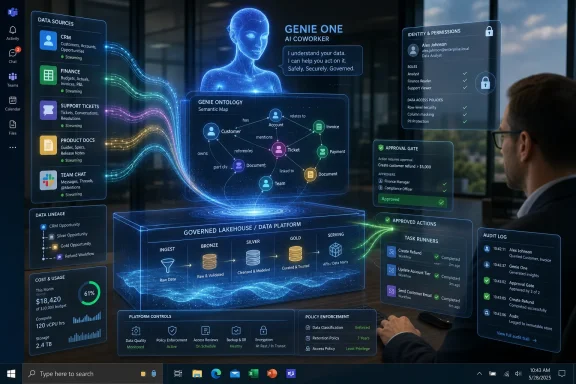
Databricks Wants the AI Coworker to Live Where the Data Already Lives
The timing is not accidental. Enterprise AI has spent the last two years oscillating between inflated demonstrations and stubborn deployment friction. Every vendor now sells some version of an assistant, copilot, agent, coworker, or digital teammate, but most of those products run into the same wall: they are impressive when the problem is self-contained and brittle when the answer depends on messy institutional knowledge.
Databricks is betting that the wall is really a data problem. Genie One is positioned as the successor to the earlier Genie experience, but the name change undersells the strategic shift. The first generation was primarily about asking questions of data already inside Databricks. Genie One is meant to work across data inside and outside the platform, then automate the next steps for teams in marketing, finance, sales, operations, and other business functions.
That distinction matters because most enterprise workflows do not begin and end inside a single data warehouse. A revenue leader might need CRM data, support tickets, usage telemetry, campaign history, product documentation, and a running interpretation of what “good” means for the current quarter. A finance team might need to reconcile forecasts against pipeline reality, not merely pull a table of last month’s expenses. If an AI tool can only query a curated dataset, it is a smarter dashboard. If it can understand the organization’s relationships, definitions, permissions, and actions, it starts to look like infrastructure.
Databricks is therefore not selling Genie One as a chat box bolted onto analytics. It is selling a new front end for business work, one that assumes employees will increasingly ask for outcomes rather than reports. That is a bold claim, and it will succeed or fail less on model cleverness than on the boring things IT pros care about: identity, lineage, permissions, cost control, auditability, integration depth, and failure behavior.
The Ontology Is the Product, Not the Chat Window
The most important phrase in Databricks’ announcement is not “AI coworker.” It is Genie Ontology. Databricks describes this as the context layer that extracts and learns business knowledge from Databricks, AI tools, connected workplace apps, and other enterprise systems. In less marketable language, the company is trying to build a living semantic map of how a business defines itself.
That is the real product. The chat interface is merely the most visible manifestation of it.
Enterprises have learned the hard way that natural-language querying is only as good as the layer beneath it. Ask “What was revenue last quarter?” and the answer depends on whether revenue means booked, billed, recognized, net, gross, recurring, regional, segmented, adjusted, or forecast-weighted. Humans navigate those distinctions through institutional memory. Dashboards handle them through brittle definitions. AI systems tend to hallucinate around them unless they are grounded in governed context.
Genie Ontology is Databricks’ attempt to make that context machine-readable and reusable. If it works, Genie One becomes more than an assistant that translates English into SQL. It becomes a business agent that knows which tables matter, which definitions are authoritative, which applications contain relevant signals, and which actions are allowed. That would put Databricks in a stronger position than vendors offering generic agents that must be wired into each enterprise from scratch.
There is an obvious WindowsForum angle here for admins and IT architects: this is another example of the enterprise AI stack moving down into governance and data control rather than staying at the application layer. The industry’s first wave of copilots promised productivity through interface convenience. The next wave is trying to turn data governance into competitive advantage. For organizations already wrestling with Microsoft 365 Copilot, Salesforce agents, ServiceNow AI, or custom Azure OpenAI deployments, Genie One adds another candidate for the “system that understands the business.”
That is both useful and dangerous. Useful because a governed ontology may reduce the chaos of every department building its own AI interpretation layer. Dangerous because the vendor that controls the ontology increasingly controls how AI sees the enterprise.
The Enterprise AI Race Has Moved from Answers to Actions
Genie One lands squarely in the agentic AI phase of the market, where “answer my question” is no longer enough. The new promise is “analyze this, decide what should happen, and carry out the work.” That shift sounds incremental, but in production environments it changes the risk profile completely.
A chatbot that returns a bad answer wastes time. An agent that takes a bad action can alter forecasts, trigger campaigns, create tickets, notify customers, change configuration, spend budget, or propagate a wrong assumption into downstream systems. The more useful the agent becomes, the more consequential its mistakes become.
Databricks knows this, which is why the company’s language leans heavily on governance, context, and business data. The implied argument is that agents fail when they lack grounding. Give them an accurate map of the organization, enforce permissions through the underlying platform, and their automation becomes trustworthy enough for real work.
That argument is plausible, but it is not proven by a launch announcement. Enterprise IT has seen enough “single pane of glass” and “self-service analytics” projects to know that context does not magically organize itself. Someone must define business terms. Someone must reconcile inconsistent systems. Someone must decide whether the sales team’s pipeline stages align with finance’s forecasting categories. Someone must clean up the permissions model that grew organically across five acquisitions and three cloud migrations.
AI does not remove that labor. It makes the payoff more visible, and perhaps the mess more urgent.
The practical consequence is that Genie One may be most valuable to organizations that have already done the difficult platform work. Companies with disciplined data models, strong identity practices, mature Databricks deployments, and clear governance policies will have a better shot at turning Genie One into useful automation. Companies hoping Genie One will paper over years of data sprawl may discover that the agent is very good at exposing precisely how little shared truth their systems contain.
Databricks Is Trying to Outflank the Application Suites
The most interesting competitive move is not against Snowflake or traditional BI tools, though those comparisons are inevitable. It is against the application suites that own the day-to-day workflows of business users. Microsoft, Salesforce, Google, ServiceNow, Workday, Atlassian, and others all want their AI assistants to become the place employees ask questions and start work.
Databricks is approaching the same prize from the data-platform side. Rather than saying the agent should live in email, CRM, office documents, or ticketing, Databricks is saying the agent should live on top of governed enterprise data and reach outward into those systems. That is a different power center.
For Windows-heavy enterprises, this creates an architectural tension. Microsoft’s argument with Copilot is that work context already lives in Microsoft 365, Teams, SharePoint, Outlook, Windows, Entra ID, and the broader Microsoft Graph. Databricks’ argument is that business truth lives in the lakehouse and the data intelligence platform, where structured and unstructured data can be governed and analyzed. Both arguments can be true, which is exactly why IT departments are going to be pulled in multiple directions.
The danger is overlapping agent layers. A sales analyst could ask Copilot, Salesforce, Databricks Genie One, or a custom internal agent for the same revenue explanation and receive subtly different answers. Each system may have access to different data, different permissions, different definitions, and different freshness. The user sees a productivity tool. The admin sees a semantic consistency problem.
This is where Databricks’ ontology push becomes strategic. If Genie One can provide a more authoritative business context than application-native assistants, Databricks gains leverage. If it becomes just another conversational layer producing another version of the truth, it adds to the noise.
The company’s success will depend on whether customers treat Databricks as the place where business meaning is governed, not merely where data is stored and processed. That is a higher bar than being the platform data engineers like. It asks Databricks to become a trusted operational layer for people who may never open a notebook.
The Launch Also Reveals the Limits of the “Coworker” Metaphor
The AI industry loves the word “coworker” because it humanizes automation without sounding as threatening as “replacement.” It suggests help, collaboration, and delegation. But in enterprise software, metaphors can obscure responsibilities.
A coworker can be trained, corrected, supervised, and held accountable through management processes. A software agent needs policy, observability, access controls, evaluation, rollback mechanisms, logs, and escalation paths. Those are not the same thing, even if the interface looks conversational.
Genie One may behave like a coworker to the business user, but IT should evaluate it like an automation platform. What systems can it touch? What actions can it perform? How are approvals handled? How are prompts, responses, intermediate reasoning, tool calls, and outputs logged? What happens when the agent is uncertain? How are data access policies inherited or overridden? How does the system prevent a user from indirectly accessing data they could not query directly?
Those questions are not edge cases. They are the core deployment questions for agentic AI.
The “AI coworker” framing also risks underplaying the organizational change. If a marketing manager can ask Genie One to analyze churn, identify a segment, draft a campaign, and route follow-up actions, the role of the analyst changes. If a finance team can automate variance explanations, the review process changes. If operations staff can query and act across systems without learning the underlying tooling, the bottleneck shifts from report creation to decision governance.
That may be a good thing. Many companies still burn thousands of hours translating executive questions into dashboard updates and one-off data pulls. But it is not frictionless productivity. It is a redistribution of power from technical intermediaries to business users, mediated by a vendor-controlled AI layer.
The Admin’s Problem Is No Longer Whether AI Is Allowed
For a while, enterprise AI policy focused on a defensive question: should employees be allowed to use generative AI at all? That phase is fading. The real question now is which AI systems are allowed to act on enterprise data, under whose authority, and with what controls.
Genie One sharpens that question because it is explicitly built for work across business functions. This is not a developer-only coding assistant or a novelty analytics bot. It is aimed at the people who approve budgets, chase revenue, design campaigns, manage operations, and explain performance to leadership.
That broad reach makes governance both more important and harder. A data scientist using an AI tool inside a controlled notebook is one risk profile. A business user invoking an agent across sales, finance, and workplace apps is another. The permissions model must be understandable enough for administrators and restrictive enough to prevent accidental leakage, but flexible enough that the product remains useful.
Cost is another practical concern. Agentic systems can be more expensive than simple chat because they may perform multiple reasoning steps, retrieve context, call tools, run queries, generate artifacts, and iterate. Databricks documentation and community discussion around Genie usage already point toward budget controls and pay-as-you-go considerations. That means Genie One will not merely be a security review item; it will also be a FinOps item.
The Windows admin analogy is obvious. Just as endpoint management moved from “can users install software?” to “how do we continuously govern identities, apps, devices, data, and conditional access?”, enterprise AI is moving from “can users use ChatGPT?” to “how do we govern agents as operational actors?” Genie One is one more sign that AI administration is becoming a permanent discipline, not a temporary exception process.
Business Users Are the Target, but Data Teams Will Carry the Burden
Databricks says Genie One is designed for business users who do not need to understand compute resources, queries, models, or notebooks. That is the right aspiration. It is also the classic self-service analytics promise, updated for the agent era.
Self-service tools usually reduce friction for consumers by increasing the responsibility placed on platform teams. Someone must curate datasets, define metrics, maintain access policies, monitor quality, review lineage, and explain why the answer changed after a pipeline update. With agents, the same obligations remain, but the surface area expands.
A dashboard is a fixed artifact. A Genie One interaction may be dynamic, multimodal, and action-oriented. The user may not know which sources were consulted or which assumptions were made unless the system exposes that clearly. If the answer is wrong, the data team may still be blamed, even if the failure came from ambiguous business terminology or an external app connector.
That means data teams will need new operating practices. They will need to evaluate agent outputs, not just data pipelines. They will need test cases for business questions, not just schema checks. They will need to monitor whether the ontology reflects current business logic. They will need to create escalation paths when an AI answer conflicts with an official report.
This is where Databricks has an opportunity to differentiate. If Genie One provides strong observability into why it answered or acted in a certain way, IT teams may see it as manageable. If it hides too much behind a polished interface, administrators will treat it as another black box asking for privileged access.
The product’s long-term credibility will depend on whether it makes governance visible to the people who have to sign off on it. Business users may buy the coworker story. IT will buy the control plane.
The WindowsForum Angle Is the Hybrid Enterprise Reality
At first glance, a Databricks AI announcement may seem distant from the Windows desktop. In practice, it sits squarely in the environment WindowsForum readers administer every day: hybrid identity, Microsoft 365, Teams collaboration, Azure data estates, browser-based SaaS, endpoint controls, compliance rules, and a growing collection of AI services that users expect to “just work.”
Many Databricks customers already operate inside Microsoft-heavy environments. Even when Databricks runs cross-cloud, the users consuming insights are often working from Windows laptops, authenticated through enterprise identity providers, communicating in Teams, exporting to Excel, and filing work through Microsoft or SaaS applications. Genie One’s value will depend partly on how well it fits into that mundane reality.
The mention of workplace app connectivity is therefore not a side note. If an AI coworker cannot meet employees where work happens, adoption stalls. But if it integrates too deeply without careful controls, the security team inherits a new class of lateral movement concern: not malware moving through systems, but an authorized AI agent moving through context on behalf of a user.
That does not mean Genie One is uniquely risky. It means all serious enterprise agents will need to be evaluated like privileged workflow engines. The user’s identity may be the starting point, but the agent’s capabilities, memory, connectors, and action permissions define the actual risk.
For IT pros, the lesson is to stop treating AI tools as isolated features. Genie One belongs in the same conversation as conditional access, data loss prevention, retention, eDiscovery, audit logging, privileged access management, SaaS governance, and cloud cost monitoring. The agent is not just an interface. It is a participant in the enterprise control plane.
Databricks Is Selling Speed, but Buyers Should Ask About Reversibility
The business case for Genie One is speed. Faster answers. Faster automation. Faster movement from insight to action. That is exactly what executives want from AI, and it is exactly what makes administrators nervous.
Speed is valuable when the system is correct and reversible. It is dangerous when the system is wrong and opaque. A human analyst who misreads a metric may send a bad slide. An agent that misclassifies a customer cohort and triggers downstream work can create a broader operational mess.
The key question for buyers is not whether Genie One can perform impressive demos. It is whether the organization can constrain, inspect, and reverse what Genie One does. Can admins set boundaries by role, department, data domain, and action type? Can sensitive workflows require human approval? Can outputs be traced back to sources and definitions? Can the system be evaluated against known business scenarios before broad release? Can failed automations be unwound?
Those are the questions that separate serious enterprise AI from keynote theater. They are also the questions that will determine whether Genie One becomes a trusted assistant or another tool that gets piloted enthusiastically and then quietly fenced off by compliance teams.
Databricks’ advantage is that it already speaks the language of governed data. Unity Catalog, lakehouse architecture, lineage, and centralized policy are familiar concepts to its customer base. The challenge is extending that trust from data access into agent behavior. Governance over tables is not the same as governance over decisions.
The Market Is Crowded Because the Prize Is Control of Work
Every major enterprise vendor is converging on the same destination: an AI layer that mediates how employees interact with software. That layer will decide what information is surfaced, what actions are suggested, what workflows are automated, and which system becomes the starting point for work. Genie One is Databricks’ bid for that layer.
The crowded market does not make the announcement less important. It makes the stakes clearer. If AI agents become the new enterprise front end, then the company that owns the agent experience gains influence over data architecture, application integration, security posture, and user behavior. That influence can reshape procurement decisions far beyond the initial AI feature.
Databricks is not alone in seeing this. Microsoft wants Copilot to be the connective tissue across productivity, Windows, security, and cloud. Salesforce wants Agentforce to operate inside customer relationships. ServiceNow wants agents embedded in enterprise workflows. Google wants Gemini across Workspace and cloud services. Snowflake, Oracle, SAP, Workday, and others all have versions of the same thesis.
Genie One’s differentiator is the claim that business data context is the foundation. That will resonate with organizations whose AI ambitions are blocked by fragmented analytics and unreliable definitions. It may be less compelling for organizations that see workflow ownership, not data ownership, as the primary control point.
The likely outcome is not one agent to rule them all. It is a negotiated hierarchy of agents, with some embedded in applications, some operating across data platforms, and some built internally for specialized processes. IT’s job will be to prevent that hierarchy from becoming an ungoverned swarm.
The Genie One Era Will Reward the Enterprises That Did the Unfashionable Work
The concrete lesson from Genie One is that the unglamorous parts of enterprise technology are becoming more valuable, not less. Data catalogs, access policies, semantic models, identity hygiene, lineage, cost controls, and workflow approvals used to be the plumbing beneath analytics. In the agentic AI era, they become the difference between useful automation and expensive confusion.
A few practical conclusions stand out for IT leaders watching Databricks’ move:
- Genie One should be evaluated as an automation and governance platform, not merely as a conversational analytics feature.
- Its usefulness will depend heavily on the quality of an organization’s data definitions, permissions, and business context.
- Databricks is trying to make the data platform a front door for business work, which puts it in competition with application-suite AI assistants.
- Administrators should scrutinize connectors, action permissions, audit logs, approval workflows, and cost controls before broad deployment.
- The organizations most likely to benefit are those that have already invested in disciplined data governance and can extend that discipline into agent behavior.
- The biggest risk is not that Genie One gives no answers, but that it gives confident answers or takes confident actions using incomplete business context.
Genie One is an important launch because it shows where enterprise AI is really heading: away from isolated assistants and toward governed agents that sit between employees and the machinery of the business. Databricks may or may not become the vendor that owns that layer for a given enterprise, but the architectural question it raises is now unavoidable. The next phase of AI adoption will not be won by the flashiest chatbot; it will be won by the systems that can turn institutional knowledge into controlled, inspectable, and reversible action.
References
- Databricks launches AI co-worker, Genie One - IT Pro IT Pro · Wed, 17 Jun 2026 11:35:30 GMT
- Databricks' new agentic coworker Genie One brings AI automation to every part of the business - SiliconANGLE SiliconANGLE · Tue, 16 Jun 2026 23:41:29 GMT
- learn.microsoft.com learn.microsoft.com