

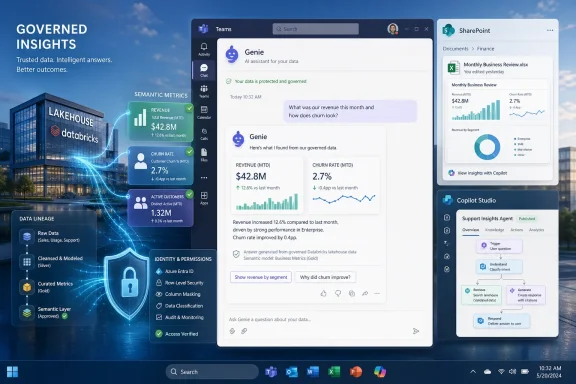
Databricks is extending its Genie natural-language analytics capability into Microsoft Teams, Microsoft 365 Copilot, and SharePoint through Copilot Studio, giving enterprise users a way to query governed Databricks data from the Microsoft 365 tools where they already work. The move is not just another connector announcement. It is a bid to make the data warehouse, lakehouse, and AI assistant disappear into the daily rhythm of meetings, chats, documents, and business workflows.
That matters because the next phase of enterprise AI will not be won only by the platform with the cleverest model or the deepest data lake. It will be won by the platform that can make trusted answers feel close enough, governed enough, and routine enough that business users stop asking where the data lives. Databricks is trying to meet Microsoft’s productivity empire on its own terrain.
For years, the central promise of modern analytics platforms has been that business teams should be able to make decisions from fresh, trustworthy data. The reality has often been less glamorous. Data engineers prepare pipelines, analysts translate requests, dashboards multiply, and the people making decisions still end up asking for “one more cut” in a Teams thread.
Genie is Databricks’ answer to that old bottleneck: a conversational interface intended to let users ask questions of enterprise data in ordinary language. The Microsoft 365 integration changes the distribution model. Instead of asking users to go into Databricks, it lets organizations bring Genie into Copilot Studio agents and publish those agents into Microsoft 365 surfaces.
That is a subtle but important inversion. The traditional enterprise software adoption path asks employees to learn a new destination. This integration says the destination is already Teams, Copilot, or SharePoint; the data platform should come to the user.
For WindowsForum’s audience, the story is not that Databricks now has another Microsoft-adjacent feature. The more consequential point is that Microsoft 365 is becoming the front door for enterprise AI, while specialized platforms compete to be the trusted systems behind it. Databricks is accepting that front-door reality and trying to make sure its lakehouse is one of the rooms Copilot can reach.
That distinction matters. Most large organizations do not suffer from a shortage of analytics tools. They suffer from fragmented usage, inconsistent trust, and the difficulty of getting non-specialists to ask good questions of complicated systems. A conversational agent in Teams may not solve those problems by itself, but it gives the data platform a better chance of showing up at the moment a decision is being made.
Databricks’ promotional framing leans heavily on “where your teams already work,” and for once the phrase is not empty marketing filler. Teams is where budget discussions, incident reviews, sales escalations, operating meetings, and project debates already happen. If an employee can ask a governed question there instead of opening a BI dashboard, filing a ticket, or waiting for an analyst, the product has moved closer to business value.
The risk is that the phrase natural language access to data can make the whole thing sound simpler than it is. Natural language is an interface, not a guarantee of correctness. The underlying data model, permissions, semantic definitions, lineage, refresh cadence, and governance controls still decide whether the answer is useful or dangerous.
That creates a powerful gravitational field. If an enterprise already pays for Microsoft 365, manages identities through Entra ID, governs collaboration through Teams and SharePoint, and is evaluating Copilot licenses, any AI workflow that fits that environment has an easier path to attention. The default enterprise question becomes not “Which app should we open?” but “Can this be exposed through Copilot?”
Databricks is hardly alone in seeing that shift. Every major enterprise software vendor wants to surface its data and actions inside the collaboration and assistant layers that employees already use. Salesforce, ServiceNow, Workday, SAP, Snowflake, and countless smaller vendors are all navigating the same architectural pressure: the user experience is moving toward assistants, but the systems of record remain specialized.
That is why the Databricks integration should be read as part of a broader unbundling and rebundling cycle. Specialized platforms still matter, but their interfaces are being partially absorbed into horizontal AI surfaces. The vendor that controls the daily work surface gets leverage; the vendor that controls trusted data still gets power, provided it can plug in cleanly.
Genie points at a different audience. Its purpose is to make enterprise data conversational for business users who may never write SQL, manage a cluster, or understand the underlying notebook workflows. By putting Genie inside Teams and Microsoft 365 Copilot, Databricks is trying to make that business-user expansion feel less like a product rollout and more like an extension of existing work.
That matters commercially. Data platforms often expand inside accounts when they move from specialist usage to broad operational dependency. A tool used only by data teams is strategic infrastructure; a tool used by sales managers, finance analysts, supply chain planners, and operations leaders becomes harder to displace.
The phrase investors like is “stickiness,” but the operational version is more concrete. If quarterly business reviews, inventory questions, customer escalations, and executive dashboards all begin to rely on Databricks-backed answers surfaced through Microsoft 365, the platform becomes embedded in the organization’s decision muscle memory. That is the kind of usage vendors want because it supports expansion without requiring every user to become a Databricks-native power user.
A dashboard usually shows its constraints. A chart has axes, filters, date ranges, and a visible framing of what is being measured. A conversational answer can feel more authoritative because it arrives as prose. That makes governance, semantic consistency, and user education more important, not less.
Databricks has an advantage here if customers have already invested in Unity Catalog, permissioning, lineage, and well-defined data products. A Genie answer can only be as trustworthy as the curated data and metadata behind it. If the underlying enterprise data estate is chaotic, Copilot-era convenience may simply accelerate confusion.
Microsoft admins will also care about the identity model. A useful enterprise AI integration should respect existing user permissions rather than become a shortcut around them. The official setup path for Azure Databricks and Copilot Studio includes choices around end-user credentials versus maker-provided credentials, and that choice is not a footnote. It determines whether the agent behaves like a personal, permission-aware assistant or a shared service account with broader implications.
Genie Spaces are meant to constrain that ambiguity by giving users a curated domain for questions. That is the right direction. Enterprises do not need an all-knowing chatbot wandering across a lakehouse. They need carefully scoped assistants that understand a business domain, know which tables and metrics matter, and can return answers with enough context to be challenged.
Copilot Studio adds another layer of orchestration. The agent must decide when to call Genie, how to handle delays, how to phrase requests, and how to present responses inside Microsoft 365. Those orchestration details can sound small, but they shape user trust. An agent that times out, returns half-answers, or fails to explain its assumptions will be abandoned quickly.
The best deployments will likely look less like “ask anything about company data” and more like a portfolio of focused assistants. A sales operations agent, a finance close agent, a supply chain risk agent, and a customer support analytics agent are easier to govern than one giant omniscient bot. That is less magical, but it is how enterprises usually make technology durable.
That is the quiet brilliance of Microsoft’s position. It does not need to own every enterprise dataset to benefit from the AI assistant boom. It needs to own the identity, collaboration, security, app distribution, and productivity context through which those datasets are accessed.
For Databricks, the bargain is still attractive. Microsoft has the audience Databricks wants to reach. Enterprise workers live in Teams in a way they do not live in most analytics environments. If Genie can travel through Microsoft’s channels without losing Databricks’ governance story, the trade-off is rational.
But there is a long-term tension. The closer Databricks gets to Microsoft 365 workflows, the more the end user may perceive the experience as “Copilot answered my question” rather than “Databricks powered this insight.” Infrastructure companies have always dealt with this kind of invisibility. The difference now is that AI assistants are becoming the branded layer users emotionally attach to.
Putting data-backed agents near SharePoint hints at a future where structured analytics and unstructured enterprise knowledge are queried together. A manager may not want only the latest revenue variance from Databricks. They may also want the related forecast memo, the sales-region narrative, and the remediation plan discussed in a Teams channel.
That combined experience is where enterprise AI becomes genuinely useful and genuinely risky. The assistant must bridge structured and unstructured data without blurring the difference between a governed metric and a draft document. It must know when it is summarizing a file, retrieving a metric, or inferring a relationship between the two.
Databricks’ strength is on the structured and semi-structured data side. Microsoft’s strength is the productivity and content graph. The integration points toward a world where those domains meet inside agents. The winners will be the vendors that make the boundary visible enough for trust but seamless enough for daily use.
Still, the strategic logic is easy to see. Databricks competes in a crowded market where cloud data platforms, AI infrastructure providers, BI vendors, and hyperscalers all want to own enterprise analytics. If Genie becomes more accessible through Microsoft 365, Databricks can argue that its data intelligence platform is not locked away in technical teams but available to the broader enterprise.
That could help in sales cycles where buyers care about business adoption rather than platform elegance. CIOs and CFOs increasingly ask whether expensive AI and data platforms will produce measurable productivity gains. A Teams-accessible analytics assistant is easier to demonstrate to nontechnical executives than a lakehouse architecture diagram.
But adoption will depend on more than integration availability. Customers must configure it, govern it, train users, pick domains, monitor answer quality, and manage costs. The path from “native integration” to “material business impact” runs through a lot of unglamorous implementation work.
Databricks’ Microsoft 365 move is strong because it acknowledges that the analytics interface is no longer confined to BI dashboards. Business intelligence used to be a destination. Increasingly, it is becoming a service embedded in other applications.
That creates pressure on traditional BI tools. Dashboards will not disappear; they remain valuable for monitoring, standardized reporting, and visual exploration. But for ad hoc business questions, a conversational agent inside Teams may be good enough, faster, and more convenient.
The phrase “good enough” is doing a lot of work. An executive asking for a directional read during a meeting may accept a conversational answer with caveats. A finance team closing the books cannot. The enterprise market will not move uniformly, but it will move where convenience and acceptable risk overlap.
The operational questions come quickly. Who is allowed to create a Genie-enabled agent? Which Databricks workspaces and Genie Spaces can be exposed? Are agents reviewed before they appear in the organizational catalog? How are permissions tested? Who handles incorrect answers? How are costs attributed when usage grows?
There is also the problem of sprawl. The low-code promise of Copilot Studio is that departments can build what they need without waiting for central IT. The governance nightmare is that departments build overlapping agents with inconsistent instructions, duplicated data access, and unclear support boundaries.
The answer is not to block everything. That would simply push users back to shadow workflows and manual exports. The better answer is to create a controlled path: approved connectors, named owners, scoped data domains, review gates, logging, and a process for retiring agents that are no longer maintained.
Users will ask vague questions. They will use local business slang. They will expect the agent to remember context from prior meetings. They will ask for charts in places where the integration may not preserve the full native Genie experience. They will compare the answer to whatever spreadsheet they personally trust.
This is where product polish becomes more than aesthetics. If the agent can explain what it queried, which assumptions it used, and why an answer may differ from another report, users are more likely to trust it. If it behaves like a black box, every discrepancy becomes a reason to retreat to old habits.
Databricks and Microsoft both know this. The larger AI market has already learned that novelty produces trials, but reliability produces habits. The integration’s success will depend less on whether the first answer impresses a demo audience and more on whether the tenth answer survives an annoyed operations manager asking why the numbers changed.
Databricks plugging into that surface is a reminder of where enterprise software power is consolidating. The user may be on Windows, macOS, or a browser session, but the collaboration and AI context is increasingly Microsoft-managed. For admins, that means the boundaries between “productivity suite,” “data platform,” and “AI application” are dissolving.
It also means Microsoft’s governance stack will be tested by systems it does not fully own. A Copilot Studio agent connected to Databricks is not merely a Microsoft app and not merely a Databricks app. It is a cross-platform workflow that depends on identity, permissions, connectors, model orchestration, and data semantics behaving coherently.
That is the new enterprise normal. The most important AI experiences will often be composites. The support burden will fall on the people who understand where those composites break.
Nobody should confuse this with a finished revolution in analytics. It is an enabling layer, not an outcome. The integration can make questions easier to ask; it cannot automatically make the enterprise’s definitions cleaner, its permissions saner, or its data products better maintained.
Still, integrations like this are how platform shifts become real. They do not arrive all at once as a grand replacement for dashboards, BI tools, or analyst teams. They arrive as a Teams agent that answers a sales question, then a finance agent that saves a meeting, then an operations agent that becomes part of the weekly rhythm.
That matters because the next phase of enterprise AI will not be won only by the platform with the cleverest model or the deepest data lake. It will be won by the platform that can make trusted answers feel close enough, governed enough, and routine enough that business users stop asking where the data lives. Databricks is trying to meet Microsoft’s productivity empire on its own terrain.
 Databricks Is Chasing the Last Mile of Analytics
For years, the central promise of modern analytics platforms has been that business teams should be able to make decisions from fresh, trustworthy data. The reality has often been less glamorous. Data engineers prepare pipelines, analysts translate requests, dashboards multiply, and the people making decisions still end up asking for “one more cut” in a Teams thread.Genie is Databricks’ answer to that old bottleneck: a conversational interface intended to let users ask questions of enterprise data in ordinary language. The Microsoft 365 integration changes the distribution model. Instead of asking users to go into Databricks, it lets organizations bring Genie into Copilot Studio agents and publish those agents into Microsoft 365 surfaces.
That is a subtle but important inversion. The traditional enterprise software adoption path asks employees to learn a new destination. This integration says the destination is already Teams, Copilot, or SharePoint; the data platform should come to the user.
For WindowsForum’s audience, the story is not that Databricks now has another Microsoft-adjacent feature. The more consequential point is that Microsoft 365 is becoming the front door for enterprise AI, while specialized platforms compete to be the trusted systems behind it. Databricks is accepting that front-door reality and trying to make sure its lakehouse is one of the rooms Copilot can reach.
The Connector Is Really a Distribution Strategy
The mechanics are straightforward in outline. A maker can connect Databricks to Microsoft Power Platform, add a Genie Space as a tool inside a Copilot Studio agent, configure credentials and instructions, and then publish that agent to Teams or Microsoft 365 Copilot. In Microsoft’s language, this is agent extensibility. In enterprise buying language, it is distribution.That distinction matters. Most large organizations do not suffer from a shortage of analytics tools. They suffer from fragmented usage, inconsistent trust, and the difficulty of getting non-specialists to ask good questions of complicated systems. A conversational agent in Teams may not solve those problems by itself, but it gives the data platform a better chance of showing up at the moment a decision is being made.
Databricks’ promotional framing leans heavily on “where your teams already work,” and for once the phrase is not empty marketing filler. Teams is where budget discussions, incident reviews, sales escalations, operating meetings, and project debates already happen. If an employee can ask a governed question there instead of opening a BI dashboard, filing a ticket, or waiting for an analyst, the product has moved closer to business value.
The risk is that the phrase natural language access to data can make the whole thing sound simpler than it is. Natural language is an interface, not a guarantee of correctness. The underlying data model, permissions, semantic definitions, lineage, refresh cadence, and governance controls still decide whether the answer is useful or dangerous.
Microsoft 365 Has Become the Enterprise AI Control Plane
Microsoft’s role in this story is larger than the presence of Teams icons and Copilot branding. The company has spent the past several years turning Microsoft 365 into an AI distribution layer: Copilot for productivity apps, Copilot Studio for custom agents, Teams as a collaboration shell, SharePoint and OneDrive as content substrate, and Microsoft Graph as connective tissue.That creates a powerful gravitational field. If an enterprise already pays for Microsoft 365, manages identities through Entra ID, governs collaboration through Teams and SharePoint, and is evaluating Copilot licenses, any AI workflow that fits that environment has an easier path to attention. The default enterprise question becomes not “Which app should we open?” but “Can this be exposed through Copilot?”
Databricks is hardly alone in seeing that shift. Every major enterprise software vendor wants to surface its data and actions inside the collaboration and assistant layers that employees already use. Salesforce, ServiceNow, Workday, SAP, Snowflake, and countless smaller vendors are all navigating the same architectural pressure: the user experience is moving toward assistants, but the systems of record remain specialized.
That is why the Databricks integration should be read as part of a broader unbundling and rebundling cycle. Specialized platforms still matter, but their interfaces are being partially absorbed into horizontal AI surfaces. The vendor that controls the daily work surface gets leverage; the vendor that controls trusted data still gets power, provided it can plug in cleanly.
Genie Moves Databricks Beyond the Data Team
Databricks built its reputation with engineers, data scientists, and platform teams. Its lakehouse pitch was technical and architectural: combine the scalability of data lakes with the manageability and performance expectations of warehouses. That pitch landed with buyers responsible for machine learning, data engineering, and large-scale analytics modernization.Genie points at a different audience. Its purpose is to make enterprise data conversational for business users who may never write SQL, manage a cluster, or understand the underlying notebook workflows. By putting Genie inside Teams and Microsoft 365 Copilot, Databricks is trying to make that business-user expansion feel less like a product rollout and more like an extension of existing work.
That matters commercially. Data platforms often expand inside accounts when they move from specialist usage to broad operational dependency. A tool used only by data teams is strategic infrastructure; a tool used by sales managers, finance analysts, supply chain planners, and operations leaders becomes harder to displace.
The phrase investors like is “stickiness,” but the operational version is more concrete. If quarterly business reviews, inventory questions, customer escalations, and executive dashboards all begin to rely on Databricks-backed answers surfaced through Microsoft 365, the platform becomes embedded in the organization’s decision muscle memory. That is the kind of usage vendors want because it supports expansion without requiring every user to become a Databricks-native power user.
The Promise Depends on Governance, Not Chat
The biggest mistake enterprises can make with this type of integration is assuming that chat makes analytics easier in every respect. It may make the interface easier. It may also make ambiguity easier to miss.A dashboard usually shows its constraints. A chart has axes, filters, date ranges, and a visible framing of what is being measured. A conversational answer can feel more authoritative because it arrives as prose. That makes governance, semantic consistency, and user education more important, not less.
Databricks has an advantage here if customers have already invested in Unity Catalog, permissioning, lineage, and well-defined data products. A Genie answer can only be as trustworthy as the curated data and metadata behind it. If the underlying enterprise data estate is chaotic, Copilot-era convenience may simply accelerate confusion.
Microsoft admins will also care about the identity model. A useful enterprise AI integration should respect existing user permissions rather than become a shortcut around them. The official setup path for Azure Databricks and Copilot Studio includes choices around end-user credentials versus maker-provided credentials, and that choice is not a footnote. It determines whether the agent behaves like a personal, permission-aware assistant or a shared service account with broader implications.
The Agent Is Only as Good as the Semantic Contract
The hardest problem in natural-language analytics is not parsing the question. It is knowing what the question means inside a particular business. “Revenue,” “active customer,” “pipeline,” “churn,” “gross margin,” and “bookings” are not universal nouns; they are negotiated definitions that vary by company, department, and sometimes quarter.Genie Spaces are meant to constrain that ambiguity by giving users a curated domain for questions. That is the right direction. Enterprises do not need an all-knowing chatbot wandering across a lakehouse. They need carefully scoped assistants that understand a business domain, know which tables and metrics matter, and can return answers with enough context to be challenged.
Copilot Studio adds another layer of orchestration. The agent must decide when to call Genie, how to handle delays, how to phrase requests, and how to present responses inside Microsoft 365. Those orchestration details can sound small, but they shape user trust. An agent that times out, returns half-answers, or fails to explain its assumptions will be abandoned quickly.
The best deployments will likely look less like “ask anything about company data” and more like a portfolio of focused assistants. A sales operations agent, a finance close agent, a supply chain risk agent, and a customer support analytics agent are easier to govern than one giant omniscient bot. That is less magical, but it is how enterprises usually make technology durable.
Microsoft Benefits Even When Databricks Gets the Query
This integration also reinforces Microsoft’s platform strategy. If Databricks data becomes more useful because it is reachable through Teams and Microsoft 365 Copilot, Microsoft gains another reason for customers to keep Copilot Studio and Microsoft 365 at the center of AI workflow design. The more third-party systems plug into Copilot, the more Copilot becomes a daily operating layer rather than a feature bolted onto Office.That is the quiet brilliance of Microsoft’s position. It does not need to own every enterprise dataset to benefit from the AI assistant boom. It needs to own the identity, collaboration, security, app distribution, and productivity context through which those datasets are accessed.
For Databricks, the bargain is still attractive. Microsoft has the audience Databricks wants to reach. Enterprise workers live in Teams in a way they do not live in most analytics environments. If Genie can travel through Microsoft’s channels without losing Databricks’ governance story, the trade-off is rational.
But there is a long-term tension. The closer Databricks gets to Microsoft 365 workflows, the more the end user may perceive the experience as “Copilot answered my question” rather than “Databricks powered this insight.” Infrastructure companies have always dealt with this kind of invisibility. The difference now is that AI assistants are becoming the branded layer users emotionally attach to.
SharePoint Is a Signal, Not Just a Channel
The SharePoint part of the announcement deserves more attention than it will probably get. SharePoint is not fashionable in the way AI startups are fashionable, but it remains one of the deepest repositories of enterprise context in the Microsoft world. Policies, project documents, operating procedures, meeting artifacts, departmental sites, and business files all live there.Putting data-backed agents near SharePoint hints at a future where structured analytics and unstructured enterprise knowledge are queried together. A manager may not want only the latest revenue variance from Databricks. They may also want the related forecast memo, the sales-region narrative, and the remediation plan discussed in a Teams channel.
That combined experience is where enterprise AI becomes genuinely useful and genuinely risky. The assistant must bridge structured and unstructured data without blurring the difference between a governed metric and a draft document. It must know when it is summarizing a file, retrieving a metric, or inferring a relationship between the two.
Databricks’ strength is on the structured and semi-structured data side. Microsoft’s strength is the productivity and content graph. The integration points toward a world where those domains meet inside agents. The winners will be the vendors that make the boundary visible enough for trust but seamless enough for daily use.
The Investor Story Is Plausible but Not Proven
The TipRanks framing focuses naturally on Databricks’ adoption, account penetration, upsell potential, and competitive position. Those are reasonable implications, but they should not be mistaken for evidence of financial impact. A LinkedIn demo post does not tell us revenue contribution, pricing, usage volume, customer conversion, or renewal influence.Still, the strategic logic is easy to see. Databricks competes in a crowded market where cloud data platforms, AI infrastructure providers, BI vendors, and hyperscalers all want to own enterprise analytics. If Genie becomes more accessible through Microsoft 365, Databricks can argue that its data intelligence platform is not locked away in technical teams but available to the broader enterprise.
That could help in sales cycles where buyers care about business adoption rather than platform elegance. CIOs and CFOs increasingly ask whether expensive AI and data platforms will produce measurable productivity gains. A Teams-accessible analytics assistant is easier to demonstrate to nontechnical executives than a lakehouse architecture diagram.
But adoption will depend on more than integration availability. Customers must configure it, govern it, train users, pick domains, monitor answer quality, and manage costs. The path from “native integration” to “material business impact” runs through a lot of unglamorous implementation work.
The Competitive Fight Is Moving Into the Workflow
Snowflake, Microsoft Fabric, Google BigQuery, AWS, Salesforce, and many other platforms are all converging on the same idea: users should be able to ask questions in natural language and receive governed answers from enterprise data. The differentiator is shifting from whether a vendor has a chatbot to whether the chatbot is close to the work, grounded in trusted semantics, and integrated with enterprise controls.Databricks’ Microsoft 365 move is strong because it acknowledges that the analytics interface is no longer confined to BI dashboards. Business intelligence used to be a destination. Increasingly, it is becoming a service embedded in other applications.
That creates pressure on traditional BI tools. Dashboards will not disappear; they remain valuable for monitoring, standardized reporting, and visual exploration. But for ad hoc business questions, a conversational agent inside Teams may be good enough, faster, and more convenient.
The phrase “good enough” is doing a lot of work. An executive asking for a directional read during a meeting may accept a conversational answer with caveats. A finance team closing the books cannot. The enterprise market will not move uniformly, but it will move where convenience and acceptable risk overlap.
Admins Will Inherit the Messy Middle
For IT administrators, the integration lands in a familiar place: somewhere between empowering users and preventing chaos. Copilot Studio makes it easier for makers to build and publish agents, but enterprise environments cannot treat every agent as an innocent productivity experiment. Agents that touch business data need lifecycle management, review, security policies, and ownership.The operational questions come quickly. Who is allowed to create a Genie-enabled agent? Which Databricks workspaces and Genie Spaces can be exposed? Are agents reviewed before they appear in the organizational catalog? How are permissions tested? Who handles incorrect answers? How are costs attributed when usage grows?
There is also the problem of sprawl. The low-code promise of Copilot Studio is that departments can build what they need without waiting for central IT. The governance nightmare is that departments build overlapping agents with inconsistent instructions, duplicated data access, and unclear support boundaries.
The answer is not to block everything. That would simply push users back to shadow workflows and manual exports. The better answer is to create a controlled path: approved connectors, named owners, scoped data domains, review gates, logging, and a process for retiring agents that are no longer maintained.
The User Experience Must Survive the Demo
Enterprise AI demos have a habit of compressing time. The question is clean, the data is ready, the answer appears, and the workflow looks inevitable. Real deployments are slower and messier.Users will ask vague questions. They will use local business slang. They will expect the agent to remember context from prior meetings. They will ask for charts in places where the integration may not preserve the full native Genie experience. They will compare the answer to whatever spreadsheet they personally trust.
This is where product polish becomes more than aesthetics. If the agent can explain what it queried, which assumptions it used, and why an answer may differ from another report, users are more likely to trust it. If it behaves like a black box, every discrepancy becomes a reason to retreat to old habits.
Databricks and Microsoft both know this. The larger AI market has already learned that novelty produces trials, but reliability produces habits. The integration’s success will depend less on whether the first answer impresses a demo audience and more on whether the tenth answer survives an annoyed operations manager asking why the numbers changed.
The Windows Angle Is Enterprise Gravity
This story belongs on a Windows-focused site because Microsoft 365 is now as central to enterprise computing as Windows itself once was. The desktop operating system still matters, but the modern Microsoft workplace is an identity-governed mesh of Teams, SharePoint, Office apps, Entra ID, Power Platform, and Copilot. Windows is the endpoint; Microsoft 365 is the work surface.Databricks plugging into that surface is a reminder of where enterprise software power is consolidating. The user may be on Windows, macOS, or a browser session, but the collaboration and AI context is increasingly Microsoft-managed. For admins, that means the boundaries between “productivity suite,” “data platform,” and “AI application” are dissolving.
It also means Microsoft’s governance stack will be tested by systems it does not fully own. A Copilot Studio agent connected to Databricks is not merely a Microsoft app and not merely a Databricks app. It is a cross-platform workflow that depends on identity, permissions, connectors, model orchestration, and data semantics behaving coherently.
That is the new enterprise normal. The most important AI experiences will often be composites. The support burden will fall on the people who understand where those composites break.
Databricks Gains Reach, Microsoft Gains Pull
The strategic trade is clear. Databricks gains access to Microsoft 365’s daily audience. Microsoft gains another proof point that Copilot Studio can be the place where enterprise agents are assembled and distributed. Customers get a potentially useful path to make governed data more accessible, provided they do the governance work.Nobody should confuse this with a finished revolution in analytics. It is an enabling layer, not an outcome. The integration can make questions easier to ask; it cannot automatically make the enterprise’s definitions cleaner, its permissions saner, or its data products better maintained.
Still, integrations like this are how platform shifts become real. They do not arrive all at once as a grand replacement for dashboards, BI tools, or analyst teams. They arrive as a Teams agent that answers a sales question, then a finance agent that saves a meeting, then an operations agent that becomes part of the weekly rhythm.
The Genie-in-Copilot Bet Comes Down to Five Practical Tests
The announcement is best understood as a strategic opening rather than a final verdict. Databricks has put Genie closer to Microsoft 365 users, but customers will decide whether that proximity creates durable value or just another AI surface to manage.- Organizations should treat Genie-enabled Copilot Studio agents as governed data products, not casual chatbots.
- The most successful deployments will start with narrow business domains where metrics, permissions, and ownership are already well defined.
- Microsoft 365 distribution can increase adoption, but it also raises the stakes for admin approval, monitoring, and support.
- Natural-language access will help business users only if answers expose enough context to be trusted and challenged.
- Databricks’ competitive upside depends on real usage inside enterprise workflows, not the mere existence of a connector.
References
- Primary source: TipRanks
Published: 2026-06-05T00:14:12.261204
Databricks Deepens Microsoft 365 Integration With Genie for Enterprise Data Access - TipRanks.com
A LinkedIn post from Databricks highlights a new native integration that connects its Genie capability with Microsoft Teams, M365 Copilot, and SharePoint via Copilo...www.tipranks.com
- Related coverage: linkedin.com
Genie Integrates with Microsoft Teams and M365 | Databricks posted on the topic | LinkedIn
[DEMO] Bring Genie to where your teams already work. Genie can now connect directly with Microsoft Teams, M365 Copilot, and SharePoint through a native integration with Copilot Studio. Users can ask questions of their data in natural language and get insights without leaving their workflow...www.linkedin.com
- Official source: support.microsoft.com
Get started with Workflows in Microsoft 365 Copilot | Microsoft Support
Learn how you can automate tasks with Workflows--building, testing, monitoring, and managing your flows with Microsoft 365 Copilot.support.microsoft.com - Official source: microsoft.com
Deploy a custom copilot to SharePoint, with a seamless single sign-on experience | Microsoft Copilot Blog
This sample demonstrates how a copilot created with Microsoft Copilot Studio can be published to a SharePoint site, with seamless SSO support. Coupled with the Generative Answers capability, it provides a secure conversational experience, fully embedded in SharePoint.www.microsoft.com - Official source: techcommunity.microsoft.com
Azure Databricks Genie integration with Copilot Studio and Microsoft Foundry is now live! | Microsoft Community Hub
This blog was co-authored by Toussaint Webb, Databricks We’re excited to announce the Public Preview availability of AI/BI Genie in... techcommunity.microsoft.com
- Related coverage: datastudios.org
Microsoft Copilot Studio: Custom GPTs, Actions, and Enterprise Workflow Automation
Microsoft Copilot Studio is the development environment behind the Microsoft 365 Copilot ecosystem. It lets organizations build, deploy, and manage custom Copilot experiences that connect internal data, APIs, and workflows to Microsoft Teams, Outlook, Excel, and other apps.The 2025 version of... www.datastudios.org
- Related coverage: docs.databricks.com
Databricks and Microsoft Power Platform integration | Databricks on AWS
Learn how to connect Databricks to Microsoft Power Platform. Build apps in Power Apps, flows in Power Automate, and agents in Copilot Studio using Databricks data and Genie Agents.docs.databricks.com - Official source: learn.microsoft.com
Use Azure Databricks data on Microsoft Power Platform - Azure Databricks | Microsoft Learn
Learn how to build apps in Power Apps and flows in Power Automate using Databricks data on Microsoft Power Platform.learn.microsoft.com - Related coverage: community.databricks.com
How to Connect Genie to a Copilot Agent in Copilot... - Databricks Community - 155257
Artificial intelligence is rapidly reshaping how data teams explore, analyse, and operationalise insights. One of the most exciting - 155257community.databricks.com - Related coverage: windowscentral.com
Claude AI now plugs into Outlook, Teams, and OneDrive | Windows Central
Microsoft's AI diversification continues as it pulls away from overreliance on OpenAI.www.windowscentral.com - Official source: cdn-dynmedia-1.microsoft.com
- Related coverage: m365maps.com
- Official source: adoption.microsoft.com
