
 Overview
The Lexar comment matters because it captures a practical truth about today’s gaming PCs: storage is not just where games live, it is the first part of the machine users feel every day. If a system feels cramped, the complaint is immediate. By contrast, shaving a few gigabytes off RAM may be annoying, but it is often seen as an acceptable compromise, especially when a builder is already juggling CPU, GPU, motherboard, and power supply costs.
That perception is not happening in a vacuum. Microsoft’s own Windows 11 baseline remains modest on paper at 4 GB of RAM and 64 GB of storage, but those are installation requirements, not a realistic gaming target. Microsoft also notes that some app requirements exceed the Windows 11 minimums, which is exactly why modern gaming builds have moved far beyond the OS floor.
The storage preference is also reinforced by the way games have evolved. Microsoft’s own guidance for consumer PCs says that if you plan to keep photos, videos, and other content alongside apps, 512 GB to 2 TB+ is the sensible range, and game requirements vary widely. In other words, the market has already shifted from “can it run?” to “can it stay installed?”
There is another layer here: memory has become the expensive part in some parts of the supply chain, but that does not automatically make RAM the priority. DDR4 and DDR5 pricing dynamics have been unstable, with market reports showing sharp rises and unusual inversions in which older memory can cost more than newer kits. That volatility changes buyer behavior, but it does not change the fact that gamers tend to notice storage limits first and RAM limits second.
Why 512 GB Has Become the New Psychological Floor
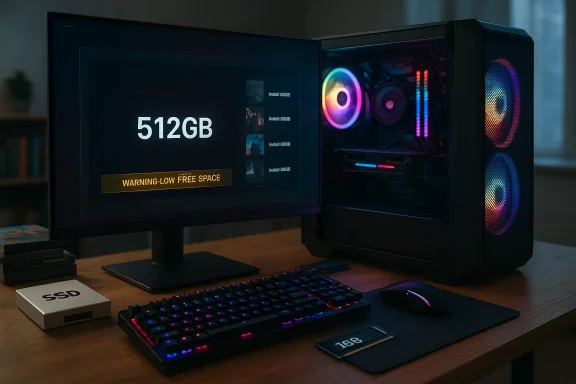
For many gamers, 512 GB is no longer a luxury number; it is the point where a PC starts to feel normal. Anything below that quickly becomes a game of file triage, uninstalling one title to make room for another, and watching patch sizes eat away at the remaining headroom. That is not a great experience for a market that increasingly sells convenience, fast loading, and instant access.
Lexar’s reported observation lines up with how people actually use consumer PCs. Even if a system boot drive technically works at 256 GB or smaller, the owner often ends up treating it like a temporary staging area instead of a real gaming library. That means a lower-capacity SSD can feel like a false economy, even if it saves money upfront.
Capacity is now a usability feature
The storage question is no longer merely about raw gigabytes. It is about how often the user has to think about file management, install locations, cloud sync, and cleanup utilities. A larger SSD silently removes friction, and friction is what consumers hate most.
A few practical forces have pushed 512 GB into the mainstream:
- Modern AAA games often require tens or hundreds of gigabytes.
- Shader caches, launcher data, and update files consume hidden space.
- Windows itself now expects enough free headroom for updates and maintenance.
- Many users want at least two or three large games installed at once.
- SSD performance stays consistently good only when the drive is not nearly full.
When storage gets tight, the machine feels older than it is. That perception is powerful, because buyers do not benchmark emotions, but they absolutely react to them.
The shift also changes how budget builders reason. A user can tolerate a smaller RAM kit if the machine still feels responsive enough for everyday tasks. But a cramped SSD creates immediate annoyance the first time a big install fails or a launcher forces a long cleanup session. That kind of pain is memorable.
RAM Is Becoming the More Flexible Compromise
Lexar’s point about users accepting smaller RAM kits is important because it reflects a different kind of tradeoff. RAM is performance-critical, but it is often less visible to the end user than storage capacity. If a gamer can keep multitasking, browsing, and running their titles smoothly, they may accept 16 GB where they once would have insisted on 32 GB.
That doesn’t mean RAM is suddenly unimportant. It means consumers perceive RAM as a quality-of-performance item, while SSD space is increasingly a quality-of-life item. The latter is easier to justify in a purchase decision because it protects the user from ongoing inconvenience.
Minimums versus practical standards
Microsoft still lists 4 GB as the Windows 11 minimum, but that is far below what most enthusiasts consider reasonable in 2026. The practical baseline for a gaming desktop is significantly higher, and 16 GB is often treated as the entry point for smooth everyday use. Microsoft’s own consumer guidance supports the broader idea that real-world systems need more than minimum specs to stay comfortable over time.
This is why the RAM-versus-SSD decision is not symmetrical. A smaller RAM kit may still deliver a system that boots quickly, runs the OS, and handles a game session. A smaller SSD, by contrast, can become a management problem before the user even finishes installing their first few games.
The economics of the two components also differ. RAM is often purchased in a narrower set of capacities, and users may be more willing to choose 16 GB now with an upgrade path later. Storage choices can be harder to undo because the boot drive is already in use, and moving an entire library later is tedious. Convenience is the hidden spec here.
The Modern Game Library Has Broken Small Drives
The biggest reason 512 GB now feels like a floor is simple: game installs are huge. A modern PC owner can easily lose a third of a 512 GB drive to Windows, core applications, and caches before launching a single major title. Add a few big releases, and the remaining space can disappear very quickly.
Microsoft’s own gaming-related materials and support pages reinforce the general direction of travel. Even years ago, Flight Simulator demanded serious space, and more recent Microsoft guidance points buyers toward larger drives if they want room for games and media. That is a sign of where the market has been headed all along.
Games are not the only thing consuming space
The storage challenge is bigger than install size alone. Launchers, update files, mod directories, shader caches, recording software, and captured clips all stack up. Even a disciplined gamer can find a “clean” drive filling much faster than expected.
This is why many users mentally treat SSD capacity as part of the gaming experience, not a background component. If a machine can’t hold a healthy rotation of current games, it is less useful, no matter how fast it is on paper. The user may never say “my storage policy is bad,” but they absolutely feel it.
A useful way to think about the shift is this:
- The game is too large to be treated as a temporary download.
- The SSD must therefore function like a library shelf.
- A small shelf creates daily friction.
- Daily friction drives upgrades faster than benchmarks do.
That logic explains why people will spend more to avoid a 256 GB SSD than they will to jump from 16 GB to 32 GB of memory. The pain point is more immediate.
What Lexar’s Comment Says About Retail Behavior
Lexar’s reported observation is not just a product note; it is a window into what actually moves on shelves. If 256 GB SSDs are stagnant while 512 GB and larger drives remain preferred, then manufacturers and retailers have a clear signal about where the market’s center of gravity sits. That matters for channel planning, bundle strategies, and product segmentation.
The company’s broader point also reflects a familiar consumer pattern: buyers can be educated into tolerating less in one category if the savings feel meaningful, but there are some thresholds they simply do not want to cross. In storage, 512 GB appears to be one of those thresholds. Below it, the compromise starts to feel like a downgrade rather than a saving.
Pricing pressure does not always reshape priorities
The memory market has been volatile enough that many buyers are rethinking how much RAM they truly need at the time of purchase. Spot-market reports in 2025 showed dramatic DDR4 movements, and TechPowerUp highlighted a period where 16 Gb DDR4 module pricing rose steeply before only a modest correction. That kind of pricing shock encourages selective spending, but it does not automatically make storage less important.
Instead, consumers appear to be compressing their compromise into the part of the build that hurts least. For some, that means one step down on RAM capacity. For others, it means delaying a CPU upgrade or settling for a more modest motherboard feature set. The point is not that users love smaller memory kits. The point is that they hate small SSDs even more.
Retailers should read that carefully. A low-capacity SSD may look attractive in an entry-level price table, but if it does not convert, it is simply dead shelf space. The market may reward slightly larger drives with much better sell-through, even when margins per unit are tighter.
Enterprise Habits Are Bleeding Into Consumer Expectations
It would be a mistake to treat this as only a gamer story. The broader computing market has been training consumers to expect larger SSDs for years, especially as notebooks, handhelds, and compact desktops have normalized flash storage as the default. Once people get used to fast, silent, always-on solid-state storage, HDDs feel like a fallback.
Lexar’s remark that some users would rather revert to HDDs than buy an SSD smaller than 512 GB is telling. It suggests that raw capacity still beats the inconvenience of slow mechanical storage for certain budgets, but only if the price difference is significant enough. The modern buyer is essentially saying that if they must compromise, they would rather compromise on speed than on space.
The cloud has not eliminated local storage needs
There is a common assumption that streaming, cloud saves, and game launchers reduce the need for local storage. In practice, they have not. Local installs remain necessary for latency, offline access, modding, and reliability, and users still need room for temporary data even when the primary content is online.
That means the SSD remains the center of gravity in both consumer and small-business PCs. Whether the system is used for gaming, creative work, or mixed productivity, the drive capacity question keeps returning. More cloud usage has changed what people store locally, but not the need to store things locally.
The consumer effect is especially strong in gaming because game files are simply too large to treat casually. The result is a market where buyers may accept a slightly smaller memory kit, but they are increasingly unwilling to accept a storage configuration that feels like a stopgap. That is a durable behavioral shift.
AI Demand and Memory Markets Are Distorting the Build Equation
The current pricing environment matters because AI infrastructure demand has created unusually strong pressure across parts of the semiconductor supply chain. That pressure influences what consumers can afford, even when the consumer and data-center markets are not buying the exact same products. In practice, one market’s appetite can reshape another market’s pricing and availability.
That is why the RAM-versus-SSD decision is not just about preference. It is also about what is available at a rational price. When memory costs spike and storage remains comparatively easier to justify, consumers adapt accordingly. They spend where the pain is more visible and delay where the pain is more abstract.
The market is teaching buyers to prioritize
DRAM price commentary over the last year has shown how quickly the memory landscape can change. When a component that used to be cheap becomes materially more expensive, buyers redraw their budgets. That can produce strange outcomes, including configurations that would have looked unbalanced a few years ago.
What makes the current moment unusual is that storage is not the part people are being asked to sacrifice first. Normally, consumers instinctively protect CPU and GPU performance. But in many mainstream gaming systems, those big-ticket components have already gotten expensive enough that buyers search for savings elsewhere. RAM becomes negotiable. SSD capacity does not.
That creates a market signal manufacturers cannot ignore. If users keep demanding 512 GB as the entry point, vendors will keep shaping product tiers around that expectation. The floor moves upward, and the industry follows.
Enterprise and Consumer Impact Are Not the Same
For enterprises, the discussion is less emotional and more logistical. IT departments care about fleet consistency, total cost of ownership, and supportability. For consumers, especially gamers, the decision is personal: how many titles can I install, and how annoying will this PC be to live with?
That difference matters because the same hardware can be judged very differently in each market. A company may spec a smaller drive and rely on centralized storage or cloud workflows. A gamer, meanwhile, expects the local machine to handle everything without constant pruning.
Gaming PCs are judged by everyday convenience
A business user can often work around a modest SSD because the machine is designed around managed workflows. A gamer cannot easily work around a cramped library drive because the entire value proposition is built around local performance and immediate access. That is why gaming demand can pull storage expectations upward faster than some enterprise purchase cycles would suggest.
This also helps explain the strength of 512 GB as a consumer norm. It is large enough to feel modern, but not so large that it destroys entry-level pricing. For builders, it is the first capacity that feels like a real SSD rather than a placeholder.
In that sense, Lexar’s comment may reflect the broader desktop market better than it first appears. The consumer is not asking for lavish storage. They are asking for enough to avoid constant compromise. That is a very different demand signal, and a much stronger one.
Strengths and Opportunities
The upside for storage vendors is obvious: if 512 GB is now the psychological minimum, then product lines that previously looked midrange can become volume leaders. That creates room for better segmentation, clearer marketing, and stronger attach rates on larger capacities. It also gives builders a more coherent value story, because customers can see why the extra spend is worthwhile.
- 512 GB as a mainstream floor gives vendors a clearer default SKU.
- Larger SSDs can be marketed as convenience, not just speed.
- Gaming bundles can pair sensible storage with modest RAM to hit budgets.
- Inventory planning becomes easier when low-capacity drives lose appeal.
- Consumer education can focus on real-world install space rather than benchmarks.
- Retail conversion may improve if customers stop seeing 256 GB as acceptable.
- Upgrade cycles could accelerate as users outgrow cramped boot drives faster.
The opportunity is not limited to premium products. If manufacturers can deliver higher-capacity drives at affordable price points, they can absorb demand from users who are trading away RAM or other parts of the build. That makes storage one of the few areas where “more” still sells cleanly.
Risks and Concerns
The main risk is that buyers may assume they can always “fix” a small SSD later, only to discover how annoying migration, cloning, and reinstalling actually are. Another concern is that memory pricing volatility could push users into uneven configurations that are cheap now but awkward later. In the worst case, the current environment normalizes under-specced builds that feel compromised from day one.
- Low-capacity SSDs may become unsellable inventory in some channels.
- Budget builders may underinvest in RAM and regret it sooner than expected.
- Price spikes could make balanced builds harder to achieve.
- Consumers may misread minimum specs as practical recommendations.
- Small SSDs fill quickly, creating support complaints and return risk.
- HDD fallback thinking can reintroduce performance frustration.
- AI-driven component demand may keep memory pricing unstable longer than expected.
There is also a broader market risk: if vendors overcorrect and assume everyone wants large SSDs, they may ignore price-sensitive buyers who still need an ultra-low entry point. The sweet spot is not “biggest possible.” It is “big enough that the user never feels punished.”
Looking Ahead
The next phase of this story will likely be defined by how quickly manufacturers re-center their mainstream offers around 512 GB and 1 TB storage tiers. If memory pricing remains unstable while SSD prices stay relatively accessible, the RAM-versus-storage tradeoff may become even more pronounced. That would reinforce Lexar’s observation and make storage the more durable part of the build.
At the same time, gamers are becoming more sophisticated about what they will and will not compromise on. They understand that they can survive with a slightly smaller RAM kit far more easily than with a tiny boot drive. That is a sign of a mature PC market: users now know which bottlenecks are tolerable and which ones are not. And in 2026, storage is the bottleneck they refuse to accept.
What to watch:
- Retail SSD mix shifts toward 512 GB as the new entry point.
- RAM promotions may become more aggressive to keep builds balanced.
- PC OEM configurations could move away from sub-512 GB system drives.
- Game install sizes will continue to pressure small-capacity systems.
- Memory market volatility may keep the RAM upgrade path uncertain.
- Consumer expectations may harden around 1 TB as the next comfort tier.
The broader lesson is simple: the market is not merely chasing faster hardware anymore. It is chasing less annoyance. If Lexar’s read on gamer behavior holds, then the industry is entering a phase where capacity, not just speed, will define what “good enough” means for mainstream PCs.
