

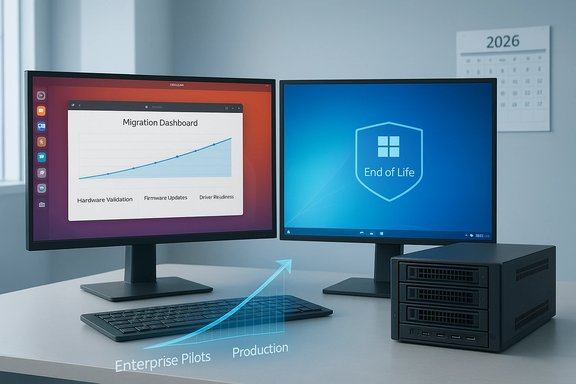
The tectonic plates of desktop computing are shifting—quietly, cumulatively, and in ways that matter to IT leaders. What began as curiosity and opportunistic testing in 2025 has become a set of measurable signals: a wave of distro downloads timed to Windows 10’s end of support, rising Linux usage in web and gaming telemetry, clearer OEM engagement, and an approaching Ubuntu LTS that tightens the enterprise story. Together these forces make 2026 the year when more Linux desktops could realistically move from lab pilots to selective production deployments—if the ecosystem resolves several stubborn technical and commercial gaps first.
The immediate catalyst is straightforward: Windows 10 reached end of support on October 14, 2025, creating a hard deadline for millions of devices and forcing organizations to choose between Windows 11 upgrades, paid Extended Security Updates (ESU), hardware replacement, or alternatives such as ChromeOS or Linux. Microsoft’s lifecycle notices and guidance framed the date as an operational inflection point. At the same time, several Linux distributions timed polished releases and migration tooling to that calendar pressure, producing unusually large interest spikes. Zorin OS 18, positioned explicitly as a Windows-friendly migration path, rapidly accumulated download milestones in weeks and months after its release—signals that many users are actively testing Linux as a practical alternative. Outside consumer headlines, telemetry from web analytics and gaming surveys recorded small but meaningful market-share gains for desktop Linux. StatCounter and similar trackers showed Linux nudging into the low-to-mid single digits in important markets, while Valve’s Steam Hardware & Software Survey registered Linux at its highest recent levels among gamers—numbers that matter because even a low single-digit shift in a large base translates to millions of devices and meaningful developer attention. Those are the headline facts; what follows is a practical, evidence-based assessment of why 2026 could be different from past “Year of Linux” predictions—and where the real risks and opportunities lie for enterprises.
The combination of Windows 10’s end of support, improved Proton compatibility and gaming signals, developer-friendly distros with low-friction migration tooling, and the stabilizing cadence of Ubuntu 26.04 LTS makes 2026 a credible inflection year for incremental Linux desktop growth in enterprises. The deciding factors will be conversion and retention metrics, OEM and ISV commitments, and whether management and security tooling can match enterprise expectations.
For IT decision-makers: treat 2026 as a planning year. Run instrumented pilots, insist on measurable KPIs, and demand vendor-validated hardware paths. For the Linux ecosystem: the priority is converting curiosity into durable deployments by improving enterprise-grade tooling, publishing transparent retention data, and resolving outstanding driver and anti‑cheat gaps.
The market is moving from curiosity to consequence. Those who prepare with measured pilots, fallback strategies, and clear metrics will be ready to seize the competitive and environmental benefits should the Linux desktop continue its steady climb.
Source: TechTarget https://www.techtarget.com/searchen...com/article/windows-insider-program-changes/]
 Background / Overview
The immediate catalyst is straightforward: Windows 10 reached end of support on October 14, 2025, creating a hard deadline for millions of devices and forcing organizations to choose between Windows 11 upgrades, paid Extended Security Updates (ESU), hardware replacement, or alternatives such as ChromeOS or Linux. Microsoft’s lifecycle notices and guidance framed the date as an operational inflection point. At the same time, several Linux distributions timed polished releases and migration tooling to that calendar pressure, producing unusually large interest spikes. Zorin OS 18, positioned explicitly as a Windows-friendly migration path, rapidly accumulated download milestones in weeks and months after its release—signals that many users are actively testing Linux as a practical alternative. Outside consumer headlines, telemetry from web analytics and gaming surveys recorded small but meaningful market-share gains for desktop Linux. StatCounter and similar trackers showed Linux nudging into the low-to-mid single digits in important markets, while Valve’s Steam Hardware & Software Survey registered Linux at its highest recent levels among gamers—numbers that matter because even a low single-digit shift in a large base translates to millions of devices and meaningful developer attention. Those are the headline facts; what follows is a practical, evidence-based assessment of why 2026 could be different from past “Year of Linux” predictions—and where the real risks and opportunities lie for enterprises.What changed in 2025–early 2026: seven reinforcing vectors
1. A calendar-driven decision point: Windows 10 EOL
The October 14, 2025 end-of-support date compressed upgrade windows and forced procurement cycles. For many organizations, the choice was no longer theoretical: keep unpatched machines, pay for short-term ESU, upgrade hardware to meet Windows 11 requirements (TPM, CPU, Secure Boot), or consider an alternative OS. That operational pressure created a rare, time-boxed opportunity for Linux distributions to present migration offers that made sense financially and logistically.2. Distro engineering and migration tooling improved
Some distributions invested deliberately in onboarding friction reduction: migration assistants, built-in cloud sync (OneDrive/Web Apps), and appearance/layouts that reduce the learning curve for Windows users. Zorin OS 18 is a clear example: a polished interface plus explicit upgrade paths and marketing aimed at Windows switchers produced rapid download traction. However, downloads are not installs, and installs are not retention—download metrics are interest, not finalized enterprise decisions.3. Gaming and Proton lowered a major consumer friction
Valve’s Proton compatibility work and the Steam Deck’s mainstream visibility changed the lived experience for many gamers. Proton's steady improvements and Valve’s SteamOS presence mean thousands of titles are playable on Linux, and Steam’s survey showed Linux usage at all‑time highs in late 2025. For the millions of endpoints that live or die by gaming compatibility, this reduced a long-standing reason to keep Windows around. Still, anti-cheat and kernel‑level protections remain the biggest unresolved hurdles for competitive multiplayer titles.4. OEM and vendor signals
OEMs and boutique vendors increasingly surface Linux as a supported option for specific SKUs and refurbished channels. Better vendor validation—factory images, LVFS/fwupd firmware updates, and explicit compatibility matrices—reduces the day‑one driver surprises that historically sank many Linux installs. This vendor engagement is growing, but it is uneven across parts and price tiers.5. Public-sector pilots and procurement momentum
Municipal and educational pilots that emphasize cost, sovereignty, and device longevity provide high-credibility case studies for cautious enterprises. Local government migrations (documented pilots, staged rollouts) have shown tangible TCO and sustainability gains, which can tip procurement policy when audited counts and timelines are published. Those institutional pilots matter because enterprises look to them for operational proof.6. Measurable telemetry and market share movement
Multiple independent datasets—StatCounter browser OS telemetry, government analytics (DAP), and commercial inventory scans—converge on the same pattern: Linux is rising from very small shares into the low single digits in consumer desktop contexts, with pockets exceeding that in targeted markets. These are modest percentages, but in absolute terms they represent millions of endpoints and a change in the calculus for ISVs and OEMs.7. A near-term technical calendar: Ubuntu 26.04 LTS
Canonical’s Ubuntu 26.04 LTS (Resolute Raccoon) is scheduled for release on April 23, 2026, with well-defined freeze milestones in February–April. An LTS release with strong enterprise support expectations provides a predictable platform for pilot testing and for vendors to validate drivers and management tooling. The LTS schedule tightens the enterprise migration window in a way that’s operationally meaningful for IT teams planning pilots in 2026.Enterprise readiness: where Linux is credible today
Workloads and user segments most amenable to Linux desktops
- Developers and engineers: native toolchains and server continuity make Linux a natural fit.
- Knowledge workers with web-first apps: browser-first workflows, cloud suites, and web portals often run equally well on Linux.
- Refurbishment programs and sustainability-driven teams: older hardware often performs better under lightweight Linux desktops.
- Education and municipal deployments: where procurement can be tailored and standardized images are feasible.
Management tooling and identity integration
Enterprise adoption depends on mature management tooling—patch orchestration, endpoint visibility, directory integration (SSSD/Samba/AD), and MDM parity. Vendors and commercial Linux distros are improving offerings (Canonical, Red Hat, and several third-party providers), but parity with Windows‑centric fleets (Intune, Group Policy, Microsoft Defender integrations) remains a work in progress. Expect staged pilots and hybrid models (Linux for general-purpose endpoints, Windows VMs for legacy apps) to remain the default pattern in 2026.ISV and vertical app constraints
Industry-specific Windows-only applications—medical imaging suites, specialized finance terminals, manufacturing control software—still anchor many enterprises to Windows. The choices are: maintain a Windows VM fallback, replatform the application, or keep a small Windows pool. Until ISVs sign on with certified Linux builds or validated compatibility layers, large-scale enterprise conversions will be incremental and targeted.Technical barriers that still matter
Driver and peripheral coverage
Wi‑Fi adapters, fingerprint readers, power management, docking stations, and some printers/scanners still trigger first‑boot failures or degraded functionality on Linux. Kernel changes occasionally regress vendor-supplied closed drivers, and while GPU vendors have improved upstream cooperation, the problem is not fully solved. The practical mitigation is vendor-validated SKUs, LVFS firmware support, and thorough live‑USB testing before any fleet decision.Anti‑cheat and DRM
Kernel-level anti-cheat systems remain a significant blocker for multiplayer and competitive titles. Proton and compatibility stacks cover many single-player and indie games, but where anti-cheat is required—especially at the kernel level—publishers and anti-cheat vendors must re-architect or provide signed Linux solutions before gaming will fully enable mainstream Linux adoption. This constraint matters less for enterprises but is a major consumer-to-developer signaling mechanism.Measurement ambiguity: downloads vs installs vs retention
A recurring caveat: distro download counts (even in the millions) are an interest metric, not a reliable measure of active installations or daily retention. Many downloads are trials, images burned to USB for testing, or repeated fetches. The crucial, enterprise-relevant metrics are active devices, retention rates, and audited fleet counts—data that few distro projects publish routinely. Treat download spikes as leading indicators, not as finalized conversions.Practical migration playbook for IT leaders (30–90 day pilot)
- Inventory: map devices, OS eligibility for Windows 11, and list all Windows‑only or vendor‑certified apps and peripherals.
- Define KPIs: support tickets per user, time-to-resolve, user satisfaction, app compatibility success rate, and cost differentials versus ESU or hardware replacement.
- Pilot cohort selection: pick non‑critical groups (administrative staff, developers, small teams) and equip them with a rollback plan.
- Live‑USB validation: require pilot users to run a live session for one full workweek to validate Wi‑Fi, printers, video conferencing, and the top three daily apps.
- Fallbacks: keep Windows VMs or dedicated Windows devices for patent‑roadmap apps or regulatory software.
- Support model: evaluate internal helpdesk readiness and commercial support contracts (Canonical, Red Hat, and select integrators).
- Measure and iterate: collect telemetry (opt‑in), audit conversions, and publish retained endpoint counts if scaling is justified.
Commercial and competitive implications
- For OEMs: offering factory‑installed Linux or certified refurb units is a new revenue path, but it requires explicit business cases and channel training. Widespread preinstalls would be a structural game-changer if they scale beyond boutique SKUs.
- For ISVs: a small but growing Linux install base—backed by credible telemetry—creates a business case to prioritize Linux ports or to certify compatibility layers. Expect selective ISV commitments for high‑value vertical apps before broad support arrives.
- For Microsoft and Windows ecosystem partners: the sensible response is to reduce upgrade friction, offer clear ESU/pricing, and engage constructively on interoperability; ignoring customer pain points risks accelerating migration vectors.
What to watch in 2026 — measurable signals that matter
- Distribution projects publishing install completions and retention metrics (not just ISO downloads).
- StatCounter/DAP-style browser telemetry showing sustained, multi-month Linux share growth outside gaming niches.
- OEM announcements for broadly available, factory‑installed Linux SKUs or major refurbisher programs.
- ISV commitments to signed drivers, anti‑cheat support, or native Linux builds in release notes.
- Ubuntu 26.04 LTS general availability and downstream enterprise validation cycles after April 23, 2026.
Risks, caveats and a cautionary appraisal
- Downloads do not equal installs; installs do not equal retention; retention does not equal enterprise migration. Treat early distro numbers as strong interest signals but not definitive proof of broad replacement. Caveat: any extrapolation from downloads to fleet replacement must be explicitly labeled speculative.
- Vendor lock‑in and vertical application dependencies are real constraints for regulated industries; many large enterprises will prefer hybrid strategies that mix Linux and Windows for the foreseeable future.
- Hardware regressions and closed drivers can still break day‑one experiences; test all peripherals before a fleet decision and prefer vendor-validated SKUs for scale deployments.
- Anti‑cheat and DRM remain structural barriers for consumer gaming parity and developer prioritization; until solved broadly, certain gaming-focused users will retain Windows.
- Measurement and sampling bias in public telemetry means single-source claims are unreliable; use triangulation across StatCounter, Steam Survey, DAP data, and independent inventory scans for a responsible picture.
Conclusion — a pragmatic forecast
2026 is unlikely to produce a single headline moment announcing the “death of Windows.” Instead, expect a pragmatic, multi‑vector evolution: Linux will expand in targeted segments—developers, public sector pilots, refurb programs, and selected knowledge-worker fleets—while enterprises adopt measured hybrid strategies that preserve Windows where it is operationally necessary.The combination of Windows 10’s end of support, improved Proton compatibility and gaming signals, developer-friendly distros with low-friction migration tooling, and the stabilizing cadence of Ubuntu 26.04 LTS makes 2026 a credible inflection year for incremental Linux desktop growth in enterprises. The deciding factors will be conversion and retention metrics, OEM and ISV commitments, and whether management and security tooling can match enterprise expectations.
For IT decision-makers: treat 2026 as a planning year. Run instrumented pilots, insist on measurable KPIs, and demand vendor-validated hardware paths. For the Linux ecosystem: the priority is converting curiosity into durable deployments by improving enterprise-grade tooling, publishing transparent retention data, and resolving outstanding driver and anti‑cheat gaps.
The market is moving from curiosity to consequence. Those who prepare with measured pilots, fallback strategies, and clear metrics will be ready to seize the competitive and environmental benefits should the Linux desktop continue its steady climb.
Source: TechTarget https://www.techtarget.com/searchen...com/article/windows-insider-program-changes/]
