

Tesla’s 2026 Model 3 Premium Long Range RWD has arrived in Australia as a $61,900 before-on-roads electric sedan claiming up to 750km of range, adding Grok voice assistance and optional FSD (Supervised) while undercutting its predecessor. That makes it more than another Tesla trim shuffle. It is a reminder that the Model 3’s most disruptive trick was never just acceleration, minimalism, or even charging access. It was forcing every other EV maker to explain why their longer, heavier, newer, or more expensive car still cannot travel as far.
The most important thing about the latest Model 3 Long Range RWD is not that it looks dramatically new, because it does not. It is that Tesla has made a 750km WLTP claim feel almost routine in a mid-size sedan that sits closer to the mainstream than the luxury fringe.
That matters because EV range has spent years as both a selling point and a psychological obstacle. Buyers say they want more of it, even when their daily use rarely demands it. Automakers respond with larger batteries, taller SUVs, and ever-higher price tags, often turning range into a premium-class feature rather than a mass-market expectation.
Tesla’s move is more surgical. By pairing a large battery with rear-wheel drive, aerodynamic sedan packaging, and Tesla’s long-running efficiency obsession, the Model 3 turns endurance into a relatively attainable configuration rather than a halo model. The Performance variant remains the emotional choice, but the Long Range RWD is the adult in the room.
CarExpert’s review lands on that exact tension. The Model 3 is no longer shocking because it is strange; it is compelling because the strange bits now sit inside a car that is otherwise polished, efficient, quick, practical, and relatively affordable. The disruptive Tesla of old wanted to prove that EVs could be exciting. The 2026 Model 3 is making the more dangerous argument that most rivals are still wasting energy.
That advantage shows up in the numbers. The Model 3 Premium Long Range RWD’s claimed 12.5kWh/100km energy consumption is the kind of figure that makes many electric crossovers look clumsy. CarExpert’s tested 13.3kWh/100km result is more meaningful than the brochure claim because it suggests the car’s efficiency is not merely a laboratory artifact.
The claimed 750km range will not be the number every owner sees every week. Weather, speed, tyres, payload, elevation, and climate control all matter. Australian highway driving is especially good at humbling optimistic range figures, and WLTP remains a standardized comparison tool rather than a promise from the gods.
But even when discounted, the headline figure gives the Model 3 a buffer many competitors lack. If a rival’s official range starts in the 500s, real-world conditions can pull it into the zone where drivers begin planning around chargers. If a Tesla starts at 750km, the same percentage haircut still leaves a useful touring car.
CarExpert notes that it is $3000 cheaper than its predecessor. That is not just a discount; it is Tesla using maturity as leverage. The company has spent years refining the Model 3’s production, software, and supply chain, and it can now apply pressure where newer entrants are still trying to establish themselves.
The competitive set is getting stronger. The BYD Seal, Kia EV4, Mazda 6e, MG IM5, and Hyundai Ioniq 6 all give shoppers credible alternatives depending on taste, body style, dealer preference, and brand loyalty. The difference is that Tesla is fighting them with a car that has already gone through its awkward adolescence.
That is the hidden challenge for rivals. Beating Tesla on novelty is easy. Beating Tesla on a single feature is possible. Beating Tesla on price, range, software integration, charging confidence, performance, and owner familiarity all at once is much harder.
Soft-touch materials, synthetic leather, microfibre, fabric trim, carpet-lined storage areas, ventilated front seats, and a clean driving position give the car a more resolved feel than early Model 3 skeptics might expect. The review’s point that the cabin can feel unusually premium for the money is important because it undercuts an old anti-Tesla reflex: that buyers are sacrificing traditional car quality for battery and software.
The seating position also appears to remain one of the Model 3’s quiet strengths. Some cars feel as though the driver is perched inside a styled object; the Model 3’s low cowl, small wheel, and natural driving posture make it feel more integrated. That matters on long trips, where a spec sheet cannot rescue a car that never feels quite right.
Then comes the screen. Tesla’s 15.4-inch central display is the car’s command center, instrument panel, infotainment hub, gear selector, climate interface, navigation system, owner’s manual, and software stage. When it works, it feels coherent in a way many legacy-car touchscreens do not. When it irritates, it irritates because Tesla has made the screen not just useful but mandatory.
That trade-off is not fatal, but it is real. Automakers often dream of owning the full digital relationship with the driver, and Tesla is one of the few with enough software competence to make that dream tolerable. Still, “our system is good” is not the same as “you will not miss yours.”
The gear selector is the sharper example. Swiping on a screen to select drive or reverse is clever in the showroom and faintly absurd in a three-point turn. The overhead backup controls may satisfy a regulatory or redundancy requirement, but they do not restore the muscle-memory convenience of a stalk, lever, or physical switch.
Tesla’s Autoshift feature tries to solve this by predicting the desired direction using context and sensor data. That is exactly the kind of engineering flourish Tesla loves: turn a deleted control into an AI feature. But the complaint remains obvious. The best interface is often the one that does not need prediction in the first place.
If Grok can handle natural requests, navigation queries, and broader contextual tasks with fewer scripted commands, it may soften the pain of Tesla’s screen-first philosophy. CarExpert’s experience suggests it can already manage basic navigation help, more nuanced destination distinctions, and the sort of personality-driven responses that make AI assistants feel less like menu trees.
The risk is that conversational AI becomes another layer of spectacle over unresolved ergonomics. Voice is excellent when your hands are busy and the request is simple. It is less ideal when passengers are talking, reception is poor, accents confuse the system, or the driver simply wants to change seat ventilation without announcing it to the cabin.
That is the Model 3’s interior contradiction in miniature. It is modern, clean, well equipped, and often delightful. It is also a rolling argument that almost every physical control is a failure of imagination. Many buyers will accept that argument. Others will decide Tesla has mistaken deletion for progress.
The storage story is also strong. Between the rear boot, underfloor space, and front trunk, the Model 3 offers a claimed 682 litres of combined cargo capacity. That gives it a practical edge over many sedans and helps explain why Tesla owners often use these cars as do-everything household vehicles rather than delicate commuter pods.
But the second row is not limousine-like. CarExpert’s criticism of kneeroom and limited foot space under the front seats is a reminder that skateboard EV platforms do not automatically guarantee packaging miracles. Battery placement, seat mounting, floor height, and roofline all shape comfort.
Adults can fit, and children will likely be fine, but the Model 3 is not the answer for every family. A Model Y or another electric crossover will still make sense for buyers who prioritize rear-seat ease, hip-point height, and loading bulky child gear. The Model 3’s advantage is efficiency; the cost is some of the spatial generosity buyers now associate with SUVs.
The current Model 3 appears to have crossed a more mature threshold. CarExpert describes a car with better ride comfort, quieter glass, revised steering behavior, and stronger overall cohesion after the Highland update. That is significant because it shifts the Model 3 from “fast EV” to “good sedan.”
The Long Range RWD configuration is especially interesting because it avoids the trap of excess. With 235kW and a claimed 0-100km/h time of 5.2 seconds, it is already quick enough for nearly any sane public-road use. The Performance model exists for buyers who want theatre, track capability, and all-wheel-drive punch, but the Long Range RWD may be the more elegant engineering answer.
Rear-wheel drive also gives the car a traditional dynamic character that should appeal to enthusiasts who have not completely surrendered to SUVs. The review’s praise for steering weight, body control, and grip suggests Tesla has not traded away driver involvement in pursuit of range. That balance is harder than it looks.
The caveat is wet-weather traction. A powerful rear-drive EV can struggle to deploy torque cleanly from a standstill on slippery roads, and CarExpert’s test car apparently did. That does not make all-wheel drive mandatory, but it does remind buyers that range, performance, and driven wheels are not abstract spec-sheet choices. They shape the car’s behavior when the road stops cooperating.
CarExpert’s account of point-to-point driving with driver oversight is striking. A system that can navigate from destination to destination, manage lane changes, and handle much of the workload is no longer a futuristic demo. It is a product feature that some buyers can subscribe to monthly.
But the review also notes questionable lane changes and speed fluctuations. That is the difference between impressive and trustworthy. A system can be remarkable and still require constant human judgment, especially when the legal and safety responsibility remains with the driver.
The subscription price matters because it changes buyer psychology. At $149 per month from Basic Autopilot in Australia, FSD (Supervised) becomes something drivers can trial, cancel, and reassess rather than a five-figure leap of faith. That is good for adoption, but it also reframes autonomy as an ongoing service rather than a fixed capability.
For IT-minded readers, the analogy is obvious. Tesla is moving the car further into the software-as-a-service world, where features are activated, improved, repriced, renamed, and sometimes regionally constrained over time. That model can deliver rapid improvement, but it also asks buyers to accept that part of the car’s value lives on the vendor’s side of the ledger.
Standard equipment is also broad. Autonomous emergency braking, blind-spot monitoring, adaptive cruise control, lane-keep assist, collision avoidance, parking sensors, a reversing camera, Sentry Mode, and seven airbags make the car competitive on paper. Tesla has long understood that safety is part engineering, part software, and part brand identity.
Still, safety ratings and autonomy marketing answer different questions. ANCAP can assess crash structures, occupant protection, and defined assistance functions under test conditions. It does not magically settle whether drivers will overtrust a supervised automation system or whether Tesla’s interface choices create avoidable distraction.
That distinction is especially important for a car that centralizes so many functions in one screen. A vehicle can be crashworthy and still ergonomically debatable. The Model 3’s safety case is strong, but it does not erase the concern that too many everyday actions require visual confirmation away from the road.
The charging network is central. Even as non-Tesla charging improves, Tesla’s reputation for reliable public charging still reduces anxiety for owners who actually travel. Range gets people interested, but charging confidence keeps them from regretting the purchase.
Low routine maintenance also helps. Tesla’s service recommendations are sparse compared with combustion vehicles: cabin filter changes, tyre rotation and balance checks, brake fluid checks, and climate-specific brake inspections. EVs are not maintenance-free, and tyres can suffer under instant torque and heavy battery weight, but the ownership rhythm is different.
The app experience is another advantage that legacy automakers still too often underestimate. Cabin preconditioning, charging control, location features, Sentry alerts, and over-the-air updates make the vehicle feel less like a static appliance. For buyers accustomed to managing everything else from a phone, that matters.
But ecosystem cuts both ways. The more Tesla controls, the more buyers must be comfortable with Tesla’s decisions. No CarPlay. Screen-based controls. Subscription autonomy. Brand association with Elon Musk. Software changes that can alter behavior after purchase. For some, this is the appeal. For others, it is the warning label.
Tesla’s brand is unusually fused with its chief executive. That helped the company when Musk symbolized technological daring and anti-establishment ambition. It complicates the company’s position now that his public persona has become more polarizing across markets.
The important point is not whether a reviewer, buyer, or forum reader personally likes or dislikes Musk. It is that brand risk has become part of the purchase calculus. A Model 3 is visible in a driveway. It signals participation in a company whose leader is never far from the news cycle.
For fleet managers and corporate buyers, that may matter less than total cost of ownership, charging access, and emissions targets. For private buyers, identity often matters more than spec-sheet rationalists admit. Tesla can build the best car in a segment and still lose some buyers before the test drive.
That is the unusual burden Tesla carries. Most automakers are trying to make their EVs more emotionally interesting. Tesla sometimes has to make its cars compelling enough to overcome emotions generated elsewhere.
This is healthy. The EV market needed competition that did not simply imitate Tesla’s tablet-on-wheels formula. Buyers should be able to choose between different interface philosophies, styling languages, warranty structures, and dealer experiences.
Yet the Model 3 remains the benchmark because it forces the comparison to be comprehensive. If a rival has a nicer cabin, does it match the range? If it has CarPlay, does it match the charging experience? If it is cheaper, does it match the efficiency? If it rides better, does it match the software? If it has more rear room, does it sacrifice energy consumption through a taller body?
The Model 3 does not win every category. It does something more valuable: it remains difficult to dismiss. Nearly a decade after launch, that is the mark of a serious platform.
The 2026 Long Range RWD also shows Tesla playing a different game from the one critics sometimes imagine. This is not a company relying only on hype cycles and robotaxi promises. At least in this product, Tesla is doing the unglamorous work of improving range, refinement, price, and equipment in a familiar car.
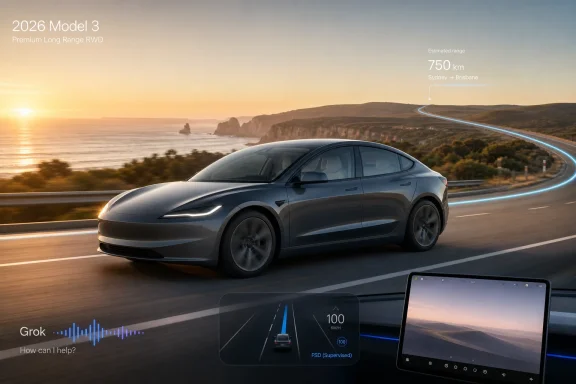 Tesla Finds a New Way to Make Range Boring
The most important thing about the latest Model 3 Long Range RWD is not that it looks dramatically new, because it does not. It is that Tesla has made a 750km WLTP claim feel almost routine in a mid-size sedan that sits closer to the mainstream than the luxury fringe.That matters because EV range has spent years as both a selling point and a psychological obstacle. Buyers say they want more of it, even when their daily use rarely demands it. Automakers respond with larger batteries, taller SUVs, and ever-higher price tags, often turning range into a premium-class feature rather than a mass-market expectation.
Tesla’s move is more surgical. By pairing a large battery with rear-wheel drive, aerodynamic sedan packaging, and Tesla’s long-running efficiency obsession, the Model 3 turns endurance into a relatively attainable configuration rather than a halo model. The Performance variant remains the emotional choice, but the Long Range RWD is the adult in the room.
CarExpert’s review lands on that exact tension. The Model 3 is no longer shocking because it is strange; it is compelling because the strange bits now sit inside a car that is otherwise polished, efficient, quick, practical, and relatively affordable. The disruptive Tesla of old wanted to prove that EVs could be exciting. The 2026 Model 3 is making the more dangerous argument that most rivals are still wasting energy.
The Sedan Shape Is Doing More Work Than the Badge
The broader EV market has drifted heavily toward SUVs, partly because customers like the seating position and partly because automakers like the margins. But physics has not been repealed. A lower, sleeker sedan still has a natural advantage when the goal is moving people and battery mass through the air with minimal waste.That advantage shows up in the numbers. The Model 3 Premium Long Range RWD’s claimed 12.5kWh/100km energy consumption is the kind of figure that makes many electric crossovers look clumsy. CarExpert’s tested 13.3kWh/100km result is more meaningful than the brochure claim because it suggests the car’s efficiency is not merely a laboratory artifact.
The claimed 750km range will not be the number every owner sees every week. Weather, speed, tyres, payload, elevation, and climate control all matter. Australian highway driving is especially good at humbling optimistic range figures, and WLTP remains a standardized comparison tool rather than a promise from the gods.
But even when discounted, the headline figure gives the Model 3 a buffer many competitors lack. If a rival’s official range starts in the 500s, real-world conditions can pull it into the zone where drivers begin planning around chargers. If a Tesla starts at 750km, the same percentage haircut still leaves a useful touring car.
The Price Cut Is the Quiet Knife
At $61,900 before on-road costs, the Premium Long Range RWD is not cheap in the absolute sense. It is still a new-car purchase requiring the kind of household budget that excludes many buyers. But inside the Australian EV market, it is priced with a ruthlessness that should make product planners uncomfortable.CarExpert notes that it is $3000 cheaper than its predecessor. That is not just a discount; it is Tesla using maturity as leverage. The company has spent years refining the Model 3’s production, software, and supply chain, and it can now apply pressure where newer entrants are still trying to establish themselves.
The competitive set is getting stronger. The BYD Seal, Kia EV4, Mazda 6e, MG IM5, and Hyundai Ioniq 6 all give shoppers credible alternatives depending on taste, body style, dealer preference, and brand loyalty. The difference is that Tesla is fighting them with a car that has already gone through its awkward adolescence.
That is the hidden challenge for rivals. Beating Tesla on novelty is easy. Beating Tesla on a single feature is possible. Beating Tesla on price, range, software integration, charging confidence, performance, and owner familiarity all at once is much harder.
The Interior Is Premium Until It Becomes Ideological
One of the more interesting parts of CarExpert’s review is the praise for the Model 3’s cabin materials. Tesla interiors have often been caricatured as sparse, cheap, or tech-bro austere, sometimes fairly and sometimes lazily. The current Model 3 complicates that picture.Soft-touch materials, synthetic leather, microfibre, fabric trim, carpet-lined storage areas, ventilated front seats, and a clean driving position give the car a more resolved feel than early Model 3 skeptics might expect. The review’s point that the cabin can feel unusually premium for the money is important because it undercuts an old anti-Tesla reflex: that buyers are sacrificing traditional car quality for battery and software.
The seating position also appears to remain one of the Model 3’s quiet strengths. Some cars feel as though the driver is perched inside a styled object; the Model 3’s low cowl, small wheel, and natural driving posture make it feel more integrated. That matters on long trips, where a spec sheet cannot rescue a car that never feels quite right.
Then comes the screen. Tesla’s 15.4-inch central display is the car’s command center, instrument panel, infotainment hub, gear selector, climate interface, navigation system, owner’s manual, and software stage. When it works, it feels coherent in a way many legacy-car touchscreens do not. When it irritates, it irritates because Tesla has made the screen not just useful but mandatory.
Minimalism Still Has a Cost
Tesla’s refusal to support Apple CarPlay and Android Auto remains one of the company’s most stubborn decisions. The native navigation is strong, live traffic integration is useful, and Tesla’s route planning has long been one of the better EV experiences. But for drivers committed to Waze, Apple Maps, Google Maps, podcast apps, messaging workflows, or phone-native habits, Tesla is still asking them to give something up.That trade-off is not fatal, but it is real. Automakers often dream of owning the full digital relationship with the driver, and Tesla is one of the few with enough software competence to make that dream tolerable. Still, “our system is good” is not the same as “you will not miss yours.”
The gear selector is the sharper example. Swiping on a screen to select drive or reverse is clever in the showroom and faintly absurd in a three-point turn. The overhead backup controls may satisfy a regulatory or redundancy requirement, but they do not restore the muscle-memory convenience of a stalk, lever, or physical switch.
Tesla’s Autoshift feature tries to solve this by predicting the desired direction using context and sensor data. That is exactly the kind of engineering flourish Tesla loves: turn a deleted control into an AI feature. But the complaint remains obvious. The best interface is often the one that does not need prediction in the first place.
Grok Enters the Cabin, but the Screen Still Rules
The addition of Grok as a more conversational voice assistant is a sign of where Tesla thinks the in-car experience is headed. Voice control has been promised as the antidote to touchscreen overload for years, but most automotive systems have been too brittle, too slow, or too linguistically narrow to replace buttons.If Grok can handle natural requests, navigation queries, and broader contextual tasks with fewer scripted commands, it may soften the pain of Tesla’s screen-first philosophy. CarExpert’s experience suggests it can already manage basic navigation help, more nuanced destination distinctions, and the sort of personality-driven responses that make AI assistants feel less like menu trees.
The risk is that conversational AI becomes another layer of spectacle over unresolved ergonomics. Voice is excellent when your hands are busy and the request is simple. It is less ideal when passengers are talking, reception is poor, accents confuse the system, or the driver simply wants to change seat ventilation without announcing it to the cabin.
That is the Model 3’s interior contradiction in miniature. It is modern, clean, well equipped, and often delightful. It is also a rolling argument that almost every physical control is a failure of imagination. Many buyers will accept that argument. Others will decide Tesla has mistaken deletion for progress.
The Back Seat Reveals the Model 3’s Family-Car Limits
The Model 3’s rear cabin shows how far Tesla has come and where the sedan format still imposes limits. The rear touchscreen is a genuinely unusual feature at this price point, offering climate control, entertainment apps, games, and Bluetooth headset support. For families, that is not a gimmick; it can be the difference between a quiet trip and a negotiation.The storage story is also strong. Between the rear boot, underfloor space, and front trunk, the Model 3 offers a claimed 682 litres of combined cargo capacity. That gives it a practical edge over many sedans and helps explain why Tesla owners often use these cars as do-everything household vehicles rather than delicate commuter pods.
But the second row is not limousine-like. CarExpert’s criticism of kneeroom and limited foot space under the front seats is a reminder that skateboard EV platforms do not automatically guarantee packaging miracles. Battery placement, seat mounting, floor height, and roofline all shape comfort.
Adults can fit, and children will likely be fine, but the Model 3 is not the answer for every family. A Model Y or another electric crossover will still make sense for buyers who prioritize rear-seat ease, hip-point height, and loading bulky child gear. The Model 3’s advantage is efficiency; the cost is some of the spatial generosity buyers now associate with SUVs.
The Drive Experience Has Caught Up With the Numbers
For years, Tesla performance was discussed mainly in terms of acceleration. That was understandable because instant electric torque made even ordinary Teslas feel startling compared with combustion rivals. But acceleration alone does not make a car satisfying.The current Model 3 appears to have crossed a more mature threshold. CarExpert describes a car with better ride comfort, quieter glass, revised steering behavior, and stronger overall cohesion after the Highland update. That is significant because it shifts the Model 3 from “fast EV” to “good sedan.”
The Long Range RWD configuration is especially interesting because it avoids the trap of excess. With 235kW and a claimed 0-100km/h time of 5.2 seconds, it is already quick enough for nearly any sane public-road use. The Performance model exists for buyers who want theatre, track capability, and all-wheel-drive punch, but the Long Range RWD may be the more elegant engineering answer.
Rear-wheel drive also gives the car a traditional dynamic character that should appeal to enthusiasts who have not completely surrendered to SUVs. The review’s praise for steering weight, body control, and grip suggests Tesla has not traded away driver involvement in pursuit of range. That balance is harder than it looks.
The caveat is wet-weather traction. A powerful rear-drive EV can struggle to deploy torque cleanly from a standstill on slippery roads, and CarExpert’s test car apparently did. That does not make all-wheel drive mandatory, but it does remind buyers that range, performance, and driven wheels are not abstract spec-sheet choices. They shape the car’s behavior when the road stops cooperating.
FSD Is No Longer Vaporware, but It Is Still a Contract With the Driver
The arrival of FSD (Supervised) as a subscription option in Australia changes the Model 3 conversation. For years, Tesla’s autonomy branding has carried an unusual mix of genuine technical progress, regulatory ambiguity, owner enthusiasm, and justified skepticism. The word “supervised” is doing a lot of work.CarExpert’s account of point-to-point driving with driver oversight is striking. A system that can navigate from destination to destination, manage lane changes, and handle much of the workload is no longer a futuristic demo. It is a product feature that some buyers can subscribe to monthly.
But the review also notes questionable lane changes and speed fluctuations. That is the difference between impressive and trustworthy. A system can be remarkable and still require constant human judgment, especially when the legal and safety responsibility remains with the driver.
The subscription price matters because it changes buyer psychology. At $149 per month from Basic Autopilot in Australia, FSD (Supervised) becomes something drivers can trial, cancel, and reassess rather than a five-figure leap of faith. That is good for adoption, but it also reframes autonomy as an ongoing service rather than a fixed capability.
For IT-minded readers, the analogy is obvious. Tesla is moving the car further into the software-as-a-service world, where features are activated, improved, repriced, renamed, and sometimes regionally constrained over time. That model can deliver rapid improvement, but it also asks buyers to accept that part of the car’s value lives on the vendor’s side of the ledger.
Safety Scores Do Not End the Argument
The updated Model 3’s five-star ANCAP rating gives Tesla a strong safety credential at a time when advanced driver assistance systems are under more scrutiny. The reported sub-scores are robust: 90 percent adult occupant protection, 95 percent child occupant protection, 89 percent vulnerable road user protection, and 88 percent safety assist. Those figures matter because they show the Model 3 is not leaning on software glamour while neglecting crash protection.Standard equipment is also broad. Autonomous emergency braking, blind-spot monitoring, adaptive cruise control, lane-keep assist, collision avoidance, parking sensors, a reversing camera, Sentry Mode, and seven airbags make the car competitive on paper. Tesla has long understood that safety is part engineering, part software, and part brand identity.
Still, safety ratings and autonomy marketing answer different questions. ANCAP can assess crash structures, occupant protection, and defined assistance functions under test conditions. It does not magically settle whether drivers will overtrust a supervised automation system or whether Tesla’s interface choices create avoidable distraction.
That distinction is especially important for a car that centralizes so many functions in one screen. A vehicle can be crashworthy and still ergonomically debatable. The Model 3’s safety case is strong, but it does not erase the concern that too many everyday actions require visual confirmation away from the road.
Tesla Ownership Remains the Product Rivals Struggle to Copy
A Model 3 is not just a car. It is an account, an app, a charging network, a software update channel, a route planner, a service model, and a public identity. That ecosystem effect remains Tesla’s deepest advantage.The charging network is central. Even as non-Tesla charging improves, Tesla’s reputation for reliable public charging still reduces anxiety for owners who actually travel. Range gets people interested, but charging confidence keeps them from regretting the purchase.
Low routine maintenance also helps. Tesla’s service recommendations are sparse compared with combustion vehicles: cabin filter changes, tyre rotation and balance checks, brake fluid checks, and climate-specific brake inspections. EVs are not maintenance-free, and tyres can suffer under instant torque and heavy battery weight, but the ownership rhythm is different.
The app experience is another advantage that legacy automakers still too often underestimate. Cabin preconditioning, charging control, location features, Sentry alerts, and over-the-air updates make the vehicle feel less like a static appliance. For buyers accustomed to managing everything else from a phone, that matters.
But ecosystem cuts both ways. The more Tesla controls, the more buyers must be comfortable with Tesla’s decisions. No CarPlay. Screen-based controls. Subscription autonomy. Brand association with Elon Musk. Software changes that can alter behavior after purchase. For some, this is the appeal. For others, it is the warning label.
The Musk Problem Is Now a Product Variable
CarExpert briefly notes that the Tesla badge may be problematic for buyers who object to Elon Musk’s politics. That sentence would have seemed strange in a conventional car review 15 years ago. In 2026, it is unavoidable.Tesla’s brand is unusually fused with its chief executive. That helped the company when Musk symbolized technological daring and anti-establishment ambition. It complicates the company’s position now that his public persona has become more polarizing across markets.
The important point is not whether a reviewer, buyer, or forum reader personally likes or dislikes Musk. It is that brand risk has become part of the purchase calculus. A Model 3 is visible in a driveway. It signals participation in a company whose leader is never far from the news cycle.
For fleet managers and corporate buyers, that may matter less than total cost of ownership, charging access, and emissions targets. For private buyers, identity often matters more than spec-sheet rationalists admit. Tesla can build the best car in a segment and still lose some buyers before the test drive.
That is the unusual burden Tesla carries. Most automakers are trying to make their EVs more emotionally interesting. Tesla sometimes has to make its cars compelling enough to overcome emotions generated elsewhere.
The Rivals Are Better, but Tesla Still Owns the Benchmark
The Australian mid-size EV field no longer belongs to Tesla by default. BYD has scale and pricing aggression. Kia and Hyundai bring mainstream polish and dealer familiarity. Mazda is entering with brand equity among buyers who still care about conventional cabin design. MG and IM-backed products are pushing feature density and value.This is healthy. The EV market needed competition that did not simply imitate Tesla’s tablet-on-wheels formula. Buyers should be able to choose between different interface philosophies, styling languages, warranty structures, and dealer experiences.
Yet the Model 3 remains the benchmark because it forces the comparison to be comprehensive. If a rival has a nicer cabin, does it match the range? If it has CarPlay, does it match the charging experience? If it is cheaper, does it match the efficiency? If it rides better, does it match the software? If it has more rear room, does it sacrifice energy consumption through a taller body?
The Model 3 does not win every category. It does something more valuable: it remains difficult to dismiss. Nearly a decade after launch, that is the mark of a serious platform.
The 2026 Long Range RWD also shows Tesla playing a different game from the one critics sometimes imagine. This is not a company relying only on hype cycles and robotaxi promises. At least in this product, Tesla is doing the unglamorous work of improving range, refinement, price, and equipment in a familiar car.
The 750km Model 3 Leaves Rivals With Fewer Excuses
The most concrete lesson from CarExpert’s review is that Tesla has made the rational Model 3 more compelling than the flashy one. The Long Range RWD is not the quickest, most expensive, or most dramatic version. It is the version that best expresses why the Model 3 still matters.- The 750km WLTP range claim gives the Model 3 Premium Long Range RWD a rare endurance advantage in a price bracket where many EVs still ask buyers to compromise.
- The $61,900 before-on-road-costs price makes the car more aggressive because it undercuts the previous equivalent while adding meaningful software and equipment updates.
- The cabin now feels more premium than Tesla stereotypes suggest, but the screen-first interface remains a genuine ergonomic divide.
- The driving experience has matured beyond straight-line acceleration, with better refinement, ride comfort, steering confidence, and long-distance composure.
- FSD (Supervised) is now a real subscription feature in Australia, but its name correctly reminds drivers that responsibility has not left the human seat.
- The Model 3’s biggest advantage is still the whole Tesla system: efficiency, charging, software, app integration, and familiarity working together rather than as isolated features.
References
- Primary source: CarExpert
Published: Sun, 14 Jun 2026 14:00:00 GMT
2026 Tesla Model 3 Premium Long Range RWD review | CarExpert
The mid-spec Tesla Model 3 makes a strong case as both the sweet spot in the range and a mid-size sedan standout.www.carexpert.com.au - Related coverage: tesla.com
- Related coverage: cars24.com.au
2026 Tesla Model 3 updated with 750km range
Tesla’s 2026 Model 3 gains Australia’s longest EV range at 750km, updated styling, a new camera, and the return of the indicator stalk. www.cars24.com.au
- Related coverage: manofmany.com
'Longest-Range EV in Australia': 2026 Tesla Model 3 Long Range Rear-Wheel Drive Defeats Range Anxiety | Man of Many
The 2026 Tesla Model 3 Long Range Rear-Wheel Drive offers up to 750km WLTP range, claiming the title of Australia's longest-range EV.manofmany.com - Related coverage: carsguide.com.au
- Related coverage: carsales.com.au
2026 Tesla Model 3 Long Range RWD confirmed for Aus - carsales.com.au
New ultra efficient electric sedan can cover up to 750km on a single chargewww.carsales.com.au
- Related coverage: euroncap.com
Euro NCAP | Tesla Model 3
Euro NCAP 2025 safety results for Tesla Model 3, rated 5 stars. See detailed results, pictures, video and expert insights.www.euroncap.com - Related coverage: ancap.com.au
Tesla Model 3 | Safety Rating & Report | ANCAP
Take a look through the latest ANCAP safety ratings & gradings, assessment scores & technical reports - including a range of crash test images and videos - for the Tesla Model 3.www.ancap.com.au - Related coverage: henryman.net
Tesla Full Self-Driving (Supervised) Australian review: V13 – The Connected by Henry Man
Insane. I tested Tesla’s Full Self-Driving (Supervised) across more than 500 kilometres in cities, along highways, and around the suburbs in Australia. Is Tesla’s camera-only approach reliable? Wha…henryman.net - Related coverage: techradar.com
Tesla just switched to a Netflix-style subscription model for Full Self-Driving – here's why | TechRadar
Yet another service you have to subscribe towww.techradar.com - Related coverage: cdn.euroncap.com
