

Tesla’s European ADAS test-operator hiring in early 2023 was best read as an early signal that the company was preparing localized validation work for Full Self-Driving outside North America, not proof that a public European FSD rollout was imminent. Three years later, that distinction matters more than ever. Tesla did eventually get its first European foothold for FSD Supervised in the Netherlands in April 2026, but the path from job posting to customer availability ran through regulators, test fleets, safety claims, and a very different European approval culture. The job ad was a breadcrumb; the real story was the long institutional grind behind it.
Tesla’s 2023 hunt for ADAS test operators in Europe looked, at first glance, like the kind of personnel move enthusiasts love to decode. Advanced Driver Assistance Systems is the umbrella under which Autopilot, Enhanced Autopilot, and Full Self-Driving sit, and a role focused on identifying “improvements and regressions across software iterations” sounds exactly like the daily work of validating a rapidly changing driving stack.
But hiring a test operator is not the same thing as opening a public beta. It means Tesla needed human eyes, local roads, repeatable routes, and structured feedback in European conditions. That is a necessary step before release, but it is also the sort of work that can happen for months or years before customers see anything meaningful in their cars.
That was especially true in Europe, where Tesla’s North American playbook never mapped cleanly onto the regulatory landscape. In the United States and Canada, Tesla could expand FSD Beta under a model that placed the legal burden on the human driver and used fleet telemetry to refine the system in public. In Europe, vehicle type approval, UNECE rules, national authorities, and local road-behavior norms made the question much less about whether the software could drive and much more about whether Tesla could prove it fit into a formal safety regime.
So yes, the ADAS operator posting was almost certainly connected to FSD development. But the sharper reading is that Tesla was building the operational substrate for European validation: collecting evidence, finding edge cases, and preparing software for a market where “move fast and patch over the air” has to coexist with a more bureaucratic definition of roadworthiness.
Elon Musk repeatedly suggested that FSD Beta could come to Europe sooner than it did. In 2022, he floated summer availability for left-hand-drive markets, with right-hand-drive markets to follow. He also said around Tesla’s AI Day 2 that he hoped for European expansion before the end of that year. Those deadlines came and went because the bottleneck was not simply Tesla’s confidence in the neural nets.
The company also had a branding problem. “Full Self-Driving” has always carried more ambition than the product’s legal status permits. Tesla now emphasizes “FSD Supervised,” a name that does important defensive work: it reminds customers and regulators that the system remains driver-assistance technology, not a driverless system.
That distinction is not pedantry. A Level 2 system can steer, accelerate, brake, and navigate in sophisticated ways, but the human remains responsible for supervising it continuously. If the driver is still legally and practically in charge, then the system’s safety case is judged differently than a true autonomous system — and the marketing around it becomes part of the safety debate.
The details matter. RDW said it had assessed the system through a formal European approval process, and reporting around the decision described roughly 18 months of work between Tesla and Dutch authorities. That timeline makes the 2023 ADAS hiring look less like idle speculation and more like the beginning of a long validation campaign.
It also undercuts the fan-culture habit of treating every Tesla job ad as an imminent product tease. The hiring was meaningful because it pointed to a real program. It was not meaningful because it guaranteed a near-term consumer rollout.
The Netherlands approval also showed how Tesla’s European expansion would likely proceed: not as a single switch thrown across the continent, but as a sequence of approvals, recognitions, political arguments, and national interpretations. European Union membership creates pathways for harmonization, but it does not erase the work needed to convince authorities that a specific driver-assistance system meets local and regional requirements.
That word is doing legal, technical, and political work all at once. It tells regulators that Tesla is not claiming the vehicle can operate without human oversight. It tells drivers they must remain ready to intervene. And it tells critics that Tesla’s system should be judged as a powerful driver-assistance feature rather than a robotaxi platform.
For WindowsForum readers, the useful analogy is not a finished operating system replacing the user. It is more like an aggressive automation layer sitting on top of an existing interface, capable of executing complicated routines but still requiring an operator who understands when the automation has gone off script. The more capable the automation becomes, the more tempting it is for users to trust it beyond its design envelope.
That is where Tesla’s challenge becomes less about impressive demos and more about human factors. If a system can drive smoothly for 20 minutes, the dangerous moment may arrive in the twenty-first minute, when the driver has mentally checked out. Regulators know this, insurers know this, and anyone who has watched semi-automated systems fail in aviation, industrial control, or IT operations should know it too.
Tesla’s European work therefore sits in a paradox. The system must be good enough to justify approval, but its very competence can encourage overreliance. That is why the safety case cannot be reduced to miles driven without incident.
The latest line of attack centers on Tesla’s claims that FSD Supervised is dramatically safer than manual driving. Tesla has pointed to figures suggesting far longer distances between major collisions when FSD is engaged than when humans drive without it. Critics argue that such comparisons can be misleading if they fail to control for road type, driver behavior, weather, vehicle age, disengagement timing, or how crashes are counted.
This is not an academic quarrel. If Tesla says FSD is seven times safer than human driving, that claim can shape how customers behave behind the wheel. A driver who believes the software is vastly safer may supervise it less carefully, even if the product documentation says supervision is mandatory.
The U.S. debate is also different from the Dutch one. In America, the argument often begins with Tesla’s own telemetry and whether federal regulators have enough visibility into it. In the Netherlands, RDW emphasized independent testing and formal approval. That does not automatically make the Dutch process perfect, but it changes the center of gravity from corporate self-reporting to regulatory evaluation.
For Tesla, that difference is both an opportunity and a constraint. Independent approval can lend credibility that Tesla’s own safety charts cannot. But it also means Tesla must satisfy authorities that are not merely applauding deployment scale; they are examining behavior, compliance, and risk.
Europe was structurally less friendly to that model. Regulators there have generally been more cautious about allowing features whose behavior changes over time through software updates, particularly when those features affect vehicle control. The fact that Tesla can modify a car overnight is one of its great competitive advantages, but it is also exactly what makes approval authorities ask hard questions about versioning, validation, and regression risk.
That is why an ADAS test-operator role matters. Regressions are not hypothetical in machine-learning-driven systems. A new model can improve unprotected left turns while worsening lane positioning at a particular roundabout; it can handle one country’s road signs more confidently while misreading another’s temporary construction layout.
Europe is a continent of edge cases masquerading as a market. A system that behaves acceptably in wide American suburbs may face a very different challenge in Amsterdam, Paris, Milan, Berlin, or London. The work of test operators is to convert that messy reality into reproducible evidence.
But hardware upgrades should not be mistaken for regulatory clearance. Better cameras, revised compute, heaters, fans, and altered camera configurations can improve capability and reliability, yet Europe’s central question was never simply whether Tesla had enough pixels. It was whether the approved vehicle system, as deployed, behaved safely under the rules that govern driver assistance.
Tesla has often argued from scale: more vehicles, more data, more miles, more learning. Regulators argue from assurance: defined requirements, tested behavior, known limitations, documented mitigations. The two approaches are not mutually exclusive, but they do produce tension.
For existing Tesla owners, that tension creates a familiar frustration. A car may have the hardware to run a feature, the owner may have paid for an FSD package years ago, and the software may exist elsewhere — yet the feature can remain unavailable because the local legal environment has not caught up or has not been satisfied.
That gap between purchased promise and delivered capability has been one of Tesla’s longest-running customer-relations problems. Europe made the gap more visible because owners could see FSD progress in North America while their own cars remained tied to older Autopilot-era behavior.
The next phase is likely to be procedural and political. Other authorities may look to RDW’s work as persuasive, but they still have their own responsibilities. Some countries may move faster than others. Some may demand additional demonstrations, documentation, or conditions.
This is the unglamorous side of software-defined vehicles. A feature can be globally developed but locally governed. The code may be centralized in Tesla’s engineering organization, yet its availability depends on a patchwork of approval systems, traffic laws, liability assumptions, and public tolerance for risk.
Tesla’s supporters will see the Dutch decision as proof that European regulators are finally acknowledging the system’s maturity. Critics will see it as the beginning of a dangerous normalization of an overmarketed Level 2 product. The truth is likely more complicated: Europe is neither blindly blocking Tesla nor casually endorsing autonomy. It is forcing the company to translate Silicon Valley confidence into regulator-readable evidence.
The problem is that modifiers do not always undo impressions. Once customers hear “Full Self-Driving,” the word “Supervised” may feel like fine print, even when it is central to safe use. That is why regulators in several jurisdictions have shown interest not only in what the system does, but in what Tesla tells people it does.
The issue has direct consequences for public trust. If Tesla’s system performs well, the name may look visionary in retrospect. If it fails visibly, the same name becomes evidence that the company invited misuse.
This is not unique to Tesla. The entire auto industry is inching toward more capable driver assistance while trying to avoid the liability and technical burden of true autonomy. Tesla is simply the most aggressive, most visible, and most rhetorically exposed player in the field.
A fair safety analysis must account for where and when FSD is used. If drivers engage it more often on highways or in easier conditions, the raw mileage between crashes may look better than manual driving for reasons unrelated to software superiority. If the system disengages shortly before a collision, the reporting window matters enormously. If telemetry misses incidents because connectivity is lost or damage interrupts reporting, the dataset may be incomplete.
None of that proves Tesla’s system is unsafe. It proves that the headline number is not the whole story.
For a company that thrives on simple narratives, this is awkward terrain. “Seven times safer” is a slogan. Statistical validity is a spreadsheet, a methodology section, and a fight over definitions. Regulators live in the latter world, even when customers hear the former.
That means monitoring, warnings, escalation, lockouts, and user education matter almost as much as lane selection. A Level 2 system that requires supervision must be designed around the predictable failure of humans to supervise boring automation indefinitely. If Tesla wants broader approval, it must show not only that the car can drive well, but that the driver remains meaningfully in the loop.
This is where Europe may have an advantage. A stricter approval environment can force clearer boundaries, stronger reporting, and a less ambiguous relationship between capability and responsibility. That may slow deployment, but it can also make the eventual product harder to dismiss as a public beta wearing a retail badge.
The danger for Tesla is that every incident becomes a referendum on the whole project. The danger for regulators is that excessive caution leaves useful safety technology stuck in paperwork while human drivers continue causing crashes at scale. The policy challenge is to avoid both errors at once.
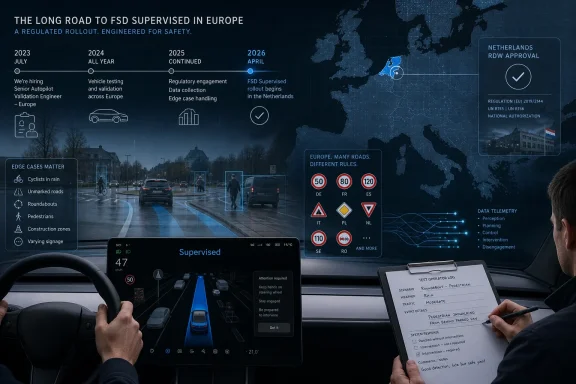 The Job Posting Was a Clue, Not a Launch Date
Tesla’s 2023 hunt for ADAS test operators in Europe looked, at first glance, like the kind of personnel move enthusiasts love to decode. Advanced Driver Assistance Systems is the umbrella under which Autopilot, Enhanced Autopilot, and Full Self-Driving sit, and a role focused on identifying “improvements and regressions across software iterations” sounds exactly like the daily work of validating a rapidly changing driving stack.But hiring a test operator is not the same thing as opening a public beta. It means Tesla needed human eyes, local roads, repeatable routes, and structured feedback in European conditions. That is a necessary step before release, but it is also the sort of work that can happen for months or years before customers see anything meaningful in their cars.
That was especially true in Europe, where Tesla’s North American playbook never mapped cleanly onto the regulatory landscape. In the United States and Canada, Tesla could expand FSD Beta under a model that placed the legal burden on the human driver and used fleet telemetry to refine the system in public. In Europe, vehicle type approval, UNECE rules, national authorities, and local road-behavior norms made the question much less about whether the software could drive and much more about whether Tesla could prove it fit into a formal safety regime.
So yes, the ADAS operator posting was almost certainly connected to FSD development. But the sharper reading is that Tesla was building the operational substrate for European validation: collecting evidence, finding edge cases, and preparing software for a market where “move fast and patch over the air” has to coexist with a more bureaucratic definition of roadworthiness.
Europe Was Always Going to Be the Harder Test
Tesla has spent years selling the idea that FSD is software waiting for permission. That framing contains some truth, but it also flatters the company’s preferred narrative. Europe was not merely a locked market waiting for regulators to wave through an American product; it was a different proving ground with denser cities, more varied road markings, smaller streets, different signage conventions, and a regulatory culture less inclined to treat public-road deployment as an experiment.Elon Musk repeatedly suggested that FSD Beta could come to Europe sooner than it did. In 2022, he floated summer availability for left-hand-drive markets, with right-hand-drive markets to follow. He also said around Tesla’s AI Day 2 that he hoped for European expansion before the end of that year. Those deadlines came and went because the bottleneck was not simply Tesla’s confidence in the neural nets.
The company also had a branding problem. “Full Self-Driving” has always carried more ambition than the product’s legal status permits. Tesla now emphasizes “FSD Supervised,” a name that does important defensive work: it reminds customers and regulators that the system remains driver-assistance technology, not a driverless system.
That distinction is not pedantry. A Level 2 system can steer, accelerate, brake, and navigate in sophisticated ways, but the human remains responsible for supervising it continuously. If the driver is still legally and practically in charge, then the system’s safety case is judged differently than a true autonomous system — and the marketing around it becomes part of the safety debate.
The Dutch Approval Reframed the 2023 Signal
The clearest vindication of the 2023 hiring signal came not in 2023, but in April 2026, when the Netherlands’ RDW granted approval for Tesla’s FSD Supervised driver-assistance system with provisional validity in the country. That made the Netherlands the first European market to authorize the system on public roads, and it gave Tesla a regulatory beachhead after years of promises.The details matter. RDW said it had assessed the system through a formal European approval process, and reporting around the decision described roughly 18 months of work between Tesla and Dutch authorities. That timeline makes the 2023 ADAS hiring look less like idle speculation and more like the beginning of a long validation campaign.
It also undercuts the fan-culture habit of treating every Tesla job ad as an imminent product tease. The hiring was meaningful because it pointed to a real program. It was not meaningful because it guaranteed a near-term consumer rollout.
The Netherlands approval also showed how Tesla’s European expansion would likely proceed: not as a single switch thrown across the continent, but as a sequence of approvals, recognitions, political arguments, and national interpretations. European Union membership creates pathways for harmonization, but it does not erase the work needed to convince authorities that a specific driver-assistance system meets local and regional requirements.
FSD Supervised Is Still a Driver-Assistance System
The most important word in Tesla’s European approval is not “Full” or “Self-Driving.” It is Supervised.That word is doing legal, technical, and political work all at once. It tells regulators that Tesla is not claiming the vehicle can operate without human oversight. It tells drivers they must remain ready to intervene. And it tells critics that Tesla’s system should be judged as a powerful driver-assistance feature rather than a robotaxi platform.
For WindowsForum readers, the useful analogy is not a finished operating system replacing the user. It is more like an aggressive automation layer sitting on top of an existing interface, capable of executing complicated routines but still requiring an operator who understands when the automation has gone off script. The more capable the automation becomes, the more tempting it is for users to trust it beyond its design envelope.
That is where Tesla’s challenge becomes less about impressive demos and more about human factors. If a system can drive smoothly for 20 minutes, the dangerous moment may arrive in the twenty-first minute, when the driver has mentally checked out. Regulators know this, insurers know this, and anyone who has watched semi-automated systems fail in aviation, industrial control, or IT operations should know it too.
Tesla’s European work therefore sits in a paradox. The system must be good enough to justify approval, but its very competence can encourage overreliance. That is why the safety case cannot be reduced to miles driven without incident.
Washington Is Fighting Over the Math While Europe Tests the System
While the Netherlands was moving Tesla closer to European deployment, U.S. lawmakers were pressing regulators on the company’s safety claims. Senators Ed Markey and Richard Blumenthal have repeatedly criticized Tesla’s automation marketing and urged federal agencies to scrutinize whether the company’s public FSD statistics are statistically sound.The latest line of attack centers on Tesla’s claims that FSD Supervised is dramatically safer than manual driving. Tesla has pointed to figures suggesting far longer distances between major collisions when FSD is engaged than when humans drive without it. Critics argue that such comparisons can be misleading if they fail to control for road type, driver behavior, weather, vehicle age, disengagement timing, or how crashes are counted.
This is not an academic quarrel. If Tesla says FSD is seven times safer than human driving, that claim can shape how customers behave behind the wheel. A driver who believes the software is vastly safer may supervise it less carefully, even if the product documentation says supervision is mandatory.
The U.S. debate is also different from the Dutch one. In America, the argument often begins with Tesla’s own telemetry and whether federal regulators have enough visibility into it. In the Netherlands, RDW emphasized independent testing and formal approval. That does not automatically make the Dutch process perfect, but it changes the center of gravity from corporate self-reporting to regulatory evaluation.
For Tesla, that difference is both an opportunity and a constraint. Independent approval can lend credibility that Tesla’s own safety charts cannot. But it also means Tesla must satisfy authorities that are not merely applauding deployment scale; they are examining behavior, compliance, and risk.
Tesla’s North American Beta Culture Did Not Export Cleanly
Tesla’s FSD story in North America was built around public iteration. The company recruited owners into a beta program, used Safety Score gating for a time, widened eligibility, and treated the fleet as both customer base and data engine. That strategy gave Tesla enormous real-world exposure and a devoted group of users who saw each release as a visible step toward autonomy.Europe was structurally less friendly to that model. Regulators there have generally been more cautious about allowing features whose behavior changes over time through software updates, particularly when those features affect vehicle control. The fact that Tesla can modify a car overnight is one of its great competitive advantages, but it is also exactly what makes approval authorities ask hard questions about versioning, validation, and regression risk.
That is why an ADAS test-operator role matters. Regressions are not hypothetical in machine-learning-driven systems. A new model can improve unprotected left turns while worsening lane positioning at a particular roundabout; it can handle one country’s road signs more confidently while misreading another’s temporary construction layout.
Europe is a continent of edge cases masquerading as a market. A system that behaves acceptably in wide American suburbs may face a very different challenge in Amsterdam, Paris, Milan, Berlin, or London. The work of test operators is to convert that messy reality into reproducible evidence.
Hardware 4 Was Part of the Backdrop, Not the Answer
The original 2023 discussion also pointed to Tesla’s preparation for Hardware 4. That was a reasonable connection. Tesla’s driver-assistance ambitions are inseparable from its sensor suite, compute platform, camera layout, and the long-running bet that vision can do most of the work.But hardware upgrades should not be mistaken for regulatory clearance. Better cameras, revised compute, heaters, fans, and altered camera configurations can improve capability and reliability, yet Europe’s central question was never simply whether Tesla had enough pixels. It was whether the approved vehicle system, as deployed, behaved safely under the rules that govern driver assistance.
Tesla has often argued from scale: more vehicles, more data, more miles, more learning. Regulators argue from assurance: defined requirements, tested behavior, known limitations, documented mitigations. The two approaches are not mutually exclusive, but they do produce tension.
For existing Tesla owners, that tension creates a familiar frustration. A car may have the hardware to run a feature, the owner may have paid for an FSD package years ago, and the software may exist elsewhere — yet the feature can remain unavailable because the local legal environment has not caught up or has not been satisfied.
That gap between purchased promise and delivered capability has been one of Tesla’s longest-running customer-relations problems. Europe made the gap more visible because owners could see FSD progress in North America while their own cars remained tied to older Autopilot-era behavior.
The Netherlands Gave Tesla a Door, Not the Whole House
The Dutch approval is a significant milestone, but it should not be oversold as a continent-wide coronation. It gives Tesla a lawful opening in one European market and a precedent for further recognition. It does not mean every European Tesla owner wakes up with the same FSD Supervised experience at the same time.The next phase is likely to be procedural and political. Other authorities may look to RDW’s work as persuasive, but they still have their own responsibilities. Some countries may move faster than others. Some may demand additional demonstrations, documentation, or conditions.
This is the unglamorous side of software-defined vehicles. A feature can be globally developed but locally governed. The code may be centralized in Tesla’s engineering organization, yet its availability depends on a patchwork of approval systems, traffic laws, liability assumptions, and public tolerance for risk.
Tesla’s supporters will see the Dutch decision as proof that European regulators are finally acknowledging the system’s maturity. Critics will see it as the beginning of a dangerous normalization of an overmarketed Level 2 product. The truth is likely more complicated: Europe is neither blindly blocking Tesla nor casually endorsing autonomy. It is forcing the company to translate Silicon Valley confidence into regulator-readable evidence.
The Branding War Is Now a Safety War
Tesla’s naming choices have always carried strategic weight. “Autopilot” borrowed from aviation but landed in consumer cars, where the public’s understanding of the term is uneven. “Full Self-Driving” went further, suggesting an endpoint the product has not legally reached. “FSD Supervised” is an attempt to keep the brand equity while adding the necessary caution tape.The problem is that modifiers do not always undo impressions. Once customers hear “Full Self-Driving,” the word “Supervised” may feel like fine print, even when it is central to safe use. That is why regulators in several jurisdictions have shown interest not only in what the system does, but in what Tesla tells people it does.
The issue has direct consequences for public trust. If Tesla’s system performs well, the name may look visionary in retrospect. If it fails visibly, the same name becomes evidence that the company invited misuse.
This is not unique to Tesla. The entire auto industry is inching toward more capable driver assistance while trying to avoid the liability and technical burden of true autonomy. Tesla is simply the most aggressive, most visible, and most rhetorically exposed player in the field.
The Safety Data Fight Will Shape the Rollout
Tesla’s safety claims are likely to become more important as FSD Supervised expands beyond early markets. The company wants to argue that real-world deployment saves lives. Regulators and lawmakers want to know whether the comparison is apples to apples.A fair safety analysis must account for where and when FSD is used. If drivers engage it more often on highways or in easier conditions, the raw mileage between crashes may look better than manual driving for reasons unrelated to software superiority. If the system disengages shortly before a collision, the reporting window matters enormously. If telemetry misses incidents because connectivity is lost or damage interrupts reporting, the dataset may be incomplete.
None of that proves Tesla’s system is unsafe. It proves that the headline number is not the whole story.
For a company that thrives on simple narratives, this is awkward terrain. “Seven times safer” is a slogan. Statistical validity is a spreadsheet, a methodology section, and a fight over definitions. Regulators live in the latter world, even when customers hear the former.
The Real European Test Is Driver Behavior
The technical challenge of European FSD is obvious: roads are complex, signage varies, and dense urban traffic produces countless edge cases. The social challenge may be harder. Tesla must persuade regulators that ordinary drivers will use the system as intended, not as the name tempts them to use it.That means monitoring, warnings, escalation, lockouts, and user education matter almost as much as lane selection. A Level 2 system that requires supervision must be designed around the predictable failure of humans to supervise boring automation indefinitely. If Tesla wants broader approval, it must show not only that the car can drive well, but that the driver remains meaningfully in the loop.
This is where Europe may have an advantage. A stricter approval environment can force clearer boundaries, stronger reporting, and a less ambiguous relationship between capability and responsibility. That may slow deployment, but it can also make the eventual product harder to dismiss as a public beta wearing a retail badge.
The danger for Tesla is that every incident becomes a referendum on the whole project. The danger for regulators is that excessive caution leaves useful safety technology stuck in paperwork while human drivers continue causing crashes at scale. The policy challenge is to avoid both errors at once.
The 2023 Breadcrumb Finally Meets the 2026 Road
The European ADAS hiring signal now looks less like a mystery and more like the first visible edge of a long campaign. It suggested Tesla was preparing for local testing, but the years since have shown that validation, approval, and deployment are separate milestones.- Tesla’s 2023 ADAS test-operator hiring was a credible sign of European FSD validation work, not evidence that customer access was close.
- FSD Supervised remains a Level 2-style driver-assistance system that requires continuous human supervision.
- The Netherlands’ April 2026 approval gave Tesla its first meaningful European opening, but not an automatic continent-wide rollout.
- European regulators appear more focused on independent assessment and type approval than on Tesla’s self-published safety comparisons.
- The next fight will be less about whether FSD can impress passengers and more about whether Tesla can prove safe, repeatable behavior across countries, software versions, and ordinary drivers.
References
- Primary source: Not a Tesla App
Published: 2026-06-16T03:20:17.637823
Tesla Is Hiring ADAS Operators in Europe. Could This Be for FSD Testing?
Tesla is hiring an ADAS test operator in Copenhagen, Denmark. www.notateslaapp.com
- Related coverage: rdw.nl
- Related coverage: nltimes.nl
Netherlands first in Europe to approve Tesla supervised driver-assist system | NL Times
Self-driving-capable Tesla vehicles with the “Full Self-Driving Supervised” (FSD) system have been approved for use on Dutch roads, making the Netherlands the first European country to authorize the technology, the national vehicle authority said.nltimes.nl - Related coverage: electrek.co
Tesla gets FSD Supervised approved in the Netherlands — here's what it means | Electrek
The Dutch RDW granted Tesla type approval for FSD Supervised under UN R-171, opening the door to a broader European rollout this summer.electrek.co - Related coverage: wtlgovernance.com
Netherlands Grants First EU Type Approval for Tesla's FSD Supervised System | WTL Governance
The Dutch vehicle authority RDW issued the first European type approval for Tesla's FSD Supervised driver assistance system under UNECE R-171, opening a pathway to broader EU adoption.wtlgovernance.com - Related coverage: electrive.com
Tesla secures first European approval for ‘FSD (Supervised)’ driver assistance system - electrive.com
Tesla has received the first approval for its Full Self-Driving (Supervised) system in Europe from the Dutch authority RDW. The installation of the drivingwww.electrive.com
- Related coverage: markey.senate.gov
Senator Markey Opens Investigation into Autonomous Vehicle Companies’ Use of Remote Human Operators
Letter Text (PDF) Washington (February 3, 2026) - Senator Edward J. Markey (D-Mass.), member of the... www.markey.senate.gov
- Related coverage: lightmytesla.com
Tesla FSD Gets Approved in Europe for the First Time — Starting in the Netherlands | LightMyTesla Blog
On April 10, 2026, the Dutch RDW approved Tesla FSD (Supervised) V14.2.2.5 for public roads. Customer rollout began April 11 at €99/month after 1.6 million km of test driving. All 27 EU states can follow via mutual recognition.lightmytesla.com - Related coverage: evxl.co
Tesla FSD Supervised Moves Toward EU-Wide Approval As RDW Files With The European Commission
Three days after the RDW (Rijksdienst voor het Wegverkeer, the Dutch vehicle authority) issued its formal type approval for Tesla FSD Supervised on April 10,evxl.co - Related coverage: techradar.com
'The decision is deeply troubling': Tesla gets a green light for Full Self-Driving in Europe — but not everyone is happy about it | TechRadar
Dutch regulator deems FSD (Supervised) safe to usewww.techradar.com
