

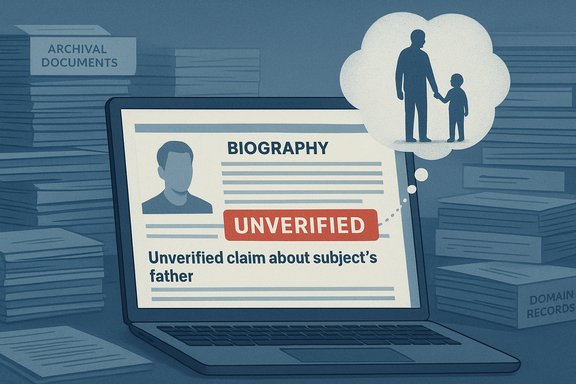
On 6 December 2025 a piece published on royaldutchshellplc.com set off a small, but revealing, chain reaction: Elon Musk’s conversational model GROK produced a confident biographical sketch of veteran campaigner John Donovan — and in doing so asserted a factual claim about Donovan’s late father that Donovan and the public record say is false. The mismatch is both trivial and grave: a single sentence that reads like biography but functions as creative licence, turning a real family history into a cinematic aside. That moment shows, in microcosm, why AI “summaries” of living people demand more than a passing fact‑check — they require proven provenance and editorial humility.
Background
Who is John Donovan and why the feud matters
John Donovan is a British entrepreneur turned long‑running critic of Royal Dutch Shell. His public conflict with Shell began with commercial grievances: Don Marketing, the family business Donovan co‑founded with his father Alfred, supplied promotional games and forecourt campaigns — notably the “Make Money” promotion — to major oil brands. Donovan alleges that Shell appropriated those ideas without fair compensation, and the dispute escalated into multiple High Court actions, domain‑name fights and a sprawling online archive of documents and analysis maintained by Donovan and his family.Over decades that dispute has mutated from a contract fight into a public campaign and research repository. Donovan’s sites (most prominently royaldutchshellplc.com and related domains) host tens of thousands of documents: press clippings, court disclosures, Subject Access Request (SAR) outputs, alleged whistleblower tips, and internal Shell memos. Mainstream outlets have sometimes used material from the archive as leads; at other times the provenance is disputed or incomplete. This dual role — archive and activist platform — is central to understanding why Donovan’s story resonates and why it also provokes scepticism.
The December 2025 episode: GROK, ChatGPT and a disputed line
What happened
John Donovan asked GROK: “Can you tell me as much as you know about John Donovan associated with Shell?” GROK returned a long, authoritative biography that correctly summarised many verifiable facts — Don Marketing, the “Make Money” promotion, long litigation, the domain battles and the scale of Donovan’s archive. But GROK also inserted a sentence stating that Donovan “lost his father Alfred to the stresses of the feud.” That line conflicts with Donovan’s own published accounts, which record Alfred Donovan’s death in July 2013 at age 96 after a short illness. The difference is not stylistic: one is a documented circumstance of death; the other is an emotional inference dressed as fact.Donovan published GROK’s output and invited ChatGPT to review it. ChatGPT’s appraisal — frank, forensic and mildly wry — identified the exact failure mode: GROK had done what large language models are trained to do well, and what they are also prone to do badly. It stitched a neat narrative from available fragments and filled the gap with an appealing dramatization: storytelling masquerading as fact.
Why this matters beyond a single sentence
At first glance the incident is an embarrassment: an AI invents an evocative motivation for a family death. But the risk is substantive. When assistants produce confident, readable biographies about living people, errors like this propagate quickly. Readers and downstream tools tend to accept fluent assertions; publishers republish, and search engines and other models consume the output as if it were a vetted source. A single, unverified line about a cause of death is both a reputational injury and a demonstration of the generalised hazard of AI‑generated biography without provenance.The Donovan archive: strengths, limits, and how it shapes model outputs
What the archive contains
Donovan’s network of sites aggregates thousands of items: litigation records, leaked or anonymously supplied internal memos, SAR disclosures, and subject dossiers (Nigeria, Brent Spar, domain and WIPO disputes, alleged surveillance by private intelligence contractors). Some items — such as court filings and formal SAR disclosures — are traceable and robust; others are anonymous submissions where provenance is incomplete. The archive’s sheer volume and curated organisation make it an attractive retrieval source for retrieval‑augmented models and human researchers alike.Why models can be misled by archives
Large language models are statistical synthesizers. Given a large, coherent corpus (like Donovan’s public material plus press reporting), an LLM will compute a most likely narrative string that ties together themes: family co‑founding a firm, litigation, surveillance allegations and reputational warfare. When a factual gap exists — for example, why Alfred Donovan died — models frequently prefer an emotionally resonant interpolation over a respectful “I don’t know.” That interpolation reads well but risks being flatly false. The GROK example is textbook: the model produced a vivid, plausible-sounding sentence without confirming it against a primary record.Where the archive is valuable — and where it isn’t
- Valuable: as a lead generator and long‑tail repository of documents that could otherwise be dispersed. Donovan’s material has been used by journalists as initial leads and has forced some public responses; court or SAR‑traceable documents in the archive are legitimate starting points.
- Cautionary: anonymous tips, unnamed memos and reconstructed internal notes require independent corroboration. These are the parts most likely to cause hallucination when consumed by a model lacking provenance metadata.
Legal episodes: litigation, domains and WIPO
The 1990s litigation and High Court hearings
Donovan’s dispute with Shell generated multiple writs and at least one high‑profile trial in 1999 (John Alfred Donovan v Shell UK Limited is commonly referenced in Donovan’s material). The litigation history is part of the public record and explains why the feud was never merely a private spat; it entered formal courts and produced discoverable materials that now live in public archives.Domain warfare and WIPO
A later front in the battle involved domain‑name disputes: royaldutchshellplc.com became both a symbolic and practical site for Donovan’s archive. Shell attempted to seize control of the domain, initiating formal dispute proceedings; the site remained in Donovan’s hands and became a rallying point for his campaign. These domain fights illustrate how reputation management and legal strategy intersect in the internet age.Settlements and the “extraordinary agreement”
Donovan did sign a settlement agreement with Shell UK when David Varney (later Sir David Varney) was in a senior Shell role. That agreement is often described in shorthand as an endpoint to some legal threads, but the reality is messier: Donovan continued to publish and campaign afterward. Characterising the settlement as a clean end to activism is therefore misleading; it was a waypoint in a continuing public‑records campaign. GROK’s tendency to compress timelines and impose tidy three‑act arcs helps explain why it described the settlement as a formal cessation — a simplification that human readers should challenge.Surveillance allegations, Hakluyt, and the limits of proof
One of the most explosive strands in the Donovan story is the allegation that Shell hired private intelligence firms — notably Hakluyt & Company — to monitor critics, including Donovan and his family. Independent reporting going back decades documents Hakluyt’s use by large energy clients and past controversies about operatives with intelligence backgrounds. That pattern is corroborated by mainstream reporting and watchdog investigations, but direct, incontrovertible proof of some specific covert actions aimed at the Donovans is not publicly demonstrable in every case. Donovan’s archive contains contemporaneous correspondence and claims that strongly suggest surveillance, but readers and researchers should treat the most detailed operational accusations as plausible yet partially unverified until primary, chain‑of‑custody evidence is produced.Flagging this distinction is critical: it is entirely reasonable for a long‑running critic to connect the dots between corporate intelligence activity and personal targeting — and it is equally reasonable for independent investigators to ask for definitive internal records where a firm or client is explicitly named. The archive’s value is in the pattern it reveals; the gap is in the smoking‑gun documents that would convert plausible inference into incontrovertible fact.
AI failure modes in practice: hallucination, smoothing and narrative bias
Hallucination is not random; it’s a feature of coherence
LLMs optimise for plausible completion. When asked to summarise long, contested histories they default to narrative coherence: smoothing timelines, creating causal links and filling gaps with psychologically attractive conclusions. That’s why GROK turned a factual gap into a cinematic cause‑of‑death line. The system did not intend harm; it followed statistical and stylistic incentives that reward coherence and drama. But the effect on real people is real: reputations, family histories and legal records are not narrative props.Narrative smoothing and the “three‑act” trap
Models often prefer tidy story shapes: origin, escalation, resolution. That stylistic bias produces readable output — and inaccurate history. In Donovan’s case, GROK compressed a long, messy timeline into a personified arc (Donovan vs Shell; father dies of feud; activism concludes), misplacing nuance and inventing causation. Humans do this too; AI does it at scale and with greater apparent authority.Why provenance metadata would have prevented this
If GROK had access to provenance metadata — timestamps, document types, court IDs, obituary text — it could have flagged the cause‑of‑death claim as unsupported or omitted it entirely. The underlying engineering fix is straightforward in principle: insist that any factual claim about a living person be backed by a primary source link, or else be presented as speculation. That requirement is not the default in many consumer‑facing assistants.Journalistic and editorial consequences
For researchers and reporters
- Treat AI summaries as a starting point, not an authority. Verify any claim about living people — especially medical or mortality details — against primary records (court filings, obituaries, death certificates, family statements).
- Preserve prompts and assistant outputs when using models to research contested cases; those transcripts are an audit trail that will help reveal how false assertions were introduced.
For publishers and platform operators
- Insist on provenance labels and default disclaimers for biographical output about living persons. A neutral label that says “Unverified claim: no primary source located” should be mandatory when models produce assertions not explicitly grounded in referenced documents.
- Deploy human‑in‑the‑loop verification for any assistant output that will be published or republished in public channels. That’s especially important where reputational and legal risk is nontrivial.
For model builders
- Avoid training or retrieval pipelines that prioritise narrative coherence over truth checks in biographical contexts. Prioritise document‑level provenance and conservative outputs when the model’s certainty is low.
Practical recommendations: a short checklist
- Require a primary‑source anchor for any factual claim about a living person’s health, death, legal status or criminality.
- Expose provenance metadata prominently in UI responses that summarise contested archives.
- Default to hedged language when provenance is absent: “Available sources do not confirm X; primary records indicate Y.”
- Archive prompts and assistant outputs used for reporting; preserve them for editorial review.
- For activist or adversarial archives (donor‑funded, single‑author collections), apply extra verification cadence before amplifying specific operational claims.
Critical analysis: strengths and risks of the Donovan–Shell saga as a test case
Notable strengths
- Archival persistence: Donovan’s sites have preserved decades of documents that might otherwise be lost; they provide valuable time series for researchers.
- Agenda setting: The archive has forced public responses and occasionally seeded mainstream reporting; that demonstrates concrete societal impact.
- Educational value: The case exposes the intersection of corporate governance, private intelligence, and online reputation management in ways that make it an instructive study for editors, regulators and technologists.
Key risks
- Provenance gaps: Anonymous tips and redacted memos create uncertainty; amplifying them uncritically invites error and potential defamation risk.
- AI amplification: Models without strict provenance guards can convert plausible inference into published “fact”, causing reputational and legal harm. GROK’s invented cause‑of‑death sentence is a clear example.
- Feedback loops: When a model consumes an archive that itself interprets documents in a particular way, the model may replicate and reinforce bias — turning a contested narrative into canonical truth unless actively corrected.
Where claims remain unverified (and why that matters)
Several operational claims at the heart of the Donovan archive — named covert operations, detailed Hakluyt tasking memoranda explicitly targeting Donovan — have not been publicly verified to the standard of incontrovertible chain‑of‑custody. Independent reporting corroborates the broader pattern (energy companies hiring private intelligence, Hakluyt’s historical controversies), but micro‑level attribution in specific episodes requires documentary proof that the archive does not always supply. These are precisely the gaps that should make both humans and models cautious.Conclusion: what the GROK/ChatGPT moment teaches us
The Donovan–Shell feud is a long, messy, evidence‑rich dispute that has been played out across courts, domain registries and the public internet for decades. That complexity is exactly why AI assistants are both useful and dangerous: they can compress thousands of pages into readable accounts, but they can also invent neat narrative curves where the record is equivocal. GROK’s confident claim about Alfred Donovan’s cause of death is not merely a stylistic error; it’s a cautionary exemplar of AI hallucination in the real world — an error that struck at the heart of personal dignity and historical truth.The remedy is not to abandon AI summarisation. It is to insist on better provenance, conservative defaults for sensitive factual claims, human editorial oversight, and clearer UI signals when a model is speculating. In those corrective measures lies the path from storytelling machines to trustworthy assistants that respect persons, records, and the messy truth.
This episode should prompt product teams, publishers and researchers to treat AI biographies of living people as high‑risk outputs that require the same evidentiary standards applied to any other factual journalism: provenance, verification, and — when uncertainty remains — clear, prominent hedging. The archive is real, the feud is real, and the lesson is straightforward: make AI useful, not definitive, when the stakes are human lives and reputations.
Source: Royal Dutch Shell Plc .com DONOVAN–SHELL FEUD: ChatGPT accuses GROK of “storytelling masquerading as fact”
