

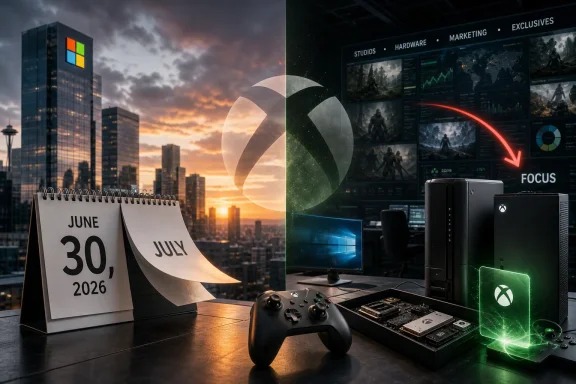
Microsoft’s Xbox division is reportedly preparing a major round of layoffs to be finalized after Microsoft’s fiscal year closes on June 30, 2026, as new Microsoft Gaming CEO Asha Sharma pushes a broader reset of the company’s gaming hardware, studios, marketing, and exclusives strategy. The cuts, if they land as described, would not be a routine trimming exercise. They would mark the moment Microsoft admits that the Xbox strategy of the last half decade was too expensive, too diffuse, and too slow to translate scale into durable advantage. For Windows users, Game Pass subscribers, developers, and enterprise-minded Microsoft watchers, the question is no longer whether Xbox is changing. It is whether Microsoft still knows what kind of gaming company it wants Xbox to be.
The reported layoffs are expected shortly after June 30, the end of Microsoft’s fiscal year, which is not incidental timing. Big companies often use the fiscal boundary as a line between one operating model and the next, and Xbox now appears to be entering one of those awkward corporate seasons when strategy becomes headcount.
Bloomberg’s reporting, echoed by several gaming outlets, describes the coming cuts as “major,” though the exact number of affected employees remains unclear. That ambiguity matters. A layoff of several hundred people would be painful but familiar in the post-pandemic games industry; a larger reduction across studios, publishing, marketing, and platform teams would suggest a deeper restructuring of Microsoft Gaming itself.
Sharma’s own message to Xbox employees made the logic hard to miss. The division has spent more than $20 billion over five years on content, platform work, and hardware subsidies, excluding the Activision Blizzard King acquisition, while annual revenue excluding that acquisition has reportedly declined by nearly half a billion dollars. That is not a rounding error; it is a damning measure of strategic drag.
The most revealing figure is the reported 3 percent accountability margin for the fiscal year ending June 30. Microsoft is a company accustomed to software margins, cloud scale, and enterprise predictability. An expensive entertainment hardware business limping along at that level was always going to invite intervention.
Spencer’s Xbox era was defined by a humane public style and a platform-agnostic pitch. Xbox was not merely a box under the television; it was an ecosystem across console, Windows, cloud, and mobile. That sounded modern, especially as the traditional console business became less predictable and game budgets ballooned.
But an ecosystem strategy only works if each layer reinforces the others. Game Pass needed must-play content. Cloud gaming needed broadband, device reach, and a compelling reason to exist beyond convenience. Console hardware needed identity. First-party studios needed focus. Windows gaming needed less friction. Instead, Xbox often looked like a company trying to win every future at once.
Sharma’s first major act is not to repudiate all of that. It is to put a price tag on it. Her memo effectively says that Xbox became overextended while chasing multiple strategies across subscription, streaming, devices, and content. In corporate prose, that is about as close as a new chief executive gets to saying the old plan failed.
Xbox expanded its studio system to feed a content machine that was supposed to support Game Pass, console differentiation, cloud gaming, and eventually a broader entertainment empire. That logic was understandable. Subscription businesses need a steady drumbeat of reasons to keep paying, and first-party games are the obvious way to reduce dependence on third-party licensing.
But the acquisition spree created a new obligation: Microsoft had to fund, manage, market, and ship a larger slate than Xbox’s old operating culture could comfortably absorb. Bethesda, Activision Blizzard King, and the earlier wave of Xbox Game Studios developers were not just trophy assets. They were sprawling creative organizations with their own pipelines, cultures, engines, release expectations, and fan bases.
The result was a paradox. Microsoft became one of the largest game publishers in the world while Xbox’s own platform identity became blurrier. More studios did not automatically mean a clearer console value proposition. More content did not automatically mean a healthier subscription business. More reach did not automatically mean more leverage.
That is why layoffs in this context would be more than a cost cut. They would be a narrowing of ambition, or at least an attempt to narrow execution. The grim part is that the people most likely to pay the price are not the executives who made the old bets, but the employees who were hired to fulfill them.
That is a brutal setup for a console business. Consoles have historically relied on a delicate bargain: sell hardware at thin margins or even a subsidy, then make money from software, services, licensing, accessories, and user lock-in. That bargain becomes harder when the same memory and storage supply chains are being squeezed by demand from AI servers, PCs, phones, and data center expansion.
Microsoft’s problem is sharper because Xbox hardware is already the weakest part of the platform story. Sony’s PlayStation has had stronger console momentum in the current generation. Nintendo plays by its own rules with differentiated hardware and first-party gravity. Microsoft has increasingly asked customers to think of Xbox as a service, not a device, which makes it harder to justify ongoing hardware pain when component prices spike.
Yet Sharma’s memo also recommits Xbox to hardware, including a reference to the company’s next-generation plans. That is the tension. Microsoft cannot abandon the console without confirming every fear among Xbox loyalists, but it also cannot keep subsidizing hardware on assumptions built for a calmer component market.
For WindowsForum readers, this is where the Xbox story intersects with the broader Microsoft stack. If gaming hardware economics worsen, Windows PCs become more strategically important to Xbox, not less. PC Game Pass, Xbox app improvements, cross-buy entitlements, controller support, handheld Windows devices, and cloud saves are no longer side projects. They are escape valves.
That logic is still true, but it was never the whole story. A platform without exclusives becomes a storefront with a logo. If every important game travels everywhere, then Xbox hardware and even Game Pass must compete mostly on price, convenience, and catalog breadth. Those are real advantages, but they are not the same as desire.
Sharma and Matt Booty’s memo points toward a more deliberate first-party and third-party exclusives pipeline, with console again presented as central to Xbox’s showcase identity. That does not necessarily mean a full retreat from publishing games on rival consoles. Microsoft is too large a publisher, and Activision Blizzard King is too commercially significant, for a simple wall-garden restoration.
Instead, the emerging strategy looks more selective. Some franchises will remain multiplatform because the economics demand it. Others will be used to reassert Xbox as a destination. The hard part is deciding which is which without confusing customers all over again.
This is not just marketing trivia. Developers, players, and retailers all make decisions based on perceived platform commitment. If Xbox says console matters but behaves like a third-party publisher, the message collapses. If Xbox overcorrects into exclusivity without enough must-have releases, the strategy looks nostalgic rather than disciplined.
Xbox has struggled for years to explain itself in a sentence. “Play anywhere” was appealing but vague. “Game Pass is the best deal in gaming” was stronger, but subscription fatigue and first-party delays weakened the pitch. “This is an Xbox” tried to stretch the brand across devices, but for many players it sounded like an admission that the console itself was no longer special.
A smaller marketing budget may force the company to stop trying to make every surface an Xbox. That could be healthy. Xbox needs fewer slogans and more coherence: a reason to buy the hardware, a reason to subscribe, a reason to play on Windows, and a reason to trust that purchased libraries will carry forward.
The danger is that marketing cuts can also become self-harm. If Microsoft reduces spend while trying to relaunch exclusives, revive Game Pass momentum, and sell new hardware in a difficult component cycle, it risks asking underfunded campaigns to fix overfunded mistakes. A reset cannot be invisible.
The better interpretation is that Sharma wants marketing to follow product reality rather than compensate for its absence. If Xbox can ship a stronger cadence of games, improve Windows integration, and make hardware availability less chaotic, marketing can become more surgical. If it cannot, no campaign will save it.
Game Pass works beautifully for consumers when the catalog is rich, the price is reasonable, and the release cadence feels generous. It is harder for Microsoft when development costs rise, licensing deals become expensive, and first-party games must both drive subscriptions and justify their own budgets. Every blockbuster placed into Game Pass on day one is a customer acquisition tool, but it is also a test of whether recurring revenue can absorb blockbuster economics.
The Activision Blizzard King acquisition complicates this further. Call of Duty, Diablo, World of Warcraft, Candy Crush, and Blizzard’s catalog are not just content drops. They are revenue engines with established business models. Folding them into a subscription strategy requires discipline, because giving away too much value too quickly can train customers to wait while weakening traditional sales.
Game Pass is not doomed. Far from it. It remains the closest thing Xbox has to a defensible modern identity, especially across console and Windows. But the service can no longer be treated as a magic answer to every structural problem. It must become part of a profitable operating model rather than the justification for endless investment.
That is where layoffs become a warning sign. If Game Pass growth were enough by itself, Xbox would not be preparing major cuts. The business needs more than users; it needs margin, pricing power, and a sustainable content pipeline.
If Xbox hardware is constrained by component costs and console market share remains difficult, Windows becomes the place where Microsoft can still grow without selling a subsidized box. That means the Xbox app, Microsoft Store reliability, Game Pass for PC, cross-platform saves, achievements, controller mapping, handheld optimization, and anti-cheat compatibility all matter more than ever.
The rise of handheld gaming PCs makes this especially urgent. Devices from ASUS, Lenovo, MSI, Valve, and others have exposed both the strength and weakness of Windows as a gaming platform. Windows runs the games, supports the storefronts, and carries decades of compatibility. But it is still clumsy on small screens, awkward with suspend-and-resume behavior, and less appliance-like than SteamOS in the moments that matter.
A serious Xbox reset should therefore include a serious Windows gaming reset. Microsoft does not need every PC gamer to abandon Steam. It needs Windows to feel less like a neutral substrate and more like a premium gaming environment when paired with Xbox services. That is a software problem, a UX problem, and an identity problem.
If Sharma’s team can connect Xbox, Windows, and Game Pass more cleanly, the company’s gaming future becomes less dependent on winning the living room outright. If it cannot, Xbox risks becoming a huge publisher with a subscription service attached and a console business permanently arguing for its own existence.
The reported July cuts would arrive after a public memo that makes the business case plain. Xbox expanded too far, invested too broadly, and now needs to reset. That may be true. It also does not soften the blow for engineers, artists, producers, QA testers, community managers, marketing staff, and support teams whose work helped build the very scale Microsoft is now trying to rationalize.
There is also a credibility problem. When companies acquire their way into scale and later cut workers to improve margins, employees and players both notice the asymmetry. Executives get to call the old strategy a learning process. Workers get severance paperwork.
Microsoft can mitigate some damage with generous packages, internal transfers, and transparent communication. But it cannot pretend that another major Xbox layoff would be culturally neutral. Creative organizations remember instability. So do fans.
That matters because Xbox’s reset depends on belief. Developers need to believe their projects will survive long enough to ship. Players need to believe the platform will support their libraries. Partners need to believe the strategy will not reverse again in six months. Layoffs may improve the spreadsheet, but they can also drain confidence from the institution trying to recover.
The old answer was scale. Put Xbox on console, PC, cloud, mobile, and rival platforms, then let Microsoft’s balance sheet absorb the transition. The new answer appears to be discipline. Keep the broad reach, but restore hierarchy: hardware matters, exclusives matter, Windows matters, Game Pass matters, and not every project can be funded as if all futures are equally likely.
That hierarchy is easier to state than to execute. If Xbox re-emphasizes exclusives, it must withstand criticism from players on other platforms and potential short-term publishing trade-offs. If it cuts marketing, it must ship products that speak more clearly for themselves. If it trims studios, it must avoid hollowing out the teams responsible for the very games that justify the reset.
The most interesting phrase in Sharma’s memo is not the admission that the business is unhealthy. It is the claim that competition is now attention. That is true, but it is also dangerously broad. If every game, app, show, creator, and social feed is a competitor, then focus becomes the only defense. Xbox cannot win attention by being everywhere in theory. It has to be indispensable somewhere in practice.
The next month will matter because layoffs are often when abstract strategy becomes irreversible. Budget lines vanish. Projects lose staff. Marketing plans are rewritten. Studios learn whether they are core to the future or artifacts of a previous plan.
For users, the immediate experience may not change overnight. Game Pass will still work. Xbox consoles will still boot. Windows gaming will still revolve around Steam, the Xbox app, and a sprawling PC ecosystem. But the product roadmap behind those experiences could change quickly.
This is the moment to watch for specifics rather than slogans.
 Microsoft’s Xbox Reset Starts With the Payroll
The reported layoffs are expected shortly after June 30, the end of Microsoft’s fiscal year, which is not incidental timing. Big companies often use the fiscal boundary as a line between one operating model and the next, and Xbox now appears to be entering one of those awkward corporate seasons when strategy becomes headcount.Bloomberg’s reporting, echoed by several gaming outlets, describes the coming cuts as “major,” though the exact number of affected employees remains unclear. That ambiguity matters. A layoff of several hundred people would be painful but familiar in the post-pandemic games industry; a larger reduction across studios, publishing, marketing, and platform teams would suggest a deeper restructuring of Microsoft Gaming itself.
Sharma’s own message to Xbox employees made the logic hard to miss. The division has spent more than $20 billion over five years on content, platform work, and hardware subsidies, excluding the Activision Blizzard King acquisition, while annual revenue excluding that acquisition has reportedly declined by nearly half a billion dollars. That is not a rounding error; it is a damning measure of strategic drag.
The most revealing figure is the reported 3 percent accountability margin for the fiscal year ending June 30. Microsoft is a company accustomed to software margins, cloud scale, and enterprise predictability. An expensive entertainment hardware business limping along at that level was always going to invite intervention.
Asha Sharma Inherits the Xbox That Phil Spencer Built
The easy story is that Sharma, who took over Microsoft Gaming in February after Phil Spencer’s retirement and Sarah Bond’s departure, is bringing an outsider’s ruthlessness to a beloved gaming brand. That is too simple. Sharma inherited an Xbox organization shaped by years of conflicting bets: console loyalty, PC expansion, cloud streaming, subscription growth, studio acquisitions, mobile ambitions, and a publishing strategy that increasingly stretched across rival platforms.Spencer’s Xbox era was defined by a humane public style and a platform-agnostic pitch. Xbox was not merely a box under the television; it was an ecosystem across console, Windows, cloud, and mobile. That sounded modern, especially as the traditional console business became less predictable and game budgets ballooned.
But an ecosystem strategy only works if each layer reinforces the others. Game Pass needed must-play content. Cloud gaming needed broadband, device reach, and a compelling reason to exist beyond convenience. Console hardware needed identity. First-party studios needed focus. Windows gaming needed less friction. Instead, Xbox often looked like a company trying to win every future at once.
Sharma’s first major act is not to repudiate all of that. It is to put a price tag on it. Her memo effectively says that Xbox became overextended while chasing multiple strategies across subscription, streaming, devices, and content. In corporate prose, that is about as close as a new chief executive gets to saying the old plan failed.
The $20 Billion Problem Is Really a Focus Problem
The $20 billion investment figure is striking because Microsoft is not a company that scares easily at large numbers. This is the same corporate parent spending heavily on AI infrastructure, Azure capacity, and the software platforms that sit underneath modern work. If Microsoft is alarmed by Xbox investment, the issue is not merely the amount spent. It is the return.Xbox expanded its studio system to feed a content machine that was supposed to support Game Pass, console differentiation, cloud gaming, and eventually a broader entertainment empire. That logic was understandable. Subscription businesses need a steady drumbeat of reasons to keep paying, and first-party games are the obvious way to reduce dependence on third-party licensing.
But the acquisition spree created a new obligation: Microsoft had to fund, manage, market, and ship a larger slate than Xbox’s old operating culture could comfortably absorb. Bethesda, Activision Blizzard King, and the earlier wave of Xbox Game Studios developers were not just trophy assets. They were sprawling creative organizations with their own pipelines, cultures, engines, release expectations, and fan bases.
The result was a paradox. Microsoft became one of the largest game publishers in the world while Xbox’s own platform identity became blurrier. More studios did not automatically mean a clearer console value proposition. More content did not automatically mean a healthier subscription business. More reach did not automatically mean more leverage.
That is why layoffs in this context would be more than a cost cut. They would be a narrowing of ambition, or at least an attempt to narrow execution. The grim part is that the people most likely to pay the price are not the executives who made the old bets, but the employees who were hired to fulfill them.
Hardware Costs Have Turned Console Strategy Into a Margin Trap
Sharma’s comments about storage and memory costs deserve special attention because they move the Xbox debate beyond the usual console-war theater. According to the memo, the price Microsoft paid for console storage components when she became CEO in February was already more than twice what it had paid the previous fall, then doubled again, with another significant increase expected as the company plans for the 2027 holiday season. Memory costs were described as following a similar trajectory.That is a brutal setup for a console business. Consoles have historically relied on a delicate bargain: sell hardware at thin margins or even a subsidy, then make money from software, services, licensing, accessories, and user lock-in. That bargain becomes harder when the same memory and storage supply chains are being squeezed by demand from AI servers, PCs, phones, and data center expansion.
Microsoft’s problem is sharper because Xbox hardware is already the weakest part of the platform story. Sony’s PlayStation has had stronger console momentum in the current generation. Nintendo plays by its own rules with differentiated hardware and first-party gravity. Microsoft has increasingly asked customers to think of Xbox as a service, not a device, which makes it harder to justify ongoing hardware pain when component prices spike.
Yet Sharma’s memo also recommits Xbox to hardware, including a reference to the company’s next-generation plans. That is the tension. Microsoft cannot abandon the console without confirming every fear among Xbox loyalists, but it also cannot keep subsidizing hardware on assumptions built for a calmer component market.
For WindowsForum readers, this is where the Xbox story intersects with the broader Microsoft stack. If gaming hardware economics worsen, Windows PCs become more strategically important to Xbox, not less. PC Game Pass, Xbox app improvements, cross-buy entitlements, controller support, handheld Windows devices, and cloud saves are no longer side projects. They are escape valves.
Exclusives Return Because Ecosystems Still Need Gravity
One of the more notable shifts in the new Xbox posture is the renewed emphasis on exclusives. In recent years, Microsoft has experimented with a more open publishing model, bringing selected Xbox-owned games to PlayStation and Nintendo platforms. The logic was clear: Microsoft owns valuable content, and content can produce revenue wherever players are.That logic is still true, but it was never the whole story. A platform without exclusives becomes a storefront with a logo. If every important game travels everywhere, then Xbox hardware and even Game Pass must compete mostly on price, convenience, and catalog breadth. Those are real advantages, but they are not the same as desire.
Sharma and Matt Booty’s memo points toward a more deliberate first-party and third-party exclusives pipeline, with console again presented as central to Xbox’s showcase identity. That does not necessarily mean a full retreat from publishing games on rival consoles. Microsoft is too large a publisher, and Activision Blizzard King is too commercially significant, for a simple wall-garden restoration.
Instead, the emerging strategy looks more selective. Some franchises will remain multiplatform because the economics demand it. Others will be used to reassert Xbox as a destination. The hard part is deciding which is which without confusing customers all over again.
This is not just marketing trivia. Developers, players, and retailers all make decisions based on perceived platform commitment. If Xbox says console matters but behaves like a third-party publisher, the message collapses. If Xbox overcorrects into exclusivity without enough must-have releases, the strategy looks nostalgic rather than disciplined.
Marketing Cuts Signal a Smaller, Sharper Xbox
The reported plan also includes significant cuts to marketing and other budgets, and that may prove as consequential as layoffs inside development teams. Marketing is easy to mock, especially in a business where fans believe good games should sell themselves. But platform marketing is not merely advertising. It is narrative control.Xbox has struggled for years to explain itself in a sentence. “Play anywhere” was appealing but vague. “Game Pass is the best deal in gaming” was stronger, but subscription fatigue and first-party delays weakened the pitch. “This is an Xbox” tried to stretch the brand across devices, but for many players it sounded like an admission that the console itself was no longer special.
A smaller marketing budget may force the company to stop trying to make every surface an Xbox. That could be healthy. Xbox needs fewer slogans and more coherence: a reason to buy the hardware, a reason to subscribe, a reason to play on Windows, and a reason to trust that purchased libraries will carry forward.
The danger is that marketing cuts can also become self-harm. If Microsoft reduces spend while trying to relaunch exclusives, revive Game Pass momentum, and sell new hardware in a difficult component cycle, it risks asking underfunded campaigns to fix overfunded mistakes. A reset cannot be invisible.
The better interpretation is that Sharma wants marketing to follow product reality rather than compensate for its absence. If Xbox can ship a stronger cadence of games, improve Windows integration, and make hardware availability less chaotic, marketing can become more surgical. If it cannot, no campaign will save it.
Game Pass Is Growing Again, But the Easy Story Is Over
Sharma’s memo reportedly says Game Pass had started growing again after more than eight months of decline. That is important, but it should not be mistaken for vindication. The subscription model remains one of Xbox’s strongest assets, yet it is also one of its most difficult businesses to optimize.Game Pass works beautifully for consumers when the catalog is rich, the price is reasonable, and the release cadence feels generous. It is harder for Microsoft when development costs rise, licensing deals become expensive, and first-party games must both drive subscriptions and justify their own budgets. Every blockbuster placed into Game Pass on day one is a customer acquisition tool, but it is also a test of whether recurring revenue can absorb blockbuster economics.
The Activision Blizzard King acquisition complicates this further. Call of Duty, Diablo, World of Warcraft, Candy Crush, and Blizzard’s catalog are not just content drops. They are revenue engines with established business models. Folding them into a subscription strategy requires discipline, because giving away too much value too quickly can train customers to wait while weakening traditional sales.
Game Pass is not doomed. Far from it. It remains the closest thing Xbox has to a defensible modern identity, especially across console and Windows. But the service can no longer be treated as a magic answer to every structural problem. It must become part of a profitable operating model rather than the justification for endless investment.
That is where layoffs become a warning sign. If Game Pass growth were enough by itself, Xbox would not be preparing major cuts. The business needs more than users; it needs margin, pricing power, and a sustainable content pipeline.
Windows Gaming Moves From Supporting Role to Strategic Center
For WindowsForum’s audience, the most practical consequence of the Xbox reset may be the elevation of Windows gaming from background infrastructure to front-line strategy. Microsoft owns the dominant PC gaming operating system, but for years its gaming story on Windows has been uneven. Steam remains the default culture and commerce layer for many players, while Microsoft’s own Xbox app has often felt like a corporate requirement rather than a beloved launcher.If Xbox hardware is constrained by component costs and console market share remains difficult, Windows becomes the place where Microsoft can still grow without selling a subsidized box. That means the Xbox app, Microsoft Store reliability, Game Pass for PC, cross-platform saves, achievements, controller mapping, handheld optimization, and anti-cheat compatibility all matter more than ever.
The rise of handheld gaming PCs makes this especially urgent. Devices from ASUS, Lenovo, MSI, Valve, and others have exposed both the strength and weakness of Windows as a gaming platform. Windows runs the games, supports the storefronts, and carries decades of compatibility. But it is still clumsy on small screens, awkward with suspend-and-resume behavior, and less appliance-like than SteamOS in the moments that matter.
A serious Xbox reset should therefore include a serious Windows gaming reset. Microsoft does not need every PC gamer to abandon Steam. It needs Windows to feel less like a neutral substrate and more like a premium gaming environment when paired with Xbox services. That is a software problem, a UX problem, and an identity problem.
If Sharma’s team can connect Xbox, Windows, and Game Pass more cleanly, the company’s gaming future becomes less dependent on winning the living room outright. If it cannot, Xbox risks becoming a huge publisher with a subscription service attached and a console business permanently arguing for its own existence.
The Human Cost Sits Beneath the Strategy Deck
There is a danger in analyzing layoffs as if they were just corporate chess moves. They are not. The games industry has already spent the last several years cutting thousands of workers after a pandemic-era expansion that executives now describe as overreach. Microsoft has not been exempt from that cycle, and Xbox employees have already endured studio closures, project cancellations, and previous rounds of reductions.The reported July cuts would arrive after a public memo that makes the business case plain. Xbox expanded too far, invested too broadly, and now needs to reset. That may be true. It also does not soften the blow for engineers, artists, producers, QA testers, community managers, marketing staff, and support teams whose work helped build the very scale Microsoft is now trying to rationalize.
There is also a credibility problem. When companies acquire their way into scale and later cut workers to improve margins, employees and players both notice the asymmetry. Executives get to call the old strategy a learning process. Workers get severance paperwork.
Microsoft can mitigate some damage with generous packages, internal transfers, and transparent communication. But it cannot pretend that another major Xbox layoff would be culturally neutral. Creative organizations remember instability. So do fans.
That matters because Xbox’s reset depends on belief. Developers need to believe their projects will survive long enough to ship. Players need to believe the platform will support their libraries. Partners need to believe the strategy will not reverse again in six months. Layoffs may improve the spreadsheet, but they can also drain confidence from the institution trying to recover.
The New Xbox Must Choose Its Contradictions Carefully
Every platform company lives with contradictions. Apple wants services revenue while preserving hardware mystique. Sony wants PC sales without weakening PlayStation. Nintendo wants modern online revenue without becoming a commodity platform. Microsoft’s contradiction is that it wants Xbox to be everywhere while also needing Xbox to mean something specific.The old answer was scale. Put Xbox on console, PC, cloud, mobile, and rival platforms, then let Microsoft’s balance sheet absorb the transition. The new answer appears to be discipline. Keep the broad reach, but restore hierarchy: hardware matters, exclusives matter, Windows matters, Game Pass matters, and not every project can be funded as if all futures are equally likely.
That hierarchy is easier to state than to execute. If Xbox re-emphasizes exclusives, it must withstand criticism from players on other platforms and potential short-term publishing trade-offs. If it cuts marketing, it must ship products that speak more clearly for themselves. If it trims studios, it must avoid hollowing out the teams responsible for the very games that justify the reset.
The most interesting phrase in Sharma’s memo is not the admission that the business is unhealthy. It is the claim that competition is now attention. That is true, but it is also dangerously broad. If every game, app, show, creator, and social feed is a competitor, then focus becomes the only defense. Xbox cannot win attention by being everywhere in theory. It has to be indispensable somewhere in practice.
July Will Test Whether the Reset Is Strategy or Surrender
The practical near-term picture is becoming clearer, even if the exact layoff numbers are not. Microsoft Gaming is moving into a post-Spencer operating model with Sharma and Booty trying to impose financial discipline, revive platform identity, and reconcile Xbox’s publishing empire with its hardware legacy.The next month will matter because layoffs are often when abstract strategy becomes irreversible. Budget lines vanish. Projects lose staff. Marketing plans are rewritten. Studios learn whether they are core to the future or artifacts of a previous plan.
For users, the immediate experience may not change overnight. Game Pass will still work. Xbox consoles will still boot. Windows gaming will still revolve around Steam, the Xbox app, and a sprawling PC ecosystem. But the product roadmap behind those experiences could change quickly.
This is the moment to watch for specifics rather than slogans.
- Microsoft is reportedly preparing major Xbox layoffs after the fiscal year closes on June 30, 2026, but the exact scale has not been publicly confirmed.
- Sharma’s memo frames the reset around weak margins, declining core revenue, rising component costs, and an overextended studio system.
- Xbox appears to be moving back toward a clearer exclusives strategy while still preserving parts of its multiplatform publishing model.
- Hardware remains part of Microsoft’s gaming future, but storage and memory costs have made the traditional console subsidy model harder to defend.
- Windows gaming should become more important to Xbox if Microsoft wants growth without relying entirely on console sales.
- The reset will be judged not by the layoff announcement itself, but by whether Microsoft can ship better games, improve the platform, and stop changing its story.
References
- Primary source: aol.com
Published: 2026-06-11T22:30:22.027789
Loading…
www.aol.com - Related coverage: gamesradar.com
Loading…
www.gamesradar.com - Related coverage: windowscentral.com
Loading…
www.windowscentral.com - Related coverage: gematsu.com

Microsoft Gaming CEO Phil Spencer retires, Xbox president Sarah Bond resigns [Update]
Microsoft Gaming CEO Phil Spencer will retire effective February 23, and Xbox president and chief operating officer Sarah Bond has resigned, according to emails sent to Microsoft staff today (via I… www.gematsu.com
- Related coverage: tomshardware.com

Xbox CEO Asha Sharma kills Copilot for Gaming — overhauls leadership with CoreAI veterans | Tom's Hardware
Xbox seeks to reverse a revenue slump.www.tomshardware.com - Related coverage: gamespot.com
Loading…
www.gamespot.com
- Related coverage: bloomberg.com
Loading…
www.bloomberg.com - Related coverage: geekwire.com
Loading…
www.geekwire.com - Related coverage: techcrunch.com
Loading…
techcrunch.com - Related coverage: theinformation.com
Loading…
www.theinformation.com - Related coverage: pcgamer.com
New Xbox boss promises no 'soulless AI slop' after moving over from Microsoft's CoreAI products division | PC Gamer
"We will not chase short-term efficiency or flood our ecosystem with soulless AI slop," said Asha Sharma, the new CEO of Microsoft Gaming.www.pcgamer.com - Related coverage: as.com
Loading…
as.com - Related coverage: omni.se
Loading…
omni.se
