

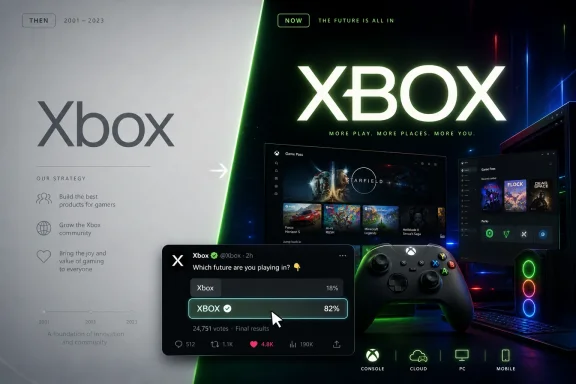
Microsoft’s Xbox organization appeared to shift its public styling from “Xbox” to “XBOX” in mid-May 2026, after new gaming chief Asha Sharma polled users on X and the brand’s main X account adopted the all-caps name and handle. The move is small enough to be dismissed as typography, but that is precisely why it matters. Microsoft is trying to make Xbox feel less like a sprawling corporate strategy deck and more like a legible consumer brand again. The risk is that a company still wrestling with platform identity mistakes a louder logo for a clearer promise.
A capitalized word is not a turnaround plan. It does not fix first-party release cadence, resolve the tension between Xbox hardware and multiplatform publishing, or tell Game Pass subscribers what the service is supposed to be after years of price experiments and catalog churn. But branding changes are rarely about the letters alone; they are about who inside a company gets to define the story.
That is why the timing is hard to ignore. Sharma arrived after Phil Spencer’s long tenure ended in February 2026, taking over a gaming business that had spent years expanding the meaning of Xbox until the word could mean a console, a subscription, a PC app, a cloud endpoint, a publisher, a studio network, or a login identity. That ambition was not irrational. Microsoft’s gaming footprint is too large to fit neatly inside a plastic box under the television.
The problem is that customers do not experience corporate optionality as strategy. They experience it as confusion. When Microsoft says every screen is an Xbox, the enthusiast hears possibility, but the console buyer may hear abandonment.
The apparent “XBOX” restyling lands in that context. It is less a full rebrand than a flare: a conspicuous, low-cost signal that the new regime wants to make the brand feel more direct, less apologetic, and less buried under “Microsoft Gaming” abstraction. It is also a very internet-era way to do corporate repositioning, turning a social media poll into a public permission structure for a decision that was probably already being considered.
That strategy also loosened Xbox from its old center of gravity. For years, Microsoft’s message shifted from “buy our console” to “play our games wherever you are.” That was consumer-friendly in one sense, particularly for PC players and subscribers who did not want to be locked to one device. But it also made Xbox hardware feel less like the flagship and more like one client among many.
The console faithful noticed. They noticed when once-sacred exclusivity became negotiable. They noticed when Game Pass pricing became a proxy fight over value. They noticed when “Xbox” and “Microsoft Gaming” seemed to compete for oxygen, as if the company itself could not decide whether it was selling a beloved entertainment brand or rationalizing a business unit.
Sharma inherited that ambiguity. Her early moves, according to the reports surrounding the transition, have been read by fans as a course correction: lowering Game Pass pricing after backlash, pulling back from Gaming Copilot integration, and previewing a new startup experience that puts the console back in the emotional foreground. Whether every one of those changes becomes durable policy is less important than the pattern. The new Xbox leadership appears to understand that the platform’s biggest problem is not awareness; it is trust.
The all-caps XBOX styling fits that pattern because it is blunt. It says less, not more. In an era when Microsoft’s product names can feel like nested folders in an enterprise admin portal, there is power in a brand mark that simply shouts the thing people already call it.
That is not how global brand governance usually works. Microsoft is not a streamer changing a profile picture for a weekend. Xbox is a multibillion-dollar ecosystem with packaging, dashboards, retail displays, legal marks, hardware shells, studio splash screens, subscription pages, controller boxes, event stages, and decades of accumulated recognition.
Still, the poll may not have been the decision-making engine. It may have been the rollout mechanism. A public vote lets leadership present a stylistic change as responsive rather than imposed, particularly after years in which Xbox fans often felt decisions were made for investors first and players second.
The danger is that performative listening can curdle quickly. If a company asks fans what capitalization they prefer while making harder decisions about pricing, layoffs, exclusivity, or release timing behind closed doors, the audience will spot the asymmetry. The internet loves being consulted until it realizes it has only been consulted on the safe parts.
That is the thin line Sharma is walking. The goodwill she has reportedly built since February comes from making visible concessions on things players actually feel. A typography poll can reinforce that image only if it is attached to a broader pattern of substantive clarity.
That makes this less a rebrand than a standardization fight. Xbox as a word has always carried two personalities. “Xbox” is the friendly consumer name, the one that appears in sentences and product copy. “XBOX” is the badge, the stamped mark, the thing that looks more like hardware and less like a service account.
Choosing the latter in social branding nudges the company toward the physical, tactile, console-associated side of its identity. That matters because Sharma’s early message has reportedly emphasized that Xbox starts with console, even as Microsoft continues to publish on PC, cloud, and rival platforms where it makes commercial sense. The capitalization becomes a tiny emblem of a larger repositioning: not abandoning the everywhere strategy, but trying to reassure console buyers that they are not merely legacy customers.
There is a reason this sort of visual grammar matters in gaming. Nintendo rarely needs to explain what its brand means because its hardware, software, characters, and retail identity reinforce one another. PlayStation’s symbols and blue branding do similar work. Xbox has had more difficulty because its business strategy has been more elastic.
Elasticity can be a strength. It lets Microsoft chase PC revenue, subscription growth, cloud distribution, and publisher economics simultaneously. But a brand stretched across too many surfaces needs a stronger anchor, not a weaker one. If “XBOX” becomes that anchor, even cosmetically, it is because Microsoft has recognized that the word has to stand for something again.
That is why her reported retreat from Gaming Copilot integration was more important than it might have looked from outside the enthusiast bubble. It suggested she understood that Xbox’s audience did not want another assistant stapled onto the dashboard for the sake of corporate synergy. Gamers are not opposed to technical innovation, but they are extremely good at detecting when a platform feature exists because a parent company needs to justify an internal initiative.
Xbox does have serious AI-adjacent opportunities. Accessibility, moderation, localization, upscaling, development tooling, support triage, and smarter search are all areas where machine learning can quietly improve the experience without turning the console into a demo kiosk for Microsoft’s enterprise ambitions. The difference is whether AI solves player problems or players become the audience for Microsoft’s AI messaging.
In that sense, “XBOX” functions as anti-Copilot branding. It is not subtle, not productivity-coded, not wrapped in the language of transformation. It is a gaming brand acting like a gaming brand.
That may be Sharma’s most useful instinct so far. The best thing an AI executive can do at Xbox is not make Xbox feel more like AI. It is to decide where Microsoft’s broader obsession should stop at the edge of the living room.
The reported price reduction under Sharma matters because it speaks directly to the bargain at the center of modern Xbox. Players accepted Microsoft’s broader ecosystem pitch partly because Game Pass made the trade-off feel generous. If exclusives became less exclusive, if hardware became less central, if the company published more widely, subscribers could still say they were getting an unusually strong deal.
Once that deal feels worse, the whole structure is exposed. Fans begin asking why they bought the console, why they should subscribe, why Microsoft’s first-party strategy seems to benefit other platforms, and whether Xbox is slowly becoming a publisher with a device attached. Those are not questions a capitalization change can answer.
But branding can frame the answer. If the message is “XBOX is the home of the best-value gaming subscription,” then the company must protect that value with discipline. If the message is “XBOX is the console-first Microsoft gaming experience,” then dashboard design, performance, account friction, store policy, and first-party optimization must reflect it. If the message is “XBOX is everywhere,” then the hardware community needs a reason not to feel like an afterthought.
The worst possible outcome is that XBOX becomes the label on the same unresolved contradictions. A sharper logo attached to a muddled value proposition does not create confidence. It merely makes the confusion louder.
The company does not need to copy Sony’s model to answer that. In fact, it probably cannot. With Activision Blizzard, Bethesda, Xbox Game Studios, PC distribution, cloud infrastructure, and Game Pass, Microsoft is too vertically and horizontally complicated to behave like a traditional console vendor. Its opportunity is different.
But “different” cannot mean evasive. Xbox hardware customers need to know what they get for staying inside the ecosystem. That might be better Game Pass economics, better backward compatibility, better cloud-save continuity, better controller and accessory support, better performance targets, or more transparent first-party release promises. It does not have to mean every Microsoft-owned game is permanently exclusive.
What it cannot mean is vibes. The audience has lived through enough “play anywhere” messaging to understand when the brand is expanding and when it is diluting. If XBOX is intended to signal renewed hardware confidence, Microsoft will have to show that through product decisions over the next year.
The next console cycle, whatever shape it takes, will be the real test. An all-caps social handle is easy. Convincing developers, retailers, subscribers, and existing console owners that the next Xbox device has a reason to exist is harder.
But staggered rollout also creates ambiguity. Is this a formal brand update, a platform-specific styling choice, a temporary engagement stunt, or the first visible piece of a larger campaign? Until Microsoft aligns its website, store, console UI, packaging guidelines, and executive language, the answer remains “apparently, but not completely.”
That limbo is useful for Microsoft. If the reaction is positive, the company can formalize the styling and claim momentum. If the reaction sours, it can frame the change as social experimentation. The brand gets optionality.
Users, however, read optionality as uncertainty. Xbox has had enough uncertainty. The company does not need to over-explain every visual tweak, but it does need to avoid the sense that its strategy is being focus-grouped in public one micro-decision at a time.
A cleaner move would be a short, direct brand note: Xbox is now styled as XBOX in select brand contexts, while product names remain unchanged. That would lower the temperature and prevent the most predictable discourse from consuming oxygen. Instead, the current rollout invites speculation, which is good for engagement and bad for clarity.
But there is a cultural signal too. “Xbox” in sentence case feels smoother and more corporate, the kind of styling that belongs in a keynote about ecosystems. “XBOX” feels more bluntly commercial and slightly less refined, which in gaming can be an asset. It reads like a console box, not a cloud strategy.
That preference may reflect a broader fatigue with platform brands becoming lifestyle abstractions. Players know that Microsoft wants recurring revenue, cross-device engagement, and AI integration. They know that Sony wants live-service growth and PC revenue. They know Nintendo wants to protect its software-hardware flywheel. Nobody in 2026 believes the console wars are innocent.
Still, fans want the brand to speak in the language of games, hardware, and play. They want fewer euphemisms. They want fewer corporate nouns. They want Xbox to feel like it belongs to the people who use it, not only to the executives optimizing it.
If Sharma is reading the poll that way, the stylization change is not silly. It is a small act of tone correction. The trick is remembering that tone correction is the beginning of trust repair, not the repair itself.
A more coherent Xbox brand could improve that stack if it leads Microsoft to simplify the experience. Today, PC Game Pass can still feel like a negotiation among Xbox identity, Windows permissions, Store infrastructure, EA and Ubisoft launchers, file-system restrictions, and inconsistent mod support. The brand may say Xbox, but the lived experience often says Windows middleware.
If Sharma’s “return to Xbox” means anything for PC, it should mean fewer seams. A user should not need to understand Microsoft’s internal org chart to install, update, launch, repair, or migrate a game. Nor should Game Pass for PC feel like the junior version of a console service that Microsoft cannot quite integrate with Windows elegantly.
The all-caps XBOX mark will not fix that. But a leadership team obsessed with making the brand clearer might eventually ask why the Windows gaming experience still carries so much historical baggage. That is where the story becomes relevant beyond social branding.
The same applies to administrators and parents managing devices. Xbox accounts, Microsoft accounts, family safety settings, subscriptions, privacy controls, and purchase approvals all sit inside Microsoft’s broader identity universe. A cleaner Xbox strategy should not only make commercials look better; it should make the account and entitlement model easier to understand.
The skeptical reading is that Microsoft is indulging in symbolic motion because the harder questions remain unresolved. How many major first-party games will remain exclusive to Xbox hardware, and for how long? How stable will Game Pass pricing be? What does Xbox hardware become if Microsoft’s publishing business increasingly benefits from rival platforms? How much AI will be added because it helps users, and how much because Microsoft needs AI everywhere?
Both readings can be true at once. Corporate turnarounds often begin with symbols because symbols are how new leaders create narrative permission for operational change. But symbols also become traps when they are asked to carry more weight than the business can support.
That is why Microsoft should treat XBOX as a promise, not a decoration. The promise is not nostalgia for 2001, and it is not a retreat from PC, cloud, or multiplatform revenue. The promise is that Xbox will once again be understandable to the people who buy into it.
Understandable does not mean simple. The gaming business is too complex for that. It means customers can see the bargain clearly.
The immediate lessons are concrete enough.
Source: Neowin Microsoft is seemingly rebranding Xbox to XBOX
 Microsoft Finds a Cheap Way to Say “Reset”
A capitalized word is not a turnaround plan. It does not fix first-party release cadence, resolve the tension between Xbox hardware and multiplatform publishing, or tell Game Pass subscribers what the service is supposed to be after years of price experiments and catalog churn. But branding changes are rarely about the letters alone; they are about who inside a company gets to define the story.That is why the timing is hard to ignore. Sharma arrived after Phil Spencer’s long tenure ended in February 2026, taking over a gaming business that had spent years expanding the meaning of Xbox until the word could mean a console, a subscription, a PC app, a cloud endpoint, a publisher, a studio network, or a login identity. That ambition was not irrational. Microsoft’s gaming footprint is too large to fit neatly inside a plastic box under the television.
The problem is that customers do not experience corporate optionality as strategy. They experience it as confusion. When Microsoft says every screen is an Xbox, the enthusiast hears possibility, but the console buyer may hear abandonment.
The apparent “XBOX” restyling lands in that context. It is less a full rebrand than a flare: a conspicuous, low-cost signal that the new regime wants to make the brand feel more direct, less apologetic, and less buried under “Microsoft Gaming” abstraction. It is also a very internet-era way to do corporate repositioning, turning a social media poll into a public permission structure for a decision that was probably already being considered.
The Spencer Era Left Xbox Bigger, Broader, and Harder to Explain
Phil Spencer’s version of Xbox was expansive almost to a fault. Under his watch, Microsoft bought studios, built Game Pass into the most aggressive subscription play in gaming, pushed cloud streaming, leaned into PC, and eventually acquired Activision Blizzard. The strategy made sense in boardroom terms: if hardware margins are thin and console generations are cyclical, own content, services, identity, and distribution.That strategy also loosened Xbox from its old center of gravity. For years, Microsoft’s message shifted from “buy our console” to “play our games wherever you are.” That was consumer-friendly in one sense, particularly for PC players and subscribers who did not want to be locked to one device. But it also made Xbox hardware feel less like the flagship and more like one client among many.
The console faithful noticed. They noticed when once-sacred exclusivity became negotiable. They noticed when Game Pass pricing became a proxy fight over value. They noticed when “Xbox” and “Microsoft Gaming” seemed to compete for oxygen, as if the company itself could not decide whether it was selling a beloved entertainment brand or rationalizing a business unit.
Sharma inherited that ambiguity. Her early moves, according to the reports surrounding the transition, have been read by fans as a course correction: lowering Game Pass pricing after backlash, pulling back from Gaming Copilot integration, and previewing a new startup experience that puts the console back in the emotional foreground. Whether every one of those changes becomes durable policy is less important than the pattern. The new Xbox leadership appears to understand that the platform’s biggest problem is not awareness; it is trust.
The all-caps XBOX styling fits that pattern because it is blunt. It says less, not more. In an era when Microsoft’s product names can feel like nested folders in an enterprise admin portal, there is power in a brand mark that simply shouts the thing people already call it.
A Social Poll Is a Strange Place to Find a Brand Mandate
The poll itself is the part that will annoy brand professionals and delight chaos merchants. Sharma asked users to choose between “Xbox” and “XBOX,” nearly 20,000 votes reportedly came in, and roughly two-thirds favored the all-caps version. Soon after, the main X account reflected the change, while other properties such as the website and accounts on Instagram, Bluesky, and Threads had not uniformly followed.That is not how global brand governance usually works. Microsoft is not a streamer changing a profile picture for a weekend. Xbox is a multibillion-dollar ecosystem with packaging, dashboards, retail displays, legal marks, hardware shells, studio splash screens, subscription pages, controller boxes, event stages, and decades of accumulated recognition.
Still, the poll may not have been the decision-making engine. It may have been the rollout mechanism. A public vote lets leadership present a stylistic change as responsive rather than imposed, particularly after years in which Xbox fans often felt decisions were made for investors first and players second.
The danger is that performative listening can curdle quickly. If a company asks fans what capitalization they prefer while making harder decisions about pricing, layoffs, exclusivity, or release timing behind closed doors, the audience will spot the asymmetry. The internet loves being consulted until it realizes it has only been consulted on the safe parts.
That is the thin line Sharma is walking. The goodwill she has reportedly built since February comes from making visible concessions on things players actually feel. A typography poll can reinforce that image only if it is attached to a broader pattern of substantive clarity.
XBOX Looks New Because It Is Also Old
The funny thing about “XBOX” is that it is not alien to the brand at all. Microsoft has long used uppercase styling in some contexts, especially on physical packaging, console boxes, and hardware-adjacent materials where bold block lettering reads well at retail. To a shopper walking past a shelf, XBOX is not a philosophical departure. It is a label.That makes this less a rebrand than a standardization fight. Xbox as a word has always carried two personalities. “Xbox” is the friendly consumer name, the one that appears in sentences and product copy. “XBOX” is the badge, the stamped mark, the thing that looks more like hardware and less like a service account.
Choosing the latter in social branding nudges the company toward the physical, tactile, console-associated side of its identity. That matters because Sharma’s early message has reportedly emphasized that Xbox starts with console, even as Microsoft continues to publish on PC, cloud, and rival platforms where it makes commercial sense. The capitalization becomes a tiny emblem of a larger repositioning: not abandoning the everywhere strategy, but trying to reassure console buyers that they are not merely legacy customers.
There is a reason this sort of visual grammar matters in gaming. Nintendo rarely needs to explain what its brand means because its hardware, software, characters, and retail identity reinforce one another. PlayStation’s symbols and blue branding do similar work. Xbox has had more difficulty because its business strategy has been more elastic.
Elasticity can be a strength. It lets Microsoft chase PC revenue, subscription growth, cloud distribution, and publisher economics simultaneously. But a brand stretched across too many surfaces needs a stronger anchor, not a weaker one. If “XBOX” becomes that anchor, even cosmetically, it is because Microsoft has recognized that the word has to stand for something again.
The AI Executive Who Had to De-AI the Room
Sharma’s appointment was always going to be interpreted through the AI lens. She came from Microsoft’s CoreAI world at a moment when the company has been aggressively inserting Copilot across its software empire. For Xbox fans already worried that the business was becoming too spreadsheet-driven, an AI executive taking over from Spencer was bound to trigger suspicion.That is why her reported retreat from Gaming Copilot integration was more important than it might have looked from outside the enthusiast bubble. It suggested she understood that Xbox’s audience did not want another assistant stapled onto the dashboard for the sake of corporate synergy. Gamers are not opposed to technical innovation, but they are extremely good at detecting when a platform feature exists because a parent company needs to justify an internal initiative.
Xbox does have serious AI-adjacent opportunities. Accessibility, moderation, localization, upscaling, development tooling, support triage, and smarter search are all areas where machine learning can quietly improve the experience without turning the console into a demo kiosk for Microsoft’s enterprise ambitions. The difference is whether AI solves player problems or players become the audience for Microsoft’s AI messaging.
In that sense, “XBOX” functions as anti-Copilot branding. It is not subtle, not productivity-coded, not wrapped in the language of transformation. It is a gaming brand acting like a gaming brand.
That may be Sharma’s most useful instinct so far. The best thing an AI executive can do at Xbox is not make Xbox feel more like AI. It is to decide where Microsoft’s broader obsession should stop at the edge of the living room.
Game Pass Made the Brand Valuable and Volatile
No discussion of Xbox identity can avoid Game Pass. The service is Microsoft’s most successful redefinition of the platform and its most persistent source of anxiety. It gave Xbox a reason to matter beyond hardware sales, but it also trained customers to think about games through a subscription-value lens that can become brutal when prices rise or catalogs shift.The reported price reduction under Sharma matters because it speaks directly to the bargain at the center of modern Xbox. Players accepted Microsoft’s broader ecosystem pitch partly because Game Pass made the trade-off feel generous. If exclusives became less exclusive, if hardware became less central, if the company published more widely, subscribers could still say they were getting an unusually strong deal.
Once that deal feels worse, the whole structure is exposed. Fans begin asking why they bought the console, why they should subscribe, why Microsoft’s first-party strategy seems to benefit other platforms, and whether Xbox is slowly becoming a publisher with a device attached. Those are not questions a capitalization change can answer.
But branding can frame the answer. If the message is “XBOX is the home of the best-value gaming subscription,” then the company must protect that value with discipline. If the message is “XBOX is the console-first Microsoft gaming experience,” then dashboard design, performance, account friction, store policy, and first-party optimization must reflect it. If the message is “XBOX is everywhere,” then the hardware community needs a reason not to feel like an afterthought.
The worst possible outcome is that XBOX becomes the label on the same unresolved contradictions. A sharper logo attached to a muddled value proposition does not create confidence. It merely makes the confusion louder.
The Console Question Still Refuses to Go Away
Microsoft has spent years insisting that console hardware remains part of its future, even as its economic incentives increasingly point beyond console exclusivity. This is the central Xbox tension, and every branding move is judged against it. Fans are not really arguing about capital letters. They are arguing about whether Microsoft still wants to win in the living room.The company does not need to copy Sony’s model to answer that. In fact, it probably cannot. With Activision Blizzard, Bethesda, Xbox Game Studios, PC distribution, cloud infrastructure, and Game Pass, Microsoft is too vertically and horizontally complicated to behave like a traditional console vendor. Its opportunity is different.
But “different” cannot mean evasive. Xbox hardware customers need to know what they get for staying inside the ecosystem. That might be better Game Pass economics, better backward compatibility, better cloud-save continuity, better controller and accessory support, better performance targets, or more transparent first-party release promises. It does not have to mean every Microsoft-owned game is permanently exclusive.
What it cannot mean is vibes. The audience has lived through enough “play anywhere” messaging to understand when the brand is expanding and when it is diluting. If XBOX is intended to signal renewed hardware confidence, Microsoft will have to show that through product decisions over the next year.
The next console cycle, whatever shape it takes, will be the real test. An all-caps social handle is easy. Convincing developers, retailers, subscribers, and existing console owners that the next Xbox device has a reason to exist is harder.
The Account Handle Changed Before the Ecosystem Did
One of the more revealing details is that the X account appears to have moved first, while other official brand surfaces lagged behind. That is common in modern corporate signaling. Social media is the cheapest, fastest, least operationally complex place to test a shift, and it reaches the most emotionally reactive part of the audience.But staggered rollout also creates ambiguity. Is this a formal brand update, a platform-specific styling choice, a temporary engagement stunt, or the first visible piece of a larger campaign? Until Microsoft aligns its website, store, console UI, packaging guidelines, and executive language, the answer remains “apparently, but not completely.”
That limbo is useful for Microsoft. If the reaction is positive, the company can formalize the styling and claim momentum. If the reaction sours, it can frame the change as social experimentation. The brand gets optionality.
Users, however, read optionality as uncertainty. Xbox has had enough uncertainty. The company does not need to over-explain every visual tweak, but it does need to avoid the sense that its strategy is being focus-grouped in public one micro-decision at a time.
A cleaner move would be a short, direct brand note: Xbox is now styled as XBOX in select brand contexts, while product names remain unchanged. That would lower the temperature and prevent the most predictable discourse from consuming oxygen. Instead, the current rollout invites speculation, which is good for engagement and bad for clarity.
The Fan Vote Reveals a Hunger for a Less Polished Xbox
Why would a majority of poll respondents prefer XBOX? Part of the answer is probably visual taste. All-caps looks louder, more assertive, and more like the original hardware-era brand that many longtime fans remember.But there is a cultural signal too. “Xbox” in sentence case feels smoother and more corporate, the kind of styling that belongs in a keynote about ecosystems. “XBOX” feels more bluntly commercial and slightly less refined, which in gaming can be an asset. It reads like a console box, not a cloud strategy.
That preference may reflect a broader fatigue with platform brands becoming lifestyle abstractions. Players know that Microsoft wants recurring revenue, cross-device engagement, and AI integration. They know that Sony wants live-service growth and PC revenue. They know Nintendo wants to protect its software-hardware flywheel. Nobody in 2026 believes the console wars are innocent.
Still, fans want the brand to speak in the language of games, hardware, and play. They want fewer euphemisms. They want fewer corporate nouns. They want Xbox to feel like it belongs to the people who use it, not only to the executives optimizing it.
If Sharma is reading the poll that way, the stylization change is not silly. It is a small act of tone correction. The trick is remembering that tone correction is the beginning of trust repair, not the repair itself.
Where WindowsForum Readers Should Actually Care
For Windows users and PC gamers, the Xbox identity crisis is not just console drama. Xbox is deeply embedded in the Windows gaming stack: the Xbox app, Game Bar, Microsoft Store entitlements, Game Pass for PC, cloud saves, account services, cross-play, controller support, and the increasingly important bridge between console and PC libraries.A more coherent Xbox brand could improve that stack if it leads Microsoft to simplify the experience. Today, PC Game Pass can still feel like a negotiation among Xbox identity, Windows permissions, Store infrastructure, EA and Ubisoft launchers, file-system restrictions, and inconsistent mod support. The brand may say Xbox, but the lived experience often says Windows middleware.
If Sharma’s “return to Xbox” means anything for PC, it should mean fewer seams. A user should not need to understand Microsoft’s internal org chart to install, update, launch, repair, or migrate a game. Nor should Game Pass for PC feel like the junior version of a console service that Microsoft cannot quite integrate with Windows elegantly.
The all-caps XBOX mark will not fix that. But a leadership team obsessed with making the brand clearer might eventually ask why the Windows gaming experience still carries so much historical baggage. That is where the story becomes relevant beyond social branding.
The same applies to administrators and parents managing devices. Xbox accounts, Microsoft accounts, family safety settings, subscriptions, privacy controls, and purchase approvals all sit inside Microsoft’s broader identity universe. A cleaner Xbox strategy should not only make commercials look better; it should make the account and entitlement model easier to understand.
The New Letters Need Old-Fashioned Follow-Through
The generous reading of this moment is that Sharma is doing exactly what a new leader should do. She is marking the transition, listening publicly, undoing unpopular experiments, and trying to re-center a brand that became too diffuse. In that reading, XBOX is the visible tip of a larger internal reset.The skeptical reading is that Microsoft is indulging in symbolic motion because the harder questions remain unresolved. How many major first-party games will remain exclusive to Xbox hardware, and for how long? How stable will Game Pass pricing be? What does Xbox hardware become if Microsoft’s publishing business increasingly benefits from rival platforms? How much AI will be added because it helps users, and how much because Microsoft needs AI everywhere?
Both readings can be true at once. Corporate turnarounds often begin with symbols because symbols are how new leaders create narrative permission for operational change. But symbols also become traps when they are asked to carry more weight than the business can support.
That is why Microsoft should treat XBOX as a promise, not a decoration. The promise is not nostalgia for 2001, and it is not a retreat from PC, cloud, or multiplatform revenue. The promise is that Xbox will once again be understandable to the people who buy into it.
Understandable does not mean simple. The gaming business is too complex for that. It means customers can see the bargain clearly.
The Capital Letters Only Matter If Microsoft Makes Them Earn Their Space
This episode is easy to mock because the surface-level fact is absurdly small: a brand may have changed one lowercase letter into an uppercase one. But for a platform that has spent years blurring the line between console, service, publisher, and ecosystem, small signals get read as strategy. Microsoft should expect that scrutiny because it trained users to parse every Xbox move for evidence of the company’s real intentions.The immediate lessons are concrete enough.
- Microsoft appears to be testing or beginning a public shift from “Xbox” to “XBOX” styling, led first by social branding rather than a fully synchronized ecosystem rollout.
- The change follows Asha Sharma’s February 2026 arrival as Microsoft’s gaming chief after Phil Spencer’s departure, making it part of a broader leadership reset.
- The all-caps styling is more of a restyle than a true rebrand, especially because uppercase XBOX has already appeared in hardware and packaging contexts.
- The move matters because it aligns with a reported effort to move away from “Microsoft Gaming” abstraction and put the Xbox name back at the center.
- The risk is that fans interpret the poll-driven rollout as cosmetic listening unless Microsoft pairs it with durable answers on Game Pass pricing, console commitment, AI restraint, and first-party release strategy.
- The Windows and PC gaming audience should watch whether the clearer brand language translates into a less fragmented Xbox app, Store, account, and Game Pass experience.
Source: Neowin Microsoft is seemingly rebranding Xbox to XBOX
