

Microsoft is reportedly considering whether to reorganize Xbox as a wholly owned subsidiary, joint venture, or even a more independent business while new Xbox CEO Asha Sharma pushes for faster development of Halo, Fallout, and The Elder Scrolls games in 2026. The report does not say a restructuring is imminent, and that distinction matters. But the mere fact that these options are being discussed says something blunt about Microsoft’s gaming problem: Xbox has become too large, too expensive, and too strategically muddled to be managed as just another division inside Redmond.
For WindowsForum readers, this is not only a console story. Xbox is now bound up with Windows, Game Pass, cloud streaming, PC storefronts, Activision Blizzard, Bethesda, AI-era platform strategy, and Microsoft’s consumer relevance beyond Office and Azure. If Microsoft really wants Xbox to “move faster,” the first thing it has to decide is whether Xbox is a platform, a publisher, a subscription service, a hardware business, or an IP licensing engine. Trying to be all five at once is how the company got here.
Xbox began life as Microsoft’s answer to a threat. In the late 1990s and early 2000s, the company feared that living-room devices could become alternative computing platforms that weakened Windows. The original Xbox was therefore both a game console and a strategic hedge: a DirectX box under the television, built by a company that understood operating systems, developer tools, and platform lock-in better than almost anyone.
That logic carried Xbox through the Xbox 360 era, when Microsoft briefly looked like it had cracked the console market’s cultural code. Xbox Live was the service layer Sony had failed to build, Halo was the shooter that defined dorm-room networking and online matchmaking, and the console itself felt like an extension of the Windows ecosystem without being shackled to Windows’ worst instincts. For a while, Xbox was Microsoft’s coolest product.
The trouble is that the business no longer fits that clean origin story. Microsoft now owns Bethesda, Activision Blizzard, King, Mojang, and a sprawling portfolio of studios that would have seemed absurdly large even during the Xbox 360 peak. It sells consoles, publishes on PlayStation, rents games through Game Pass, runs cloud infrastructure, promotes PC gaming, experiments with mobile distribution, and still tries to maintain a coherent fan identity around a black-and-green box.
That is not a division. That is an entertainment conglomerate awkwardly wearing a platform company’s hoodie.
The reported restructuring options make sense in that context. A wholly owned subsidiary could give Xbox clearer accounting, its own operational mandate, and more room to make decisions that look strange from the perspective of Windows or Azure. A joint venture would be more radical, implying Microsoft might want outside capital, distribution, or media partners to shoulder risk. A spinout would be the loudest move of all, though the report frames it as one option among many rather than a settled plan.
The important point is not that Microsoft has decided to cut Xbox loose. It is that Xbox has grown complicated enough that Microsoft is apparently willing to ask what kind of corporate container it should live in.
The Activision Blizzard deal was the apex of that strategy. It gave Microsoft Call of Duty, Warcraft, Diablo, Overwatch, Candy Crush, and a massive publishing machine. But it also made Xbox’s mission harder to explain. If the world’s biggest Xbox-owned shooter must remain widely available on PlayStation and other platforms for regulatory and commercial reasons, then Xbox hardware becomes less of a fortress and more of a storefront.
Bethesda created a different version of the same tension. Starfield was meant to prove the value of first-party exclusivity, yet the broader conversation around Bethesda now revolves around the long gaps between tentpole releases. Fallout has not had a new mainline single-player entry since Fallout 4 in 2015, and the most recent new Fallout release, Fallout 76, arrived in 2018 after a rough launch that took years of repair. The Elder Scrolls VI was announced in 2018 and remains a distant promise.
Sharma’s reported focus on Halo, Fallout, and The Elder Scrolls therefore reads less like a creative wish list than a diagnosis. These are not obscure catalog assets. They are among the most recognizable names Microsoft owns, and they have been allowed to drift through a decade in which gaming attention became more fragmented and harder to win back.
Halo is the sharpest example because it is Xbox’s original myth. Halo Infinite launched in 2021 with strong core combat and a live-service plan that quickly exposed production and pipeline weaknesses. If Halo: Campaign Evolved really arrives in July 2026 as a rebuilt Unreal Engine 5 remake of Combat Evolved and launches on Xbox, PC, and PlayStation 5, it will mark both a nostalgic reset and a philosophical surrender. The franchise that once sold Xbox consoles would become a Microsoft-owned game designed to meet players wherever they already are.
That may be smart business. It also means Xbox’s identity is being rewritten in public.
Games are not merely delayed because creative directors are precious or engineers are slow. They are delayed because AAA development has become a collision between cinematic ambition, open-world scope, online infrastructure, player expectations, platform certification, localization, accessibility, anti-cheat systems, monetization design, and the need to ship something that will survive social media’s first 48 hours. To accelerate that machine without narrowing scope is usually to move crunch, quality risk, or creative compromise downstream.
Bethesda is a particularly bad fit for impatient clocks. The studio’s biggest games sell partly because they feel like strange, handcrafted ecosystems full of simulation, jank, lore, and player-driven nonsense. That formula is hard to industrialize. A faster Fallout that loses the density and weirdness of Fallout is not really a faster Fallout; it is a brand extension wearing power armor.
The Elder Scrolls is even more exposed. Skyrim’s longevity has become both a blessing and a curse. It kept the franchise alive across three console generations, but it also raised expectations for the next mainline entry to absurd levels. Microsoft can spend more money and assign more resources, but there is no simple staffing equation that turns a mythic open-world RPG into an assembly-line product.
Halo has the opposite problem. It has shipped more often, changed hands more visibly, and endured more public debate over what it is supposed to be. A remake can buy time, reset technology, and reintroduce the franchise to PlayStation players. But it cannot by itself answer whether Halo’s future is arena multiplayer, cinematic campaign, co-op nostalgia, live-service platform, or all of the above.
That is why Sharma’s reported plan to spend more on top-tier games in the coming fiscal year should be read with both optimism and caution. More money is necessary. It is not sufficient. The industry is littered with expensive games that moved quickly toward the wrong target.
The accounting point matters. Xbox’s performance is often discussed through a fog of selective metrics: Game Pass subscribers when the number is favorable, engagement when subscriptions stall, content revenue when Activision helps, console commitment when hardware anxiety spikes, and “players across devices” when platform identity gets messy. A subsidiary structure could make it harder to hide the trade-offs.
It could also make Xbox easier to partner around. A semi-autonomous Xbox might be better positioned to negotiate with device manufacturers, cloud providers, media companies, or even rival platforms without every move being filtered through the politics of Microsoft’s broader empire. If Microsoft wants Xbox to become the entertainment layer across screens rather than a console-first business, a separate structure could reduce internal drag.
But legal structure does not solve product confusion. GitHub works inside Microsoft because its mission is legible: it is the home for developers and code collaboration. LinkedIn works because its professional graph and advertising business are distinct from Microsoft 365 even when integrations exist. Xbox is messier because its hardware, software, content, services, and community promises overlap in ways that can contradict one another.
A subsidiary Xbox could still face the same brutal questions. Should Call of Duty prioritize Game Pass, premium sales, or platform ubiquity? Should Bethesda games launch everywhere on day one, or should they serve as reasons to buy into Xbox hardware and services? Should Windows be the center of Xbox’s PC strategy, or should Xbox behave like a publisher that happens to be owned by the Windows company?
Those questions are strategic, not structural. A new box on an org chart can make decisions cleaner. It cannot make them easy.
What has changed is the emotional meaning of that decision. A decade ago, putting Halo on PlayStation would have sounded like a white flag. In 2026, it looks more like a margin strategy. The console is still useful, but it is no longer the only place where the Xbox business must win.
This is where Windows users should pay attention. Microsoft’s most defensible gaming platform may not be the Xbox console at all. It may be the combination of Windows PCs, Game Pass, cloud saves, cross-buy entitlements, controller support, and a software identity that follows the player across devices. The irony is that Microsoft spent decades trying to extend Windows into the living room, and now Xbox may survive by becoming less dependent on a dedicated living-room box.
That does not mean hardware is irrelevant. Consoles still provide a controlled target for developers, a simple consumer proposition, and a loyal audience that values convenience over component upgrades. Microsoft abandoning hardware entirely would risk turning Xbox into just another publisher with an expensive subscription service attached.
But the hardware business has to be honest about its role. If Xbox consoles are premium access points into a wider Microsoft gaming ecosystem, say that. If they are meant to compete unit-for-unit with PlayStation, fund and market them accordingly. If they are becoming reference devices for a Windows-adjacent gaming OS, then Microsoft must finally make that experience less confusing than the current PC gaming stack.
The reported restructuring conversation is therefore not a side note to platform strategy. It is platform strategy by another name.
Fallout is a particularly painful case because the television adaptation reignited mainstream interest in the franchise. That kind of cross-media moment is rare and valuable. Yet Microsoft does not have a new single-player Fallout ready to capitalize on it, which makes the company look less like a master of synergy and more like a landlord sitting on a famous address.
The Elder Scrolls VI is an even longer-running symbol of the gap between announcement culture and production reality. Its 2018 reveal was little more than a promise, and promises age badly when the rest of the industry moves on. By 2026, an entire generation of players has grown up with Skyrim as a modding platform, meme factory, and comfort game rather than a prelude to an imminent sequel.
Microsoft can try to solve this by increasing budgets, parallelizing development, or encouraging Bethesda to work with external teams. Each option carries risk. Outsourcing can dilute identity. Parallel teams can fragment technology and lore. Bigger budgets can make executives more conservative, not less, because the cost of failure rises with every headcount request.
The better answer may be a portfolio approach that respects different rhythms. Not every franchise needs a single monolithic release every decade. Fallout could support smaller narrative games, remasters, experimental spin-offs, and live-service expansions without replacing the need for a true mainline sequel. The Elder Scrolls could benefit from carefully scoped releases that keep the world alive without pretending every product must be Skyrim 2.
That is where Xbox’s scale should help. Microsoft owns enough studios to stop treating every beloved franchise as the sole burden of one team. The danger is that “move faster” becomes a mandate to squeeze Bethesda rather than a mandate to build a healthier publishing architecture around Bethesda.
That history makes Halo’s modern uncertainty more damaging. When Halo struggles, Xbox’s brand problem becomes visible. It suggests not just that one studio missed a target, but that Microsoft has difficulty stewarding the very myth that justified its gaming ambitions.
A remake of Combat Evolved is a logical move. It gives Microsoft a clean story for the franchise’s 25-year history, offers a familiar campaign to new audiences, and lets the company rebuild around modern tools. Unreal Engine 5 also hints at a desire to escape bespoke technology traps that can slow content pipelines and isolate talent.
But nostalgia is not strategy. The first Halo worked because it felt new, not because it was a museum piece. If Campaign Evolved is a bridge to a more coherent future, it could be valuable. If it is merely a high-budget reminder of when Xbox mattered more, it will sharpen the contrast between past confidence and present uncertainty.
The rumored PlayStation 5 release adds another layer. For players, more access is good. For Xbox identity, it is destabilizing. The company has to make the case that Xbox means something even when its most symbolic game is no longer confined to Xbox hardware.
That case cannot be built with slogans. It has to be built with features, reliability, saves, friends, libraries, mod support, performance, fair pricing, and trust that purchased games will remain available. The future of Xbox may depend less on where Halo ships than on whether the Xbox ecosystem around Halo feels better than buying the same game somewhere else.
There is a grim contradiction in promising to spend more on top-tier games while preparing cuts. It may be financially coherent: reduce duplicated roles, cancel weaker projects, concentrate capital on fewer bigger bets. But it is culturally corrosive, especially in game development, where institutional memory and team trust matter. You cannot repeatedly tell creative workers they are both Microsoft’s future and Microsoft’s cost problem without consequences.
The gaming industry has spent the past several years normalizing layoffs after record acquisition spending and pandemic-era growth. Microsoft is not alone in that pattern, but it is one of the few companies large enough to make the contradiction impossible to ignore. When a $3 trillion-class technology giant says its gaming division is overextended, employees and players are entitled to ask who did the extending.
Sharma’s challenge is therefore not just operational. It is moral in the ordinary corporate sense: can she convince teams that Xbox has a plan worth enduring disruption for? Developers can survive hard pivots when leadership is clear, credible, and consistent. They burn out when every new mandate feels like a prelude to another cancellation.
This is also where Microsoft’s internal culture becomes part of the product story. Xbox has often marketed itself as player-friendly, creator-friendly, and community-minded. Those claims are harder to maintain when the business appears to be cycling through restructures, departures, and layoffs while asking fans to believe the next era will finally be different.
This tension becomes sharper as development budgets rise. If Microsoft spends more on Halo, Fallout, and The Elder Scrolls, it must decide whether those games exist primarily to support Game Pass, to sell premium copies, to expand Microsoft’s presence on rival platforms, or to do all of that at once. Doing all of it sounds attractive until the incentives collide.
For players, Game Pass is simple: pay a monthly fee and play a lot of games. For Microsoft, it is a balancing act between content cost, subscriber growth, churn reduction, third-party licensing, first-party opportunity cost, and platform leverage. The service becomes more powerful when it has must-play first-party games, but those are exactly the games that carry the greatest revenue risk if subscription economics do not scale fast enough.
A more independent Xbox could make that math more transparent. It could also make the hard choices harder to avoid. If Game Pass is a sustainable engine, Microsoft should be able to show it through Xbox’s operating performance. If it is a strategic subsidy designed to keep users inside Microsoft’s ecosystem, that is a different argument and one that becomes murkier if Xbox is moved into a subsidiary structure.
The reported interest in faster franchise development suggests Microsoft knows it needs more predictable content cadence. Subscription businesses are hungry machines. They do not thrive on one landmark release every several years. They need rhythm, habit, and a sense that the next valuable thing is never too far away.
The danger is that Game Pass pressure turns every franchise into feedstock. The opportunity is that Microsoft’s scale, if managed intelligently, could support a broader range of game sizes and release models than the traditional AAA cycle allows. That is the version of Xbox restructuring worth taking seriously.
Microsoft has pieces of the answer but not always the product discipline to assemble them. The Xbox app on Windows has improved, but it still does not feel like the definitive home of PC gaming. The Microsoft Store has shed some of its old stigma, yet many players still treat it as a place they use only when Game Pass requires it. Windows itself is essential to PC gaming while rarely feeling lovingly optimized for it.
A restructured Xbox could either improve or worsen this. If Xbox gains autonomy, it might push harder for Windows gaming improvements that serve players rather than internal platform politics. It might demand faster updates, cleaner library management, better handheld support, stronger overlay features, and a more coherent bridge between console and PC identities.
But if Xbox becomes more publisher-like, Windows could become just another distribution channel. That would be a mistake. Microsoft’s competitors would love for the company to underuse its operating system advantage. Valve’s SteamOS ambitions, handheld PC growth, and cloud gaming experiments all point toward a future in which Windows is powerful but not inevitable.
The next Xbox strategy should therefore treat Windows as more than a checkbox. If Xbox is “where the world plays,” then Windows is still where many of the world’s most dedicated players configure, mod, stream, benchmark, and argue. Microsoft does not need to turn Windows into a console. It needs to make the Xbox layer on Windows feel worthy of the platform beneath it.
That is a product challenge, not a branding exercise. Windows users will not be persuaded by a manifesto if the app is slow, the store is awkward, or cross-device promises break at the edges.
That does not mean Xbox hardware dies. It means hardware becomes one route into an IP ecosystem rather than the center of the business. Sony has already moved in this direction more cautiously, bringing PlayStation games to PC after exclusivity windows and turning franchises into films and television shows. Microsoft, because of its weaker console position and larger software instincts, may simply move faster and more aggressively.
There is nothing inherently wrong with that. Players benefit when more games are available on more devices. Developers benefit when their work reaches larger audiences. Microsoft benefits when it stops pretending that every valuable game must serve a console-war narrative from 2007.
But something can be good business and still carry a cost. Xbox’s most loyal fans bought into an identity built around hardware, services, achievements, friends lists, controllers, backward compatibility, and a sense of belonging to a distinct ecosystem. If Microsoft dissolves that identity too quickly into a generic everywhere-publisher model, it risks keeping the revenue while losing the community.
That is why Sharma’s “return of Xbox” language matters. The return cannot mean a retreat to exclusivity nostalgia. That market has changed. But it also cannot mean stripping Xbox for parts and calling the liquidation a strategy. The brand needs a reason to exist beyond ownership of famous names.
A subsidiary structure might help protect that reason by giving Xbox leaders a clearer mandate. Or it might expose that Microsoft’s real goal is to harvest IP more efficiently. The next year will tell us which interpretation is closer to reality.
Trust is now the scarce asset. Players want to know whether their libraries are safe, whether hardware will be supported, whether Game Pass will remain affordable, and whether Microsoft will keep changing its mind about exclusivity. Developers want to know whether Xbox is a reliable partner, a subscription gatekeeper, a storefront, a publisher, or a moving target. Employees want to know whether the next reorganization is a plan or another round of corporate weather.
Microsoft’s advantage is that it can afford patience. Its disadvantage is that patience has too often looked like drift. The company waited too long to turn Bethesda’s cultural value into a predictable release pipeline. It let Halo spend years arguing with itself. It built Game Pass into a household name among enthusiasts without fully resolving what the service should become at Microsoft scale.
Sharma appears to understand that Xbox needs sharper priorities. The reported focus on top-tier franchises is a sensible starting point because it grounds the strategy in things players actually recognize. Nobody outside investor calls falls in love with “engagement.” They fall in love with worlds, characters, mechanics, memories, and the promise that a favorite series still has a future.
But trust will not return just because Microsoft spends more. It returns when the company ships consistently, communicates plainly, and stops treating every strategic correction as a revolution. Xbox does not need another grand identity crisis. It needs evidence.
That still leaves several concrete conclusions for anyone watching the Windows and Xbox ecosystem:
For WindowsForum readers, this is not only a console story. Xbox is now bound up with Windows, Game Pass, cloud streaming, PC storefronts, Activision Blizzard, Bethesda, AI-era platform strategy, and Microsoft’s consumer relevance beyond Office and Azure. If Microsoft really wants Xbox to “move faster,” the first thing it has to decide is whether Xbox is a platform, a publisher, a subscription service, a hardware business, or an IP licensing engine. Trying to be all five at once is how the company got here.
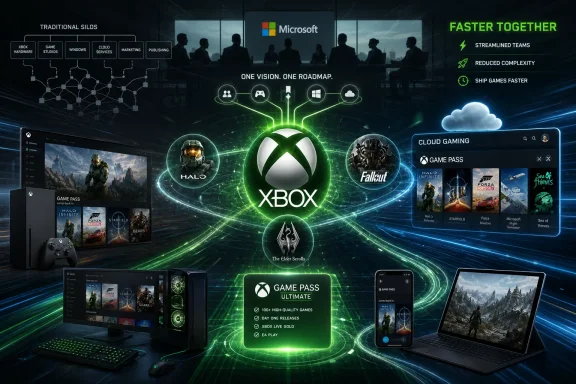 Xbox Is No Longer a Side Quest Inside Microsoft
Xbox began life as Microsoft’s answer to a threat. In the late 1990s and early 2000s, the company feared that living-room devices could become alternative computing platforms that weakened Windows. The original Xbox was therefore both a game console and a strategic hedge: a DirectX box under the television, built by a company that understood operating systems, developer tools, and platform lock-in better than almost anyone.That logic carried Xbox through the Xbox 360 era, when Microsoft briefly looked like it had cracked the console market’s cultural code. Xbox Live was the service layer Sony had failed to build, Halo was the shooter that defined dorm-room networking and online matchmaking, and the console itself felt like an extension of the Windows ecosystem without being shackled to Windows’ worst instincts. For a while, Xbox was Microsoft’s coolest product.
The trouble is that the business no longer fits that clean origin story. Microsoft now owns Bethesda, Activision Blizzard, King, Mojang, and a sprawling portfolio of studios that would have seemed absurdly large even during the Xbox 360 peak. It sells consoles, publishes on PlayStation, rents games through Game Pass, runs cloud infrastructure, promotes PC gaming, experiments with mobile distribution, and still tries to maintain a coherent fan identity around a black-and-green box.
That is not a division. That is an entertainment conglomerate awkwardly wearing a platform company’s hoodie.
The reported restructuring options make sense in that context. A wholly owned subsidiary could give Xbox clearer accounting, its own operational mandate, and more room to make decisions that look strange from the perspective of Windows or Azure. A joint venture would be more radical, implying Microsoft might want outside capital, distribution, or media partners to shoulder risk. A spinout would be the loudest move of all, though the report frames it as one option among many rather than a settled plan.
The important point is not that Microsoft has decided to cut Xbox loose. It is that Xbox has grown complicated enough that Microsoft is apparently willing to ask what kind of corporate container it should live in.
Asha Sharma Inherits the Bill for the Spencer Era
Phil Spencer’s Xbox legacy is more complicated than either his fans or critics tend to admit. He stabilized the brand after the Xbox One launch disaster, rebuilt goodwill with players, expanded Microsoft’s PC gaming ambitions, and turned Game Pass into the most influential subscription product in gaming. He also presided over an acquisition spree that created a portfolio so large that even Microsoft now appears to be asking whether it can manage it effectively.The Activision Blizzard deal was the apex of that strategy. It gave Microsoft Call of Duty, Warcraft, Diablo, Overwatch, Candy Crush, and a massive publishing machine. But it also made Xbox’s mission harder to explain. If the world’s biggest Xbox-owned shooter must remain widely available on PlayStation and other platforms for regulatory and commercial reasons, then Xbox hardware becomes less of a fortress and more of a storefront.
Bethesda created a different version of the same tension. Starfield was meant to prove the value of first-party exclusivity, yet the broader conversation around Bethesda now revolves around the long gaps between tentpole releases. Fallout has not had a new mainline single-player entry since Fallout 4 in 2015, and the most recent new Fallout release, Fallout 76, arrived in 2018 after a rough launch that took years of repair. The Elder Scrolls VI was announced in 2018 and remains a distant promise.
Sharma’s reported focus on Halo, Fallout, and The Elder Scrolls therefore reads less like a creative wish list than a diagnosis. These are not obscure catalog assets. They are among the most recognizable names Microsoft owns, and they have been allowed to drift through a decade in which gaming attention became more fragmented and harder to win back.
Halo is the sharpest example because it is Xbox’s original myth. Halo Infinite launched in 2021 with strong core combat and a live-service plan that quickly exposed production and pipeline weaknesses. If Halo: Campaign Evolved really arrives in July 2026 as a rebuilt Unreal Engine 5 remake of Combat Evolved and launches on Xbox, PC, and PlayStation 5, it will mark both a nostalgic reset and a philosophical surrender. The franchise that once sold Xbox consoles would become a Microsoft-owned game designed to meet players wherever they already are.
That may be smart business. It also means Xbox’s identity is being rewritten in public.
“Move Faster” Is the Most Dangerous Phrase in Game Development
Every troubled entertainment company eventually discovers the phrase “move faster.” It sounds operational, practical, and investor-friendly. It suggests bottlenecks can be cleared, management layers flattened, and beloved franchises converted from occasional monuments into reliable release pipelines. In software, that kind of language can be bracing; in games, it can be lethal.Games are not merely delayed because creative directors are precious or engineers are slow. They are delayed because AAA development has become a collision between cinematic ambition, open-world scope, online infrastructure, player expectations, platform certification, localization, accessibility, anti-cheat systems, monetization design, and the need to ship something that will survive social media’s first 48 hours. To accelerate that machine without narrowing scope is usually to move crunch, quality risk, or creative compromise downstream.
Bethesda is a particularly bad fit for impatient clocks. The studio’s biggest games sell partly because they feel like strange, handcrafted ecosystems full of simulation, jank, lore, and player-driven nonsense. That formula is hard to industrialize. A faster Fallout that loses the density and weirdness of Fallout is not really a faster Fallout; it is a brand extension wearing power armor.
The Elder Scrolls is even more exposed. Skyrim’s longevity has become both a blessing and a curse. It kept the franchise alive across three console generations, but it also raised expectations for the next mainline entry to absurd levels. Microsoft can spend more money and assign more resources, but there is no simple staffing equation that turns a mythic open-world RPG into an assembly-line product.
Halo has the opposite problem. It has shipped more often, changed hands more visibly, and endured more public debate over what it is supposed to be. A remake can buy time, reset technology, and reintroduce the franchise to PlayStation players. But it cannot by itself answer whether Halo’s future is arena multiplayer, cinematic campaign, co-op nostalgia, live-service platform, or all of the above.
That is why Sharma’s reported plan to spend more on top-tier games in the coming fiscal year should be read with both optimism and caution. More money is necessary. It is not sufficient. The industry is littered with expensive games that moved quickly toward the wrong target.
A Subsidiary Could Clarify Xbox’s Books, but Not Its Soul
Turning Xbox into a wholly owned subsidiary would not mean Microsoft loses control. LinkedIn and GitHub are useful comparisons because both remain Microsoft-owned while operating with distinct brands, cultures, and business rhythms. A similar structure for Xbox could make strategic sense if the goal is to give gaming leadership more autonomy while forcing the business to stand in clearer financial daylight.The accounting point matters. Xbox’s performance is often discussed through a fog of selective metrics: Game Pass subscribers when the number is favorable, engagement when subscriptions stall, content revenue when Activision helps, console commitment when hardware anxiety spikes, and “players across devices” when platform identity gets messy. A subsidiary structure could make it harder to hide the trade-offs.
It could also make Xbox easier to partner around. A semi-autonomous Xbox might be better positioned to negotiate with device manufacturers, cloud providers, media companies, or even rival platforms without every move being filtered through the politics of Microsoft’s broader empire. If Microsoft wants Xbox to become the entertainment layer across screens rather than a console-first business, a separate structure could reduce internal drag.
But legal structure does not solve product confusion. GitHub works inside Microsoft because its mission is legible: it is the home for developers and code collaboration. LinkedIn works because its professional graph and advertising business are distinct from Microsoft 365 even when integrations exist. Xbox is messier because its hardware, software, content, services, and community promises overlap in ways that can contradict one another.
A subsidiary Xbox could still face the same brutal questions. Should Call of Duty prioritize Game Pass, premium sales, or platform ubiquity? Should Bethesda games launch everywhere on day one, or should they serve as reasons to buy into Xbox hardware and services? Should Windows be the center of Xbox’s PC strategy, or should Xbox behave like a publisher that happens to be owned by the Windows company?
Those questions are strategic, not structural. A new box on an org chart can make decisions cleaner. It cannot make them easy.
The PlayStation Port Is No Longer the Scandal
The old console-war frame is increasingly useless here. For years, the question was whether Xbox games would come to PlayStation. That question has now largely been answered by Microsoft’s behavior: yes, more of them will, and the direction of travel is obvious. The more expensive Microsoft’s content portfolio becomes, the harder it is to justify artificial limits on its audience.What has changed is the emotional meaning of that decision. A decade ago, putting Halo on PlayStation would have sounded like a white flag. In 2026, it looks more like a margin strategy. The console is still useful, but it is no longer the only place where the Xbox business must win.
This is where Windows users should pay attention. Microsoft’s most defensible gaming platform may not be the Xbox console at all. It may be the combination of Windows PCs, Game Pass, cloud saves, cross-buy entitlements, controller support, and a software identity that follows the player across devices. The irony is that Microsoft spent decades trying to extend Windows into the living room, and now Xbox may survive by becoming less dependent on a dedicated living-room box.
That does not mean hardware is irrelevant. Consoles still provide a controlled target for developers, a simple consumer proposition, and a loyal audience that values convenience over component upgrades. Microsoft abandoning hardware entirely would risk turning Xbox into just another publisher with an expensive subscription service attached.
But the hardware business has to be honest about its role. If Xbox consoles are premium access points into a wider Microsoft gaming ecosystem, say that. If they are meant to compete unit-for-unit with PlayStation, fund and market them accordingly. If they are becoming reference devices for a Windows-adjacent gaming OS, then Microsoft must finally make that experience less confusing than the current PC gaming stack.
The reported restructuring conversation is therefore not a side note to platform strategy. It is platform strategy by another name.
Bethesda Is the Test Microsoft Cannot Avoid
The easiest way to understand Xbox’s problem is to look at Bethesda. Microsoft bought one of the most respected RPG publishers in the world, inherited franchises with enormous cultural reach, and then discovered that owning beloved IP does not magically produce new entries at the speed shareholders prefer. Fans cannot play an acquisition announcement. They can only play games.Fallout is a particularly painful case because the television adaptation reignited mainstream interest in the franchise. That kind of cross-media moment is rare and valuable. Yet Microsoft does not have a new single-player Fallout ready to capitalize on it, which makes the company look less like a master of synergy and more like a landlord sitting on a famous address.
The Elder Scrolls VI is an even longer-running symbol of the gap between announcement culture and production reality. Its 2018 reveal was little more than a promise, and promises age badly when the rest of the industry moves on. By 2026, an entire generation of players has grown up with Skyrim as a modding platform, meme factory, and comfort game rather than a prelude to an imminent sequel.
Microsoft can try to solve this by increasing budgets, parallelizing development, or encouraging Bethesda to work with external teams. Each option carries risk. Outsourcing can dilute identity. Parallel teams can fragment technology and lore. Bigger budgets can make executives more conservative, not less, because the cost of failure rises with every headcount request.
The better answer may be a portfolio approach that respects different rhythms. Not every franchise needs a single monolithic release every decade. Fallout could support smaller narrative games, remasters, experimental spin-offs, and live-service expansions without replacing the need for a true mainline sequel. The Elder Scrolls could benefit from carefully scoped releases that keep the world alive without pretending every product must be Skyrim 2.
That is where Xbox’s scale should help. Microsoft owns enough studios to stop treating every beloved franchise as the sole burden of one team. The danger is that “move faster” becomes a mandate to squeeze Bethesda rather than a mandate to build a healthier publishing architecture around Bethesda.
Halo Shows the Cost of Treating Icons Like Infrastructure
Halo is not just another franchise in this discussion because Halo taught Microsoft what Xbox was. It gave the console a voice, an image, and a social ritual. For years, Master Chief was not simply a character; he was Microsoft’s proof that the company could create culture rather than merely license productivity.That history makes Halo’s modern uncertainty more damaging. When Halo struggles, Xbox’s brand problem becomes visible. It suggests not just that one studio missed a target, but that Microsoft has difficulty stewarding the very myth that justified its gaming ambitions.
A remake of Combat Evolved is a logical move. It gives Microsoft a clean story for the franchise’s 25-year history, offers a familiar campaign to new audiences, and lets the company rebuild around modern tools. Unreal Engine 5 also hints at a desire to escape bespoke technology traps that can slow content pipelines and isolate talent.
But nostalgia is not strategy. The first Halo worked because it felt new, not because it was a museum piece. If Campaign Evolved is a bridge to a more coherent future, it could be valuable. If it is merely a high-budget reminder of when Xbox mattered more, it will sharpen the contrast between past confidence and present uncertainty.
The rumored PlayStation 5 release adds another layer. For players, more access is good. For Xbox identity, it is destabilizing. The company has to make the case that Xbox means something even when its most symbolic game is no longer confined to Xbox hardware.
That case cannot be built with slogans. It has to be built with features, reliability, saves, friends, libraries, mod support, performance, fair pricing, and trust that purchased games will remain available. The future of Xbox may depend less on where Halo ships than on whether the Xbox ecosystem around Halo feels better than buying the same game somewhere else.
The Layoff Shadow Makes the Spending Promise Harder to Hear
The report lands amid expectations of more Xbox layoffs after Microsoft’s fiscal year closes on June 30. That timing is not incidental. Corporate reorganizations often arrive wrapped in the language of focus, efficiency, and investment, and employees have learned to hear those words with dread.There is a grim contradiction in promising to spend more on top-tier games while preparing cuts. It may be financially coherent: reduce duplicated roles, cancel weaker projects, concentrate capital on fewer bigger bets. But it is culturally corrosive, especially in game development, where institutional memory and team trust matter. You cannot repeatedly tell creative workers they are both Microsoft’s future and Microsoft’s cost problem without consequences.
The gaming industry has spent the past several years normalizing layoffs after record acquisition spending and pandemic-era growth. Microsoft is not alone in that pattern, but it is one of the few companies large enough to make the contradiction impossible to ignore. When a $3 trillion-class technology giant says its gaming division is overextended, employees and players are entitled to ask who did the extending.
Sharma’s challenge is therefore not just operational. It is moral in the ordinary corporate sense: can she convince teams that Xbox has a plan worth enduring disruption for? Developers can survive hard pivots when leadership is clear, credible, and consistent. They burn out when every new mandate feels like a prelude to another cancellation.
This is also where Microsoft’s internal culture becomes part of the product story. Xbox has often marketed itself as player-friendly, creator-friendly, and community-minded. Those claims are harder to maintain when the business appears to be cycling through restructures, departures, and layoffs while asking fans to believe the next era will finally be different.
Game Pass Is the Unspoken Constraint Behind Every Option
Any serious Xbox restructuring has to confront Game Pass. Microsoft’s subscription service remains one of the most important experiments in modern gaming, but it also complicates every release decision. A blockbuster game on Game Pass can drive engagement and subscriptions; the same game sold at full price across every platform can generate immediate revenue that is easier to measure.This tension becomes sharper as development budgets rise. If Microsoft spends more on Halo, Fallout, and The Elder Scrolls, it must decide whether those games exist primarily to support Game Pass, to sell premium copies, to expand Microsoft’s presence on rival platforms, or to do all of that at once. Doing all of it sounds attractive until the incentives collide.
For players, Game Pass is simple: pay a monthly fee and play a lot of games. For Microsoft, it is a balancing act between content cost, subscriber growth, churn reduction, third-party licensing, first-party opportunity cost, and platform leverage. The service becomes more powerful when it has must-play first-party games, but those are exactly the games that carry the greatest revenue risk if subscription economics do not scale fast enough.
A more independent Xbox could make that math more transparent. It could also make the hard choices harder to avoid. If Game Pass is a sustainable engine, Microsoft should be able to show it through Xbox’s operating performance. If it is a strategic subsidy designed to keep users inside Microsoft’s ecosystem, that is a different argument and one that becomes murkier if Xbox is moved into a subsidiary structure.
The reported interest in faster franchise development suggests Microsoft knows it needs more predictable content cadence. Subscription businesses are hungry machines. They do not thrive on one landmark release every several years. They need rhythm, habit, and a sense that the next valuable thing is never too far away.
The danger is that Game Pass pressure turns every franchise into feedstock. The opportunity is that Microsoft’s scale, if managed intelligently, could support a broader range of game sizes and release models than the traditional AAA cycle allows. That is the version of Xbox restructuring worth taking seriously.
Windows Still Has More at Stake Than Microsoft Admits
For all the talk about consoles and franchises, Windows remains central to Xbox’s future. PC gaming is one of Microsoft’s strongest natural advantages, yet the company has spent years making that advantage feel more accidental than intentional. Steam owns the emotional center of PC game libraries. Nvidia owns much of the performance conversation. Discord owns social presence. Mod communities often route around official storefronts entirely.Microsoft has pieces of the answer but not always the product discipline to assemble them. The Xbox app on Windows has improved, but it still does not feel like the definitive home of PC gaming. The Microsoft Store has shed some of its old stigma, yet many players still treat it as a place they use only when Game Pass requires it. Windows itself is essential to PC gaming while rarely feeling lovingly optimized for it.
A restructured Xbox could either improve or worsen this. If Xbox gains autonomy, it might push harder for Windows gaming improvements that serve players rather than internal platform politics. It might demand faster updates, cleaner library management, better handheld support, stronger overlay features, and a more coherent bridge between console and PC identities.
But if Xbox becomes more publisher-like, Windows could become just another distribution channel. That would be a mistake. Microsoft’s competitors would love for the company to underuse its operating system advantage. Valve’s SteamOS ambitions, handheld PC growth, and cloud gaming experiments all point toward a future in which Windows is powerful but not inevitable.
The next Xbox strategy should therefore treat Windows as more than a checkbox. If Xbox is “where the world plays,” then Windows is still where many of the world’s most dedicated players configure, mod, stream, benchmark, and argue. Microsoft does not need to turn Windows into a console. It needs to make the Xbox layer on Windows feel worthy of the platform beneath it.
That is a product challenge, not a branding exercise. Windows users will not be persuaded by a manifesto if the app is slow, the store is awkward, or cross-device promises break at the edges.
The Real Reorganization Is From Hardware Brand to IP Machine
The harshest reading of the report is that Microsoft is preparing Xbox for a future in which its most valuable assets are not consoles or subscriptions, but franchises. Halo, Fallout, The Elder Scrolls, Call of Duty, Minecraft, Warcraft, Diablo, Doom, Forza, Gears, and Candy Crush represent a catalog few entertainment companies can match. The rational corporate move is to extract more value from that catalog across platforms, media, merchandise, and services.That does not mean Xbox hardware dies. It means hardware becomes one route into an IP ecosystem rather than the center of the business. Sony has already moved in this direction more cautiously, bringing PlayStation games to PC after exclusivity windows and turning franchises into films and television shows. Microsoft, because of its weaker console position and larger software instincts, may simply move faster and more aggressively.
There is nothing inherently wrong with that. Players benefit when more games are available on more devices. Developers benefit when their work reaches larger audiences. Microsoft benefits when it stops pretending that every valuable game must serve a console-war narrative from 2007.
But something can be good business and still carry a cost. Xbox’s most loyal fans bought into an identity built around hardware, services, achievements, friends lists, controllers, backward compatibility, and a sense of belonging to a distinct ecosystem. If Microsoft dissolves that identity too quickly into a generic everywhere-publisher model, it risks keeping the revenue while losing the community.
That is why Sharma’s “return of Xbox” language matters. The return cannot mean a retreat to exclusivity nostalgia. That market has changed. But it also cannot mean stripping Xbox for parts and calling the liquidation a strategy. The brand needs a reason to exist beyond ownership of famous names.
A subsidiary structure might help protect that reason by giving Xbox leaders a clearer mandate. Or it might expose that Microsoft’s real goal is to harvest IP more efficiently. The next year will tell us which interpretation is closer to reality.
The Console War Is Over, but the Trust War Is Not
The most outdated reaction to the report is to ask whether it means Xbox has “lost” to PlayStation. That war, at least in its old form, is over. Microsoft has already chosen a broader battlefield. The more relevant question is whether players, developers, and partners trust Xbox’s new shape enough to invest their time and money in it.Trust is now the scarce asset. Players want to know whether their libraries are safe, whether hardware will be supported, whether Game Pass will remain affordable, and whether Microsoft will keep changing its mind about exclusivity. Developers want to know whether Xbox is a reliable partner, a subscription gatekeeper, a storefront, a publisher, or a moving target. Employees want to know whether the next reorganization is a plan or another round of corporate weather.
Microsoft’s advantage is that it can afford patience. Its disadvantage is that patience has too often looked like drift. The company waited too long to turn Bethesda’s cultural value into a predictable release pipeline. It let Halo spend years arguing with itself. It built Game Pass into a household name among enthusiasts without fully resolving what the service should become at Microsoft scale.
Sharma appears to understand that Xbox needs sharper priorities. The reported focus on top-tier franchises is a sensible starting point because it grounds the strategy in things players actually recognize. Nobody outside investor calls falls in love with “engagement.” They fall in love with worlds, characters, mechanics, memories, and the promise that a favorite series still has a future.
But trust will not return just because Microsoft spends more. It returns when the company ships consistently, communicates plainly, and stops treating every strategic correction as a revolution. Xbox does not need another grand identity crisis. It needs evidence.
The Sharma Doctrine Will Be Judged by Games, Not Org Charts
The practical reading of the report is narrower than the social-media panic cycle will allow. Microsoft is reportedly discussing structural options, not announcing a divorce from Xbox. Sharma is reportedly preparing to spend more on major games, not promising that The Elder Scrolls VI will suddenly materialize next spring. The company appears to be searching for speed, accountability, and a better way to manage assets that have outgrown the old Xbox container.That still leaves several concrete conclusions for anyone watching the Windows and Xbox ecosystem:
- Microsoft is reportedly considering structural changes because Xbox’s current form no longer cleanly matches the scale of the business it now operates.
- A wholly owned subsidiary would not make Xbox independent from Microsoft, but it could give the gaming business more autonomy and clearer financial accountability.
- A joint venture or spinout would be more disruptive, and the report does not establish that either move is imminent.
- Halo, Fallout, and The Elder Scrolls are likely to become the early tests of Sharma’s promise to make Xbox move faster.
- Faster development will only help if Microsoft also fixes production discipline, platform clarity, and the relationship between Game Pass and premium sales.
- Windows users should watch this closely because Xbox’s future increasingly runs through PC gaming, cross-device services, and Microsoft’s ability to make its own ecosystem feel coherent.
References
- Primary source: Windows Central
Published: 2026-06-12T20:50:09.832406
Loading…
www.windowscentral.com - Related coverage: pcgamer.com
Loading…
www.pcgamer.com - Related coverage: gamesradar.com
Major Xbox layoffs reportedly on the way as CEO Asha Sharma admits Microsoft's gaming division is "over extended" | GamesRadar+
Going forward, this cannot continuewww.gamesradar.com - Related coverage: gamespot.com
Loading…
www.gamespot.com - Related coverage: tomsguide.com
Loading…
www.tomsguide.com - Related coverage: fortune.com
‘Not an Allbirds Moment’: Xbox’s CEO says she is grounding the console in gaming roots, not AI | Fortune
Since stepping into the Xbox CEO role, Asha Sharma has preached a "return of Xbox."fortune.com
- Related coverage: news.xbox.com
XBOX Games Showcase 2026 Recap: The Return of Exclusives, World Premieres, and Anniversary Hardware - XBOX Wire
XBOX Game Showcase 2026 just concluded. Find out everything announced - from the return of exclusives, to anniversary hardware, to games from XBOX and our partners – inside. news.xbox.com
- Related coverage: techradar.com
Loading…
www.techradar.com - Related coverage: omni.se
Xbox planerar stora nedskärningar i sommar
Microsofts speldivision Xbox planerar stora nedskärningar i juli när den nya vd:n Asha Sharma gör om spelverksamheten för att vända flera års svag utveckling, rapporterar Bloomberg.omni.se - Related coverage: t3.com

Xbox rightly bins lame AI Copilot concept in bid to win back fans
Gaming sidekick gets kicked outwww.t3.com
