

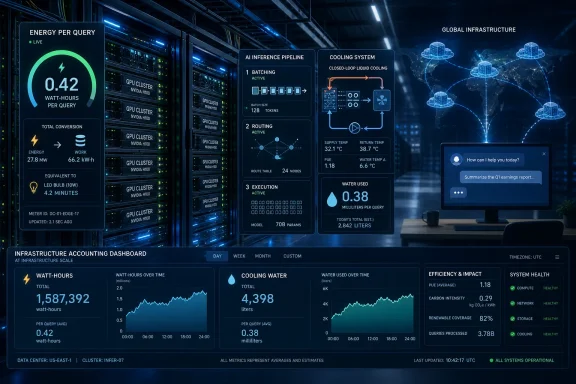
Microsoft published new peer-reviewed research on June 15, 2026, arguing that large-scale AI inference can use roughly 0.16 to 0.60 watt-hours of electricity per typical query, with near-term engineering gains potentially improving per-query efficiency by 8 to 20 times. The claim matters because the AI debate has moved from novelty to infrastructure: power lines, water systems, datacenter permits, GPU supply chains, and local trust. Microsoft is not saying AI is free, or even small at global scale. It is saying the scary per-prompt numbers often cited in public debate are incomplete unless they account for what hyperscale systems actually do when billions of requests are batched, routed, cooled, and served as a fleet.
The public conversation around AI energy use has been trapped between two unsatisfying poles. On one side are breathless comparisons that make every chatbot answer sound like an environmental indulgence. On the other are vendor assurances that efficiency will solve the problem before anyone needs to worry too much.
Microsoft’s new Joule study tries to occupy the middle ground, but it is not a neutral act. It is both a research paper and a strategic intervention in a regulatory and community debate that Microsoft cannot avoid. If Copilot, Azure AI Foundry, GitHub Copilot, Windows-integrated assistants, and enterprise agents are to become ordinary software infrastructure, Microsoft needs a credible answer for mayors, utilities, regulators, CIOs, and customers asking what all of this costs in electricity and water.
The company’s answer is precise enough to be useful and narrow enough to require caution. A typical query to some of the largest and most capable language models, under production-scale assumptions, falls below one watt-hour. Microsoft frames that as roughly equivalent to running a 40-watt PC for 15 to 60 seconds, or a 1,000-watt microwave for less than a few seconds.
That comparison is rhetorically effective because it punctures the idea that a single prompt is automatically extravagant. But the more important number is not the one-query figure. It is what happens when that figure is multiplied by billions of interactions per day, then stretched further by coding agents, long-context retrieval, multimodal workflows, and systems that call other systems in the background.
That distinction is not academic. A single model running on a single machine is often a poor proxy for a global AI service. In the real world, requests arrive continuously, vary in length and complexity, and can be routed to different model sizes depending on the task. Idle capacity is expensive, so cloud providers have strong incentives to keep accelerators busy and squeeze more tokens out of each watt.
Microsoft’s airline analogy is apt, if a little self-serving. A large airline can fill seats, reposition aircraft, optimize routes, and absorb uneven demand better than a small operator. A hyperscale AI provider can similarly batch requests, allocate hardware dynamically, and choose between different inference strategies.
But scale cuts both ways. The same machinery that improves per-query efficiency also makes it easier to put AI everywhere. When an efficiency gain lowers cost, product teams tend to spend the savings on more features, more automation, longer answers, richer context windows, and more background reasoning. In computing, efficiency rarely stays banked as conservation; it usually becomes capacity.
That is why the right question is not whether Microsoft has found a smaller number for a Copilot-style query. It is whether the industry can keep efficiency gains ahead of demand growth as AI shifts from chat windows to always-on agents.
That makes inference the part of AI energy use that WindowsForum readers should watch most closely. It is the workload that scales with adoption. It is also the workload most likely to be embedded into operating systems, productivity suites, browsers, search, security tools, developer environments, and line-of-business applications.
Microsoft’s own examples show why token counts matter. A short conversational query may involve a few hundred generated tokens. A coding task, research workflow, or multi-step reasoning job may run into thousands of output tokens, and long-context systems may read enormous amounts of input before generating anything at all. The user sees “answer my question”; the datacenter sees a sequence of matrix operations, memory movement, scheduling decisions, and cooling demands.
This is where the study usefully pushes past the simplistic “one query equals one cost” framing. The cost of AI depends on input length, output length, model size, hardware efficiency, utilization, cooling, and the orchestration layer around it. In plain English: asking a model to draft a sentence is not the same infrastructure event as asking an agent to inspect a repository, reason over logs, generate a patch, and explain the change.
For Windows users, this distinction may eventually become visible in product design. Local NPUs, cloud offload, small models, large models, and hybrid execution are not just latency and privacy choices. They are energy architecture choices. The more AI becomes part of Windows and Microsoft 365, the more these hidden routing decisions will shape the cost and sustainability profile of ordinary computing.
The first lever is model design. Smaller, specialized models can perform well on narrower tasks without invoking the largest available system. Microsoft points to Phi models and Fara-7B as examples of this direction, and to model routing in Azure AI Foundry as a way to match a request to an appropriately sized model. If a lightweight model can answer a simple question, sending that question to a frontier-scale model is wasteful.
The second lever is serving architecture. Techniques such as disaggregated serving separate different phases of inference so hardware can be used more efficiently. Long outputs, in particular, can stress systems differently from short exchanges, and better orchestration can reduce waste while maintaining response quality and latency. This is the unglamorous engineering layer that rarely makes keynote slides but often determines whether AI economics work.
The third lever is hardware. Newer GPUs and purpose-built inference accelerators can deliver more computation per watt, and Microsoft is increasingly explicit about custom silicon such as Maia. Better chips do not eliminate the need for more power, but they can change the slope of the demand curve.
The stack matters because each layer changes the baseline for the next. A smaller model reduces the work to be done. A better serving system keeps accelerators busier and avoids avoidable overhead. More efficient hardware lowers the energy cost of the remaining work. When these improvements compound, the result can be dramatic.
Still, “can” is not “will.” Efficiency gains depend on deployment, workload mix, latency requirements, customer behavior, and product incentives. A conservative CIO should read Microsoft’s claim as a roadmap, not as a guarantee that every AI feature in every product will automatically become 20 times more efficient.
Microsoft estimates that a typical query against large production models consumes between 0.0 and 0.067 milliliters of cooling water under conservative assumptions, with a median below a single drop. That number is designed to counter a popular perception that every AI request carries a visible water footprint. For the prompt itself, Microsoft’s estimate suggests the water cost can be tiny.
But communities do not experience water use as an average per prompt. They experience it as a facility, a permit, a seasonal constraint, a cooling design, and a relationship with local infrastructure. A datacenter that consumes little water per AI query may still be controversial if it sits in a region worried about drought, aquifers, municipal capacity, or industrial growth.
Microsoft knows this, which is why the company has been emphasizing zero-water datacenter designs and closed-loop cooling. The shift matters. Traditional evaporative cooling can reduce energy needs but consumes water; closed-loop systems reduce ongoing water consumption but may alter energy trade-offs. There is no free thermodynamic lunch.
That is the key point often lost in vendor messaging. Reducing water use can increase the importance of electricity efficiency. Reducing electricity use can change cooling requirements. Moving workloads across regions can change carbon intensity, latency, and local grid impact. Sustainability is not a single scoreboard; it is a set of trade-offs that only look simple in a press release.
Microsoft’s per-query water estimate is useful, but it should not be treated as the end of the conversation. The accountable metric for communities will remain facility-level reporting: how much water a datacenter withdraws, how much it consumes, when it uses it, where it returns it, and how those numbers change during heat waves and peak demand.
A billion queries per day is no longer a fantasy number. Leading AI services already operate at that order of magnitude, and Microsoft’s business strategy assumes AI interactions will become more frequent, not less. The company wants Copilot in productivity software, developer workflows, business processes, security operations, and consumer experiences.
The mixed-workload scenario is even more important. Microsoft notes that if 10 percent of queries are longer and more complex — generating thousands of tokens for tasks such as code generation or multi-step reasoning — efficiency improvements still cut total energy use by more than half. That finding matters because the future of AI is not merely chat. It is long-running work.
Agents are the wild card. A chatbot answer is relatively bounded. An agent can search, read, plan, call tools, revise, validate, and produce artifacts. Some of those steps may involve multiple model calls, hidden prompts, retrieval operations, and checks the user never sees. As software moves from “answer this” to “do this,” the unit of demand shifts from the query to the task.
That transition could make per-query comparisons less meaningful over time. If a future Windows or Microsoft 365 agent silently performs 30 model calls to complete a workflow, the user may think they made one request while the infrastructure served many. The accounting will need to follow the work, not the chat bubble.
This creates an uncomfortable tension for enterprise buyers. On one hand, centralized cloud AI may be more energy-efficient per query than fragmented self-hosted deployments. On the other hand, relying on hyperscale AI deepens vendor dependence and concentrates infrastructure power in a handful of companies. Sustainability, cost, compliance, and lock-in become entangled.
Azure AI Foundry’s model routing illustrates the point. In principle, routing requests to the right model is exactly what responsible AI infrastructure should do. In practice, the best routing systems require telemetry, workload visibility, model catalogs, performance data, and deep integration with the serving platform. The more sophisticated the optimization, the harder it may be to reproduce outside the hyperscaler’s stack.
For sysadmins and architects, this is a familiar cloud-era bargain. You can build your own infrastructure and control more of the stack, but you may lose economies of scale. Or you can consume a managed platform that is more efficient and easier to operate, while accepting pricing, policy, and roadmap dependence.
The AI version of that bargain is sharper because the resource curve is steeper. GPUs, accelerators, power availability, cooling design, and model operations are now strategic constraints. Microsoft’s study effectively says: scale is not just bigger; scale is cleaner and cheaper per unit. That may be true, but it also strengthens the gravitational pull toward Azure.
History is full of computing systems that became vastly more efficient while total consumption rose because usage exploded. The cloud did not make servers disappear; it made server capacity easier to consume. Broadband did not reduce data traffic; it enabled streaming, backups, video calls, telemetry, and services that assumed continuous connectivity. AI may follow the same pattern.
Microsoft gestures at this history when it argues that datacenter efficiency helped moderate energy demand during earlier internet and cloud growth. That is a reasonable analogy, but AI has a different product dynamic. Generative systems can create new work for themselves: longer answers, synthetic data, agent loops, automated testing, code generation, document analysis, and background personalization.
The danger is not that a single query uses too much electricity. The danger is that software design begins to treat inference as effectively unlimited. If every ribbon button, context menu, search box, security alert, meeting transcript, and code editor panel can call a model, then efficiency becomes the enabling condition for a much larger system of consumption.
This is why procurement and governance matter. Enterprises adopting AI should not ask only whether a vendor has efficient infrastructure. They should ask which model is used for which task, whether routing policies are visible, how many calls are made per workflow, what telemetry is available, and whether local or smaller models can satisfy routine needs.
The sustainable AI question is becoming an architecture question. It belongs in design reviews, not just ESG reports.
Windows is a particularly important venue for this shift. The operating system sits at the boundary between local hardware and cloud services. With NPUs becoming standard in new PCs, Microsoft has an opportunity to move some inference to the edge. But local execution is not automatically greener or better. A datacenter GPU running at high utilization may be more efficient for some workloads than a client device doing sporadic local inference.
The right answer will vary. A short local classification task may belong on the PC. A large reasoning workflow may belong in Azure. A sensitive enterprise document may require a governed tenant boundary. A low-value autocomplete may not deserve a frontier model at all.
This is where Microsoft’s model-routing story becomes operationally important. If the company can make intelligent routing real, administrators may get AI systems that are cheaper, faster, and less wasteful. If routing remains opaque, enterprises will struggle to understand what they are buying and what they are consuming.
IT pros should push for reporting at the level where decisions are made. Per-query averages are useful for public debate, but enterprise governance needs workload-level visibility: model class, token volume, latency, region, retention behavior, and estimated energy or carbon impact. Without that, sustainable AI remains a vendor claim rather than an operational practice.
That is good. The AI industry has spent too long operating with vague estimates, dramatic anecdotes, and selective disclosures. A peer-reviewed bottom-up methodology gives the market something firmer to debate. It also invites comparison across providers, models, regions, and workloads.
Microsoft will benefit if the study resets public assumptions away from inflated per-prompt claims. But it will also face pressure to disclose more. If Azure can estimate energy per query in research, customers will ask why dashboards cannot expose similar metrics for deployed applications. If model routing saves energy, customers will ask whether they can configure it. If long queries dominate consumption, customers will ask how to budget and limit them.
This is where sustainability becomes a product feature. Cloud providers already expose cost dashboards because money matters. As AI workloads grow, energy and water impact may become another observability layer. The winning platform will not merely say it is efficient; it will let customers prove it.
For Microsoft, that means the study is a beginning, not a closing argument. The company has framed the issue around measurable inference efficiency. Now it has to make the measurement usable outside the lab and meaningful inside customer tenants.
 Microsoft Wants to Move the AI Sustainability Debate From Anecdote to Accounting
The public conversation around AI energy use has been trapped between two unsatisfying poles. On one side are breathless comparisons that make every chatbot answer sound like an environmental indulgence. On the other are vendor assurances that efficiency will solve the problem before anyone needs to worry too much.Microsoft’s new Joule study tries to occupy the middle ground, but it is not a neutral act. It is both a research paper and a strategic intervention in a regulatory and community debate that Microsoft cannot avoid. If Copilot, Azure AI Foundry, GitHub Copilot, Windows-integrated assistants, and enterprise agents are to become ordinary software infrastructure, Microsoft needs a credible answer for mayors, utilities, regulators, CIOs, and customers asking what all of this costs in electricity and water.
The company’s answer is precise enough to be useful and narrow enough to require caution. A typical query to some of the largest and most capable language models, under production-scale assumptions, falls below one watt-hour. Microsoft frames that as roughly equivalent to running a 40-watt PC for 15 to 60 seconds, or a 1,000-watt microwave for less than a few seconds.
That comparison is rhetorically effective because it punctures the idea that a single prompt is automatically extravagant. But the more important number is not the one-query figure. It is what happens when that figure is multiplied by billions of interactions per day, then stretched further by coding agents, long-context retrieval, multimodal workflows, and systems that call other systems in the background.
The Per-Query Number Is Smaller Than the Fear, but the Fleet Is Larger Than the Prompt
The study’s central estimate is that production-scale AI inference is substantially more efficient than many previous public estimates suggested. Microsoft attributes that difference largely to scale. Earlier measurements often looked at isolated models, narrower hardware assumptions, or less optimized serving configurations; hyperscale production systems can spread requests across fleets, increase utilization, and use specialized routing and batching techniques.That distinction is not academic. A single model running on a single machine is often a poor proxy for a global AI service. In the real world, requests arrive continuously, vary in length and complexity, and can be routed to different model sizes depending on the task. Idle capacity is expensive, so cloud providers have strong incentives to keep accelerators busy and squeeze more tokens out of each watt.
Microsoft’s airline analogy is apt, if a little self-serving. A large airline can fill seats, reposition aircraft, optimize routes, and absorb uneven demand better than a small operator. A hyperscale AI provider can similarly batch requests, allocate hardware dynamically, and choose between different inference strategies.
But scale cuts both ways. The same machinery that improves per-query efficiency also makes it easier to put AI everywhere. When an efficiency gain lowers cost, product teams tend to spend the savings on more features, more automation, longer answers, richer context windows, and more background reasoning. In computing, efficiency rarely stays banked as conservation; it usually becomes capacity.
That is why the right question is not whether Microsoft has found a smaller number for a Copilot-style query. It is whether the industry can keep efficiency gains ahead of demand growth as AI shifts from chat windows to always-on agents.
Inference Has Become the Datacenter Story Windows Users Can Actually Feel
For years, AI infrastructure coverage focused on training: the spectacular GPU clusters, the massive model runs, the eye-watering capital expenditure, and the race to build ever-larger frontier systems. Training still matters, but inference is where AI becomes a daily utility. Every Copilot prompt, every code completion, every document summary, every agentic action is an inference event.That makes inference the part of AI energy use that WindowsForum readers should watch most closely. It is the workload that scales with adoption. It is also the workload most likely to be embedded into operating systems, productivity suites, browsers, search, security tools, developer environments, and line-of-business applications.
Microsoft’s own examples show why token counts matter. A short conversational query may involve a few hundred generated tokens. A coding task, research workflow, or multi-step reasoning job may run into thousands of output tokens, and long-context systems may read enormous amounts of input before generating anything at all. The user sees “answer my question”; the datacenter sees a sequence of matrix operations, memory movement, scheduling decisions, and cooling demands.
This is where the study usefully pushes past the simplistic “one query equals one cost” framing. The cost of AI depends on input length, output length, model size, hardware efficiency, utilization, cooling, and the orchestration layer around it. In plain English: asking a model to draft a sentence is not the same infrastructure event as asking an agent to inspect a repository, reason over logs, generate a patch, and explain the change.
For Windows users, this distinction may eventually become visible in product design. Local NPUs, cloud offload, small models, large models, and hybrid execution are not just latency and privacy choices. They are energy architecture choices. The more AI becomes part of Windows and Microsoft 365, the more these hidden routing decisions will shape the cost and sustainability profile of ordinary computing.
Microsoft’s 8-to-20x Claim Rests on a Stack, Not a Miracle
The headline number — 8 to 20 times greater energy efficiency — is not presented as a single breakthrough. It is a compounded estimate from improvements across models, serving systems, and hardware. That is more plausible than a silver bullet, and also more complicated to verify from the outside.The first lever is model design. Smaller, specialized models can perform well on narrower tasks without invoking the largest available system. Microsoft points to Phi models and Fara-7B as examples of this direction, and to model routing in Azure AI Foundry as a way to match a request to an appropriately sized model. If a lightweight model can answer a simple question, sending that question to a frontier-scale model is wasteful.
The second lever is serving architecture. Techniques such as disaggregated serving separate different phases of inference so hardware can be used more efficiently. Long outputs, in particular, can stress systems differently from short exchanges, and better orchestration can reduce waste while maintaining response quality and latency. This is the unglamorous engineering layer that rarely makes keynote slides but often determines whether AI economics work.
The third lever is hardware. Newer GPUs and purpose-built inference accelerators can deliver more computation per watt, and Microsoft is increasingly explicit about custom silicon such as Maia. Better chips do not eliminate the need for more power, but they can change the slope of the demand curve.
The stack matters because each layer changes the baseline for the next. A smaller model reduces the work to be done. A better serving system keeps accelerators busier and avoids avoidable overhead. More efficient hardware lowers the energy cost of the remaining work. When these improvements compound, the result can be dramatic.
Still, “can” is not “will.” Efficiency gains depend on deployment, workload mix, latency requirements, customer behavior, and product incentives. A conservative CIO should read Microsoft’s claim as a roadmap, not as a guarantee that every AI feature in every product will automatically become 20 times more efficient.
Water Is the Local Trust Problem Microsoft Cannot Benchmark Away
Electricity is the global metric. Water is the local argument.Microsoft estimates that a typical query against large production models consumes between 0.0 and 0.067 milliliters of cooling water under conservative assumptions, with a median below a single drop. That number is designed to counter a popular perception that every AI request carries a visible water footprint. For the prompt itself, Microsoft’s estimate suggests the water cost can be tiny.
But communities do not experience water use as an average per prompt. They experience it as a facility, a permit, a seasonal constraint, a cooling design, and a relationship with local infrastructure. A datacenter that consumes little water per AI query may still be controversial if it sits in a region worried about drought, aquifers, municipal capacity, or industrial growth.
Microsoft knows this, which is why the company has been emphasizing zero-water datacenter designs and closed-loop cooling. The shift matters. Traditional evaporative cooling can reduce energy needs but consumes water; closed-loop systems reduce ongoing water consumption but may alter energy trade-offs. There is no free thermodynamic lunch.
That is the key point often lost in vendor messaging. Reducing water use can increase the importance of electricity efficiency. Reducing electricity use can change cooling requirements. Moving workloads across regions can change carbon intensity, latency, and local grid impact. Sustainability is not a single scoreboard; it is a set of trade-offs that only look simple in a press release.
Microsoft’s per-query water estimate is useful, but it should not be treated as the end of the conversation. The accountable metric for communities will remain facility-level reporting: how much water a datacenter withdraws, how much it consumes, when it uses it, where it returns it, and how those numbers change during heat waves and peak demand.
The Billion-Query Scenario Shows Both the Promise and the Trap
Microsoft’s study models one billion conversational queries per day at about 0.7 gigawatt-hours of electricity at baseline, falling to about 0.3 gigawatt-hours when efficiency improvements are applied. That is an impressive reduction. It also quietly confirms the scale of the infrastructure now being normalized.A billion queries per day is no longer a fantasy number. Leading AI services already operate at that order of magnitude, and Microsoft’s business strategy assumes AI interactions will become more frequent, not less. The company wants Copilot in productivity software, developer workflows, business processes, security operations, and consumer experiences.
The mixed-workload scenario is even more important. Microsoft notes that if 10 percent of queries are longer and more complex — generating thousands of tokens for tasks such as code generation or multi-step reasoning — efficiency improvements still cut total energy use by more than half. That finding matters because the future of AI is not merely chat. It is long-running work.
Agents are the wild card. A chatbot answer is relatively bounded. An agent can search, read, plan, call tools, revise, validate, and produce artifacts. Some of those steps may involve multiple model calls, hidden prompts, retrieval operations, and checks the user never sees. As software moves from “answer this” to “do this,” the unit of demand shifts from the query to the task.
That transition could make per-query comparisons less meaningful over time. If a future Windows or Microsoft 365 agent silently performs 30 model calls to complete a workflow, the user may think they made one request while the infrastructure served many. The accounting will need to follow the work, not the chat bubble.
Hyperscale Efficiency Is Also a Competitive Moat
Microsoft’s argument has an environmental surface and a competitive core. If large-scale systems are dramatically more efficient than small-scale deployments, then hyperscalers gain another advantage. They do not merely have more GPUs; they can run those GPUs more effectively.This creates an uncomfortable tension for enterprise buyers. On one hand, centralized cloud AI may be more energy-efficient per query than fragmented self-hosted deployments. On the other hand, relying on hyperscale AI deepens vendor dependence and concentrates infrastructure power in a handful of companies. Sustainability, cost, compliance, and lock-in become entangled.
Azure AI Foundry’s model routing illustrates the point. In principle, routing requests to the right model is exactly what responsible AI infrastructure should do. In practice, the best routing systems require telemetry, workload visibility, model catalogs, performance data, and deep integration with the serving platform. The more sophisticated the optimization, the harder it may be to reproduce outside the hyperscaler’s stack.
For sysadmins and architects, this is a familiar cloud-era bargain. You can build your own infrastructure and control more of the stack, but you may lose economies of scale. Or you can consume a managed platform that is more efficient and easier to operate, while accepting pricing, policy, and roadmap dependence.
The AI version of that bargain is sharper because the resource curve is steeper. GPUs, accelerators, power availability, cooling design, and model operations are now strategic constraints. Microsoft’s study effectively says: scale is not just bigger; scale is cleaner and cheaper per unit. That may be true, but it also strengthens the gravitational pull toward Azure.
The Missing Variable Is Demand, Not Engineering
The strongest critique of Microsoft’s framing is not that the numbers are necessarily wrong. It is that efficiency does not answer the demand question by itself.History is full of computing systems that became vastly more efficient while total consumption rose because usage exploded. The cloud did not make servers disappear; it made server capacity easier to consume. Broadband did not reduce data traffic; it enabled streaming, backups, video calls, telemetry, and services that assumed continuous connectivity. AI may follow the same pattern.
Microsoft gestures at this history when it argues that datacenter efficiency helped moderate energy demand during earlier internet and cloud growth. That is a reasonable analogy, but AI has a different product dynamic. Generative systems can create new work for themselves: longer answers, synthetic data, agent loops, automated testing, code generation, document analysis, and background personalization.
The danger is not that a single query uses too much electricity. The danger is that software design begins to treat inference as effectively unlimited. If every ribbon button, context menu, search box, security alert, meeting transcript, and code editor panel can call a model, then efficiency becomes the enabling condition for a much larger system of consumption.
This is why procurement and governance matter. Enterprises adopting AI should not ask only whether a vendor has efficient infrastructure. They should ask which model is used for which task, whether routing policies are visible, how many calls are made per workflow, what telemetry is available, and whether local or smaller models can satisfy routine needs.
The sustainable AI question is becoming an architecture question. It belongs in design reviews, not just ESG reports.
Windows and Enterprise IT Will Inherit the Routing Problem
Microsoft’s consumer and enterprise AI strategy increasingly depends on invisible model selection. A user asks for help; the system decides whether the work happens locally, in the cloud, on a small model, on a large model, or across multiple services. That decision affects latency, privacy, cost, reliability, and energy.Windows is a particularly important venue for this shift. The operating system sits at the boundary between local hardware and cloud services. With NPUs becoming standard in new PCs, Microsoft has an opportunity to move some inference to the edge. But local execution is not automatically greener or better. A datacenter GPU running at high utilization may be more efficient for some workloads than a client device doing sporadic local inference.
The right answer will vary. A short local classification task may belong on the PC. A large reasoning workflow may belong in Azure. A sensitive enterprise document may require a governed tenant boundary. A low-value autocomplete may not deserve a frontier model at all.
This is where Microsoft’s model-routing story becomes operationally important. If the company can make intelligent routing real, administrators may get AI systems that are cheaper, faster, and less wasteful. If routing remains opaque, enterprises will struggle to understand what they are buying and what they are consuming.
IT pros should push for reporting at the level where decisions are made. Per-query averages are useful for public debate, but enterprise governance needs workload-level visibility: model class, token volume, latency, region, retention behavior, and estimated energy or carbon impact. Without that, sustainable AI remains a vendor claim rather than an operational practice.
The Study Helps Microsoft, but It Also Raises the Bar for Microsoft
The most important consequence of this research may be that Microsoft has now given customers a vocabulary for accountability. Once a company says typical production inference can be measured in fractions of a watt-hour, customers can start asking for those measurements in their own environments.That is good. The AI industry has spent too long operating with vague estimates, dramatic anecdotes, and selective disclosures. A peer-reviewed bottom-up methodology gives the market something firmer to debate. It also invites comparison across providers, models, regions, and workloads.
Microsoft will benefit if the study resets public assumptions away from inflated per-prompt claims. But it will also face pressure to disclose more. If Azure can estimate energy per query in research, customers will ask why dashboards cannot expose similar metrics for deployed applications. If model routing saves energy, customers will ask whether they can configure it. If long queries dominate consumption, customers will ask how to budget and limit them.
This is where sustainability becomes a product feature. Cloud providers already expose cost dashboards because money matters. As AI workloads grow, energy and water impact may become another observability layer. The winning platform will not merely say it is efficient; it will let customers prove it.
For Microsoft, that means the study is a beginning, not a closing argument. The company has framed the issue around measurable inference efficiency. Now it has to make the measurement usable outside the lab and meaningful inside customer tenants.
The Numbers WindowsForum Readers Should Carry Into the Next AI Pitch
The practical lesson is not that AI is harmless. It is that the unit economics are more nuanced than the public argument often allows. Microsoft’s numbers suggest that hyperscale inference can be surprisingly efficient per interaction, while also confirming that aggregate demand is large enough to require serious infrastructure planning.- A typical large-model AI query, under Microsoft’s production-scale assumptions, falls in the range of 0.16 to 0.60 watt-hours of electricity.
- Microsoft estimates typical per-query cooling-water consumption for large production models at up to 0.067 milliliters, with future zero-water designs expected to reduce that further.
- Serving one billion conversational queries per day is modeled at roughly 0.7 gigawatt-hours before major optimizations and about 0.3 gigawatt-hours after them.
- The largest near-term gains come from using smaller or specialized models where appropriate, improving serving architecture, and moving to more efficient hardware.
- The hardest future workload is not the short chatbot answer but the long-running agentic task that may generate thousands of tokens and invoke multiple hidden model calls.
- Enterprises should demand workload-level transparency, because averages are poor substitutes for knowing which models ran, how often, and for what business purpose.
References
- Primary source: Microsoft
Published: 2026-06-15T16:30:10.764919
Loading…
www.microsoft.com - Related coverage: tomshardware.com

Microsoft CEO says new AI data centers use as little water annually as a restaurant — closed-loop cooling system aims to slash consumption from millions of gallons as AI infrastructure faces mounting environmental scrutiny
Critics say the plan does not solve the consumption issue of Microsoft's over 500 existing data centerswww.tomshardware.com
- Official source: datacenters.microsoft.com
Loading…
datacenters.microsoft.com - Related coverage: windowscentral.com
Loading…
www.windowscentral.com - Official source: blogs.microsoft.com

Microsoft at NVIDIA GTC: New solutions for Microsoft Foundry, Azure AI infrastructure and Physical AI - The Official Microsoft Blog
Microsoft combines accelerated computing with cloud scale engineering to bring advanced AI capabilities to our customers. For years, we’ve worked with NVIDIA to integrate hardware, software and infrastructure to power many of today’s most important AI breakthroughs. What’s new at NVIDIA GTC...blogs.microsoft.com - Official source: local.microsoft.com
Loading…
local.microsoft.com
- Official source: news.microsoft.com

Microsoft Build Live
The home for real-time coverage of the news as it is announced from Microsoft Build, June 2-3, 2026.news.microsoft.com - Related coverage: techxplore.com
Loading…
techxplore.com
