

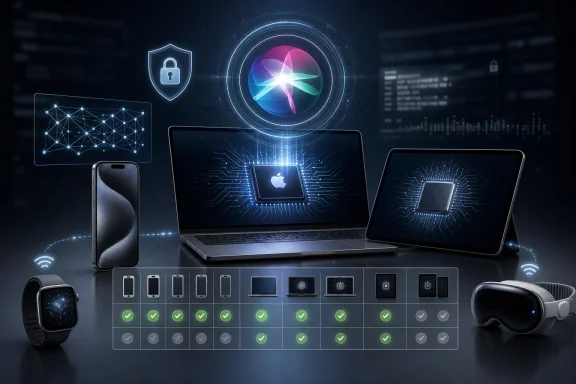
Apple’s upgraded Siri AI is slated for newer Apple hardware, with support centered on iPhone 15 Pro and later models, M-series iPads and Macs, recent Apple Watches paired to supported iPhones, and Apple Vision Pro. That device list turns a software announcement into a hardware line in the sand. For Apple, the new Siri is not just a belated answer to ChatGPT, Gemini, and Claude; it is a test of whether privacy-heavy, device-bound AI can still move the upgrade cycle. For users and IT departments, it is a reminder that the next phase of personal computing may be defined as much by eligibility matrices as by model benchmarks.
The headline feature is easy to understand: Siri is supposed to become less like a voice-command menu and more like an assistant that understands context. Apple is pitching a Siri that can look at what is on screen, reason over personal information, and take action across apps without forcing the user to remember the exact command grammar that made old Siri feel brittle.
The catch is just as important. Apple’s new Siri AI does not arrive as a universal iOS feature for every device capable of installing the latest operating system. It arrives as part of Apple Intelligence, and Apple Intelligence remains gated by newer chips, more memory, and the company’s confidence that certain workloads can be handled privately and acceptably on modern hardware.
That distinction matters because Apple has spent years selling longevity as part of the iPhone proposition. An iPhone that keeps receiving iOS updates for many years is still valuable. But if the most visible new features of the operating system are withheld from otherwise-supported devices, the meaning of “supported” starts to split in two.
There is the support that keeps your device patched, compatible, and functional. Then there is the support that lets your device participate in the next user-interface shift. Siri AI belongs firmly in the second category.
On iPad, the line is clearer and more technical: iPad Pro and iPad Air models with M1 or later chips are in, while the iPad mini with A17 Pro also qualifies. Macs follow the Apple silicon divide, with M1 and later machines supported. Apple Watch support is dependent rather than standalone: compatible watches need to be paired with an AI-supported iPhone nearby.
Apple Vision Pro, unsurprisingly, is included. It is the most obvious example of Apple’s belief that AI becomes more useful when it can see, understand, and act across a user’s spatial and app context. If Siri AI is supposed to understand what is in front of you, Vision Pro is less an accessory to the story than a preview of where Apple wants the interface to go.
The device list looks like a compatibility chart, but it functions more like a product strategy document. Apple is saying that the future Siri requires not just a microphone and internet connection, but a local computing platform with enough neural horsepower to preserve latency, privacy, and the Apple version of polish.
That made Siri feel less like an assistant than a feature with a narrow blast radius. Users adapted by asking less of it. In consumer technology, that is almost worse than failure, because once people decide a tool is unreliable, they stop testing whether it has improved.
Apple’s new pitch is aimed directly at that learned caution. A Siri that can find a restaurant recommendation buried in a message, pull a confirmation number from email, or surface photos from a recent trip is not competing on trivia. It is competing on whether it can reduce the friction of living inside Apple’s ecosystem.
That is where Apple has a plausible advantage. OpenAI, Anthropic, and Google may lead in general-purpose model perception, but Apple controls the operating system, the app frameworks, the local data store, and the hardware envelope. Siri AI’s bet is that the most useful assistant may not be the one with the flashiest answer, but the one that can safely act where your life already happens.
Apple’s answer is familiar: more processing on device, more privacy framing, and cloud assistance through Apple-controlled infrastructure when local compute is insufficient. This is the company’s strongest AI narrative because it aligns with a decade of privacy marketing. Apple does not need to convince users that AI is magical; it needs to convince them that Apple’s AI is safer to invite into their personal data than someone else’s.
But that framing has consequences. If the assistant must operate with local indexes, private models, and carefully mediated app access, Apple may move more slowly than cloud-first competitors. It may also produce an assistant that feels more conservative, more bounded, and less spectacular in open-ended conversations.
That may be acceptable. Siri does not need to win the chatbot wars on essay writing or corporate strategy memos. It needs to become trustworthy at the unglamorous jobs people actually delegate: finding, summarizing, opening, booking, replying, and connecting dots across the phone.
That is why developer beta availability matters. Siri AI is being seeded through the Apple Developer Program across iOS 27, iPadOS 27, macOS 27, and visionOS 27, with watchOS support expected later. The consumer story is “ask Siri to do more.” The developer story is “make your app legible to Siri or risk disappearing from the next interface layer.”
This is the same platform leverage Apple has used for years, but the stakes are higher. Search placement, notifications, widgets, Share sheets, Shortcuts, and Spotlight all shaped how apps surfaced on Apple devices. Siri AI could become another routing layer, deciding which app gets invoked when a user asks for an outcome rather than tapping an icon.
For developers, that creates both opportunity and anxiety. A well-integrated app could become more useful without the user opening it directly. A poorly integrated app could become functionally invisible when the interface shifts from touch-first navigation to intent-first commands.
That argument is powerful, but delicate. If Apple pushes too hard, it risks making loyal customers feel punished for keeping expensive devices. If it underplays the feature, investors will ask why the company’s biggest software story does not translate into hardware demand.
The current eligibility split threads that needle in classic Apple fashion. Security updates and operating-system support continue to preserve the long-tail value of older devices. The most advanced experience, however, is reserved for hardware Apple can present as purpose-built for the next era.
This is not new. Apple has long used computational photography, ProMotion displays, LiDAR, and chip-exclusive features to separate generations and tiers. What is new is that AI touches the whole interface. A camera feature can be optional; an assistant that understands apps and personal context feels closer to the future of the OS itself.
Apple’s privacy architecture will reassure some organizations, especially those already comfortable with Apple silicon Macs and managed iPhones. On-device processing and controlled cloud pathways are easier to defend than a free-for-all of browser-based AI tools pasted into unmanaged chatbots. In that sense, Siri AI could become a safer default for employees who are already going to use AI whether policy blesses it or not.
But enterprises will still need controls. IT teams will want to know what data Siri can access, which apps expose actions, how logs are handled, whether managed Apple Accounts behave differently, and how regional availability affects multinational fleets. The assistant may be consumer-branded, but its implications are squarely enterprise.
There is also a procurement wrinkle. If AI features become part of the standard productivity expectation, organizations may face pressure to refresh devices earlier than planned. That is not just a budget issue; it is a lifecycle-management issue for fleets that had counted on longer support windows.
Siri made the contrast worse because it was one of the first mainstream voice assistants. Apple had the brand, the install base, and the operating-system access, yet Siri became shorthand for underachievement. The company that taught consumers to talk to their phones then watched others redefine what talking to software could mean.
But Apple has recovered from this position before. It was not first in MP3 players, smartphones, tablets, watches, or streaming boxes. Its usual move is to wait until a technology can be integrated into a product story that feels coherent to mainstream users.
The risk is that AI may not wait for Apple’s preferred cadence. Model capability, developer tooling, and user habits are moving quickly. If Siri AI launches feeling tentative, delayed, or overly constrained, Apple will not merely look late; it will look structurally mismatched to the pace of the category.
That legal backdrop does not mean Siri AI will fail. It does mean Apple has less room for ambiguity. Customers will want to know whether their device supports the feature, when the feature arrives, which language and region it works in, and what “available” actually means during beta and staged rollout periods.
The company’s old habit of letting features arrive “later this year” or in “a future update” becomes more dangerous when AI is central to the purchase rationale. A camera mode delayed by a few months is annoying. An assistant that was used to sell a phone but does not ship as expected invites a different level of scrutiny.
For WindowsForum readers, the parallel to Microsoft’s own AI rollout is obvious. Copilot branding has often outpaced user clarity, and Windows users have learned to ask whether a feature is local, cloud-based, region-locked, subscription-gated, or hardware-restricted. Apple is now walking the same road, just with a different privacy vocabulary.
That helps Apple in the enterprise and developer markets. The M1 transition already gave the Mac a performance-per-watt narrative that Windows OEMs spent years chasing. Siri AI and Apple Intelligence give Apple another way to argue that its vertical integration is not just about battery life, but about local intelligence.
The open question is how much Mac users will care about Siri specifically. Voice assistants have always felt more natural on phones, watches, and smart speakers than on laptops. On the Mac, the more important feature may be not voice but system-wide intent: the ability to act across apps, inspect on-screen content, and automate tasks without traditional scripting.
If Apple gets that right, Siri AI could become the user-friendly front end to a new automation layer. If it gets it wrong, Mac users will continue doing what they have done for years: ignoring Siri while using Spotlight, Shortcuts, Alfred, Raycast, shell scripts, and browser-based AI instead.
Vision Pro points in the other direction. There, Siri AI is not just listening; it is part of a computing environment where visual context is central. If the assistant can understand what the user sees, what apps are open, and what objects or documents are in view, spatial computing becomes less dependent on hand gestures and window management.
That does not solve Vision Pro’s adoption problem. The hardware remains expensive and niche. But Siri AI gives Apple a way to keep arguing that Vision Pro is not merely a screen strapped to the face; it is a platform where AI, spatial awareness, and personal context converge.
The broader point is that Apple is not building Siri AI only for the iPhone. It is building a control surface for a family of devices where the traditional app grid is less dominant. Watches, glasses, headsets, earbuds, and ambient displays all need interfaces that are less dependent on tapping icons.
Apple historically handles fragmentation better than Android because it controls the whole stack. But AI creates new kinds of fragmentation. Two phones may run the same iOS version while offering very different assistant capabilities. Two Macs may receive the same security updates while only one gets the full local model experience. Two Apple Watches may behave differently depending on the iPhone they are paired with.
That can erode trust if Apple does not communicate clearly. Users do not think in chip names and neural engines. They think in product names, purchase dates, and whether the expensive device in their hand feels current.
The company’s challenge is to make the limitation feel legitimate rather than arbitrary. If Siri AI is fast, private, and genuinely useful on supported devices, many users will accept that older hardware could not deliver the same experience. If the feature feels modest, the cutoff will look like upsell disguised as engineering.
That is a lower ceiling than the grandest AI rhetoric, but a higher bar operationally. Cross-app actions must not misfire. Personal context must not surface the wrong private information. Screen awareness must be accurate enough that users do not feel they are supervising a reckless intern.
Apple’s advantage is that it can make these experiences feel native. Its disadvantage is that native experiences are judged harshly. A chatbot can be quirky; a system assistant that touches your messages, photos, and calendar must be dependable.
For Windows users watching from across the aisle, this is the same lesson Microsoft is learning with Copilot. AI becomes more consequential, and more controversial, when it moves from a web box into the operating system. The closer it gets to real work, the less tolerance users have for demos that collapse under daily use.
 Apple’s AI Catch-Up Arrives With an Upgrade Toll
The headline feature is easy to understand: Siri is supposed to become less like a voice-command menu and more like an assistant that understands context. Apple is pitching a Siri that can look at what is on screen, reason over personal information, and take action across apps without forcing the user to remember the exact command grammar that made old Siri feel brittle.The catch is just as important. Apple’s new Siri AI does not arrive as a universal iOS feature for every device capable of installing the latest operating system. It arrives as part of Apple Intelligence, and Apple Intelligence remains gated by newer chips, more memory, and the company’s confidence that certain workloads can be handled privately and acceptably on modern hardware.
That distinction matters because Apple has spent years selling longevity as part of the iPhone proposition. An iPhone that keeps receiving iOS updates for many years is still valuable. But if the most visible new features of the operating system are withheld from otherwise-supported devices, the meaning of “supported” starts to split in two.
There is the support that keeps your device patched, compatible, and functional. Then there is the support that lets your device participate in the next user-interface shift. Siri AI belongs firmly in the second category.
The Supported List Is Really a Map of Apple’s AI Hardware Strategy
The compatible iPhone list starts with the iPhone 15 Pro and iPhone 15 Pro Max, then expands through the iPhone 16 family and the newer iPhone 17 generation, including Pro models and Apple’s more experimental Air branding. In practical terms, that means many users with perfectly capable iPhone 13, iPhone 14, and standard iPhone 15 models remain outside the tent.On iPad, the line is clearer and more technical: iPad Pro and iPad Air models with M1 or later chips are in, while the iPad mini with A17 Pro also qualifies. Macs follow the Apple silicon divide, with M1 and later machines supported. Apple Watch support is dependent rather than standalone: compatible watches need to be paired with an AI-supported iPhone nearby.
Apple Vision Pro, unsurprisingly, is included. It is the most obvious example of Apple’s belief that AI becomes more useful when it can see, understand, and act across a user’s spatial and app context. If Siri AI is supposed to understand what is in front of you, Vision Pro is less an accessory to the story than a preview of where Apple wants the interface to go.
The device list looks like a compatibility chart, but it functions more like a product strategy document. Apple is saying that the future Siri requires not just a microphone and internet connection, but a local computing platform with enough neural horsepower to preserve latency, privacy, and the Apple version of polish.
Siri’s Old Problem Was Never Just Intelligence
Siri’s reputation problem has never been that it lacked a clever demo. It has been that users learned, slowly and painfully, not to trust it with anything too nuanced. The assistant could set timers and send texts, but it often failed at follow-up requests, app-specific actions, and context that humans would consider obvious.That made Siri feel less like an assistant than a feature with a narrow blast radius. Users adapted by asking less of it. In consumer technology, that is almost worse than failure, because once people decide a tool is unreliable, they stop testing whether it has improved.
Apple’s new pitch is aimed directly at that learned caution. A Siri that can find a restaurant recommendation buried in a message, pull a confirmation number from email, or surface photos from a recent trip is not competing on trivia. It is competing on whether it can reduce the friction of living inside Apple’s ecosystem.
That is where Apple has a plausible advantage. OpenAI, Anthropic, and Google may lead in general-purpose model perception, but Apple controls the operating system, the app frameworks, the local data store, and the hardware envelope. Siri AI’s bet is that the most useful assistant may not be the one with the flashiest answer, but the one that can safely act where your life already happens.
Personal Context Is the Feature and the Risk
The phrase personal context is doing enormous work here. It means Siri may be able to understand relationships between messages, emails, calendar entries, photos, files, and what is currently visible on screen. It also means Apple is asking users to accept a more intimate assistant at precisely the moment when AI companies are being scrutinized over data use, model training, and hallucinated answers.Apple’s answer is familiar: more processing on device, more privacy framing, and cloud assistance through Apple-controlled infrastructure when local compute is insufficient. This is the company’s strongest AI narrative because it aligns with a decade of privacy marketing. Apple does not need to convince users that AI is magical; it needs to convince them that Apple’s AI is safer to invite into their personal data than someone else’s.
But that framing has consequences. If the assistant must operate with local indexes, private models, and carefully mediated app access, Apple may move more slowly than cloud-first competitors. It may also produce an assistant that feels more conservative, more bounded, and less spectacular in open-ended conversations.
That may be acceptable. Siri does not need to win the chatbot wars on essay writing or corporate strategy memos. It needs to become trustworthy at the unglamorous jobs people actually delegate: finding, summarizing, opening, booking, replying, and connecting dots across the phone.
Developers Are the Real Distribution Channel
The new Siri depends on developers as much as users. Apple can make Mail, Messages, Photos, Calendar, and Safari work with its assistant. But the promise of cross-app action only becomes convincing if third-party apps expose the right actions and content through Apple’s frameworks.That is why developer beta availability matters. Siri AI is being seeded through the Apple Developer Program across iOS 27, iPadOS 27, macOS 27, and visionOS 27, with watchOS support expected later. The consumer story is “ask Siri to do more.” The developer story is “make your app legible to Siri or risk disappearing from the next interface layer.”
This is the same platform leverage Apple has used for years, but the stakes are higher. Search placement, notifications, widgets, Share sheets, Shortcuts, and Spotlight all shaped how apps surfaced on Apple devices. Siri AI could become another routing layer, deciding which app gets invoked when a user asks for an outcome rather than tapping an icon.
For developers, that creates both opportunity and anxiety. A well-integrated app could become more useful without the user opening it directly. A poorly integrated app could become functionally invisible when the interface shifts from touch-first navigation to intent-first commands.
The iPhone Upgrade Cycle Gets a New Sales Pitch
Apple’s business problem is not that people dislike iPhones. It is that modern iPhones last a long time, and many users need a stronger reason to upgrade than a better camera bump or a slightly faster chip. AI gives Apple a new argument: your old phone may still work, but it will not understand you the way a new one can.That argument is powerful, but delicate. If Apple pushes too hard, it risks making loyal customers feel punished for keeping expensive devices. If it underplays the feature, investors will ask why the company’s biggest software story does not translate into hardware demand.
The current eligibility split threads that needle in classic Apple fashion. Security updates and operating-system support continue to preserve the long-tail value of older devices. The most advanced experience, however, is reserved for hardware Apple can present as purpose-built for the next era.
This is not new. Apple has long used computational photography, ProMotion displays, LiDAR, and chip-exclusive features to separate generations and tiers. What is new is that AI touches the whole interface. A camera feature can be optional; an assistant that understands apps and personal context feels closer to the future of the OS itself.
Enterprise IT Will See the Promise and the Policy Headache
For sysadmins and managed-device teams, Siri AI is not just a consumer convenience. It raises immediate questions about data boundaries, app permissions, compliance, and user training. An assistant that can reason across email, files, messages, and screens is useful precisely because it sits near sensitive information.Apple’s privacy architecture will reassure some organizations, especially those already comfortable with Apple silicon Macs and managed iPhones. On-device processing and controlled cloud pathways are easier to defend than a free-for-all of browser-based AI tools pasted into unmanaged chatbots. In that sense, Siri AI could become a safer default for employees who are already going to use AI whether policy blesses it or not.
But enterprises will still need controls. IT teams will want to know what data Siri can access, which apps expose actions, how logs are handled, whether managed Apple Accounts behave differently, and how regional availability affects multinational fleets. The assistant may be consumer-branded, but its implications are squarely enterprise.
There is also a procurement wrinkle. If AI features become part of the standard productivity expectation, organizations may face pressure to refresh devices earlier than planned. That is not just a budget issue; it is a lifecycle-management issue for fleets that had counted on longer support windows.
Apple’s Laggard Problem Is Real, but Not Fatal
The criticism that Apple is late to modern AI is fair. ChatGPT changed user expectations in late 2022, Microsoft rushed Copilot across Windows and Microsoft 365, Google embedded Gemini across Android and Workspace, and Apple spent much of the early boom looking cautious, fragmented, or simply behind.Siri made the contrast worse because it was one of the first mainstream voice assistants. Apple had the brand, the install base, and the operating-system access, yet Siri became shorthand for underachievement. The company that taught consumers to talk to their phones then watched others redefine what talking to software could mean.
But Apple has recovered from this position before. It was not first in MP3 players, smartphones, tablets, watches, or streaming boxes. Its usual move is to wait until a technology can be integrated into a product story that feels coherent to mainstream users.
The risk is that AI may not wait for Apple’s preferred cadence. Model capability, developer tooling, and user habits are moving quickly. If Siri AI launches feeling tentative, delayed, or overly constrained, Apple will not merely look late; it will look structurally mismatched to the pace of the category.
The Settlement Shadow Makes the Rollout More Sensitive
Apple’s Siri AI rollout also lands after controversy over how Apple marketed earlier Apple Intelligence and enhanced Siri features. A proposed class action settlement over those claims underscores a simple problem: once a company advertises AI capabilities as part of a device’s value, delays and limitations become more than ordinary product slippage.That legal backdrop does not mean Siri AI will fail. It does mean Apple has less room for ambiguity. Customers will want to know whether their device supports the feature, when the feature arrives, which language and region it works in, and what “available” actually means during beta and staged rollout periods.
The company’s old habit of letting features arrive “later this year” or in “a future update” becomes more dangerous when AI is central to the purchase rationale. A camera mode delayed by a few months is annoying. An assistant that was used to sell a phone but does not ship as expected invites a different level of scrutiny.
For WindowsForum readers, the parallel to Microsoft’s own AI rollout is obvious. Copilot branding has often outpaced user clarity, and Windows users have learned to ask whether a feature is local, cloud-based, region-locked, subscription-gated, or hardware-restricted. Apple is now walking the same road, just with a different privacy vocabulary.
The Mac Angle Is Bigger Than It Looks
The Mac compatibility story may be less emotionally charged than the iPhone story, but it is strategically important. All Apple silicon Macs with M1 or later chips sit inside the broad support boundary, which gives Apple a cleaner story than the iPhone lineup. If you bought into the post-Intel Mac transition, you are generally part of the AI era.That helps Apple in the enterprise and developer markets. The M1 transition already gave the Mac a performance-per-watt narrative that Windows OEMs spent years chasing. Siri AI and Apple Intelligence give Apple another way to argue that its vertical integration is not just about battery life, but about local intelligence.
The open question is how much Mac users will care about Siri specifically. Voice assistants have always felt more natural on phones, watches, and smart speakers than on laptops. On the Mac, the more important feature may be not voice but system-wide intent: the ability to act across apps, inspect on-screen content, and automate tasks without traditional scripting.
If Apple gets that right, Siri AI could become the user-friendly front end to a new automation layer. If it gets it wrong, Mac users will continue doing what they have done for years: ignoring Siri while using Spotlight, Shortcuts, Alfred, Raycast, shell scripts, and browser-based AI instead.
The Watch and Vision Pro Reveal Apple’s Interface Ambition
Apple Watch support being tethered to a compatible iPhone is technically understandable, but symbolically useful. The watch is where Siri should have been strongest all along: quick requests, low-friction replies, timers, reminders, directions, and glanceable results. A more capable assistant could make the Watch feel less like a notification endpoint and more like a practical AI remote.Vision Pro points in the other direction. There, Siri AI is not just listening; it is part of a computing environment where visual context is central. If the assistant can understand what the user sees, what apps are open, and what objects or documents are in view, spatial computing becomes less dependent on hand gestures and window management.
That does not solve Vision Pro’s adoption problem. The hardware remains expensive and niche. But Siri AI gives Apple a way to keep arguing that Vision Pro is not merely a screen strapped to the face; it is a platform where AI, spatial awareness, and personal context converge.
The broader point is that Apple is not building Siri AI only for the iPhone. It is building a control surface for a family of devices where the traditional app grid is less dominant. Watches, glasses, headsets, earbuds, and ambient displays all need interfaces that are less dependent on tapping icons.
The Device Divide Will Shape User Trust
The most immediate consumer reaction will be compatibility checking. People will ask whether their iPhone gets Siri AI, whether their iPad qualifies, and whether their Mac is new enough. That is normal, but it is also a sign that AI has entered the messy world of platform fragmentation.Apple historically handles fragmentation better than Android because it controls the whole stack. But AI creates new kinds of fragmentation. Two phones may run the same iOS version while offering very different assistant capabilities. Two Macs may receive the same security updates while only one gets the full local model experience. Two Apple Watches may behave differently depending on the iPhone they are paired with.
That can erode trust if Apple does not communicate clearly. Users do not think in chip names and neural engines. They think in product names, purchase dates, and whether the expensive device in their hand feels current.
The company’s challenge is to make the limitation feel legitimate rather than arbitrary. If Siri AI is fast, private, and genuinely useful on supported devices, many users will accept that older hardware could not deliver the same experience. If the feature feels modest, the cutoff will look like upsell disguised as engineering.
Apple’s AI Moment Comes Down to Mundane Reliability
The irony of Siri AI is that Apple does not need to astonish users every day. It needs to stop disappointing them in small ways. The winning version of Siri is not necessarily the one that writes poetry, generates code, or debates economics; it is the one that correctly understands “send the hotel address to Mom,” “find the PDF from last week,” or “add the thing from this screen to my calendar.”That is a lower ceiling than the grandest AI rhetoric, but a higher bar operationally. Cross-app actions must not misfire. Personal context must not surface the wrong private information. Screen awareness must be accurate enough that users do not feel they are supervising a reckless intern.
Apple’s advantage is that it can make these experiences feel native. Its disadvantage is that native experiences are judged harshly. A chatbot can be quirky; a system assistant that touches your messages, photos, and calendar must be dependable.
For Windows users watching from across the aisle, this is the same lesson Microsoft is learning with Copilot. AI becomes more consequential, and more controversial, when it moves from a web box into the operating system. The closer it gets to real work, the less tolerance users have for demos that collapse under daily use.
The Siri AI Rollout Leaves Apple With No Place to Hide
The practical shape of Apple’s announcement is now clear enough for buyers, developers, and IT planners to act on.- Siri AI support on iPhone starts with the iPhone 15 Pro line and continues through newer iPhone 16 and iPhone 17 models.
- Supported iPads are centered on M1-and-later iPad Pro and iPad Air hardware, plus the A17 Pro iPad mini.
- Supported Macs are Apple silicon models beginning with the M1 generation.
- Apple Watch support depends on both the watch model and a nearby paired iPhone that supports Apple Intelligence.
- Developers matter because third-party app integration will determine whether Siri AI becomes a real cross-app assistant or merely a better front end for Apple’s own apps.
- The feature’s success will be judged less by keynote demos than by whether it reliably completes ordinary personal tasks without violating user trust.
References
- Primary source: TechRepublic
Published: 2026-06-15T20:50:09.871388

Siri AI Supported Devices: Full List of iPhones, iPads, Macs, and More
Apple’s Siri AI upgrade could bring smarter app actions and personal context, but only newer devices will support the features at launch.www.techrepublic.com
- Related coverage: t3.com

While iOS 27 will run on older iPhones, new Apple Intelligence features are another matter | T3
Apple will release iOS 27 for iPhone 11 and above, but to get the new Siri AI you'll need something much more recentwww.t3.com - Related coverage: techradar.com

iOS 27’s new Siri AI gesture could cause mass confusion by breaking with 15 years of iPhone tradition — but I’m confident I’ll adapt | TechRadar
Messing with your memorywww.techradar.com - Related coverage: tomsguide.com

WWDC 2026 was Apple's AI renaissance — but there's one very important feature still missing from iOS 27 | Tom's Guide
Siri may be getting a huge AI boost, but what about the rumors that Apple could add other chatbots to join ChatGPT?www.tomsguide.com - Related coverage: axios.com

Apple's Siri AI is the latest in Apple Intelligence, but Anthropic and OpenAI have moved on
OpenAI and Anthropic have been locked in a hype battle promoting their agentic AI tools for both coders and office workers.www.axios.com
- Related coverage: macrumors.com

Apple Says New Siri is Compatible With These iPhones, iPads, and Macs
The more intelligent and personalized version of Siri that Apple introduced today — "Siri AI" — is limited to devices with Apple Intelligence support. "Siri AI" is available on the devices listed below.www.macrumors.com
- Related coverage: techpp.com
iOS 27 Supported Devices: Full iPhone List for Siri AI, Apple Intelligence, and On-Device AI - TechPP
iOS 27 Supported Devices: Check the complete iPhone compatibility list for iOS 27, Siri AI, Apple Intelligence, and advanced on-device AI features.techpp.com - Related coverage: 9to5mac.com

Siri AI is coming to newer Apple devices only, here’s the full list - 9to5Mac
Here’s the full list of Siri AI-compatible hardware across iPhone, iPad, Mac, Apple Watch, and Apple Vision Pro.9to5mac.com - Official source: apple.com

New Apple Intelligence features are available today - Apple
Apple today released new Apple Intelligence features that elevate the user experience across iPhone, iPad, Mac, Apple Watch, and Apple Vision Pro.www.apple.com - Related coverage: macobserver.com

Siri AI Compatibility List: All the Supported Apple Devices
Check whether your iPhone, iPad, Mac, Apple Watch, or Vision Pro supports Siri AI with Apple's complete compatibility list today.www.macobserver.com - Official source: developer.apple.com
- Related coverage: macworld.com

iOS 27 Guide: All the new features coming to compatible iPhones, 2026 release date and more | Macworld
iOS 27 will introduce major Apple Intelligence upgrades, changes to Siri, and improvements across core iPhone apps. Here's what you need to know.www.macworld.com - Official source: images.apple.com

Due to DMA, Siri AI delayed in EU for iOS 27 and iPadOS 27 - Apple (UK)
Due to the Digital Markets Act, Apple will not be able to ship Siri AI in the European Union with the release of iOS 27 and iPadOS 27.images.apple.com - Related coverage: techcrunch.com

WWDC 2026: Everything announced on Siri AI, iOS 27, Apple Intelligence, and more | TechCrunch
Apple primarily made the case for an improved experience with its long-standing Siri assistant, which like most other announcements had a hefty helping of AI.techcrunch.com
