

Apple can probably keep its AI push profitable in the near term because its pricing power, services margin, supplier leverage, and hybrid on-device/cloud architecture give it more room than most rivals, but rising DRAM, NAND, and AI-infrastructure costs are now a real strategic constraint. The company’s WWDC 2026 reset made clear that Apple Intelligence is no longer a branding exercise bolted onto iOS. It is becoming a system-level bet on Siri, iPhone upgrades, cloud inference, privacy engineering, and recurring services revenue. The uncomfortable part is that Apple’s AI story now depends on the same memory-constrained supply chain that is making phones, PCs, servers, and GPUs more expensive across the industry.
For the past two years, the easiest criticism of Apple’s AI strategy was that it looked late. Microsoft had Copilot everywhere, Google had Gemini across Search and Android, Samsung had Galaxy AI, and Nvidia was effectively printing money by selling the infrastructure everyone else needed. Apple’s answer was characteristically Apple-like: wait, package the technology as a user experience, and insist that privacy would be the differentiator.
WWDC 2026 shifted the argument. Apple’s revamped Siri, powered by a new generation of Apple Foundation Models and backed by expanded Private Cloud Compute, is a much more serious AI architecture than the half-step Apple Intelligence rollout that frustrated users after WWDC 2024. The company is no longer asking investors or customers to believe that notification summaries and writing tools are the whole story.
But seriousness brings cost. A smarter Siri that can reason over personal context, orchestrate apps, and route work between local and cloud models is not free in the way a new wallpaper pack is free. It requires more device memory, more storage, more server capacity, more networking, and more expensive silicon somewhere in the chain.
That matters because Apple’s financial magic has always depended on making expensive hardware look inevitable while preserving enviable gross margins. AI threatens to disturb that equation from both ends. Customers may demand more intelligence without paying an obvious AI surcharge, while suppliers charge more for the memory and compute that make that intelligence possible.
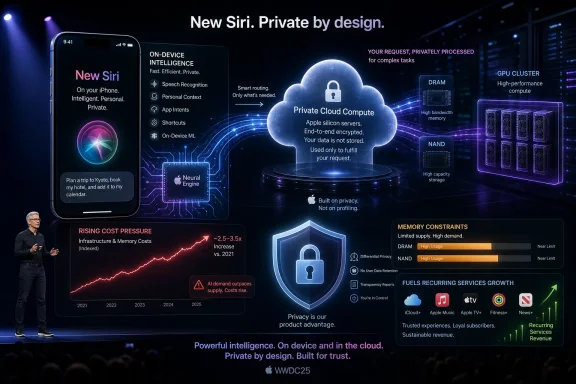
The infrastructure story is more revealing. Apple is leaning on a hybrid model that decides whether a request should run locally on the device, on Apple-controlled Private Cloud Compute, or on more powerful cloud resources. For the most demanding work, Apple is working with Google Cloud and Nvidia’s Blackwell GPUs, with confidential-computing safeguards designed to preserve Apple’s privacy claims even when the workload leaves Apple-owned data centers.
That is a major philosophical adjustment for a company that prefers vertical control. Apple is not abandoning its own silicon or its privacy architecture, but it is acknowledging that frontier-scale AI inference cannot be supported cheaply or instantly by an Apple-only server footprint. The company can design the experience, sign the software, enforce routing rules, and audit the security model. It still has to rent or buy a share of the AI factory.
This is where the memory-cost question becomes more than a component-price footnote. AI servers are voracious consumers of high-bandwidth memory, DRAM, NAND, and advanced packaging capacity. When hyperscalers reserve supply for model training and inference, smartphone vendors do not operate in a separate universe. They compete for adjacent resources, and the entire market reprices.
That does not mean Apple is immune. DRAM and NAND are not optional ingredients in modern phones, and on-device AI pushes the baseline upward. More capable local models need more memory headroom. Larger models, richer caches, and AI-enhanced media features put pressure on storage tiers. If Apple wants Apple Intelligence to feel instant and private, it cannot route everything to the cloud without undermining both experience and message.
The company has several levers. It can preserve entry-level configurations while nudging buyers toward higher storage tiers. It can reserve the most advanced Apple Intelligence features for newer chips and larger-memory devices. It can lean on services revenue to subsidize hardware economics. It can also do what Apple often does best: turn a cost increase into a segmentation strategy.
That last point is critical. Apple rarely says, “We raised prices because components got expensive.” Instead, it introduces a Pro model with a better display, better camera, more memory, more AI features, and a higher average selling price. The margin defense is hidden inside the product ladder.
That is why analysts have become excited about Siri again. Apple’s installed base is enormous, and even a modest increase in upgrade intent can produce financial effects that pure AI companies would envy. If a more capable Siri convinces users that an older iPhone feels obsolete, Apple can monetize AI through hardware replacement rather than through a visible monthly AI fee.
This is not a new Apple playbook. Retina displays, Face ID, better cameras, custom silicon, and longer software support all worked as reasons to stay inside the ecosystem and periodically move up the ladder. AI can become the next version of that logic, especially if the best features require newer Neural Engine performance, more RAM, or specific secure-enclave capabilities.
The risk is that users have become more skeptical of AI promises. Apple already burned some credibility by announcing a more personal Siri before it was ready. If the 2026 version arrives late, feels inconsistent, or appears artificially restricted to newer devices, customers may read the strategy as upselling rather than innovation.
The Google Cloud and Nvidia partnership complicates that message without necessarily invalidating it. Apple’s argument is that it can extend Private Cloud Compute beyond its own facilities while preserving the same privacy guarantees through signed software, hardware-backed confidential computing, and a tightly controlled execution environment. That is plausible, but it is also harder to explain than “it runs on your iPhone.”
For WindowsForum readers, the enterprise angle is obvious. IT departments do not evaluate AI assistants only by how clever the demo looks. They ask where data goes, who can inspect it, how long it persists, what logs exist, what regulators might think, and whether vendor assurances survive contact with procurement and legal review.
Apple has an advantage because its privacy reputation gives it permission to try this hybrid model. But that reputation becomes a liability if the system is perceived as opaque. “Runs privately on Google Cloud with Nvidia GPUs” may be technically accurate and secure, but it is a mouthful. The more partners Apple uses, the more Apple must prove that the Apple part is still the controlling layer.
Apple’s system orchestrator is therefore one of the most important parts of the strategy. It is not just a technical dispatcher. It is a margin-management tool. Every local response saves cloud cost but consumes device resources. Every cloud response improves capability but draws on scarce GPU time, memory bandwidth, power, and partner infrastructure.
That tradeoff will become more visible over time. A cheap AI assistant can be fast and shallow. A powerful AI assistant can be expensive and occasionally slow. A private AI assistant can be architecturally constrained. Apple is trying to deliver all three qualities at once: fast, powerful, and private.
The company may pull it off better than most because it controls the hardware, OS, app frameworks, silicon roadmap, and services bundle. Still, physics and accounting have a way of humbling even the most integrated platforms. If memory prices remain elevated through 2026 and into 2027, Apple’s AI roadmap will be shaped as much by supply contracts as by keynote ambition.
That is a reasonable thesis, but it is not a guaranteed one. The iPhone market is mature, replacement cycles have lengthened, and many users are perfectly happy holding devices for four or five years. AI has to become more than a novelty if it is going to bend that curve.
The strongest version of the bull case is not that people will buy a new iPhone to ask Siri trivia questions. It is that Apple will make AI disappear into daily workflows: finding files, editing photos, summarizing messages, booking actions across apps, managing personal context, and helping users do things that currently require too many taps. If that happens, older devices will feel meaningfully less capable.
The bear case is equally simple. If Apple Intelligence feels like a delayed bundle of features that competitors already shipped, the company will have added cost without creating urgency. In that scenario, memory inflation eats into margins while AI fails to drive enough incremental demand to compensate.
AI on the edge requires more local resources. AI in the cloud requires more data-center resources. Hybrid AI requires both, plus the software intelligence to decide where work should run. That means the era of treating RAM and storage as boring commodity line items is ending, at least for now.
PC buyers have already seen the practical effect. Baseline memory expectations are rising just as DRAM pricing becomes less friendly. SSD pricing is no longer a guaranteed downward curve. Enterprises planning refresh cycles now have to think about whether today’s “good enough” endpoint will be stranded outside tomorrow’s AI feature set.
Apple’s advantage is that it can impose coherence. Windows OEMs have to coordinate across Microsoft, silicon vendors, firmware suppliers, enterprise images, and wildly different price bands. Apple can draw a line and say which devices are in. That frustrates customers with older hardware, but it makes the platform easier to optimize.
That concealment is also how Apple protects profit. If AI becomes a visible commodity, users compare it directly with ChatGPT, Gemini, Claude, Copilot, and whatever comes next. If AI becomes a native behavior of iOS, Apple can monetize it indirectly through device loyalty, storage upgrades, iCloud, App Store activity, and services retention.
This is why the company’s relationship with developers matters. App Intents and deeper system integration are not side dishes. They determine whether Siri can actually do useful work across the apps people use. If developers participate, Apple’s assistant becomes a control plane for the phone. If they do not, Siri remains a better conversational layer over a still-fragmented app world.
Profitability will follow usefulness. Apple can absorb expensive memory and cloud inference if AI increases the value of the ecosystem. It cannot justify the spend indefinitely if users treat Apple Intelligence as another settings-page curiosity.
 Apple’s AI Problem Has Become a Margin Problem
For the past two years, the easiest criticism of Apple’s AI strategy was that it looked late. Microsoft had Copilot everywhere, Google had Gemini across Search and Android, Samsung had Galaxy AI, and Nvidia was effectively printing money by selling the infrastructure everyone else needed. Apple’s answer was characteristically Apple-like: wait, package the technology as a user experience, and insist that privacy would be the differentiator.WWDC 2026 shifted the argument. Apple’s revamped Siri, powered by a new generation of Apple Foundation Models and backed by expanded Private Cloud Compute, is a much more serious AI architecture than the half-step Apple Intelligence rollout that frustrated users after WWDC 2024. The company is no longer asking investors or customers to believe that notification summaries and writing tools are the whole story.
But seriousness brings cost. A smarter Siri that can reason over personal context, orchestrate apps, and route work between local and cloud models is not free in the way a new wallpaper pack is free. It requires more device memory, more storage, more server capacity, more networking, and more expensive silicon somewhere in the chain.
That matters because Apple’s financial magic has always depended on making expensive hardware look inevitable while preserving enviable gross margins. AI threatens to disturb that equation from both ends. Customers may demand more intelligence without paying an obvious AI surcharge, while suppliers charge more for the memory and compute that make that intelligence possible.
The New Siri Is Really a Supply-Chain Story
Apple’s revamped Siri is being positioned as the long-awaited correction to a decade of underwhelming voice-assistant performance. It is supposed to be more conversational, more aware of personal context, and better able to act across apps. That is the consumer-facing story, and it is the one Apple wants on stage.The infrastructure story is more revealing. Apple is leaning on a hybrid model that decides whether a request should run locally on the device, on Apple-controlled Private Cloud Compute, or on more powerful cloud resources. For the most demanding work, Apple is working with Google Cloud and Nvidia’s Blackwell GPUs, with confidential-computing safeguards designed to preserve Apple’s privacy claims even when the workload leaves Apple-owned data centers.
That is a major philosophical adjustment for a company that prefers vertical control. Apple is not abandoning its own silicon or its privacy architecture, but it is acknowledging that frontier-scale AI inference cannot be supported cheaply or instantly by an Apple-only server footprint. The company can design the experience, sign the software, enforce routing rules, and audit the security model. It still has to rent or buy a share of the AI factory.
This is where the memory-cost question becomes more than a component-price footnote. AI servers are voracious consumers of high-bandwidth memory, DRAM, NAND, and advanced packaging capacity. When hyperscalers reserve supply for model training and inference, smartphone vendors do not operate in a separate universe. They compete for adjacent resources, and the entire market reprices.
Apple Can Absorb Pain That Would Break Smaller Phone Makers
If memory inflation is a tax on the smartphone industry, Apple is one of the companies best positioned to pay it. It buys at enormous scale, plans years ahead, locks in supply, and sells into the premium end of the market where customers are less price-sensitive. A $50 cost shock that might wreck the economics of a midrange Android phone is painful but manageable inside a $1,000-plus iPhone configuration.That does not mean Apple is immune. DRAM and NAND are not optional ingredients in modern phones, and on-device AI pushes the baseline upward. More capable local models need more memory headroom. Larger models, richer caches, and AI-enhanced media features put pressure on storage tiers. If Apple wants Apple Intelligence to feel instant and private, it cannot route everything to the cloud without undermining both experience and message.
The company has several levers. It can preserve entry-level configurations while nudging buyers toward higher storage tiers. It can reserve the most advanced Apple Intelligence features for newer chips and larger-memory devices. It can lean on services revenue to subsidize hardware economics. It can also do what Apple often does best: turn a cost increase into a segmentation strategy.
That last point is critical. Apple rarely says, “We raised prices because components got expensive.” Instead, it introduces a Pro model with a better display, better camera, more memory, more AI features, and a higher average selling price. The margin defense is hidden inside the product ladder.
The Installed Base Is Apple’s Real AI Subsidy
Wall Street’s bullish case rests on a simple idea: Apple does not need to win AI the way OpenAI, Google, or Microsoft need to win AI. It does not need to sell access to a standalone chatbot at massive scale. It needs AI to make the iPhone more useful, the upgrade cycle more compelling, and the services layer more valuable.That is why analysts have become excited about Siri again. Apple’s installed base is enormous, and even a modest increase in upgrade intent can produce financial effects that pure AI companies would envy. If a more capable Siri convinces users that an older iPhone feels obsolete, Apple can monetize AI through hardware replacement rather than through a visible monthly AI fee.
This is not a new Apple playbook. Retina displays, Face ID, better cameras, custom silicon, and longer software support all worked as reasons to stay inside the ecosystem and periodically move up the ladder. AI can become the next version of that logic, especially if the best features require newer Neural Engine performance, more RAM, or specific secure-enclave capabilities.
The risk is that users have become more skeptical of AI promises. Apple already burned some credibility by announcing a more personal Siri before it was ready. If the 2026 version arrives late, feels inconsistent, or appears artificially restricted to newer devices, customers may read the strategy as upselling rather than innovation.
Private Cloud Compute Is Now a Trust Product
Apple’s privacy pitch has always been partly technical and partly theatrical. The technical side is real: on-device processing, data minimization, cryptographic verification, and stateless cloud sessions are meaningful design choices. The theatrical side is also real: Apple turns privacy into brand capital, especially against Google and Meta.The Google Cloud and Nvidia partnership complicates that message without necessarily invalidating it. Apple’s argument is that it can extend Private Cloud Compute beyond its own facilities while preserving the same privacy guarantees through signed software, hardware-backed confidential computing, and a tightly controlled execution environment. That is plausible, but it is also harder to explain than “it runs on your iPhone.”
For WindowsForum readers, the enterprise angle is obvious. IT departments do not evaluate AI assistants only by how clever the demo looks. They ask where data goes, who can inspect it, how long it persists, what logs exist, what regulators might think, and whether vendor assurances survive contact with procurement and legal review.
Apple has an advantage because its privacy reputation gives it permission to try this hybrid model. But that reputation becomes a liability if the system is perceived as opaque. “Runs privately on Google Cloud with Nvidia GPUs” may be technically accurate and secure, but it is a mouthful. The more partners Apple uses, the more Apple must prove that the Apple part is still the controlling layer.
Memory Inflation Turns AI Features Into Product Triage
The ugly economics of AI are forcing every hardware vendor into triage. Not every device can get every feature. Not every model can run locally. Not every user request deserves expensive cloud inference. Somewhere inside the operating system, a router has to decide what is worth spending compute on.Apple’s system orchestrator is therefore one of the most important parts of the strategy. It is not just a technical dispatcher. It is a margin-management tool. Every local response saves cloud cost but consumes device resources. Every cloud response improves capability but draws on scarce GPU time, memory bandwidth, power, and partner infrastructure.
That tradeoff will become more visible over time. A cheap AI assistant can be fast and shallow. A powerful AI assistant can be expensive and occasionally slow. A private AI assistant can be architecturally constrained. Apple is trying to deliver all three qualities at once: fast, powerful, and private.
The company may pull it off better than most because it controls the hardware, OS, app frameworks, silicon roadmap, and services bundle. Still, physics and accounting have a way of humbling even the most integrated platforms. If memory prices remain elevated through 2026 and into 2027, Apple’s AI roadmap will be shaped as much by supply contracts as by keynote ambition.
Investors Are Betting on the Upgrade Cycle, Not Siri’s Personality
The most aggressive Wall Street reactions to Apple’s WWDC 2026 announcements are less about Siri becoming charming and more about Siri becoming economically useful. Analysts raising price targets are effectively arguing that Apple Intelligence can lift iPhone demand, increase services attachment, and reframe Apple as an AI winner rather than an AI laggard.That is a reasonable thesis, but it is not a guaranteed one. The iPhone market is mature, replacement cycles have lengthened, and many users are perfectly happy holding devices for four or five years. AI has to become more than a novelty if it is going to bend that curve.
The strongest version of the bull case is not that people will buy a new iPhone to ask Siri trivia questions. It is that Apple will make AI disappear into daily workflows: finding files, editing photos, summarizing messages, booking actions across apps, managing personal context, and helping users do things that currently require too many taps. If that happens, older devices will feel meaningfully less capable.
The bear case is equally simple. If Apple Intelligence feels like a delayed bundle of features that competitors already shipped, the company will have added cost without creating urgency. In that scenario, memory inflation eats into margins while AI fails to drive enough incremental demand to compensate.
The Windows Angle Is Bigger Than Rivalry
For a Windows audience, Apple’s AI economics are not just a Cupertino story. They are a preview of the same pressures reshaping PCs, enterprise endpoints, and cloud contracts. Microsoft’s Copilot+ PC push, AMD and Intel’s NPU roadmaps, Nvidia’s workstation ambitions, and OEM memory configurations are all caught in the same squeeze.AI on the edge requires more local resources. AI in the cloud requires more data-center resources. Hybrid AI requires both, plus the software intelligence to decide where work should run. That means the era of treating RAM and storage as boring commodity line items is ending, at least for now.
PC buyers have already seen the practical effect. Baseline memory expectations are rising just as DRAM pricing becomes less friendly. SSD pricing is no longer a guaranteed downward curve. Enterprises planning refresh cycles now have to think about whether today’s “good enough” endpoint will be stranded outside tomorrow’s AI feature set.
Apple’s advantage is that it can impose coherence. Windows OEMs have to coordinate across Microsoft, silicon vendors, firmware suppliers, enterprise images, and wildly different price bands. Apple can draw a line and say which devices are in. That frustrates customers with older hardware, but it makes the platform easier to optimize.
Apple’s Profitability Depends on Making AI Feel Like iOS, Not Like a Metered Service
The worst outcome for Apple would be an AI experience that feels metered, inconsistent, or financially exposed. Users should not have to wonder whether a request is too expensive for Siri to answer well. They should not see privacy modes, cloud modes, model names, and capability tiers leaking through the interface. Apple’s product instinct is to hide that machinery.That concealment is also how Apple protects profit. If AI becomes a visible commodity, users compare it directly with ChatGPT, Gemini, Claude, Copilot, and whatever comes next. If AI becomes a native behavior of iOS, Apple can monetize it indirectly through device loyalty, storage upgrades, iCloud, App Store activity, and services retention.
This is why the company’s relationship with developers matters. App Intents and deeper system integration are not side dishes. They determine whether Siri can actually do useful work across the apps people use. If developers participate, Apple’s assistant becomes a control plane for the phone. If they do not, Siri remains a better conversational layer over a still-fragmented app world.
Profitability will follow usefulness. Apple can absorb expensive memory and cloud inference if AI increases the value of the ecosystem. It cannot justify the spend indefinitely if users treat Apple Intelligence as another settings-page curiosity.
Cupertino’s AI Math Comes Down to Six Hard Truths
Apple’s strategy is not reckless, but it is more exposed than the company’s stagecraft suggests. The important details are not hidden in a single analyst note or a single supplier report. They sit at the intersection of component inflation, cloud dependency, product segmentation, and user trust.- Apple’s AI push can remain profitable if it drives upgrades and services revenue faster than memory and inference costs rise.
- Rising DRAM and NAND prices make AI-capable devices harder to build cheaply, even for a buyer with Apple’s scale.
- The new Siri architecture reduces risk by mixing on-device processing with Private Cloud Compute and third-party cloud capacity.
- Apple’s use of Google Cloud and Nvidia hardware is strategically practical, but it makes the privacy story more complex.
- The most likely consumer impact is not a simple AI subscription, but stricter feature segmentation and stronger nudges toward newer, higher-margin devices.
- For IT buyers, Apple’s approach is a sign that hybrid AI architectures are becoming the default endpoint strategy, not an experimental add-on.
References
- Primary source: simplywall.st
Published: Sun, 14 Jun 2026 23:34:17 GMT
Can Apple’s AI Push Stay Profitable As Memory Costs Climb? A Fresh Look At (AAPL) - Simply Wall St News
Earlier this week, Apple used WWDC 2026 to unveil an overhauled Siri AI, expanded “Apple Intelligence” features across its platforms, and new developer tools such as Xcode 27 and Core AI that deepen AI integration while emphasizing on-device processing and privacy. At the same time, management...simplywall.st - Independent coverage: aol.com
Published: 2026-06-14T21:40:28.923123
Apple Just Joined the AI Revolution. Investors Could Be in for a Windfall, According to Several Wall Street Analysts. - AOL
Many believed the AI boom had passed Apple by. The company was just biding its time.www.aol.com - Related coverage: techradar.com
This is how Apple built 'a Siri that’s profoundly more capable' — and yes, it was done with Google and Nvidia's help | TechRadar
The all-new Siri AI is the product of intense collaboration between Apple and Google that stops short of Google's AI assistantwww.techradar.com - Related coverage: blogs.nvidia.com
NVIDIA Confidential Computing to Help Expand Apple’s Private Cloud Compute | NVIDIA Blog
NVIDIA GPUs to support server-side inference for Apple Intelligence, announced at WWDC.blogs.nvidia.com - Related coverage: macrumors.com
Apple's Overhauled Siri Will Reportedly Run on Nvidia's Blackwell Chips
Apple will rely on Google's fleet of Nvidia chips to power its overhauled version of Siri when it launches in September, according to a new report from The Information. Last week, the outlet reported that Apple plans to highlight the on-device AI capabilities of its devices at WWDC next week...www.macrumors.com - Related coverage: arstechnica.com
Apple says its AI is still private, even when it's running on Google's servers - Ars Technica
Some models run in Google's cloud, but without giving Google any kind of access.arstechnica.com
- Related coverage: datacenterdynamics.com
Apple's Private Cloud Compute to run on Google Cloud - DCD
Apple turns to Nvidia GPUs with 'confidential computing' for inferencewww.datacenterdynamics.com - Related coverage: macworld.com
Apple to use Google servers with Nvidia hardware for the new Siri | Macworld
As expected, Apple's own servers will not be enough for more advanced AI at scale.www.macworld.com - Related coverage: business-standard.com
- Related coverage: livemint.com
Apple taps Nvidia Blackwell GPUs to power massive iOS 27 Siri overhaul at WWDC 2026: Report | Mint
Apple is reportedly working to use Nvidia chips for running Gemini powered Siri on cloud. www.livemint.com
- Related coverage: macdailynews.com
Morgan Stanley boosts Apple price target to $360 after WWDC 2026; sees 51% upside as AI narrative takes center stage
In the wake of Apple’s annual WWDC, Morgan Stanley’s Eric Woodring this week maintained his Outperform (Buy) rating while raising both…macdailynews.com - Related coverage: streetinsider.com
Analysts split on Apple's WWDC as Siri AI debuts with Google tie-up
Investing.com -- Apple's annual Worldwide Developers Conference drew a divided response from Wall Street analysts, with bulls pointing to early monetization signals and a rebuilt Siri while bears questioned whether the updates are...www.streetinsider.com - Related coverage: techtimes.com
WWDC 2026: App Intents Replaces SiriKit as Gemini Siri Migration Clock Starts
WWDC 2026 opens with a formal SiriKit deprecation notice giving iOS and macOS developers two to three years to migrate to App Intents, now the only framework for Gemini-powered Siri integration.www.techtimes.com - Related coverage: antdatagain.com
- Related coverage: phonearena.com
Apple locks in NAND for 2026, but DRAM prices could still push iPhones higher - PhoneArena
Apple secured volume, but not full protection from rising memory costs.www.phonearena.com - Related coverage: trendforce.com
Memory Wall Bottleneck: AI Compute Sparks Memory Supercycle | TrendForce
AI memory wall is driving HBM and DDR5 demand, sparking a supercycle in 3Q25. Capacity shortages force devices to hike prices or cut specs. When will the cycle end?www.trendforce.com - Related coverage: tomshardware.com
DRAM prices predicted to jump 63% in Q2, NAND up to 75% — follows 95% jumps in Q1, Trendforce says AI server demand keeps supply tight | Tom's Hardware
NAND Flash contract prices are now rising faster than DRAM.www.tomshardware.com - Related coverage: pcgamer.com
'We're facing [what has] never happened before: HDD, DRAM, HBM, NAND... all in severe shortage in 2026' says Silicon Motion's CEO as memory prices continue to soar | PC Gamer
Good news, everyone! I mean, terrible news, everyone!www.pcgamer.com - Related coverage: bitkom.org
- Related coverage: omdia.tech.informa.com
- Related coverage: 0e190a550a8c4c8c4b93-fcd009c875a5577fd4fe2f5b7e3bf4eb.ssl.cf2.rackcdn.com
EINPresswire 900045103 rising memory costs and their growing impact on phones pcs ssds and gaming hardware in 2026 yy ic market analysis 2
PDF document0e190a550a8c4c8c4b93-fcd009c875a5577fd4fe2f5b7e3bf4eb.ssl.cf2.rackcdn.com
- Related coverage: briocean.com
app.designrr.io/projectHtml/2631910?token=e8947c3dcd2a23e7847c789fb3112f1b&embed_fonts=&mode=basic
PDF documentwww.briocean.com
