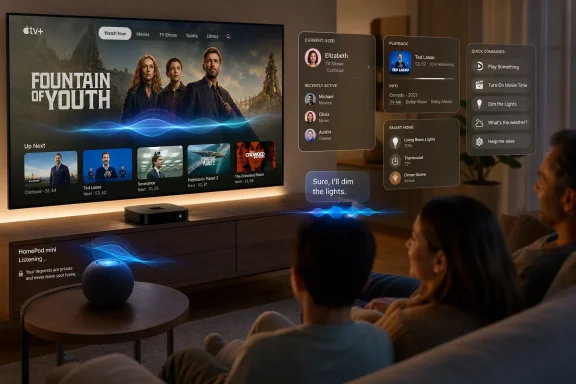
Apple is reportedly testing new Apple TV and HomePod mini models that would bring Apple Intelligence and a more capable Siri into the living room in 2027, while Apple’s broader home automation roadmap may now stretch into 2028 as more ambitious devices wait behind the same AI bottleneck. The rumor matters less because of the boxes themselves than because of what they reveal about Apple’s next front in the platform war. The company is not merely refreshing accessories; it is trying to turn the home into another place where its silicon, services, and assistant can quietly bind users tighter to the ecosystem. The catch is that Apple’s smart-home comeback depends on the one thing it has spent the last two years trying to prove it can still deliver: software intelligence that feels both useful and trustworthy.
For years, the Apple TV and HomePod mini have occupied an odd position in Apple’s lineup. They are deeply Apple products, polished and reliable in the way customers expect, but they have rarely felt like the center of the company’s ambition. The Apple TV 4K is a superb streaming box in a market full of cheaper sticks, while the HomePod mini is a tidy smart speaker in a market defined by Amazon’s volume and Google’s search-adjacent reach.
That made sense when the living room was mainly about playback and smart-home control. Apple could sell a premium streaming device, keep tvOS clean, use HomePod as a Home hub, and treat the category as an ecosystem extension rather than a growth engine. But generative AI changes the job description. If the interface of the next computing era is a conversational assistant, then the speaker in the kitchen and the box under the television are suddenly much more important.
That is the real significance of the reported 2027 refresh. Apple does not appear to be preparing a radical industrial-design reset for either product. The box is still likely to be a box; the speaker is still likely to be a small fabric-covered orb. The change is in the brain, and for this category that may be enough.
A smarter Apple TV could make search, recommendations, accessibility, and media navigation feel less like menu diving and more like intent. A smarter HomePod mini could finally give Siri the context awareness Apple has promised for years but rarely delivered in the home. In other words, Apple’s living room hardware may be about to become less interesting to look at and more important to talk to.
But for Apple Intelligence, the spec bump is the story. Apple’s AI strategy is constrained by hardware in a way that earlier cloud-first assistant strategies were not. The company has repeatedly emphasized on-device processing, privacy, and tight integration with its own chips. That creates a marketing advantage, but it also means older devices can be left behind when the neural engine, memory ceiling, or processor class does not meet the new software’s demands.
The current Apple TV 4K, introduced in 2022, is still fast for streaming and gaming-lite use. The HomePod mini, introduced in 2020, remains competent as a speaker and Home hub. Neither is obsolete in the conventional sense. The problem is that AI has moved the goalposts from “can this device run smoothly?” to “can this device understand, reason, summarize, personalize, and coordinate locally enough to satisfy Apple’s privacy model?”
That distinction matters for buyers. A four-year-old streaming box can feel perfectly modern until the platform owner decides the next interface layer requires new silicon. A six-year-old smart speaker can still play music and turn on lights, yet miss the assistant upgrade that makes the next generation feel genuinely different. Apple has spent years training customers to expect long support windows; Apple Intelligence introduces a harsher divide.
The likely result is a refresh that looks incremental on a spec sheet but consequential in daily use. Faster chips, updated wireless support, Thread improvements, ultra-wideband refinements, and a revised Siri Remote do not sound like a revolution. Combined with a redesigned Siri, they may be the difference between a home accessory and an AI endpoint.
That is a major cultural and operational shift. Apple can launch an iPhone with a camera feature that arrives later, or a Mac whose best software optimizations come in a point release. But a smart speaker whose headline feature is a more intelligent assistant cannot hide behind future updates for long. The product either understands you better on day one, or it becomes another promise in a category already full of them.
Siri’s reputation makes the stakes higher. Apple’s assistant was early, famous, and for years disappointingly literal. Users learned how to speak around its limitations: short commands, precise phrasing, low expectations. The smart home punished that weakness especially harshly, because household commands often involve context. “Turn that off,” “make it warmer in here,” or “play the next episode in the living room” require the assistant to know what room, device, account, app, and person are involved.
Apple Intelligence is supposed to repair that relationship. The pitch is not merely that Siri can answer more trivia or write a nicer message. The more important claim is that Siri can understand personal context, operate across apps, and execute multi-step actions. In the home, that could be transformative — but only if it works with the speed and reliability expected from a light switch.
A failed iPhone AI feature is embarrassing. A failed home assistant is aggravating dozens of times a week. That is why Apple cannot treat the HomePod mini as just another vessel for a keynote demo. In the living room and kitchen, Siri has to graduate from novelty to infrastructure.
And yet Apple Home has often felt like a second-language ecosystem. Enthusiasts can build excellent HomeKit setups, especially with Matter and Thread accessories in the mix, but the experience has rarely matched the simplicity Apple sells elsewhere. Automations can feel fragile. Device compatibility is better than it was, but still not effortless. Siri has lagged behind what users expect from a voice-controlled home.
This is why the rumored roadmap stretching into 2028 is more than a scheduling footnote. Apple seems to be trying to move from “we support the smart home” to “we define the smart home for Apple users.” That likely means more than a refreshed speaker and streaming box. Reports have repeatedly pointed to home displays, camera-adjacent devices, new hubs, and perhaps more experimental products that blend robotics, screens, and ambient computing.
The delay suggests Apple understands that a smart-home push cannot be half coherent. A screen in the kitchen, a camera at the door, a smarter speaker in the bedroom, and a streaming box in the living room all need the same assistant model and the same trust model. If Siri cannot reliably arbitrate between them, Apple risks shipping a collection of gadgets instead of a system.
The good news for Apple is that the smart home is still unsettled. Amazon has scale but has struggled to turn Alexa into a profitable platform. Google has intelligence but a long history of product churn that makes some buyers wary. Samsung has breadth but not the same single-user identity layer. Apple does not need to be first; it needs to make the home feel less like a device zoo.
But the same privacy posture makes execution harder. If Apple wants to run as much intelligence as possible locally, the hardware must be capable enough. If it uses private cloud infrastructure, the latency, reliability, and transparency must meet a higher bar than a generic chatbot. If it limits what data Siri can see, the assistant may be safer but less capable than rivals willing to ingest more context.
This is the recurring Apple tradeoff. The company wants AI that feels personal without feeling invasive. In the home, that balance is brutal. A genuinely useful assistant may need to know who is speaking, which room they are in, what they were watching, whether the baby is asleep, which lights usually dim at this hour, and whether a stranger is at the door. Each data point improves usefulness and increases sensitivity.
Apple’s answer is likely to be a layered system: on-device recognition where possible, private cloud compute where necessary, and user controls wrapped in plain-language permissions. That is a good architecture if it works. It is also expensive, complex, and less forgiving than shipping another cloud speaker that records a command and sends it away.
This helps explain why the Apple TV and HomePod mini matter as foundational nodes. They are always plugged in, always located in meaningful rooms, and already trusted by Apple households. If Apple can make those devices intelligent without making them creepy, it earns permission to go further.
The original touch-heavy Siri Remote was elegant and divisive. Later revisions became more practical, with better buttons and a less slippery relationship to human hands. A new version would not define the next Apple TV, but it would show whether Apple has learned the right lesson: in the living room, cleverness loses to confidence.
That is doubly true in an AI interface. Voice may become more capable, but remotes do not disappear simply because assistants improve. Families share televisions. Guests use them. Background noise interferes. People browse silently at night. A great Apple TV experience still needs physical controls that do not require explanation.
There is also a broader point here about Apple’s smart-home design language. The best home technology fades into routine. It should not require the user to remember whether a command is phrased correctly, whether a device is in the right mode, or whether a remote gesture will overshoot the menu. Apple’s opportunity is not to make the living room futuristic; it is to make it calm.
If a new Siri Remote accompanies an AI-capable Apple TV, the ideal outcome is not a flashy redesign. It is fewer moments where the user thinks about the interface at all.
Microsoft is pushing Copilot across Windows, Microsoft 365, Edge, and Azure. Google is threading Gemini through Android, Workspace, Chrome, and the smart home. Apple is trying to turn Apple Intelligence into the connective tissue across iPhone, Mac, iPad, Watch, TV, and Home. The living room is not separate from computing anymore; it is another interface surface.
For mixed households and mixed-device workplaces, that matters. Employees already bring personal ecosystems into professional environments through passkeys, iCloud, AirDrop, iMessage, personal hotspots, and cross-device continuity features. As home assistants become more capable, they may also become part of how users manage calendars, reminders, calls, documents, and media. The boundary between consumer convenience and work-adjacent data gets blurrier.
Apple’s approach may also pressure expectations around local AI. If users get accustomed to private, device-aware assistants at home, they will expect similar behavior from Windows PCs and enterprise tools. Conversely, if Microsoft’s Copilot becomes more useful at work than Siri is at home, Apple’s premium privacy pitch may not be enough to offset capability gaps.
There is a management angle, too. Smart-home devices rarely sit under corporate MDM, but they exist in the same physical spaces where remote work happens. Microphones, cameras, shared screens, personal accounts, and work accounts now coexist in kitchens and living rooms. A smarter HomePod or Apple TV does not create that challenge, but it makes the ambient computing layer more capable — and therefore more relevant to security-minded users.
Apple’s timing problem is partly self-inflicted. The company announced Apple Intelligence with enormous platform significance, then had to navigate delays and staged rollouts that made the effort feel less complete than the branding implied. That does not mean Apple is doomed in AI; it does mean the company has less room for hand-waving. A living-room launch in 2027 will be judged against whatever ChatGPT, Gemini, Copilot, Alexa, and third-party smart-home systems can do by then, not what they could do when Apple first sketched the plan.
The date also implies that Apple is aligning hardware to a broader Siri maturity curve. That may be prudent. Shipping an AI speaker before the assistant is ready would repeat the oldest smart-speaker mistake: putting a microphone in the room and then disappointing the person who uses it. Waiting may frustrate enthusiasts, but it protects the product from becoming a punchline.
Still, waiting carries a cost. Smart-home loyalty can be sticky. Once a household has standardized on cameras, switches, automations, displays, and routines, switching ecosystems is not like changing a streaming app. Apple’s affluent installed base gives it a second chance, but not unlimited chances.
The company’s bet appears to be that many Apple households have not truly committed elsewhere. They may own an Echo, a Nest display, or a handful of Matter devices, but their digital identity still runs through iPhone. Apple wants to make the home another expression of that identity before rivals make the iPhone just another client.
A display changes the interaction model. Voice is excellent for quick commands, but poor for browsing cameras, approving automations, reading context, or choosing among multiple results. The home needs both glanceable information and conversational control. Amazon and Google learned this years ago with Echo Show and Nest Hub devices, even if neither has fully solved the category.
Apple’s version would likely lean on design, privacy, FaceTime, Apple Music, Photos, Home controls, and family organization. But those ingredients alone are not enough in 2027. A countertop Apple device that cannot reason across household context would feel like an iPad with fewer apps. A wall-mounted hub that depends on rigid commands would feel like a prettier thermostat.
This is why the Apple TV and HomePod mini refreshes should be read as infrastructure. They are not necessarily the final form of Apple’s home strategy. They are the installed endpoints that can normalize AI Siri in shared spaces, test new interaction patterns, and prepare users for a more ambitious hub.
If Apple eventually ships cameras, displays, or robotic home devices, the first question will not be whether the hardware looks good. It will be whether the assistant has earned the right to occupy that much of the home.
But Apple Intelligence raises expectations beyond competent hardware. If the new Siri cannot summarize, search, coordinate, and understand context in ways users notice, the refreshes will look like delayed spec bumps. If it can, Apple suddenly has an answer to the question that has haunted HomePod since launch: why should this exist instead of a cheaper smart speaker?
The answer cannot simply be “better privacy.” Privacy is valuable, but consumers rarely buy a speaker only for what it does not do. The product must be useful first, private by design second, and delightful often enough to justify Apple pricing. That is a harder bar than much of the smart-speaker market has had to clear.
Apple also has to avoid fragmenting the experience. If the best Siri features require the newest HomePod mini, the newest Apple TV, a recent iPhone, and a particular language or region, the marketing story becomes complicated quickly. Apple’s ecosystem strength is integration; its weakness is the fine print that appears when integration depends on new hardware.
The company can manage that, but it must be unusually clear. Users will tolerate a new chip requirement if the benefit is obvious. They will be less forgiving if Apple Intelligence becomes a badge that appears on boxes without changing the everyday experience.
The bigger win would be proactive but restrained assistance. Apple could suggest a scene, a playlist, a routine, or a setting based on context without turning the living room into an ad surface. It could help troubleshoot smart-home devices in plain English. It could make multi-user homes less chaotic by recognizing voices, accounts, permissions, and preferences more reliably.
That last point is critical. The home is not a single-user device. Apple’s greatest products have often been personal: the Mac, iPhone, iPad, Watch, and AirPods. The living room is shared, and shared computing is harder. It involves families, guests, children, roommates, and overlapping subscriptions. A smarter Siri has to understand not just a user, but a household.
This is where Apple’s vertical integration could shine. The company already knows the Apple IDs, devices, subscriptions, locations, and permissions in many households. If it can use that knowledge responsibly, it can produce a home experience that feels far more coherent than a pile of third-party skills and routines.
But if Apple overcorrects toward caution, the assistant may remain too limited to impress. If it overcorrects toward ambition, it risks privacy backlash. The sweet spot is narrow: useful enough to trust, private enough to invite in.
For Apple, the upside is enormous. If the company gets this right, the HomePod mini stops being a niche speaker and becomes a low-cost Apple Intelligence terminal. The Apple TV becomes more than the best premium streaming box; it becomes the living-room expression of Apple’s AI platform. The smart home becomes less of an accessory category and more of a retention engine.
For users, the practical advice is more cautious. Anyone buying an Apple TV or HomePod mini today should assume the next meaningful generation may be defined by AI compatibility rather than design. Current devices will likely remain useful for media, AirPlay, Home hub duties, and basic Siri commands, but the most interesting features may require new hardware. That is not unusual in technology, but it is worth remembering in a category where people often keep devices for many years.
For administrators and security-minded households, the advice is to watch the permissions model as closely as the product announcement. The next generation of smart-home AI will not be judged only by benchmark charts or demo fluency. It will be judged by what data it can access, where processing happens, how logs are handled, how guests are managed, and how clearly users can say no.
Apple’s 2027 home refresh, if it arrives as reported, will therefore be a test of more than Apple’s patience. It will test whether the company can make AI feel native to the home rather than bolted onto it.
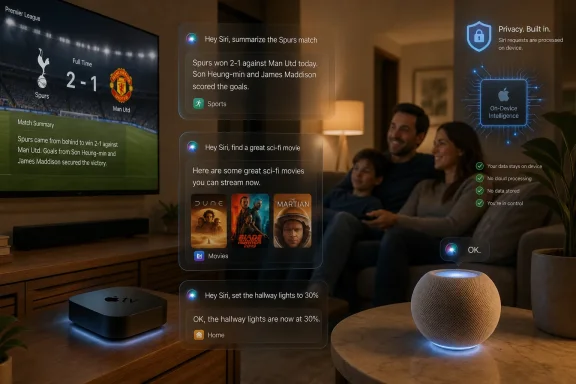 Apple’s Living Room Strategy Has Become an AI Strategy
For years, the Apple TV and HomePod mini have occupied an odd position in Apple’s lineup. They are deeply Apple products, polished and reliable in the way customers expect, but they have rarely felt like the center of the company’s ambition. The Apple TV 4K is a superb streaming box in a market full of cheaper sticks, while the HomePod mini is a tidy smart speaker in a market defined by Amazon’s volume and Google’s search-adjacent reach.That made sense when the living room was mainly about playback and smart-home control. Apple could sell a premium streaming device, keep tvOS clean, use HomePod as a Home hub, and treat the category as an ecosystem extension rather than a growth engine. But generative AI changes the job description. If the interface of the next computing era is a conversational assistant, then the speaker in the kitchen and the box under the television are suddenly much more important.
That is the real significance of the reported 2027 refresh. Apple does not appear to be preparing a radical industrial-design reset for either product. The box is still likely to be a box; the speaker is still likely to be a small fabric-covered orb. The change is in the brain, and for this category that may be enough.
A smarter Apple TV could make search, recommendations, accessibility, and media navigation feel less like menu diving and more like intent. A smarter HomePod mini could finally give Siri the context awareness Apple has promised for years but rarely delivered in the home. In other words, Apple’s living room hardware may be about to become less interesting to look at and more important to talk to.
The Spec Bump Is the Product This Time
Normally, a report that Apple is preparing modest hardware updates would be a recipe for boredom. Enthusiasts like visible change. A thinner enclosure, a new display, a fresh material, a rewritten remote — these are the things that make a product refresh feel obvious from across the room.But for Apple Intelligence, the spec bump is the story. Apple’s AI strategy is constrained by hardware in a way that earlier cloud-first assistant strategies were not. The company has repeatedly emphasized on-device processing, privacy, and tight integration with its own chips. That creates a marketing advantage, but it also means older devices can be left behind when the neural engine, memory ceiling, or processor class does not meet the new software’s demands.
The current Apple TV 4K, introduced in 2022, is still fast for streaming and gaming-lite use. The HomePod mini, introduced in 2020, remains competent as a speaker and Home hub. Neither is obsolete in the conventional sense. The problem is that AI has moved the goalposts from “can this device run smoothly?” to “can this device understand, reason, summarize, personalize, and coordinate locally enough to satisfy Apple’s privacy model?”
That distinction matters for buyers. A four-year-old streaming box can feel perfectly modern until the platform owner decides the next interface layer requires new silicon. A six-year-old smart speaker can still play music and turn on lights, yet miss the assistant upgrade that makes the next generation feel genuinely different. Apple has spent years training customers to expect long support windows; Apple Intelligence introduces a harsher divide.
The likely result is a refresh that looks incremental on a spec sheet but consequential in daily use. Faster chips, updated wireless support, Thread improvements, ultra-wideband refinements, and a revised Siri Remote do not sound like a revolution. Combined with a redesigned Siri, they may be the difference between a home accessory and an AI endpoint.
Siri Is No Longer a Feature; It Is the Shipping Gate
The most revealing part of the reporting is not that new Apple TV and HomePod mini models are in advanced testing. It is that they appear to be waiting on Siri. In the old Apple, hardware led the parade and software filled in around it. In this version of Apple’s smart-home roadmap, the assistant is the gatekeeper.That is a major cultural and operational shift. Apple can launch an iPhone with a camera feature that arrives later, or a Mac whose best software optimizations come in a point release. But a smart speaker whose headline feature is a more intelligent assistant cannot hide behind future updates for long. The product either understands you better on day one, or it becomes another promise in a category already full of them.
Siri’s reputation makes the stakes higher. Apple’s assistant was early, famous, and for years disappointingly literal. Users learned how to speak around its limitations: short commands, precise phrasing, low expectations. The smart home punished that weakness especially harshly, because household commands often involve context. “Turn that off,” “make it warmer in here,” or “play the next episode in the living room” require the assistant to know what room, device, account, app, and person are involved.
Apple Intelligence is supposed to repair that relationship. The pitch is not merely that Siri can answer more trivia or write a nicer message. The more important claim is that Siri can understand personal context, operate across apps, and execute multi-step actions. In the home, that could be transformative — but only if it works with the speed and reliability expected from a light switch.
A failed iPhone AI feature is embarrassing. A failed home assistant is aggravating dozens of times a week. That is why Apple cannot treat the HomePod mini as just another vessel for a keynote demo. In the living room and kitchen, Siri has to graduate from novelty to infrastructure.
Apple’s Home Problem Was Never Just Hardware
Apple’s smart-home problem has always been strange because the company owns so many of the ingredients. It has the phones people carry, the watches on their wrists, the tablets on their counters, the streaming box connected to the best screen in the house, and the speaker that can act as a hub. It has a privacy brand that should be well suited to cameras, locks, and household sensors. It has retail stores that could explain the system to mainstream buyers.And yet Apple Home has often felt like a second-language ecosystem. Enthusiasts can build excellent HomeKit setups, especially with Matter and Thread accessories in the mix, but the experience has rarely matched the simplicity Apple sells elsewhere. Automations can feel fragile. Device compatibility is better than it was, but still not effortless. Siri has lagged behind what users expect from a voice-controlled home.
This is why the rumored roadmap stretching into 2028 is more than a scheduling footnote. Apple seems to be trying to move from “we support the smart home” to “we define the smart home for Apple users.” That likely means more than a refreshed speaker and streaming box. Reports have repeatedly pointed to home displays, camera-adjacent devices, new hubs, and perhaps more experimental products that blend robotics, screens, and ambient computing.
The delay suggests Apple understands that a smart-home push cannot be half coherent. A screen in the kitchen, a camera at the door, a smarter speaker in the bedroom, and a streaming box in the living room all need the same assistant model and the same trust model. If Siri cannot reliably arbitrate between them, Apple risks shipping a collection of gadgets instead of a system.
The good news for Apple is that the smart home is still unsettled. Amazon has scale but has struggled to turn Alexa into a profitable platform. Google has intelligence but a long history of product churn that makes some buyers wary. Samsung has breadth but not the same single-user identity layer. Apple does not need to be first; it needs to make the home feel less like a device zoo.
Privacy Is Apple’s Best Weapon, but Also Its Constraint
Apple’s most obvious smart-home advantage is privacy. A company that can say, credibly enough for many consumers, that it would rather process personal requests on device than feed them into an advertising machine has a powerful story for microphones and cameras in private spaces. That pitch becomes even more important as AI moves from answering general questions to understanding family routines, viewing rooms, and mediating access to locks, thermostats, and cameras.But the same privacy posture makes execution harder. If Apple wants to run as much intelligence as possible locally, the hardware must be capable enough. If it uses private cloud infrastructure, the latency, reliability, and transparency must meet a higher bar than a generic chatbot. If it limits what data Siri can see, the assistant may be safer but less capable than rivals willing to ingest more context.
This is the recurring Apple tradeoff. The company wants AI that feels personal without feeling invasive. In the home, that balance is brutal. A genuinely useful assistant may need to know who is speaking, which room they are in, what they were watching, whether the baby is asleep, which lights usually dim at this hour, and whether a stranger is at the door. Each data point improves usefulness and increases sensitivity.
Apple’s answer is likely to be a layered system: on-device recognition where possible, private cloud compute where necessary, and user controls wrapped in plain-language permissions. That is a good architecture if it works. It is also expensive, complex, and less forgiving than shipping another cloud speaker that records a command and sends it away.
This helps explain why the Apple TV and HomePod mini matter as foundational nodes. They are always plugged in, always located in meaningful rooms, and already trusted by Apple households. If Apple can make those devices intelligent without making them creepy, it earns permission to go further.
The Remote Tells a Smaller but Familiar Apple Story
The reported Siri Remote tweak sounds minor, and in a strategic sense it is. Yet Apple TV owners know the remote has always been a surprisingly revealing object. Apple’s living-room ambitions have repeatedly been filtered through a small slab of aluminum and glass that users either love, tolerate, or complain about with the intensity usually reserved for printers.The original touch-heavy Siri Remote was elegant and divisive. Later revisions became more practical, with better buttons and a less slippery relationship to human hands. A new version would not define the next Apple TV, but it would show whether Apple has learned the right lesson: in the living room, cleverness loses to confidence.
That is doubly true in an AI interface. Voice may become more capable, but remotes do not disappear simply because assistants improve. Families share televisions. Guests use them. Background noise interferes. People browse silently at night. A great Apple TV experience still needs physical controls that do not require explanation.
There is also a broader point here about Apple’s smart-home design language. The best home technology fades into routine. It should not require the user to remember whether a command is phrased correctly, whether a device is in the right mode, or whether a remote gesture will overshoot the menu. Apple’s opportunity is not to make the living room futuristic; it is to make it calm.
If a new Siri Remote accompanies an AI-capable Apple TV, the ideal outcome is not a flashy redesign. It is fewer moments where the user thinks about the interface at all.
Windows Users Should Watch This as a Platform Move
At first glance, this looks like Apple ecosystem news with little relevance to WindowsForum readers. Apple TV and HomePod mini are not Windows devices, and Apple Intelligence is not a Microsoft platform. But IT pros should pay attention because this is part of the same platform consolidation reshaping PCs, phones, browsers, assistants, and enterprise identity.Microsoft is pushing Copilot across Windows, Microsoft 365, Edge, and Azure. Google is threading Gemini through Android, Workspace, Chrome, and the smart home. Apple is trying to turn Apple Intelligence into the connective tissue across iPhone, Mac, iPad, Watch, TV, and Home. The living room is not separate from computing anymore; it is another interface surface.
For mixed households and mixed-device workplaces, that matters. Employees already bring personal ecosystems into professional environments through passkeys, iCloud, AirDrop, iMessage, personal hotspots, and cross-device continuity features. As home assistants become more capable, they may also become part of how users manage calendars, reminders, calls, documents, and media. The boundary between consumer convenience and work-adjacent data gets blurrier.
Apple’s approach may also pressure expectations around local AI. If users get accustomed to private, device-aware assistants at home, they will expect similar behavior from Windows PCs and enterprise tools. Conversely, if Microsoft’s Copilot becomes more useful at work than Siri is at home, Apple’s premium privacy pitch may not be enough to offset capability gaps.
There is a management angle, too. Smart-home devices rarely sit under corporate MDM, but they exist in the same physical spaces where remote work happens. Microphones, cameras, shared screens, personal accounts, and work accounts now coexist in kitchens and living rooms. A smarter HomePod or Apple TV does not create that challenge, but it makes the ambient computing layer more capable — and therefore more relevant to security-minded users.
The 2027 Date Is a Warning, Not Just a Rumor
A 2027 arrival for Apple Intelligence-enabled living-room devices would be both soon and late. Soon, because Apple’s current HomePod mini and Apple TV 4K still feel serviceable to many owners. Late, because Amazon and Google have spent years conditioning users to expect voice assistants in the home, and the generative AI boom has already rewritten expectations for what “smart” should mean.Apple’s timing problem is partly self-inflicted. The company announced Apple Intelligence with enormous platform significance, then had to navigate delays and staged rollouts that made the effort feel less complete than the branding implied. That does not mean Apple is doomed in AI; it does mean the company has less room for hand-waving. A living-room launch in 2027 will be judged against whatever ChatGPT, Gemini, Copilot, Alexa, and third-party smart-home systems can do by then, not what they could do when Apple first sketched the plan.
The date also implies that Apple is aligning hardware to a broader Siri maturity curve. That may be prudent. Shipping an AI speaker before the assistant is ready would repeat the oldest smart-speaker mistake: putting a microphone in the room and then disappointing the person who uses it. Waiting may frustrate enthusiasts, but it protects the product from becoming a punchline.
Still, waiting carries a cost. Smart-home loyalty can be sticky. Once a household has standardized on cameras, switches, automations, displays, and routines, switching ecosystems is not like changing a streaming app. Apple’s affluent installed base gives it a second chance, but not unlimited chances.
The company’s bet appears to be that many Apple households have not truly committed elsewhere. They may own an Echo, a Nest display, or a handful of Matter devices, but their digital identity still runs through iPhone. Apple wants to make the home another expression of that identity before rivals make the iPhone just another client.
The Home Hub Shadow Looms Over Everything
The rumored Apple TV and HomePod mini refreshes are only the familiar edge of a larger story. For years, reports have pointed to an Apple smart display or home hub — a device that could sit on a counter, mount to a wall, run a homeOS-like interface, and serve as a visual command center. If that product slips toward late 2026, 2027, or beyond, it becomes part of the same narrative: Apple knows the home needs a screen, but the screen needs Siri to be worth buying.A display changes the interaction model. Voice is excellent for quick commands, but poor for browsing cameras, approving automations, reading context, or choosing among multiple results. The home needs both glanceable information and conversational control. Amazon and Google learned this years ago with Echo Show and Nest Hub devices, even if neither has fully solved the category.
Apple’s version would likely lean on design, privacy, FaceTime, Apple Music, Photos, Home controls, and family organization. But those ingredients alone are not enough in 2027. A countertop Apple device that cannot reason across household context would feel like an iPad with fewer apps. A wall-mounted hub that depends on rigid commands would feel like a prettier thermostat.
This is why the Apple TV and HomePod mini refreshes should be read as infrastructure. They are not necessarily the final form of Apple’s home strategy. They are the installed endpoints that can normalize AI Siri in shared spaces, test new interaction patterns, and prepare users for a more ambitious hub.
If Apple eventually ships cameras, displays, or robotic home devices, the first question will not be whether the hardware looks good. It will be whether the assistant has earned the right to occupy that much of the home.
Apple’s Safest Products May Carry Its Riskiest Promise
The irony is that Apple may be using two of its safest products to carry one of its riskiest promises. A refreshed Apple TV is unlikely to fail catastrophically. A new HomePod mini will probably sound good for its size, pair easily, and work as a Home hub. These are controlled, familiar devices with obvious places in the lineup.But Apple Intelligence raises expectations beyond competent hardware. If the new Siri cannot summarize, search, coordinate, and understand context in ways users notice, the refreshes will look like delayed spec bumps. If it can, Apple suddenly has an answer to the question that has haunted HomePod since launch: why should this exist instead of a cheaper smart speaker?
The answer cannot simply be “better privacy.” Privacy is valuable, but consumers rarely buy a speaker only for what it does not do. The product must be useful first, private by design second, and delightful often enough to justify Apple pricing. That is a harder bar than much of the smart-speaker market has had to clear.
Apple also has to avoid fragmenting the experience. If the best Siri features require the newest HomePod mini, the newest Apple TV, a recent iPhone, and a particular language or region, the marketing story becomes complicated quickly. Apple’s ecosystem strength is integration; its weakness is the fine print that appears when integration depends on new hardware.
The company can manage that, but it must be unusually clear. Users will tolerate a new chip requirement if the benefit is obvious. They will be less forgiving if Apple Intelligence becomes a badge that appears on boxes without changing the everyday experience.
The Living Room Refresh That Would Actually Matter
The most concrete version of success is not hard to imagine. You sit down, ask Apple TV to find the episode where a character returns, and it searches across your apps without making you remember the service. You ask HomePod mini to lower the downstairs lights except the hallway, and it understands the household layout. You ask what happened in the last ten minutes of a sports match or a news program, and it summarizes without dumping you into a web search.The bigger win would be proactive but restrained assistance. Apple could suggest a scene, a playlist, a routine, or a setting based on context without turning the living room into an ad surface. It could help troubleshoot smart-home devices in plain English. It could make multi-user homes less chaotic by recognizing voices, accounts, permissions, and preferences more reliably.
That last point is critical. The home is not a single-user device. Apple’s greatest products have often been personal: the Mac, iPhone, iPad, Watch, and AirPods. The living room is shared, and shared computing is harder. It involves families, guests, children, roommates, and overlapping subscriptions. A smarter Siri has to understand not just a user, but a household.
This is where Apple’s vertical integration could shine. The company already knows the Apple IDs, devices, subscriptions, locations, and permissions in many households. If it can use that knowledge responsibly, it can produce a home experience that feels far more coherent than a pile of third-party skills and routines.
But if Apple overcorrects toward caution, the assistant may remain too limited to impress. If it overcorrects toward ambition, it risks privacy backlash. The sweet spot is narrow: useful enough to trust, private enough to invite in.
The Calendar Now Belongs to Siri
The emerging pattern is clear. Apple’s home hardware is no longer paced only by chip availability, industrial design, or supply chain readiness. It is paced by Siri. That is an uncomfortable position for a company whose reputation was built on shipping integrated products when they were ready, because “ready” now depends on a class of software that is probabilistic, fast-moving, and judged against competitors improving in public every month.For Apple, the upside is enormous. If the company gets this right, the HomePod mini stops being a niche speaker and becomes a low-cost Apple Intelligence terminal. The Apple TV becomes more than the best premium streaming box; it becomes the living-room expression of Apple’s AI platform. The smart home becomes less of an accessory category and more of a retention engine.
For users, the practical advice is more cautious. Anyone buying an Apple TV or HomePod mini today should assume the next meaningful generation may be defined by AI compatibility rather than design. Current devices will likely remain useful for media, AirPlay, Home hub duties, and basic Siri commands, but the most interesting features may require new hardware. That is not unusual in technology, but it is worth remembering in a category where people often keep devices for many years.
For administrators and security-minded households, the advice is to watch the permissions model as closely as the product announcement. The next generation of smart-home AI will not be judged only by benchmark charts or demo fluency. It will be judged by what data it can access, where processing happens, how logs are handled, how guests are managed, and how clearly users can say no.
Apple’s 2027 home refresh, if it arrives as reported, will therefore be a test of more than Apple’s patience. It will test whether the company can make AI feel native to the home rather than bolted onto it.
The Apple Home Upgrade Path Is Becoming Easier to See
The rumor cycle is noisy, but the practical outline for Apple households is starting to come into focus. The next Apple TV and HomePod mini are likely to be evolutionary on the outside and more consequential inside, because Apple’s home strategy now depends on placing capable AI hardware in rooms people already use.- Apple’s next living-room devices are expected to prioritize Apple Intelligence and the revamped Siri over dramatic external redesigns.
- The current Apple TV 4K and HomePod mini remain useful products, but their age makes them vulnerable to missing the most advanced AI features.
- A revised Siri Remote would matter less as a headline feature than as a sign that Apple still understands the living room needs reliable physical controls.
- Apple’s wider smart-home roadmap appears to depend on Siri becoming good enough to support displays, hubs, cameras, and more ambitious household devices.
- Windows and enterprise users should view this as part of a broader ambient-computing shift, not as isolated consumer-gadget news.
- The real buying question is no longer whether Apple’s home hardware works today, but whether it will be eligible for the assistant experience Apple wants to sell tomorrow.
References
- Primary source: Digital Trends
Published: 2026-06-21T18:30:10.635945
Apple TV and HomePod mini with Apple Intelligence could land in 2027 - Digital Trends
Apple's AI ambitions may soon reach the living room. A new report suggests updated Apple TV and HomePod mini models are deep in testing, though the biggest changes could happen under the hood rather than on the outside.www.digitaltrends.com - Independent coverage: AppleInsider
Published: Sun, 21 Jun 2026 14:40:00 GMT
Apple's new home product releases will stretch into 2028
Apple's home automation updates and new product roadmap powered by Siri AI will kick off in 2026 with HomePod and Apple TV updates, but if you're excited for the robotic arm for a Home Hub, you're going to be waiting a while.appleinsider.com - Related coverage: macrumors.com
New Apple TV and HomePod Mini Are 'Nearly Ready' to Launch, New Siri Remote Also Rumored
New models of the Apple TV 4K and HomePod mini are "nearly ready to go," according to the latest word from Bloomberg's Mark Gurman. Subscribe to the MacRumors YouTube channel for more videos. Both devices have been ready "for months," but Apple is holding off on launching them until the more...www.macrumors.com - Related coverage: macdailynews.com
New Apple TV 4K and HomePod mini ready for fall launch (waiting on LLM Siri); iOS 28 work underway as ‘Bell’
Refreshed versions of the Apple TV 4K and HomePod mini have been ready for months — and are already being used internally at Apple Park…macdailynews.com - Related coverage: livemint.com
Apple’s 2026 roadmap may include home hub, cameras and refreshed HomePod mini | Mint
Apple is reportedly planning a major smart home push in 2026, including a refreshed HomePod mini, a new home hub with Face ID and Apple Intelligence, plus possible security and doorbell cameras, signalling a broader expansion of its connected home ecosystem. www.livemint.com
- Related coverage: tech.yahoo.com
New Apple TV and HomePod mini are apparently ready for a fall launch
Apple is reportedly preparing refreshed Apple TV and HomePod mini hardware with improved Siri and Apple Intelligence support for a fall launch.tech.yahoo.com
- Related coverage: stuff.tv
A new Apple TV and HomePod Mini could finally launch – there’s just one hurdle holding them back | Stuff
Apple reportedly finished both devices months ago, but they’re still waiting for one major software upgradewww.stuff.tv - Related coverage: cultofmac.com
Why we're still waiting for HomePod mini 2 and Apple TV 4K 2026 | Cult of Mac
The HomePod mini 2 and an updated Apple TV 4K are both expected in 2026. Here's why Apple hasn't already launched them.www.cultofmac.com - Related coverage: tomsguide.com
Apple could launch 7 new smart home devices this year — but there's a catch | Tom's Guide
Apple has big plans for smart home devices that start with these 7 devices but there's a big Siri catchwww.tomsguide.com - Related coverage: macworld.com
Apple HomePod mini 2, HomePod Touch, HomeHub: Release date, rumours & what’s coming | Macworld
Apple HomePod mini 2 and HomePod with display rumours: release date, specs, HomeHub plans and why Siri delays are pushing launches back.www.macworld.com - Related coverage: notebookcheck.net
Powerful Apple TV with new remote and chip, HomePod mini 2026 launch imminent, reveals leak - Notebookcheck News
Apple is delaying the release of refreshed Apple TV and HomePod mini hardware until this fall to ensure alignment with its new AI-powered Siri launch, says a fresh leak. Both devices feature internal processor upgrades designed to support the advanced capabilities of the upcoming software... www.notebookcheck.net
- Related coverage: wwwhatsnew.com
El nuevo Apple TV y HomePod mini llevan meses listos: solo esperan a que Siri funcione bien
Hay una paradoja en casa de Apple este año: los dispositivos están terminados, pero no se pueden vender. Según Mark Gurman de Bloomberg en su newsletter Power On del 31 de mayo de 2026, tanto el nuevo Apple TV 4K como el HomePod mini 2 están listos desde hace meses. El hardware está fabricado... wwwhatsnew.com
- Related coverage: t3.com
New Apple TV 4K delays could soon be over – expected in the coming months with a new Siri remote and HomePod mini | T3
Could we find out more during WWDC 26 next week?www.t3.com - Related coverage: techradar.com
The most exciting thing about the new Siri is the new hardware it’ll unlock — here’s what it could mean for a new Apple TV, HomePod mini and Siri Remote | TechRadar
An update I’ve been waiting forwww.techradar.com - Related coverage: creativebloq.com
Apple has finally caught up on AI with the new Siri for iPhone, iPad and Mac – but there's one problem | Creative Bloq
Every Apple WWDC 2026 update live as it happened.www.creativebloq.com - Related coverage: cincodias.elpais.com
Apple prepara su salto definitivo a la IA en 2027: gafas inteligentes, colgante y AirPods con cámara | Gadgets | Smartlife | Cinco Días
Aluvión de novedadescincodias.elpais.com