

Google Chrome for macOS before version 149.0.7827.103 was assigned CVE-2026-11677 on June 8, 2026, for a high-severity race condition in the browser’s Network component that could let a remote attacker escape the sandbox after compromising Chrome’s network process. The vulnerability is not the loudest Chrome bug in the June security batch, but it is exactly the sort of flaw administrators should dislike: narrow, chained, and easy to underestimate. Its practical lesson is that browser patching is no longer just about JavaScript engines and zero-days; the supporting processes around the browser are now part of the attack surface that enterprise IT has to treat as critical infrastructure.
Race-condition bugs tend to sound less dramatic than use-after-free flaws, type confusions, or out-of-bounds writes. They are easy to file mentally under “implementation detail,” the sort of thing that matters deeply to browser engineers but does not immediately tell a help desk what to do on Monday morning. CVE-2026-11677 is a reminder that this instinct is wrong.
The bug sits in Chrome’s Network component and is classified as CWE-362, concurrent execution using a shared resource with improper synchronization. In plain English, some part of Chrome’s networking logic could be pushed into an unsafe timing condition. If an attacker had already compromised the network process, a crafted HTML page could potentially turn that foothold into a sandbox escape on macOS.
That phrase — after compromising the network process — is doing important work. This is not described as a one-click, from-the-open-web-to-full-control exploit by itself. It is a second-stage problem, the kind of vulnerability that becomes dangerous when paired with another browser bug, a renderer compromise, or a malicious chain that moves through Chrome’s process architecture one boundary at a time.
That is also why it matters. Modern browser security is not built on the idea that no process will ever be compromised. It is built on containment. CVE-2026-11677 is notable because it targets the containment model itself.
That model has worked well enough that many users now think of browser exploitation as a solved problem, interrupted only by the occasional emergency update. But the browser is not a single application in the old sense. It is a small operating environment, complete with privileges, brokers, IPC pathways, process boundaries, and security assumptions that have to hold under hostile input.
CVE-2026-11677 lands in that world. A race in the Network component is not merely a crash bug if it can help an attacker cross from a compromised network process into a broader sandbox escape. The fact that user interaction is still required under the CISA ADP scoring does not make it benign; most browser attacks begin with user interaction, because opening a web page is the basic act of using the web.
The CVSS 3.1 vector assigned by CISA ADP gives the bug an 8.3 high score, with network attack vector, high attack complexity, no privileges required, user interaction required, changed scope, and high impact across confidentiality, integrity, and availability. That combination tells a familiar story: exploitation may not be trivial, but a successful exploit could be severe.
For WindowsForum readers, that may sound like a reason to move on. It is not. Mixed-platform fleets are common, and macOS machines often sit inside the same identity, browser-management, cloud-storage, and SaaS perimeter as Windows endpoints. A MacBook assigned to an executive, developer, designer, or administrator can carry the same session tokens and access paths as a domain-joined Windows laptop.
The CPE configuration in NVD is also worth reading carefully. It models the vulnerability as Chrome versions before 149.0.7827.103 running on macOS. That is not a missing CPE in the ordinary sense; it reflects the platform-specific nature of the published vulnerability record. If an organization is scanning for vulnerable Chrome builds without accounting for OS context, however, the result can be noisy in one direction and dangerously quiet in another.
This is where vulnerability management dashboards can mislead. A generic “Chrome less than 149.0.7827.103” rule may flag systems that do not match the published affected platform. A rule that only watches Windows Chrome versions may miss the macOS population entirely. The correct operational answer is not to argue with the CPE; it is to ensure inventory can see browser version, operating system, and channel with enough precision to make the CPE useful.
The complication is that Chrome’s release numbers are not always identical across platforms. In this June stable-channel update, Windows and Linux builds were listed as 149.0.7827.102, while the Mac build was 149.0.7827.103. A vulnerability record that says “Mac prior to 149.0.7827.103” is not automatically saying Windows systems need that exact build number. It is saying the macOS branch has a fixed point at that version.
That distinction matters for scanners. Security teams often normalize browser patch compliance into a single target version, because a single version is easier to communicate. But Chrome’s multi-platform release cadence can make that habit imprecise. If the goal is to prove exposure for CVE-2026-11677, the operating system condition is part of the evidence.
The better question is not whether the CPE list should include every Chromium-derived browser or every operating system. It is whether your vulnerability tooling can express what the advisory actually says. A scanner that cannot represent “Chrome on macOS before 149.0.7827.103” is not giving you fidelity; it is giving you a guess with a dashboard.
This is why high-complexity vulnerabilities still receive high attention from security teams. Attack complexity measures how hard exploitation may be under ideal scoring assumptions, not whether capable attackers care. If the payoff is sandbox escape, the bug can become valuable precisely because it completes a chain.
The network process is also an attractive place to think about boundaries. It touches protocols, sockets, proxies, certificates, DNS behaviors, isolation policies, and the messy interaction between web content and the outside world. Chrome has spent years pushing sensitive work into dedicated processes to reduce blast radius. Every one of those boundaries then becomes a place where synchronization, validation, and IPC behavior have to be right.
Race conditions are particularly uncomfortable in that context. They often depend on timing, load, thread interleavings, and state transitions that may be difficult to reproduce. They can hide from ordinary testing, resist simple crash signatures, and appear only when an attacker carefully shapes the order in which events occur. That does not make them magical; it makes them tedious, and tedious bugs are often the ones that survive longest.
But the presence of a more famous bug should not demote CVE-2026-11677 into background radiation. Browser updates are cumulative defensive events. Organizations do not get to patch only the vulnerability that made the news and leave the rest of the release behind.
The stable-channel update moved desktop Chrome to patched builds across Windows, macOS, and Linux, with the macOS fixed version relevant here being 149.0.7827.103. Google also followed its normal practice of restricting access to bug details until a majority of users have received the fix. That restriction is not secrecy for secrecy’s sake; it is a race-management tactic. Once the shape of a browser bug is public, exploit developers and defenders are reading the same clues.
For IT teams, the takeaway is simple: the advisory’s quiet entries are not optional. A large Chrome security update can contain headline zero-days, critical memory safety issues, sandbox escapes, and platform-specific flaws in the same bundle. Patch prioritization may help schedule work, but it should not become selective belief.
Chrome is often the common application layer across operating systems. The same browser signs into the same identity provider, opens the same admin consoles, reaches the same SaaS estate, and stores the same session state. If Chrome patching on Windows is strict but Chrome patching on macOS is casual, the organization has not reduced browser risk so much as moved it to a less-watched endpoint class.
This is especially true for users with elevated access. A sandbox escape on a Mac used for development, operations, or leadership can have consequences beyond the local device. Source repositories, production dashboards, cloud consoles, password managers, and internal documentation often sit one browser session away.
The old perimeter logic does not help much here. A crafted page does not need to look like an inbound network attack against a server. It can be delivered through ordinary browsing, phishing, malvertising, compromised websites, or poisoned links in collaboration tools. The browser is the perimeter now, and every unmanaged browser is a small unmanaged perimeter.
Administrators should treat NVD as one layer in a decision, not the whole decision. Vendor advisories establish the patch. CVE records establish identifiers and descriptions. CISA ADP scoring can help prioritize. Asset inventory tells you whether the vulnerable software is actually present. None of those sources replaces the others.
The absence of an NVD CVSS score should not delay action. CISA ADP’s 8.3 high score already captures the broad risk: remote reachability, no privileges required, required user interaction, changed scope, and high potential impact. The vendor has shipped a fixed version. That is enough for a patch decision.
The practical test is boring and decisive: is Chrome on macOS at 149.0.7827.103 or later? If not, update. If your tooling cannot answer that question, the vulnerability has exposed a management gap even before anyone attempts exploitation.
Browsers often require a restart to complete an update. Users can keep sessions alive for days. Managed policies can delay rollouts. VDI images, lab systems, shared Macs, kiosk-style setups, and test machines can sit outside the normal flow. Security teams that assume Chrome “probably updated itself” will eventually find an exception with production access.
The usual operational move is to combine policy with telemetry. Enforce update behavior where possible, report installed versions centrally, and treat stale browsers as endpoint compliance failures rather than user preferences. On macOS, that may mean checking MDM enforcement, Chrome Browser Cloud Management enrollment, or whatever endpoint suite the organization uses to observe application versions.
There is also a communication lesson. Telling users “update Chrome” is less effective than telling them to open Chrome’s About page, let the update complete, and relaunch the browser. In enterprise language, the task is not download; the task is reach a fixed running version.
That does not mean CVE-2026-11677 automatically affects every Chromium browser on every platform. It means administrators should ask the question rather than assume the answer. When a Chromium bug is in a component that downstream browsers inherit, downstream patch status matters. When the affected code is Chrome-specific or platform-specific, the answer may differ.
For WindowsForum’s core audience, Microsoft Edge is the obvious adjacent concern. Edge has its own release notes, enterprise controls, and update cadence, but it rides the Chromium base. A Chrome security update that touches shared code should prompt a quick check of Edge stable-channel updates, especially in environments where Edge is the default managed browser.
The broader point is that browser monoculture has operational consequences. Chromium’s dominance gives users fast performance, strong security engineering, and broad site compatibility. It also means that a single class of bug can become a fleet-wide patch event across multiple browser brands. Diversity does not eliminate browser risk, but dependence on a shared engine should make patch visibility non-negotiable.
Attackers rarely need exotic social engineering to satisfy that requirement. A link in email, a redirect from a compromised site, a malicious ad, a chat message, or a watering-hole page can all provide the necessary interaction. The user does not need to install a package or approve a scary prompt for a crafted HTML page to be relevant.
The attack complexity is marked high, and that should be respected. Not every threat actor can exploit a race condition in a hardened, multi-process browser. But exploit chains are traded, reused, and adapted. The relevant defender question is not “could a random criminal write this from scratch by Friday?” It is “what happens when this becomes one piece of a professional chain?”
That distinction is especially important for organizations with targeted users. Journalists, lawyers, executives, engineers, cryptocurrency operators, political staff, and administrators face a different browser risk profile than ordinary home users. For them, a sandbox escape is not an abstract severity term. It is the difference between a contained tab compromise and a meaningful endpoint incident.
Chrome’s sandbox is an application-level defense designed to constrain the damage of web content exploitation. A Chrome sandbox escape is not the same thing as a full macOS kernel compromise, but it can still be a serious step up in capability. Depending on the chain, it may allow access to data, processes, or brokered functionality that a confined renderer should not reach.
This is where platform debates often become unhelpful. Windows, macOS, and Linux all have different browser attack surfaces, different mitigations, and different management cultures. The operational lesson is not that one platform is doomed or another is safe. It is that browser isolation is a critical security boundary on every desktop operating system.
For many users, Chrome is the most exposed application on the machine. It touches untrusted code constantly, stores sensitive state, integrates with password managers and identity providers, and runs with the user’s authority. That makes browser patching one of the highest-return security controls available, regardless of the logo on the laptop lid.
The relaunch gap is the browser world’s chronic weakness. Chrome may download an update in the background, but the old version can remain active until the user restarts. In a consumer setting, this is an annoyance. In an enterprise setting, it is an exposure window that should be measured and managed.
Administrators should be careful not to count installed package version alone if the running process has not restarted. The distinction is subtle, but it matters in incident response and compliance reporting. A machine that has staged an update but is still running the vulnerable build is not fully remediated.
There is a cultural issue here as well. Users have been trained to keep browser sessions alive because their work lives in tabs. The browser has become a workspace, not just an application. Security teams need update policies that understand that reality without surrendering to it: clear restart prompts, reasonable deadlines, and forced relaunches where risk justifies the disruption.
The vulnerability also highlights the value of platform-specific patch SLAs. A generic “critical browser updates within seven days” policy may be too slow for an actively exploited zero-day but acceptable for some high-complexity bugs. A better policy distinguishes exploited-in-the-wild status, sandbox escape potential, user population, and asset sensitivity.
For this CVE, the absence of known exploitation in the supplied record keeps it out of the emergency-zero-day category. But the sandbox-escape potential and high impact argue against leisurely patching. Organizations should treat it as a high-priority browser update, especially for managed Macs with privileged users.
The cleanest operational stance is to avoid debating each Chrome CVE in isolation. When a stable-channel security update includes multiple high-impact flaws, one of them actively exploited and another capable of sandbox escape under prerequisite conditions, the enterprise answer should be fast deployment of the whole update. Selective urgency is how stale browser versions survive.
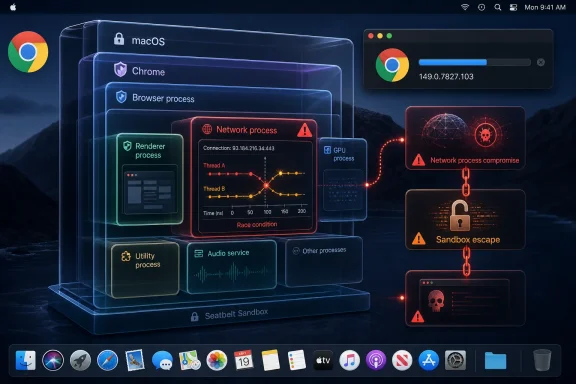 The Dangerous Part Is Not the Word “Race”
Race-condition bugs tend to sound less dramatic than use-after-free flaws, type confusions, or out-of-bounds writes. They are easy to file mentally under “implementation detail,” the sort of thing that matters deeply to browser engineers but does not immediately tell a help desk what to do on Monday morning. CVE-2026-11677 is a reminder that this instinct is wrong.The bug sits in Chrome’s Network component and is classified as CWE-362, concurrent execution using a shared resource with improper synchronization. In plain English, some part of Chrome’s networking logic could be pushed into an unsafe timing condition. If an attacker had already compromised the network process, a crafted HTML page could potentially turn that foothold into a sandbox escape on macOS.
That phrase — after compromising the network process — is doing important work. This is not described as a one-click, from-the-open-web-to-full-control exploit by itself. It is a second-stage problem, the kind of vulnerability that becomes dangerous when paired with another browser bug, a renderer compromise, or a malicious chain that moves through Chrome’s process architecture one boundary at a time.
That is also why it matters. Modern browser security is not built on the idea that no process will ever be compromised. It is built on containment. CVE-2026-11677 is notable because it targets the containment model itself.
Chrome’s Sandbox Is a Promise Made in Layers
Chrome’s security architecture depends on separation. The renderer that processes web content is not supposed to have easy access to the host operating system. The network process is supposed to do its own job within its own constraints. The browser process is supposed to coordinate without casually handing one compromised component the keys to the machine.That model has worked well enough that many users now think of browser exploitation as a solved problem, interrupted only by the occasional emergency update. But the browser is not a single application in the old sense. It is a small operating environment, complete with privileges, brokers, IPC pathways, process boundaries, and security assumptions that have to hold under hostile input.
CVE-2026-11677 lands in that world. A race in the Network component is not merely a crash bug if it can help an attacker cross from a compromised network process into a broader sandbox escape. The fact that user interaction is still required under the CISA ADP scoring does not make it benign; most browser attacks begin with user interaction, because opening a web page is the basic act of using the web.
The CVSS 3.1 vector assigned by CISA ADP gives the bug an 8.3 high score, with network attack vector, high attack complexity, no privileges required, user interaction required, changed scope, and high impact across confidentiality, integrity, and availability. That combination tells a familiar story: exploitation may not be trivial, but a successful exploit could be severe.
The macOS Scope Makes This Narrower, Not Smaller
The NVD entry currently describes the affected platform as Google Chrome on Mac prior to 149.0.7827.103. That distinction matters. The corresponding stable-channel release included patched versions for Windows, macOS, and Linux, but CVE-2026-11677’s published affected configuration is specifically tied to Chrome running on Apple macOS.For WindowsForum readers, that may sound like a reason to move on. It is not. Mixed-platform fleets are common, and macOS machines often sit inside the same identity, browser-management, cloud-storage, and SaaS perimeter as Windows endpoints. A MacBook assigned to an executive, developer, designer, or administrator can carry the same session tokens and access paths as a domain-joined Windows laptop.
The CPE configuration in NVD is also worth reading carefully. It models the vulnerability as Chrome versions before 149.0.7827.103 running on macOS. That is not a missing CPE in the ordinary sense; it reflects the platform-specific nature of the published vulnerability record. If an organization is scanning for vulnerable Chrome builds without accounting for OS context, however, the result can be noisy in one direction and dangerously quiet in another.
This is where vulnerability management dashboards can mislead. A generic “Chrome less than 149.0.7827.103” rule may flag systems that do not match the published affected platform. A rule that only watches Windows Chrome versions may miss the macOS population entirely. The correct operational answer is not to argue with the CPE; it is to ensure inventory can see browser version, operating system, and channel with enough precision to make the CPE useful.
The CPE Question Is Really an Inventory Question
“Are we missing a CPE here?” is the kind of line that appears in NVD records when the vulnerability ecosystem is still catching up to the real shape of a product. For CVE-2026-11677, NIST’s analysis added a configuration tying Google Chrome before 149.0.7827.103 to Apple macOS. That is a reasonable representation of the published description, which is explicitly Mac-specific.The complication is that Chrome’s release numbers are not always identical across platforms. In this June stable-channel update, Windows and Linux builds were listed as 149.0.7827.102, while the Mac build was 149.0.7827.103. A vulnerability record that says “Mac prior to 149.0.7827.103” is not automatically saying Windows systems need that exact build number. It is saying the macOS branch has a fixed point at that version.
That distinction matters for scanners. Security teams often normalize browser patch compliance into a single target version, because a single version is easier to communicate. But Chrome’s multi-platform release cadence can make that habit imprecise. If the goal is to prove exposure for CVE-2026-11677, the operating system condition is part of the evidence.
The better question is not whether the CPE list should include every Chromium-derived browser or every operating system. It is whether your vulnerability tooling can express what the advisory actually says. A scanner that cannot represent “Chrome on macOS before 149.0.7827.103” is not giving you fidelity; it is giving you a guess with a dashboard.
A Sandbox Escape Is a Chain, and Chains Are How Browsers Fall
The published description says an attacker would need to have compromised the network process first. That prerequisite should lower panic, but not urgency. Browser exploitation often arrives as a chain of individually constrained vulnerabilities: one bug gains code execution in a restricted context, another escapes the sandbox, and a third deepens persistence or reaches local data.This is why high-complexity vulnerabilities still receive high attention from security teams. Attack complexity measures how hard exploitation may be under ideal scoring assumptions, not whether capable attackers care. If the payoff is sandbox escape, the bug can become valuable precisely because it completes a chain.
The network process is also an attractive place to think about boundaries. It touches protocols, sockets, proxies, certificates, DNS behaviors, isolation policies, and the messy interaction between web content and the outside world. Chrome has spent years pushing sensitive work into dedicated processes to reduce blast radius. Every one of those boundaries then becomes a place where synchronization, validation, and IPC behavior have to be right.
Race conditions are particularly uncomfortable in that context. They often depend on timing, load, thread interleavings, and state transitions that may be difficult to reproduce. They can hide from ordinary testing, resist simple crash signatures, and appear only when an attacker carefully shapes the order in which events occur. That does not make them magical; it makes them tedious, and tedious bugs are often the ones that survive longest.
The June Chrome Update Was Bigger Than One CVE
CVE-2026-11677 arrived in the same general update cycle as a much noisier Chrome security story: CVE-2026-11645, a V8 out-of-bounds read and write issue that Google said had an exploit in the wild. That bug naturally attracted the headlines. A V8 zero-day with active exploitation is the kind of vulnerability that produces urgent patch reminders and executive questions.But the presence of a more famous bug should not demote CVE-2026-11677 into background radiation. Browser updates are cumulative defensive events. Organizations do not get to patch only the vulnerability that made the news and leave the rest of the release behind.
The stable-channel update moved desktop Chrome to patched builds across Windows, macOS, and Linux, with the macOS fixed version relevant here being 149.0.7827.103. Google also followed its normal practice of restricting access to bug details until a majority of users have received the fix. That restriction is not secrecy for secrecy’s sake; it is a race-management tactic. Once the shape of a browser bug is public, exploit developers and defenders are reading the same clues.
For IT teams, the takeaway is simple: the advisory’s quiet entries are not optional. A large Chrome security update can contain headline zero-days, critical memory safety issues, sandbox escapes, and platform-specific flaws in the same bundle. Patch prioritization may help schedule work, but it should not become selective belief.
macOS in the Enterprise Is Still Somebody’s Patch Problem
Many Windows-first organizations have an awkward relationship with macOS. They may manage Windows through mature endpoint tooling, rings, policies, and compliance reports, while Macs are handled through a different MDM stack, a lighter-touch enrollment model, or a “developers know what they’re doing” assumption. CVE-2026-11677 is precisely the sort of vulnerability that punishes that split-brain approach.Chrome is often the common application layer across operating systems. The same browser signs into the same identity provider, opens the same admin consoles, reaches the same SaaS estate, and stores the same session state. If Chrome patching on Windows is strict but Chrome patching on macOS is casual, the organization has not reduced browser risk so much as moved it to a less-watched endpoint class.
This is especially true for users with elevated access. A sandbox escape on a Mac used for development, operations, or leadership can have consequences beyond the local device. Source repositories, production dashboards, cloud consoles, password managers, and internal documentation often sit one browser session away.
The old perimeter logic does not help much here. A crafted page does not need to look like an inbound network attack against a server. It can be delivered through ordinary browsing, phishing, malvertising, compromised websites, or poisoned links in collaboration tools. The browser is the perimeter now, and every unmanaged browser is a small unmanaged perimeter.
The Scanner Is Not the Source of Truth
NVD enrichment is useful, but it is not instantaneous truth carved into stone. The CVE was received from Chrome on June 8, 2026, modified by CISA ADP later that day, and initially analyzed by NIST on June 9. That short timeline explains why some fields may be incomplete, why NVD’s own CVSS assessment may be absent, and why CPE interpretation can lag behind operational reality.Administrators should treat NVD as one layer in a decision, not the whole decision. Vendor advisories establish the patch. CVE records establish identifiers and descriptions. CISA ADP scoring can help prioritize. Asset inventory tells you whether the vulnerable software is actually present. None of those sources replaces the others.
The absence of an NVD CVSS score should not delay action. CISA ADP’s 8.3 high score already captures the broad risk: remote reachability, no privileges required, required user interaction, changed scope, and high potential impact. The vendor has shipped a fixed version. That is enough for a patch decision.
The practical test is boring and decisive: is Chrome on macOS at 149.0.7827.103 or later? If not, update. If your tooling cannot answer that question, the vulnerability has exposed a management gap even before anyone attempts exploitation.
Chrome’s Auto-Update Model Helps Users, but It Does Not Close Tickets
Chrome’s built-in update mechanism is one of the browser ecosystem’s great security advantages. For unmanaged consumers, it quietly narrows exposure windows. For enterprises, it reduces the number of machines that require old-fashioned manual patching. But auto-update is not the same thing as verified compliance.Browsers often require a restart to complete an update. Users can keep sessions alive for days. Managed policies can delay rollouts. VDI images, lab systems, shared Macs, kiosk-style setups, and test machines can sit outside the normal flow. Security teams that assume Chrome “probably updated itself” will eventually find an exception with production access.
The usual operational move is to combine policy with telemetry. Enforce update behavior where possible, report installed versions centrally, and treat stale browsers as endpoint compliance failures rather than user preferences. On macOS, that may mean checking MDM enforcement, Chrome Browser Cloud Management enrollment, or whatever endpoint suite the organization uses to observe application versions.
There is also a communication lesson. Telling users “update Chrome” is less effective than telling them to open Chrome’s About page, let the update complete, and relaunch the browser. In enterprise language, the task is not download; the task is reach a fixed running version.
Chromium’s Shared Codebase Spreads the Question Beyond Chrome
The CVE is assigned to Google Chrome, and the NVD configuration is about Chrome on macOS. But the security reality of Chromium does not stop at the Chrome brand. Microsoft Edge, Brave, Vivaldi, Opera, and other Chromium-based browsers share large parts of the underlying codebase, though they do not necessarily ship every component, patch, or platform build on the same timetable.That does not mean CVE-2026-11677 automatically affects every Chromium browser on every platform. It means administrators should ask the question rather than assume the answer. When a Chromium bug is in a component that downstream browsers inherit, downstream patch status matters. When the affected code is Chrome-specific or platform-specific, the answer may differ.
For WindowsForum’s core audience, Microsoft Edge is the obvious adjacent concern. Edge has its own release notes, enterprise controls, and update cadence, but it rides the Chromium base. A Chrome security update that touches shared code should prompt a quick check of Edge stable-channel updates, especially in environments where Edge is the default managed browser.
The broader point is that browser monoculture has operational consequences. Chromium’s dominance gives users fast performance, strong security engineering, and broad site compatibility. It also means that a single class of bug can become a fleet-wide patch event across multiple browser brands. Diversity does not eliminate browser risk, but dependence on a shared engine should make patch visibility non-negotiable.
The User-Interaction Requirement Is Not a Comfort Blanket
Security scoring says CVE-2026-11677 requires user interaction. That usually means a victim must open or otherwise interact with attacker-controlled content. In a browser vulnerability, that condition is almost tautological. Browsers exist to fetch and render untrusted content all day.Attackers rarely need exotic social engineering to satisfy that requirement. A link in email, a redirect from a compromised site, a malicious ad, a chat message, or a watering-hole page can all provide the necessary interaction. The user does not need to install a package or approve a scary prompt for a crafted HTML page to be relevant.
The attack complexity is marked high, and that should be respected. Not every threat actor can exploit a race condition in a hardened, multi-process browser. But exploit chains are traded, reused, and adapted. The relevant defender question is not “could a random criminal write this from scratch by Friday?” It is “what happens when this becomes one piece of a professional chain?”
That distinction is especially important for organizations with targeted users. Journalists, lawyers, executives, engineers, cryptocurrency operators, political staff, and administrators face a different browser risk profile than ordinary home users. For them, a sandbox escape is not an abstract severity term. It is the difference between a contained tab compromise and a meaningful endpoint incident.
Apple’s Platform Does Not Make Chrome Invulnerable
macOS brings its own security layers: app sandboxing concepts, hardened runtime features, Gatekeeper, notarization, System Integrity Protection, TCC privacy controls, and an increasingly locked-down platform model. Those defenses matter. They also do not absolve third-party applications from their own sandbox boundaries.Chrome’s sandbox is an application-level defense designed to constrain the damage of web content exploitation. A Chrome sandbox escape is not the same thing as a full macOS kernel compromise, but it can still be a serious step up in capability. Depending on the chain, it may allow access to data, processes, or brokered functionality that a confined renderer should not reach.
This is where platform debates often become unhelpful. Windows, macOS, and Linux all have different browser attack surfaces, different mitigations, and different management cultures. The operational lesson is not that one platform is doomed or another is safe. It is that browser isolation is a critical security boundary on every desktop operating system.
For many users, Chrome is the most exposed application on the machine. It touches untrusted code constantly, stores sensitive state, integrates with password managers and identity providers, and runs with the user’s authority. That makes browser patching one of the highest-return security controls available, regardless of the logo on the laptop lid.
The Real Risk Is the Delay Between Release and Relaunch
Google can publish a fixed build quickly. NVD can enrich the record quickly. Security vendors can generate detections quickly. None of that guarantees that the vulnerable browser process on a user’s Mac has actually stopped running.The relaunch gap is the browser world’s chronic weakness. Chrome may download an update in the background, but the old version can remain active until the user restarts. In a consumer setting, this is an annoyance. In an enterprise setting, it is an exposure window that should be measured and managed.
Administrators should be careful not to count installed package version alone if the running process has not restarted. The distinction is subtle, but it matters in incident response and compliance reporting. A machine that has staged an update but is still running the vulnerable build is not fully remediated.
There is a cultural issue here as well. Users have been trained to keep browser sessions alive because their work lives in tabs. The browser has become a workspace, not just an application. Security teams need update policies that understand that reality without surrendering to it: clear restart prompts, reasonable deadlines, and forced relaunches where risk justifies the disruption.
The Patch Window Is Where Policy Becomes Security
CVE-2026-11677 does not require a novel enterprise response. That is exactly why it is a useful test. The right actions are the fundamentals: identify affected systems, deploy the fixed Chrome build, confirm relaunch, monitor laggards, and check whether parallel Chromium-based browsers need attention.The vulnerability also highlights the value of platform-specific patch SLAs. A generic “critical browser updates within seven days” policy may be too slow for an actively exploited zero-day but acceptable for some high-complexity bugs. A better policy distinguishes exploited-in-the-wild status, sandbox escape potential, user population, and asset sensitivity.
For this CVE, the absence of known exploitation in the supplied record keeps it out of the emergency-zero-day category. But the sandbox-escape potential and high impact argue against leisurely patching. Organizations should treat it as a high-priority browser update, especially for managed Macs with privileged users.
The cleanest operational stance is to avoid debating each Chrome CVE in isolation. When a stable-channel security update includes multiple high-impact flaws, one of them actively exploited and another capable of sandbox escape under prerequisite conditions, the enterprise answer should be fast deployment of the whole update. Selective urgency is how stale browser versions survive.
The June 2026 Chrome Lesson Fits in a Few Hard Edges
CVE-2026-11677 is a narrow Mac-specific Chrome vulnerability, but its implications are broader than its CPE string. It shows why browser security is now a matter of process boundaries, patch telemetry, and endpoint governance rather than just telling users to be careful online. The following points are the ones administrators should carry into the next Chrome release cycle.- CVE-2026-11677 affects Google Chrome on macOS before 149.0.7827.103 and is described as a high-severity race condition in the Network component.
- The bug’s most serious implication is sandbox escape after a network-process compromise, which makes it more relevant as part of an exploit chain than as a standalone panic item.
- The NVD CPE configuration appears to reflect the Mac-specific wording of the vulnerability rather than a simple omission of Windows or Linux Chrome entries.
- Vulnerability scanners should account for both browser version and operating system, because Chrome fixed-version numbers can differ across platforms.
- Enterprises should verify that Chrome has not only downloaded the update but relaunched into the fixed version.
- Chromium-based browsers beyond Chrome deserve separate patch-status checks, especially where shared Chromium components may be involved.
References
- Primary source: NVD / Chromium
Published: 2026-06-15T19:14:37-07:00

NVD - CVE-2026-11677
 nvd.nist.gov
- Security advisory: MSRC
Published: 2026-06-15T19:14:37-07:00
Original feed URL

Security Update Guide - Microsoft Security Response Center
 msrc.microsoft.com
- Related coverage: vulnerability.circl.lu
Vulnerability-Lookup
Vulnerability-Lookup - Fast vulnerability lookup correlation from different sources.vulnerability.circl.lu - Related coverage: radar.offseq.com
CVE-2026-11677: Race in Google Chrome - Live Threat Intelligence - Threat Radar | OffSeq.com
Detailed information about CVE-2026-11677: Race in Google Chrome affecting Google Chrome. Get real-time updates, technical details, and mitigation strategies.radar.offseq.com
