

Google disclosed CVE-2026-11700 on June 8, 2026, as a use-after-free flaw in Chrome’s Tracing component before version 149.0.7827.103 that could let an attacker who already compromised the renderer process attempt a sandbox escape through a crafted HTML page. That description sounds narrow, almost procedural, but it points at one of the browser’s most important security boundaries. Chrome’s sandbox is supposed to contain the blast radius when web content goes bad; a bug that helps cross that line deserves more attention than its “Medium” Chromium severity label suggests. For Windows users and enterprise administrators, this is not a panic story — it is a patch-priority story.
CVE-2026-11700 is not a classic “visit a page and instantly lose the machine” vulnerability, at least not as described. The attacker first needs a compromised renderer process, meaning the bug is most dangerous as part of an exploit chain rather than as a standalone weapon. That distinction matters, because modern browser exploitation is usually less about one magic bug and more about combining several weaknesses into a path from webpage to host.
The key phrase is sandbox escape. Chrome’s renderer sandbox exists because the browser assumes hostile web content will eventually find a way to execute code inside a renderer. The security model is not “the renderer will never be compromised”; it is “a compromised renderer should still be trapped.” CVE-2026-11700 concerns the second half of that bargain.
That is why the scoring looks odd at first glance. Chromium labels the issue Medium, while CISA’s ADP enrichment assigns a CVSS 3.1 score of 8.3, or High, with high confidentiality, integrity, and availability impact. Both can be true depending on the frame: Chrome’s internal severity reflects exploit prerequisites and component context, while CVSS tries to model the consequences if the chain succeeds.
The practical lesson is simple. Security teams should not sort Chrome vulnerabilities by the vendor adjective alone. A Medium-rated sandbox escape can be more operationally important than a louder bug that is hard to reach or limited in effect.
CVE-2026-11700 fits the second stage of that model. The public description says an attacker would need to have compromised the renderer process first. That could happen through a separate vulnerability in V8, WebAssembly, a media parser, GPU handling, or some other renderer-accessible surface. Once inside that constrained process, the attacker would then look for a way to break containment.
This is why defenders should resist the comforting interpretation that “requires renderer compromise” means “not my problem.” In real exploitation, renderer compromise is often the opening move. Sandbox escapes are valuable because they turn that opening move into a more serious breach.
There is also a subtle enterprise angle here. A sandbox escape may not always produce instant administrator privileges, but it can widen access to local resources, browser data, interprocess communication channels, or operating-system interfaces that the renderer should not touch. In managed environments, that can be enough to steal tokens, tamper with browser state, or stage the next step.
Chrome’s defenses are deep, but depth cuts both ways. Attackers need chains; defenders need to break any link in those chains before the browser becomes the first beachhead in a broader incident.
Those components still matter because they often sit near complex object lifetimes. A use-after-free bug is a memory safety error where software continues to use an object after it has been released. In the wrong conditions, that stale reference can become a lever for corruption, confusion, or control over program behavior.
Tracing systems can be especially intricate because they collect events across threads, processes, and lifetimes. They may need to record something that happens in one part of the browser while another part is being torn down, suspended, or isolated. That does not make Tracing uniquely unsafe, but it illustrates why “boring” browser plumbing can become security-relevant.
For ordinary users, the component name is less important than the class of bug. Use-after-free remains one of the enduring weaknesses in large C++ codebases, and Chromium is still a vast native-code project despite years of sandboxing, fuzzing, and hardening. The industry has made exploitation harder; it has not made memory safety bugs disappear.
Microsoft Edge users should also pay attention even though the CVE names Chrome. Edge is Chromium-based, and Microsoft typically ships its own browser updates after Chromium security fixes land. The same goes for other Chromium-derived browsers, which may lag Google Chrome depending on vendor cadence and platform packaging.
That version nuance is annoying but familiar. Chrome’s release numbering can differ slightly across Windows, macOS, and Linux while referring to the same stable-channel security train. Enterprises should not try to outguess the channel mechanics; they should verify that managed devices have received the vendor’s patched build for their operating system.
For unmanaged users, the answer is the old Chrome ritual: open the browser’s About page and let it check for updates. The browser often downloads updates silently, but the fix usually does not fully apply until Chrome restarts. That restart gap is where many supposedly patched systems remain exposed longer than expected.
For administrators, the more interesting problem is inventory. Chrome is everywhere: installed per-machine, installed per-user, bundled into golden images, present in VDI pools, used on shared workstations, and duplicated across test environments. A CVE like this is a reminder that browser patching is not merely endpoint hygiene; it is a core security-control loop.
Organizations that rely on vulnerability scanners may also see temporary ambiguity because NVD enrichment lagged the CVE publication and initially did not provide NIST CVSS metrics. CISA’s ADP data filled in a high score, but asset tools may not all ingest the same feed at the same speed. The safest operational stance is to track the vendor-fixed version, not wait for every downstream database to agree.
The CVE entry names Google Chrome, not every Chromium-based browser. That does not automatically mean Edge, Brave, Vivaldi, Opera, Electron apps, or embedded Chromium runtimes are unaffected. It means the CVE as assigned and enriched is scoped to Chrome unless and until other vendors publish their own advisories, version mappings, or CPEs.
This is one of the weak spots in vulnerability management for browser engines. Chromium is both a product foundation and an upstream project. A security bug may be fixed upstream, shipped quickly by Google, then arrive later through downstream browsers and frameworks. The CVE record may remain centered on Chrome while the practical patching universe is broader.
Administrators should therefore treat the CPE list as a starting point, not a full dependency graph. If a fleet includes Microsoft Edge, Chromium-based kiosk browsers, embedded browser controls, or Electron-packaged business applications, each needs its own update channel and vendor confirmation. The absence of a CPE is not proof of absence of risk.
For WindowsForum readers, this is especially relevant because Windows desktops often accumulate browser engines invisibly. Users think they have “Chrome” and “Edge,” but applications may carry their own web runtimes. The browser monoculture has made web compatibility better; it has also concentrated classes of defects across products that do not always look related in asset inventories.
Still, the neighborhood matters. A renderer compromise bug and a sandbox escape bug are the kind of pair defenders do not want sitting unpatched together. Even if the publicly exploited issue is separate, the presence of multiple serious browser flaws in the same release train strengthens the case for rapid deployment.
This is where severity taxonomies can mislead non-specialists. A vulnerability can be Medium in one advisory, High in another enrichment, and operationally urgent because of the surrounding patch bundle. The right question is not “Which label wins?” The right question is “What credible attack path remains if we delay?”
Chrome’s security model also means details are often intentionally scarce at first. Google routinely restricts bug details until most users have updated, because public exploit guidance helps attackers as much as defenders. That creates a frustrating information gap, but it is a rational one.
In that gap, defenders should not demand perfect exploit write-ups before acting. Browser updates are low-cost compared with many enterprise patches, and the browser is one of the most exposed applications on almost every endpoint. If there is a place to accept conservative patching logic, this is it.
That makes browser restart policy a security control. Enterprises can configure relaunch notifications, deadlines, and update policies, but many organizations soften those settings to avoid user annoyance. CVE-2026-11700 is the kind of case where comfort and risk collide.
There is a difference between forcing restarts instantly and letting them drift indefinitely. A sensible policy gives users warning, preserves work where possible, and then enforces a deadline. For high-risk users — administrators, finance staff, developers with production access, executives, and anyone handling sensitive sessions — the deadline should be shorter.
Windows shops also need to remember that Chrome updates may exist alongside Edge updates. Microsoft Edge has its own update service, policies, and release cadence. A dashboard that shows Chrome patched but ignores Edge is not giving the security team the full picture.
VDI and shared workstation environments need special scrutiny. Nonpersistent desktops may revert to older images unless the base image is updated. Shared machines may have browsers installed in unexpected profiles. In those environments, “the browser updates itself” is less a policy than a hope.
The existence of CVE-2026-11700 actually reinforces the value of the design. If attackers need a separate renderer compromise and then a sandbox escape, defenders have multiple places to stop them. The architecture is doing what layered security is supposed to do: forcing the attacker to assemble a chain rather than rely on one flaw.
But layered security is not self-maintaining. The sandbox is code, the broker is code, the IPC boundary is code, and the diagnostic systems around them are code. Every one of those pieces changes as the browser evolves. New features, performance work, platform integrations, and developer tooling all reshape the attack surface.
That is why the browser update treadmill never stops. Users experience it as nuisance; attackers experience it as churn. Each update closes off known paths and forces exploit developers to spend more time and money finding alternatives.
There is a broader industry story here, too. Memory-safe languages, hardened allocators, control-flow protections, site isolation, exploit mitigations, and sandboxing all reduce risk, but they do not remove the need for fast patching. CVE-2026-11700 is not a referendum on any one defense. It is a reminder that defenses are cumulative.
For enterprises, the response should be more measured but not slower. Confirm patched Chrome versions across Windows, macOS, and Linux fleets. Check Edge and other Chromium-based browsers. Look at restart compliance, not just update availability. Review whether high-risk user groups are held to stricter browser relaunch deadlines.
Security teams should also resist overfitting to this one CVE. CVE-2026-11700 matters because of the boundary it touches, but it is part of a broader pattern: browser security updates increasingly bundle many vulnerabilities across many subsystems. The individual CVE is the visible object; the operational discipline is the real defense.
The lack of known exploitation for this specific CVE is good news, not permission to wait. Exploit chains often become clearer after patches ship, when researchers and attackers can diff changes and infer the bug. Time after disclosure is not neutral; it changes the economics of attack.
The useful posture is neither alarmism nor indifference. Treat the bug as a meaningful sandbox-escape risk, apply the vendor fix, verify restarts, and broaden the check to Chromium relatives. That is ordinary work, but ordinary work is what keeps browser CVEs from becoming incident reports.
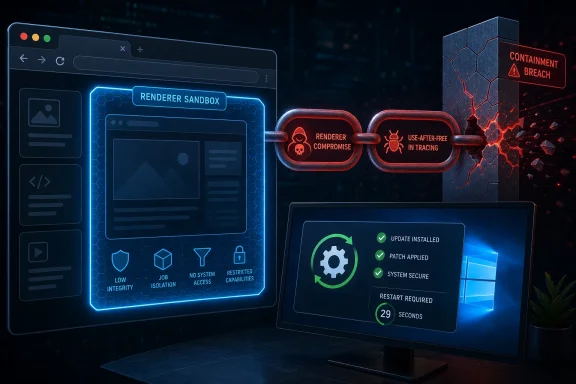 The Medium Label Hides a High-Impact Boundary Failure
CVE-2026-11700 is not a classic “visit a page and instantly lose the machine” vulnerability, at least not as described. The attacker first needs a compromised renderer process, meaning the bug is most dangerous as part of an exploit chain rather than as a standalone weapon. That distinction matters, because modern browser exploitation is usually less about one magic bug and more about combining several weaknesses into a path from webpage to host.The key phrase is sandbox escape. Chrome’s renderer sandbox exists because the browser assumes hostile web content will eventually find a way to execute code inside a renderer. The security model is not “the renderer will never be compromised”; it is “a compromised renderer should still be trapped.” CVE-2026-11700 concerns the second half of that bargain.
That is why the scoring looks odd at first glance. Chromium labels the issue Medium, while CISA’s ADP enrichment assigns a CVSS 3.1 score of 8.3, or High, with high confidentiality, integrity, and availability impact. Both can be true depending on the frame: Chrome’s internal severity reflects exploit prerequisites and component context, while CVSS tries to model the consequences if the chain succeeds.
The practical lesson is simple. Security teams should not sort Chrome vulnerabilities by the vendor adjective alone. A Medium-rated sandbox escape can be more operationally important than a louder bug that is hard to reach or limited in effect.
Browser Exploits Are Chains, Not Firecrackers
The modern browser is a fortress built around the assumption that the front gate will be attacked constantly. JavaScript engines, graphics stacks, codecs, file handlers, extension surfaces, and obscure browser subsystems all sit close to untrusted content. Chrome’s security architecture divides that risk into processes and permissions, making it harder for a single memory corruption flaw to become a full system compromise.CVE-2026-11700 fits the second stage of that model. The public description says an attacker would need to have compromised the renderer process first. That could happen through a separate vulnerability in V8, WebAssembly, a media parser, GPU handling, or some other renderer-accessible surface. Once inside that constrained process, the attacker would then look for a way to break containment.
This is why defenders should resist the comforting interpretation that “requires renderer compromise” means “not my problem.” In real exploitation, renderer compromise is often the opening move. Sandbox escapes are valuable because they turn that opening move into a more serious breach.
There is also a subtle enterprise angle here. A sandbox escape may not always produce instant administrator privileges, but it can widen access to local resources, browser data, interprocess communication channels, or operating-system interfaces that the renderer should not touch. In managed environments, that can be enough to steal tokens, tamper with browser state, or stage the next step.
Chrome’s defenses are deep, but depth cuts both ways. Attackers need chains; defenders need to break any link in those chains before the browser becomes the first beachhead in a broader incident.
Tracing Is Not a Feature Users Think About, Which Is Exactly Why It Matters
The affected component, Tracing, is not a consumer-facing feature like tabs, passwords, or extensions. It is part of the instrumentation machinery that helps Chrome and Chromium developers understand performance, scheduling, events, and internal behavior. The browser is full of these subsystems: diagnostic, telemetry, debugging, profiling, and observability code that most users never touch directly.Those components still matter because they often sit near complex object lifetimes. A use-after-free bug is a memory safety error where software continues to use an object after it has been released. In the wrong conditions, that stale reference can become a lever for corruption, confusion, or control over program behavior.
Tracing systems can be especially intricate because they collect events across threads, processes, and lifetimes. They may need to record something that happens in one part of the browser while another part is being torn down, suspended, or isolated. That does not make Tracing uniquely unsafe, but it illustrates why “boring” browser plumbing can become security-relevant.
For ordinary users, the component name is less important than the class of bug. Use-after-free remains one of the enduring weaknesses in large C++ codebases, and Chromium is still a vast native-code project despite years of sandboxing, fuzzing, and hardening. The industry has made exploitation harder; it has not made memory safety bugs disappear.
Microsoft Edge users should also pay attention even though the CVE names Chrome. Edge is Chromium-based, and Microsoft typically ships its own browser updates after Chromium security fixes land. The same goes for other Chromium-derived browsers, which may lag Google Chrome depending on vendor cadence and platform packaging.
The Patch Number Is the Only Number Most Admins Need
The affected boundary is clear enough: Google Chrome prior to 149.0.7827.103 is vulnerable according to the CVE description. The Chrome stable-channel update associated with the advisory moved desktop users to the 149.0.7827.102/.103 range depending on platform, with macOS specifically appearing as 149.0.7827.103 in several advisories. NVD’s affected configuration states versions up to, but excluding, 149.0.7827.103.That version nuance is annoying but familiar. Chrome’s release numbering can differ slightly across Windows, macOS, and Linux while referring to the same stable-channel security train. Enterprises should not try to outguess the channel mechanics; they should verify that managed devices have received the vendor’s patched build for their operating system.
For unmanaged users, the answer is the old Chrome ritual: open the browser’s About page and let it check for updates. The browser often downloads updates silently, but the fix usually does not fully apply until Chrome restarts. That restart gap is where many supposedly patched systems remain exposed longer than expected.
For administrators, the more interesting problem is inventory. Chrome is everywhere: installed per-machine, installed per-user, bundled into golden images, present in VDI pools, used on shared workstations, and duplicated across test environments. A CVE like this is a reminder that browser patching is not merely endpoint hygiene; it is a core security-control loop.
Organizations that rely on vulnerability scanners may also see temporary ambiguity because NVD enrichment lagged the CVE publication and initially did not provide NIST CVSS metrics. CISA’s ADP data filled in a high score, but asset tools may not all ingest the same feed at the same speed. The safest operational stance is to track the vendor-fixed version, not wait for every downstream database to agree.
NVD’s CPE Entry Is Boring, but the Question Behind It Is Not
The NVD record includes a CPE configuration for Google Chrome across Windows, Linux, and macOS. That is expected: the vulnerable product is Chrome, and the operating-system CPEs describe the platforms on which the affected application runs. The “Are we missing a CPE?” prompt on NVD pages is boilerplate, but it raises a real question for Chromium bugs: what about the wider ecosystem?The CVE entry names Google Chrome, not every Chromium-based browser. That does not automatically mean Edge, Brave, Vivaldi, Opera, Electron apps, or embedded Chromium runtimes are unaffected. It means the CVE as assigned and enriched is scoped to Chrome unless and until other vendors publish their own advisories, version mappings, or CPEs.
This is one of the weak spots in vulnerability management for browser engines. Chromium is both a product foundation and an upstream project. A security bug may be fixed upstream, shipped quickly by Google, then arrive later through downstream browsers and frameworks. The CVE record may remain centered on Chrome while the practical patching universe is broader.
Administrators should therefore treat the CPE list as a starting point, not a full dependency graph. If a fleet includes Microsoft Edge, Chromium-based kiosk browsers, embedded browser controls, or Electron-packaged business applications, each needs its own update channel and vendor confirmation. The absence of a CPE is not proof of absence of risk.
For WindowsForum readers, this is especially relevant because Windows desktops often accumulate browser engines invisibly. Users think they have “Chrome” and “Edge,” but applications may carry their own web runtimes. The browser monoculture has made web compatibility better; it has also concentrated classes of defects across products that do not always look related in asset inventories.
The Zero-Day Next Door Changes the Patch Conversation
CVE-2026-11700 arrived in the same general Chrome 149 security wave as other serious vulnerabilities, including reporting around CVE-2026-11645, a V8 issue that Google acknowledged was being exploited in the wild. That does not mean CVE-2026-11700 itself is known to be exploited. The public CISA ADP enrichment for CVE-2026-11700 lists exploitation as none, and the CVE text does not claim active abuse.Still, the neighborhood matters. A renderer compromise bug and a sandbox escape bug are the kind of pair defenders do not want sitting unpatched together. Even if the publicly exploited issue is separate, the presence of multiple serious browser flaws in the same release train strengthens the case for rapid deployment.
This is where severity taxonomies can mislead non-specialists. A vulnerability can be Medium in one advisory, High in another enrichment, and operationally urgent because of the surrounding patch bundle. The right question is not “Which label wins?” The right question is “What credible attack path remains if we delay?”
Chrome’s security model also means details are often intentionally scarce at first. Google routinely restricts bug details until most users have updated, because public exploit guidance helps attackers as much as defenders. That creates a frustrating information gap, but it is a rational one.
In that gap, defenders should not demand perfect exploit write-ups before acting. Browser updates are low-cost compared with many enterprise patches, and the browser is one of the most exposed applications on almost every endpoint. If there is a place to accept conservative patching logic, this is it.
Windows Administrators Should Treat Browser Restarts as a Security Dependency
The biggest failure mode for Chrome patching is not usually download failure. It is restart failure. Users keep sessions open for days, pin tabs as memory aids, and treat the browser as the shell where work lives. The update may be staged, but the vulnerable code can remain active until the process exits.That makes browser restart policy a security control. Enterprises can configure relaunch notifications, deadlines, and update policies, but many organizations soften those settings to avoid user annoyance. CVE-2026-11700 is the kind of case where comfort and risk collide.
There is a difference between forcing restarts instantly and letting them drift indefinitely. A sensible policy gives users warning, preserves work where possible, and then enforces a deadline. For high-risk users — administrators, finance staff, developers with production access, executives, and anyone handling sensitive sessions — the deadline should be shorter.
Windows shops also need to remember that Chrome updates may exist alongside Edge updates. Microsoft Edge has its own update service, policies, and release cadence. A dashboard that shows Chrome patched but ignores Edge is not giving the security team the full picture.
VDI and shared workstation environments need special scrutiny. Nonpersistent desktops may revert to older images unless the base image is updated. Shared machines may have browsers installed in unexpected profiles. In those environments, “the browser updates itself” is less a policy than a hope.
The Sandbox Still Works, but It Needs Maintenance
It is tempting to read every sandbox escape CVE as evidence that the sandbox has failed. That is too simplistic. Sandboxing remains one of the most important reasons browser exploitation is harder than it was in the pre-Chrome era.The existence of CVE-2026-11700 actually reinforces the value of the design. If attackers need a separate renderer compromise and then a sandbox escape, defenders have multiple places to stop them. The architecture is doing what layered security is supposed to do: forcing the attacker to assemble a chain rather than rely on one flaw.
But layered security is not self-maintaining. The sandbox is code, the broker is code, the IPC boundary is code, and the diagnostic systems around them are code. Every one of those pieces changes as the browser evolves. New features, performance work, platform integrations, and developer tooling all reshape the attack surface.
That is why the browser update treadmill never stops. Users experience it as nuisance; attackers experience it as churn. Each update closes off known paths and forces exploit developers to spend more time and money finding alternatives.
There is a broader industry story here, too. Memory-safe languages, hardened allocators, control-flow protections, site isolation, exploit mitigations, and sandboxing all reduce risk, but they do not remove the need for fast patching. CVE-2026-11700 is not a referendum on any one defense. It is a reminder that defenses are cumulative.
The Real Risk Is Complacency, Not Catastrophe
For home users, the guidance is refreshingly direct: update Chrome and restart it. That advice may sound banal, but it closes the gap that attackers count on. Browser exploits are most valuable against populations that run behind the stable channel while assuming automatic updates have handled everything.For enterprises, the response should be more measured but not slower. Confirm patched Chrome versions across Windows, macOS, and Linux fleets. Check Edge and other Chromium-based browsers. Look at restart compliance, not just update availability. Review whether high-risk user groups are held to stricter browser relaunch deadlines.
Security teams should also resist overfitting to this one CVE. CVE-2026-11700 matters because of the boundary it touches, but it is part of a broader pattern: browser security updates increasingly bundle many vulnerabilities across many subsystems. The individual CVE is the visible object; the operational discipline is the real defense.
The lack of known exploitation for this specific CVE is good news, not permission to wait. Exploit chains often become clearer after patches ship, when researchers and attackers can diff changes and infer the bug. Time after disclosure is not neutral; it changes the economics of attack.
The useful posture is neither alarmism nor indifference. Treat the bug as a meaningful sandbox-escape risk, apply the vendor fix, verify restarts, and broaden the check to Chromium relatives. That is ordinary work, but ordinary work is what keeps browser CVEs from becoming incident reports.
The Patch Is Small; the Inventory Lesson Is Not
The concrete actions are not complicated, which is precisely why organizations should be judged by how quickly they complete them. CVE-2026-11700 is a narrow technical flaw with broad management implications: know your browsers, know their versions, and know whether updates have actually taken effect.- Chrome installations should be updated to the patched 149.0.7827.103-era stable build or the appropriate later build for the platform.
- Browser restarts should be verified, because a staged update is not the same as a running patched process.
- Chromium-based browsers and embedded runtimes should be checked separately instead of assumed safe from Chrome’s advisory alone.
- Vulnerability dashboards should be interpreted carefully when NVD, CISA enrichment, and vendor severity labels do not line up neatly.
- High-risk users should face shorter browser relaunch deadlines because their sessions and privileges make exploit chains more valuable.
References
- Primary source: NVD / Chromium
Published: 2026-06-15T19:15:07-07:00
NVD - CVE-2026-11700
 nvd.nist.gov
- Security advisory: MSRC
Published: 2026-06-15T19:15:07-07:00
Original feed URL
Security Update Guide - Microsoft Security Response Center
 msrc.microsoft.com
- Related coverage: vulnerability.circl.lu
Vulnerability-Lookup
Vulnerability-Lookup - Fast vulnerability lookup correlation from different sources.vulnerability.circl.lu
