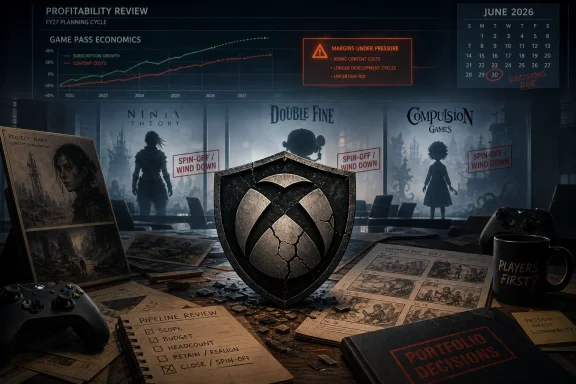
Bloomberg reported on June 15, 2026, that Double Fine, Ninja Theory, Compulsion Games, and several other Xbox-owned studios are in talks with Microsoft to spin off or find buyers as they try to avoid closure during a wider Xbox restructuring. The story is not just another grim dispatch from the games industry’s layoff cycle. It is the clearest sign yet that Microsoft’s decade-long bet on owning a vast creative portfolio has run into the arithmetic of platform decline, subscription pressure, and corporate impatience. For Windows and Xbox users, the question is no longer whether Microsoft can buy enough talent to fix gaming; it is whether it still wants to carry the kind of studios that made Xbox feel culturally distinct.
The most striking part of the report is not that Microsoft may close more studios. It is that the names reportedly at risk are precisely the kind of studios Microsoft once held up as proof that it understood games as more than content units.
Double Fine was supposed to be the charming counterweight to blockbuster consolidation: Tim Schafer’s San Francisco shop, founded after LucasArts and beloved for Psychonauts, Brütal Legend, Broken Age, and its unusually transparent development documentaries. Ninja Theory was the prestige art-house acquisition, a Cambridge studio capable of turning mental health, performance capture, and mythic combat into the Hellblade series. Compulsion Games, based in Montreal, gave Microsoft another eccentric narrative studio, with We Happy Few and the recently released South of Midnight fitting the “different voices under one roof” pitch.
That roof now appears to be leaking. Bloomberg’s reporting, echoed by PC Gamer, GameSpot, GamesRadar, Gematsu, and Windows Central, says these studios are in active negotiations to spin off or otherwise escape closure. The Verge, according to reports summarizing its account, went further on Ninja Theory, saying the studio will close unless it can find a buyer.
This is the language of emergency, not routine portfolio management. A spin-off is sometimes presented as freedom, but in this context it sounds more like a fire exit: a way for Microsoft to cut obligations while allowing a studio’s brand, leadership, or remaining staff to make a case to outside investors. Even if the doors stay open, the reported expectation of job losses means independence would arrive as triage rather than liberation.
Microsoft has not spent the last decade behaving like a company worried about owning too many studios. It acquired Mojang in 2014, brought in Ninja Theory, Playground Games, Obsidian, inXile, Compulsion, and Undead Labs in the late 2010s, added Double Fine in 2019, swallowed ZeniMax/Bethesda in 2021, and closed the industry’s largest acquisition with Activision Blizzard in 2023. The old Xbox thesis was that scale would solve scarcity: more teams, more games, more Game Pass value, more reasons to stay in the ecosystem.
The new thesis appears harsher. Scale, if it does not produce dependable returns, becomes exposure.
That is what makes this moment so dangerous for creative teams. Double Fine does not have to be a failure in the ordinary sense to be at risk. Ninja Theory does not have to make bad games. Compulsion does not have to lack talent. They only have to fail a new test imposed from above: can this studio justify its existence inside Microsoft’s current strategic frame?
The answer may look different in 2026 than it did in 2019. Phil Spencer’s acquisition era was built around a generous-sounding bargain. Developers could keep their culture, Microsoft would provide stability, and Xbox would get a wider range of games for Game Pass and the console ecosystem. Schafer publicly praised that arrangement, saying Microsoft had allowed Double Fine to keep making strange things, including a game about a walking lighthouse.
But executive promises age poorly when the market changes. Game Pass growth is no longer treated as an unstoppable curve. Xbox hardware has struggled against PlayStation, Nintendo, PC, and mobile gravity. Microsoft’s gaming division is now large enough that the parent company can demand not just growth, but clarity. If an internal studio cannot map cleanly onto recurring revenue, franchise expansion, or platform differentiation, the patience that once looked like strategic vision can be reclassified as subsidy.
That is the brutal corporate move at the heart of the reset. Microsoft is not merely cutting costs. It is deciding which kinds of creativity deserve corporate shelter.
The purchase of Double Fine in 2019 captured the hopeful version of that project. Here was a studio that likely benefited from financial stability after years of crowdfunding, publishing deals, and creative risk. For players, it suggested that Microsoft could be a patron, not just a platform holder. The eventual release of Psychonauts 2 became one of the cleaner examples of what that support could accomplish.
Ninja Theory carried a similar symbolic weight. The original Hellblade: Senua’s Sacrifice was admired for its ambition and sensitivity, while Senua’s Saga: Hellblade II became a showcase for Xbox’s cinematic ambitions. Even when players debated whether its narrow design justified its production values, the studio represented an Xbox that wanted prestige alongside scale.
That symbolism now cuts the other way. If these studios can be sold, spun off, or closed, then Microsoft is effectively unwinding the emotional contract that accompanied its acquisitions. The message to developers is not simply that layoffs happen. The message is that even being bought by one of the world’s richest companies may offer only temporary shelter, and that the buyer’s next strategy can erase the logic of the last one.
The timing is especially sharp because reports say Ninja Theory had only recently announced another Hellblade project at an Xbox showcase. Announcing a game and then reportedly putting the studio behind it at risk makes the showcase format look almost surreal: marketing promises on one side, restructuring math on the other. That contradiction is not unique to Microsoft, but Microsoft’s scale makes it harder to excuse as ordinary industry turbulence.
In that model, Double Fine, Ninja Theory, and Compulsion made sense. They could produce games that broadened the service’s texture: smaller than Call of Duty, stranger than Forza, more narratively pointed than the average service-filler. A subscription catalog stuffed only with mega-franchises risks feeling like a rental shelf; a catalog with distinctive first-party work can feel curated.
But subscriptions also introduce a measurement problem. A boxed release either sells or it does not. A Game Pass title can be valuable in fuzzier ways: retention, brand perception, engagement, discovery, press attention, awards, or the simple fact that it gives subscribers something to talk about. Those are real benefits, but they are harder to defend when executives demand direct return on investment.
This is where the Netflix analogy starts to look less flattering than it once did. Subscription platforms often begin by celebrating range and experimentation, then mature into a more ruthless understanding of what drives sign-ups and prevents cancellations. The middle tier of creative work becomes vulnerable: too expensive to be cheap filler, too niche to become a tentpole, too beloved to cut without reputational damage, and yet not obviously central to the machine.
Xbox’s risk is that it trains players to expect a broad library while making the internal economics hostile to the very studios that give that library character. Microsoft can license third-party games, of course. It can lean on Activision Blizzard, Bethesda, Minecraft, Halo, Forza, and whatever future hardware strategy it pursues. But if the subscription service becomes a pipeline for the same safe franchises, it loses part of the argument that made Microsoft’s approach feel different.
That makes studio closures more than a console-fan drama. When Microsoft cuts a first-party studio, it changes what lands on PC Game Pass, what gets optimized for Windows, what supports Xbox achievements and cloud saves, and what kind of games Microsoft uses to define its ecosystem. A Double Fine game is not simply an Xbox game; it is a Windows game, a Game Pass game, and a cultural signal about what Microsoft thinks belongs on its platform.
The practical impact may arrive slowly. Existing games will not vanish overnight merely because a studio changes ownership or shuts down, though long-term support, updates, sequels, and preservation can become complicated. Multiplayer games need servers. Narrative games need patches. Accessibility improvements, compatibility work, and storefront maintenance all depend on someone being responsible after the press release fades.
For sysadmins and IT pros, the lesson is broader but familiar. Microsoft’s consumer strategy often bleeds into its platform strategy. The company sells continuity, integration, and ecosystem gravity, but its internal priorities can change faster than users’ expectations. Whether the subject is Windows features, cloud services, or gaming studios, the promise of “Microsoft-backed” stability is only as durable as the business case underneath it.
There is also a developer-relations angle. Microsoft has spent years courting creators through Xbox, ID@Xbox, Windows tooling, DirectX, cloud services, and cross-platform messaging. If its own acquired studios are now negotiating for survival, independent developers may wonder what kind of partner Microsoft wants to be. A platform holder can recover from bad optics, but trust is cumulative. So is distrust.
Buying a studio is a transaction. Running one is a relationship. It requires knowing when to leave a team alone, when to intervene, when to fund a risky project, when to cancel one, and how to measure value that does not show up cleanly in quarterly revenue. The larger the portfolio, the more tempting it becomes to replace judgment with dashboards.
Microsoft’s gaming empire now contains wildly different organisms. Mojang is not Double Fine. Bethesda Game Studios is not Ninja Theory. King is not Compulsion. Activision’s annualized blockbuster logic is not the same as the slow, idiosyncratic rhythm of a boutique narrative studio. A corporate owner can celebrate that diversity in a showcase trailer, but finance departments tend to prefer comparable units.
That is why the “several other studios” line in the reporting matters. Named studios give fans something to mourn, but unnamed studios reveal the structure of the threat. If the reset is portfolio-wide, every team must infer where it stands in the new hierarchy. That uncertainty can be corrosive even before layoffs begin.
The most optimistic reading is that spin-offs could preserve creative identities that Microsoft no longer wants to house. Tango Gameworks’ resurrection under Krafton after Microsoft closed it in 2024 showed that a studio’s value to players and developers can outlast Microsoft’s willingness to fund it. But that example also underlined the absurdity of the situation: a platform holder closed a critically admired team, then another company saw enough value to pick up the pieces.
Spin-offs are not magic. They require funding, rights negotiations, leadership bandwidth, and a plan for projects in development. They can save a name while shrinking a staff. They can preserve a studio while stripping away the very security that made long-term creative work possible. For employees, “independence” can mean opportunity, but it can also mean losing Microsoft benefits, budgets, infrastructure, and runway.
Still, the corporate math is not entirely imaginary. Gaming is expensive, volatile, and slow. Big-budget games can take five or more years to build. Smaller studios can produce acclaimed work that never becomes a mass-market engine. Hardware margins are under pressure. Marketing costs are brutal. Subscription economics remain opaque. A company can be profitable overall while deciding that a particular division, project, or studio no longer meets its targets.
The problem is not that Microsoft has noticed costs. The problem is that its own previous strategy helped create the cost structure it now appears to be attacking. Microsoft bought studios to solve a content problem, then bought more studios to solve a scale problem, then bought Activision Blizzard to solve a relevance problem. Each deal made the next quarterly reckoning larger.
There is a familiar pattern in modern tech consolidation. A platform buys creative labor to feed an ecosystem. The platform promises autonomy because autonomy is useful during the acquisition phase. Later, once the ecosystem’s growth slows or leadership changes, autonomy becomes inefficiency. The very qualities that justified the acquisition become liabilities.
This is why the Xbox reset feels bigger than a list of studios. It is a referendum on whether Big Tech can be a good long-term home for medium-sized creative teams. Microsoft is hardly alone here, but Xbox’s case is unusually visible because it spent years presenting its acquisitions as a player-friendly alternative to the harsher logic of traditional publishing.
Those tensions predate Sharma. The “This is an Xbox” era stretched the brand across devices in a way that made strategic sense but emotional nonsense to some console loyalists. The Activision Blizzard deal made Microsoft a publishing giant whose incentives did not always align with making Xbox hardware feel essential. Game Pass trained players to value access over ownership, then ran into the difficulty of making access pay for everything.
A reset could therefore be necessary. Xbox has needed sharper priorities for years. But the shape of the reset matters. Cutting distinctive studios while promising a return to Xbox risks defining “Xbox” as a smaller, safer, more franchise-driven machine. That may be cleaner. It may even be more profitable. It is not obviously more interesting.
There is also a messaging problem that no executive memo can fully solve. If Microsoft says Xbox was overextended, players will ask why management extended it. If Microsoft says studios must stand on their own, developers will ask what acquisition was supposed to protect them from. If Microsoft says the future is focused, the industry will ask whether focus simply means fewer people making fewer kinds of games.
Sharma may well be trying to prevent worse damage later. She may believe that a smaller Xbox with healthier economics is better than a sprawling Xbox sustained by wishful thinking. But resets do not happen in spreadsheets alone. They happen to people, to projects, and to communities that took Microsoft’s earlier promises seriously.
What is no longer fluid is the direction of pressure. Xbox is moving from abundance as strategy toward selectivity as survival. For players, developers, and Windows users, that means the next few months should be read less as isolated cuts and more as a map of what Microsoft now believes Xbox is for.
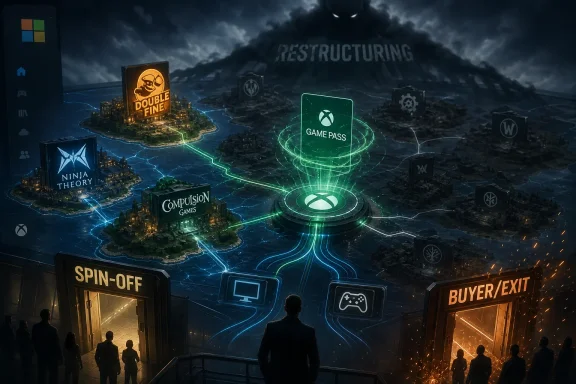 Microsoft’s Studio Empire Has Reached Its Margin Call
The most striking part of the report is not that Microsoft may close more studios. It is that the names reportedly at risk are precisely the kind of studios Microsoft once held up as proof that it understood games as more than content units.Double Fine was supposed to be the charming counterweight to blockbuster consolidation: Tim Schafer’s San Francisco shop, founded after LucasArts and beloved for Psychonauts, Brütal Legend, Broken Age, and its unusually transparent development documentaries. Ninja Theory was the prestige art-house acquisition, a Cambridge studio capable of turning mental health, performance capture, and mythic combat into the Hellblade series. Compulsion Games, based in Montreal, gave Microsoft another eccentric narrative studio, with We Happy Few and the recently released South of Midnight fitting the “different voices under one roof” pitch.
That roof now appears to be leaking. Bloomberg’s reporting, echoed by PC Gamer, GameSpot, GamesRadar, Gematsu, and Windows Central, says these studios are in active negotiations to spin off or otherwise escape closure. The Verge, according to reports summarizing its account, went further on Ninja Theory, saying the studio will close unless it can find a buyer.
This is the language of emergency, not routine portfolio management. A spin-off is sometimes presented as freedom, but in this context it sounds more like a fire exit: a way for Microsoft to cut obligations while allowing a studio’s brand, leadership, or remaining staff to make a case to outside investors. Even if the doors stay open, the reported expectation of job losses means independence would arrive as triage rather than liberation.
Microsoft has not spent the last decade behaving like a company worried about owning too many studios. It acquired Mojang in 2014, brought in Ninja Theory, Playground Games, Obsidian, inXile, Compulsion, and Undead Labs in the late 2010s, added Double Fine in 2019, swallowed ZeniMax/Bethesda in 2021, and closed the industry’s largest acquisition with Activision Blizzard in 2023. The old Xbox thesis was that scale would solve scarcity: more teams, more games, more Game Pass value, more reasons to stay in the ecosystem.
The new thesis appears harsher. Scale, if it does not produce dependable returns, becomes exposure.
The “Xbox Reset” Turns Culture Into Cost
New Xbox CEO Asha Sharma has reportedly framed the current reorganization as a reset, with Microsoft’s gaming business described as overextended. That word matters because it shifts the blame from any single game’s performance to the shape of the entire Xbox operation. If the problem is overextension, then even good studios can become bad balance-sheet lines.That is what makes this moment so dangerous for creative teams. Double Fine does not have to be a failure in the ordinary sense to be at risk. Ninja Theory does not have to make bad games. Compulsion does not have to lack talent. They only have to fail a new test imposed from above: can this studio justify its existence inside Microsoft’s current strategic frame?
The answer may look different in 2026 than it did in 2019. Phil Spencer’s acquisition era was built around a generous-sounding bargain. Developers could keep their culture, Microsoft would provide stability, and Xbox would get a wider range of games for Game Pass and the console ecosystem. Schafer publicly praised that arrangement, saying Microsoft had allowed Double Fine to keep making strange things, including a game about a walking lighthouse.
But executive promises age poorly when the market changes. Game Pass growth is no longer treated as an unstoppable curve. Xbox hardware has struggled against PlayStation, Nintendo, PC, and mobile gravity. Microsoft’s gaming division is now large enough that the parent company can demand not just growth, but clarity. If an internal studio cannot map cleanly onto recurring revenue, franchise expansion, or platform differentiation, the patience that once looked like strategic vision can be reclassified as subsidy.
That is the brutal corporate move at the heart of the reset. Microsoft is not merely cutting costs. It is deciding which kinds of creativity deserve corporate shelter.
The Phil Spencer Era Ends in Reverse
Phil Spencer’s time leading Xbox will likely be remembered for two contradictory legacies. He rescued Xbox from the Xbox One disaster by making the brand more player-friendly, more PC-friendly, and less obsessed with old console-war boundaries. He also presided over a consolidation spree so large that it handed his successors an impossible integration problem.The purchase of Double Fine in 2019 captured the hopeful version of that project. Here was a studio that likely benefited from financial stability after years of crowdfunding, publishing deals, and creative risk. For players, it suggested that Microsoft could be a patron, not just a platform holder. The eventual release of Psychonauts 2 became one of the cleaner examples of what that support could accomplish.
Ninja Theory carried a similar symbolic weight. The original Hellblade: Senua’s Sacrifice was admired for its ambition and sensitivity, while Senua’s Saga: Hellblade II became a showcase for Xbox’s cinematic ambitions. Even when players debated whether its narrow design justified its production values, the studio represented an Xbox that wanted prestige alongside scale.
That symbolism now cuts the other way. If these studios can be sold, spun off, or closed, then Microsoft is effectively unwinding the emotional contract that accompanied its acquisitions. The message to developers is not simply that layoffs happen. The message is that even being bought by one of the world’s richest companies may offer only temporary shelter, and that the buyer’s next strategy can erase the logic of the last one.
The timing is especially sharp because reports say Ninja Theory had only recently announced another Hellblade project at an Xbox showcase. Announcing a game and then reportedly putting the studio behind it at risk makes the showcase format look almost surreal: marketing promises on one side, restructuring math on the other. That contradiction is not unique to Microsoft, but Microsoft’s scale makes it harder to excuse as ordinary industry turbulence.
Game Pass Was Supposed to Need Studios Like These
For years, the strongest argument for Microsoft’s eclectic studio portfolio was Game Pass. Subscription services need cadence, variety, and discovery. Not every release has to be a $70 blockbuster if the goal is to make the monthly subscription feel alive.In that model, Double Fine, Ninja Theory, and Compulsion made sense. They could produce games that broadened the service’s texture: smaller than Call of Duty, stranger than Forza, more narratively pointed than the average service-filler. A subscription catalog stuffed only with mega-franchises risks feeling like a rental shelf; a catalog with distinctive first-party work can feel curated.
But subscriptions also introduce a measurement problem. A boxed release either sells or it does not. A Game Pass title can be valuable in fuzzier ways: retention, brand perception, engagement, discovery, press attention, awards, or the simple fact that it gives subscribers something to talk about. Those are real benefits, but they are harder to defend when executives demand direct return on investment.
This is where the Netflix analogy starts to look less flattering than it once did. Subscription platforms often begin by celebrating range and experimentation, then mature into a more ruthless understanding of what drives sign-ups and prevents cancellations. The middle tier of creative work becomes vulnerable: too expensive to be cheap filler, too niche to become a tentpole, too beloved to cut without reputational damage, and yet not obviously central to the machine.
Xbox’s risk is that it trains players to expect a broad library while making the internal economics hostile to the very studios that give that library character. Microsoft can license third-party games, of course. It can lean on Activision Blizzard, Bethesda, Minecraft, Halo, Forza, and whatever future hardware strategy it pursues. But if the subscription service becomes a pipeline for the same safe franchises, it loses part of the argument that made Microsoft’s approach feel different.
Windows Gamers Are Watching a Platform Strategy Collide With Reality
WindowsForum readers do not need reminding that Xbox is no longer just a console business. Microsoft’s gaming strategy runs through Windows, the Microsoft Store, Game Pass for PC, cloud gaming, cross-save infrastructure, controller support, Xbox app integration, and now increasingly blurred boundaries between console and PC hardware.That makes studio closures more than a console-fan drama. When Microsoft cuts a first-party studio, it changes what lands on PC Game Pass, what gets optimized for Windows, what supports Xbox achievements and cloud saves, and what kind of games Microsoft uses to define its ecosystem. A Double Fine game is not simply an Xbox game; it is a Windows game, a Game Pass game, and a cultural signal about what Microsoft thinks belongs on its platform.
The practical impact may arrive slowly. Existing games will not vanish overnight merely because a studio changes ownership or shuts down, though long-term support, updates, sequels, and preservation can become complicated. Multiplayer games need servers. Narrative games need patches. Accessibility improvements, compatibility work, and storefront maintenance all depend on someone being responsible after the press release fades.
For sysadmins and IT pros, the lesson is broader but familiar. Microsoft’s consumer strategy often bleeds into its platform strategy. The company sells continuity, integration, and ecosystem gravity, but its internal priorities can change faster than users’ expectations. Whether the subject is Windows features, cloud services, or gaming studios, the promise of “Microsoft-backed” stability is only as durable as the business case underneath it.
There is also a developer-relations angle. Microsoft has spent years courting creators through Xbox, ID@Xbox, Windows tooling, DirectX, cloud services, and cross-platform messaging. If its own acquired studios are now negotiating for survival, independent developers may wonder what kind of partner Microsoft wants to be. A platform holder can recover from bad optics, but trust is cumulative. So is distrust.
The Acquisitions Were Easier Than the Stewardship
The games industry spent years debating whether Microsoft should be allowed to buy Activision Blizzard. Regulators, rivals, and commentators focused on market power, exclusivity, and the future of Call of Duty. Those were important questions, but the current turmoil highlights a different problem: acquisition is not stewardship.Buying a studio is a transaction. Running one is a relationship. It requires knowing when to leave a team alone, when to intervene, when to fund a risky project, when to cancel one, and how to measure value that does not show up cleanly in quarterly revenue. The larger the portfolio, the more tempting it becomes to replace judgment with dashboards.
Microsoft’s gaming empire now contains wildly different organisms. Mojang is not Double Fine. Bethesda Game Studios is not Ninja Theory. King is not Compulsion. Activision’s annualized blockbuster logic is not the same as the slow, idiosyncratic rhythm of a boutique narrative studio. A corporate owner can celebrate that diversity in a showcase trailer, but finance departments tend to prefer comparable units.
That is why the “several other studios” line in the reporting matters. Named studios give fans something to mourn, but unnamed studios reveal the structure of the threat. If the reset is portfolio-wide, every team must infer where it stands in the new hierarchy. That uncertainty can be corrosive even before layoffs begin.
The most optimistic reading is that spin-offs could preserve creative identities that Microsoft no longer wants to house. Tango Gameworks’ resurrection under Krafton after Microsoft closed it in 2024 showed that a studio’s value to players and developers can outlast Microsoft’s willingness to fund it. But that example also underlined the absurdity of the situation: a platform holder closed a critically admired team, then another company saw enough value to pick up the pieces.
Spin-offs are not magic. They require funding, rights negotiations, leadership bandwidth, and a plan for projects in development. They can save a name while shrinking a staff. They can preserve a studio while stripping away the very security that made long-term creative work possible. For employees, “independence” can mean opportunity, but it can also mean losing Microsoft benefits, budgets, infrastructure, and runway.
The Corporate Math Is Not the Whole Story
It is tempting to flatten this into the usual outrage cycle: Microsoft is rich, therefore no cuts are justified. The moral intuition is understandable. Microsoft reported enormous profits, has poured billions into AI infrastructure and partnerships, and remains one of the most powerful companies in the world. Seeing beloved game studios fight for survival under that umbrella feels obscene.Still, the corporate math is not entirely imaginary. Gaming is expensive, volatile, and slow. Big-budget games can take five or more years to build. Smaller studios can produce acclaimed work that never becomes a mass-market engine. Hardware margins are under pressure. Marketing costs are brutal. Subscription economics remain opaque. A company can be profitable overall while deciding that a particular division, project, or studio no longer meets its targets.
The problem is not that Microsoft has noticed costs. The problem is that its own previous strategy helped create the cost structure it now appears to be attacking. Microsoft bought studios to solve a content problem, then bought more studios to solve a scale problem, then bought Activision Blizzard to solve a relevance problem. Each deal made the next quarterly reckoning larger.
There is a familiar pattern in modern tech consolidation. A platform buys creative labor to feed an ecosystem. The platform promises autonomy because autonomy is useful during the acquisition phase. Later, once the ecosystem’s growth slows or leadership changes, autonomy becomes inefficiency. The very qualities that justified the acquisition become liabilities.
This is why the Xbox reset feels bigger than a list of studios. It is a referendum on whether Big Tech can be a good long-term home for medium-sized creative teams. Microsoft is hardly alone here, but Xbox’s case is unusually visible because it spent years presenting its acquisitions as a player-friendly alternative to the harsher logic of traditional publishing.
Asha Sharma Inherits a Brand That Wants Contradictory Things
Asha Sharma’s reported reset is likely to be judged harshly by fans, but she also inherited a contradictory assignment. Xbox must be a console brand, a PC service, a cloud platform, a publisher, a subscription business, a hardware ecosystem, and a home for both blockbuster franchises and experimental studios. It must be everywhere and distinct somewhere.Those tensions predate Sharma. The “This is an Xbox” era stretched the brand across devices in a way that made strategic sense but emotional nonsense to some console loyalists. The Activision Blizzard deal made Microsoft a publishing giant whose incentives did not always align with making Xbox hardware feel essential. Game Pass trained players to value access over ownership, then ran into the difficulty of making access pay for everything.
A reset could therefore be necessary. Xbox has needed sharper priorities for years. But the shape of the reset matters. Cutting distinctive studios while promising a return to Xbox risks defining “Xbox” as a smaller, safer, more franchise-driven machine. That may be cleaner. It may even be more profitable. It is not obviously more interesting.
There is also a messaging problem that no executive memo can fully solve. If Microsoft says Xbox was overextended, players will ask why management extended it. If Microsoft says studios must stand on their own, developers will ask what acquisition was supposed to protect them from. If Microsoft says the future is focused, the industry will ask whether focus simply means fewer people making fewer kinds of games.
Sharma may well be trying to prevent worse damage later. She may believe that a smaller Xbox with healthier economics is better than a sprawling Xbox sustained by wishful thinking. But resets do not happen in spreadsheets alone. They happen to people, to projects, and to communities that took Microsoft’s earlier promises seriously.
The Xbox Reset Has Already Told Players What to Watch
The immediate facts remain fluid, and the reported negotiations could produce several outcomes. Some studios may spin off. Some may find buyers. Some may shrink. Some may close. Microsoft may confirm, deny, or reframe pieces of the reporting as it moves past the end of its fiscal year on June 30.What is no longer fluid is the direction of pressure. Xbox is moving from abundance as strategy toward selectivity as survival. For players, developers, and Windows users, that means the next few months should be read less as isolated cuts and more as a map of what Microsoft now believes Xbox is for.
- Double Fine, Ninja Theory, Compulsion Games, and other unnamed Xbox studios are reportedly negotiating with Microsoft because closure is on the table.
- Spin-offs may preserve studio identities, but they are unlikely to prevent all job losses or guarantee continuity for every project.
- The reported risk to Ninja Theory is especially jarring because the studio had recently been part of Xbox’s public showcase messaging.
- Microsoft’s earlier acquisition strategy promised creative stability, but the current reset suggests that autonomy is vulnerable when portfolio economics change.
- PC Game Pass and Windows gamers are directly affected because Xbox’s first-party decisions shape the catalog, support expectations, and cultural value of Microsoft’s gaming ecosystem.
- The next confirmed actions after Microsoft’s June 30 fiscal-year close will reveal whether this is a targeted restructuring or a deeper retreat from the middle tier of first-party development.
References
- Primary source: PC Gamer
Published: Mon, 15 Jun 2026 21:43:14 GMT
Double Fine, Ninja Theory, and other Xbox studios could close | PC Gamer
Microsoft's "Xbox reset" is starting to sound more like a bulldozing.www.pcgamer.com - Related coverage: tomshardware.com
Xbox will pay five times more for memory and storage in 2027 than it did two years ago — CEO Asha Sharma admits there's an unsustainable hardware gap that 'cannot continue' | Tom's Hardware
The next-gen Xbox could end up costing well over $1,000.www.tomshardware.com - Related coverage: windowscentral.com
Xbox admits it’s “over‑extended” as leadership signals a major rethink of its studio strategy | Windows Central
Xbox leadership admits the company became overextended and says major changes are needed to strengthen its biggest franchises.www.windowscentral.com - Related coverage: gamesradar.com
Microsoft considered cutting Xbox off entirely and making it easier to sell, report says | GamesRadar+
Amid Xbox overhaul discussions, all options seem to be on the tablewww.gamesradar.com - Related coverage: gematsu.com
Bloomberg: Several Xbox studios in negotiations to avoid closure - Gematsu
Several studios within Xbox are in active negotiations to spin off from the company in order to avoid closure, including Compulsion Games…www.gematsu.com - Related coverage: gamespot.com
Double Fine, Ninja Theory, And More Reportedly Trying To Spin Off From Xbox Game Studios
Can some of Xbox Game Studios' beloved niche developers escape the impending layoffs and closures reportedly planned by Microsoft?www.gamespot.com
- Related coverage: tomsguide.com
New Xbox CEO Asha Sharma explains her plans for the future of Microsoft gaming in latest interview | Tom's Guide
Who is Asha Sharma, and what is she saying about Xbox as she takes over the reins from Phil Spencer?www.tomsguide.com - Related coverage: dotesports.com
XBOX studios reportedly in spin-off talks to avoid Microsoft closures
Several XBOX studios are reportedly in talks to spin off from Microsoft as the company weighs closures and more job cuts.dotesports.com - Related coverage: bloomberg.com
- Related coverage: fortune.com
‘Not an Allbirds Moment’: Xbox’s CEO says she is grounding the console in gaming roots, not AI | Fortune
Since stepping into the Xbox CEO role, Asha Sharma has preached a "return of Xbox."fortune.com
- Related coverage: pcworld.com
New Xbox boss promises no 'bad AI' and a 'return to Xbox' | PCWorld
The incoming CEO of Microsoft's gaming business says she has "no tolerance for bad AI." There's way too much wiggle room in that statement.www.pcworld.com - Related coverage: omni.se
Xbox planerar stora nedskärningar i sommar
Microsofts speldivision Xbox planerar stora nedskärningar i juli när den nya vd:n Asha Sharma gör om spelverksamheten för att vända flera års svag utveckling, rapporterar Bloomberg.omni.se