

Microsoft and Oracle reportedly ended talks in June 2026 over a proposed cloud infrastructure leasing arrangement after security and compliance concerns proved too difficult to resolve, even as their existing Oracle Database@Azure partnership continues to expand across Microsoft’s global cloud footprint. That distinction matters. This is not a breakup between two vendors that have spent years trying to make Azure and Oracle Cloud Infrastructure feel less like rival planets. It is a reminder that the cloud’s new multicloud pragmatism still has a hard edge: when infrastructure, liability, regulators, and customer trust collide, even the biggest companies in technology can discover that “strategic partnership” is easier to sell than to operationalize.
The reported collapse of Microsoft and Oracle’s infrastructure leasing talks lands at an awkward moment because the companies have been loudly arguing the opposite story in public. Oracle Database@Azure has become one of the industry’s more visible examples of multicloud cooperation, putting Oracle database services inside Azure data centers and wrapping them with Azure-native identity, networking, monitoring, and procurement hooks.
That arrangement is real, useful, and expanding. It lets enterprises keep Oracle databases close to Azure applications without pretending that decades of Oracle estate planning can be wished away by a migration slide deck. For customers with serious latency, licensing, and governance constraints, that is not marketing fluff; it is the kind of plumbing that determines whether a cloud migration happens at all.
But a broader leasing deal would have been a different animal. Leasing infrastructure capacity is not the same as co-locating a managed database service with a carefully documented operating model. It raises more primitive questions: who owns the rack, who patches the host, who can access the control plane, who answers the auditor, and who takes the blame when a regulated workload discovers daylight between two compliance regimes.
That appears to be where the talks ran aground. The reported sticking points — security and compliance — are not incidental details that lawyers clean up after engineers finish the architecture. In cloud infrastructure, they are the architecture.
Oracle Database@Azure is built around a specific customer problem. Large enterprises want Oracle’s database stack, especially Exadata-backed performance and Oracle-native operational practices, while also wanting Azure’s application services, identity layer, analytics, and AI tooling. Instead of forcing customers to stitch together separate clouds over private links and contractual workarounds, Microsoft and Oracle created a more integrated landing zone.
That product has been scaling quickly. Microsoft has described plans to bring the service to 33 live regions, and Oracle’s own materials show continuing regional and feature expansion through 2026, including support for newer database services, GoldenGate, and AI-flavored database capabilities. The cadence looks less like an experiment and more like a platform bet.
A leasing arrangement would have served a different strategic purpose. Microsoft would reportedly gain access to additional infrastructure capacity, while Oracle could monetize resources and deepen its relevance inside the enterprise cloud conversation. That sounds elegant until one remembers that hyperscale infrastructure is not fungible in the way office space or aircraft capacity might be.
Cloud capacity carries a chain of custody. Servers, firmware, networks, storage systems, identity boundaries, logging systems, staff access rules, incident response obligations, data residency commitments, and audit evidence all attach themselves to the customer promise. The minute one cloud provider leases from another, customers and regulators will want to know exactly where that promise begins and ends.
A cloud infrastructure leasing arrangement would likely have needed to satisfy frameworks and expectations such as FedRAMP, SOC 2, HIPAA, financial-sector oversight, and customer-specific contractual controls. Passing those checks is not simply a matter of saying that both companies are already compliant in their own clouds. The proposed combined operating model would itself become the thing that auditors examine.
That distinction is crucial. A provider can have a clean certification boundary for its own cloud and still struggle to prove that a hybridized, leased, cross-operated arrangement meets the same standard. Auditors do not bless vibes. They ask who has privileged access, how changes are approved, where logs are retained, how incidents are escalated, whether subcontractors are disclosed, and how customers are notified when something goes wrong.
For regulated customers, ambiguity is expensive. If a workload runs on Microsoft-sold capacity backed by Oracle-controlled infrastructure, the customer needs a clear answer on whether Microsoft, Oracle, or both are accountable for each layer. If the answer requires a 40-page matrix and a conference call with three legal teams, the commercial appeal of the deal starts to fade.
In that environment, leasing infrastructure from another major cloud provider sounds like a rational pressure valve. If Oracle had available capacity in the right places, Microsoft could theoretically use it to satisfy demand faster than building everything itself. Speed matters when enterprise customers are signing AI, database, analytics, and application modernization commitments that depend on infrastructure being available when promised.
But Microsoft’s cloud business is built on more than raw capacity. Azure is a trust machine. Customers buy into its compliance portfolio, identity integration, management plane, support structure, marketplace, and procurement model. If leased infrastructure introduced too much uncertainty into that machine, the extra capacity could become less valuable than it first appeared.
There is also a reputational asymmetry. If an Azure customer’s workload fails a compliance review because of a backend leasing arrangement, the customer will not casually shrug and say Oracle made things complicated. The customer bought Azure. Microsoft would wear the operational and trust consequences even if Oracle’s infrastructure was technically involved.
That is the kind of risk a hyperscaler can tolerate only when the boundaries are exceptionally clear. Oracle Database@Azure has a defined product surface and shared responsibility model. A broader lease may have been too wide, too novel, or too difficult to explain to the customers whose approval would matter most.
That strategy acknowledges an uncomfortable truth for every cloud vendor outside the top Azure-AWS-Google tier. Enterprise cloud estates are already messy. Customers rarely want theological purity. They want latency to go down, licensing fights to calm down, procurement to become easier, and critical workloads to stop living in architectural exile.
Oracle Database@Azure fits that strategy beautifully because it lets Oracle protect its database franchise while borrowing Azure’s distribution. Microsoft benefits because it keeps Oracle-heavy enterprises closer to Azure services instead of losing them to OCI-only deployments. Customers benefit because they get a sanctioned path that is less ugly than hand-built interconnects and bespoke operating procedures.
The failed leasing talks do not undo that. If anything, they show why Oracle’s more productized multicloud offerings are valuable: they provide a bounded integration model that can be sold, documented, audited, and supported. The more general the infrastructure-sharing ambition becomes, the more the entire arrangement starts to resemble a cloud sovereignty puzzle with two vendors’ logos on the cover.
That pressure makes infrastructure leasing more attractive. If demand is surging faster than campuses can be built, a provider has incentives to consider unconventional supply arrangements. Leasing from a partner can look like a clever bridge between today’s shortage and tomorrow’s buildout.
Yet AI also raises the stakes for security and compliance. The workloads now landing in cloud environments include proprietary training data, regulated customer records, sensitive model outputs, and internal knowledge bases. Enterprises are asking not only where their data is stored, but whether it might be exposed through telemetry, support channels, model operations, or administrative tooling.
In that climate, a leasing arrangement between two cloud providers has to clear a higher bar than it might have five years ago. It is not enough to say the hardware is secure. Customers want to know whether AI-era data flows are observable, governable, and defensible under audit. The more strategic the workloads, the less patience buyers have for architectural haze.
Oracle Database@Azure gives Microsoft and Oracle a relatively clear answer. Oracle manages the Oracle database infrastructure and related operations, while the service is surfaced in an Azure environment with Azure networking, monitoring, identity federation, and procurement integration. That does not make it simple, but it makes it explainable.
A generalized leasing deal would likely blur that explanation. Would Microsoft operate Oracle-owned infrastructure according to Azure standards? Would Oracle staff retain operational access? Would customers be told when their workloads ran on leased capacity? Would certifications apply identically across regions? Would regulators accept the same evidence package?
These are not academic concerns for sysadmins. They determine escalation paths during outages, evidence collection during audits, and blast-radius analysis after security incidents. They also determine how much confidence an enterprise can place in automated deployment policies, compliance dashboards, and internal risk registers.
Cloud buyers have learned to be suspicious of abstractions that erase accountability. A clean portal experience can hide a complicated backend, but it cannot eliminate the need for an accountable operator. The reported failure of this deal suggests Microsoft and Oracle may have decided that the responsibility boundary could not be made clean enough.
Microsoft and Oracle’s partnership reflects that reality. It does not promise a frictionless cloud utopia. It targets a specific pain point: Oracle databases are deeply embedded, Azure is widely adopted, and customers need these worlds to interoperate without turning every migration into a custom engineering project.
That is why the leasing talks matter even if they failed quietly. They show the difference between multicloud as a product and multicloud as a supply-chain arrangement. The former can be packaged around a workload. The latter reaches into the provider’s own operational core.
The industry may see more of both. Hyperscalers will keep partnering where customer demand is strong enough and the commercial upside is obvious. But the deeper those partnerships reach into infrastructure ownership and control, the more likely they are to hit the invisible wall of compliance, risk, and accountability.
Many Microsoft-centric organizations now run portfolios that combine Azure, Microsoft 365, Oracle databases, SaaS platforms, private networks, and AI services. The purchasing experience increasingly makes these combinations look unified. The operational reality often remains split across vendors, contracts, support models, and control planes.
That split is where administrators and architects earn their keep. Before adopting any cross-cloud managed service, teams should understand the shared responsibility model, identity flow, logging posture, support escalation path, backup and recovery mechanics, and regional availability commitments. Those details are not paperwork; they are the difference between a service that survives production and one that becomes an audit headache.
The reported Microsoft-Oracle leasing failure is therefore less a shock than a warning label. If two of the most sophisticated enterprise vendors in the world could not reportedly make a broader infrastructure leasing model satisfy security and compliance concerns, customers should be careful about assuming their own multicloud designs are automatically governable because the vendors have issued a joint press release.
That is a more modest claim, and modest claims are often the ones that survive contact with enterprise IT. Customers do not need every layer of Oracle and Microsoft infrastructure to become interchangeable. They need specific workloads to work predictably, securely, and supportably.
The danger for both vendors is overextension. If they sell the partnership as proof that cloud boundaries no longer matter, then every failed attempt to deepen the relationship looks like a contradiction. If they sell it as a targeted integration for mission-critical databases, the story is easier to defend.
The best cloud partnerships are not marriages. They are treaties. They define borders, permissions, obligations, and dispute mechanisms. Oracle Database@Azure appears to have a treaty that works; the reported leasing deal may have asked both sides to govern territory neither was willing to share on those terms.
Here is what enterprise buyers should take from the reported breakdown:
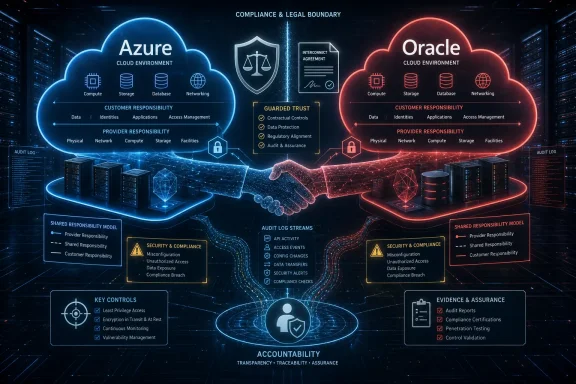 The Failed Lease Deal Exposes the Limits of Cloud Diplomacy
The reported collapse of Microsoft and Oracle’s infrastructure leasing talks lands at an awkward moment because the companies have been loudly arguing the opposite story in public. Oracle Database@Azure has become one of the industry’s more visible examples of multicloud cooperation, putting Oracle database services inside Azure data centers and wrapping them with Azure-native identity, networking, monitoring, and procurement hooks.That arrangement is real, useful, and expanding. It lets enterprises keep Oracle databases close to Azure applications without pretending that decades of Oracle estate planning can be wished away by a migration slide deck. For customers with serious latency, licensing, and governance constraints, that is not marketing fluff; it is the kind of plumbing that determines whether a cloud migration happens at all.
But a broader leasing deal would have been a different animal. Leasing infrastructure capacity is not the same as co-locating a managed database service with a carefully documented operating model. It raises more primitive questions: who owns the rack, who patches the host, who can access the control plane, who answers the auditor, and who takes the blame when a regulated workload discovers daylight between two compliance regimes.
That appears to be where the talks ran aground. The reported sticking points — security and compliance — are not incidental details that lawyers clean up after engineers finish the architecture. In cloud infrastructure, they are the architecture.
Oracle Database@Azure Is Not the Deal That Failed
The first trap in this story is to treat the failed leasing talks as evidence that Microsoft and Oracle’s broader cloud relationship is deteriorating. The better reading is narrower and more interesting: the companies found a model that works for Oracle databases in Azure, but apparently could not extend that model into a more general infrastructure-sharing arrangement.Oracle Database@Azure is built around a specific customer problem. Large enterprises want Oracle’s database stack, especially Exadata-backed performance and Oracle-native operational practices, while also wanting Azure’s application services, identity layer, analytics, and AI tooling. Instead of forcing customers to stitch together separate clouds over private links and contractual workarounds, Microsoft and Oracle created a more integrated landing zone.
That product has been scaling quickly. Microsoft has described plans to bring the service to 33 live regions, and Oracle’s own materials show continuing regional and feature expansion through 2026, including support for newer database services, GoldenGate, and AI-flavored database capabilities. The cadence looks less like an experiment and more like a platform bet.
A leasing arrangement would have served a different strategic purpose. Microsoft would reportedly gain access to additional infrastructure capacity, while Oracle could monetize resources and deepen its relevance inside the enterprise cloud conversation. That sounds elegant until one remembers that hyperscale infrastructure is not fungible in the way office space or aircraft capacity might be.
Cloud capacity carries a chain of custody. Servers, firmware, networks, storage systems, identity boundaries, logging systems, staff access rules, incident response obligations, data residency commitments, and audit evidence all attach themselves to the customer promise. The minute one cloud provider leases from another, customers and regulators will want to know exactly where that promise begins and ends.
Compliance Is the Boring Word That Stops Billion-Dollar Deals
“Security and compliance concerns” can sound like a vague corporate excuse, but in this context it is a plausible deal-killer. Microsoft and Oracle both serve customers that treat cloud location, administrative access, encryption boundaries, and auditability as contractual and sometimes legal requirements. That includes governments, banks, insurers, healthcare systems, defense contractors, and multinational companies operating under overlapping regional rules.A cloud infrastructure leasing arrangement would likely have needed to satisfy frameworks and expectations such as FedRAMP, SOC 2, HIPAA, financial-sector oversight, and customer-specific contractual controls. Passing those checks is not simply a matter of saying that both companies are already compliant in their own clouds. The proposed combined operating model would itself become the thing that auditors examine.
That distinction is crucial. A provider can have a clean certification boundary for its own cloud and still struggle to prove that a hybridized, leased, cross-operated arrangement meets the same standard. Auditors do not bless vibes. They ask who has privileged access, how changes are approved, where logs are retained, how incidents are escalated, whether subcontractors are disclosed, and how customers are notified when something goes wrong.
For regulated customers, ambiguity is expensive. If a workload runs on Microsoft-sold capacity backed by Oracle-controlled infrastructure, the customer needs a clear answer on whether Microsoft, Oracle, or both are accountable for each layer. If the answer requires a 40-page matrix and a conference call with three legal teams, the commercial appeal of the deal starts to fade.
Microsoft Needs Capacity, But Not at Any Price
The reported logic for Microsoft is easy to understand. Azure demand remains intense, especially as AI workloads place new pressure on data center capacity, networking, power availability, and GPU-adjacent infrastructure planning. Every hyperscaler is trying to secure enough capacity while avoiding stranded assets, energy bottlenecks, and regional imbalances.In that environment, leasing infrastructure from another major cloud provider sounds like a rational pressure valve. If Oracle had available capacity in the right places, Microsoft could theoretically use it to satisfy demand faster than building everything itself. Speed matters when enterprise customers are signing AI, database, analytics, and application modernization commitments that depend on infrastructure being available when promised.
But Microsoft’s cloud business is built on more than raw capacity. Azure is a trust machine. Customers buy into its compliance portfolio, identity integration, management plane, support structure, marketplace, and procurement model. If leased infrastructure introduced too much uncertainty into that machine, the extra capacity could become less valuable than it first appeared.
There is also a reputational asymmetry. If an Azure customer’s workload fails a compliance review because of a backend leasing arrangement, the customer will not casually shrug and say Oracle made things complicated. The customer bought Azure. Microsoft would wear the operational and trust consequences even if Oracle’s infrastructure was technically involved.
That is the kind of risk a hyperscaler can tolerate only when the boundaries are exceptionally clear. Oracle Database@Azure has a defined product surface and shared responsibility model. A broader lease may have been too wide, too novel, or too difficult to explain to the customers whose approval would matter most.
Oracle’s Cloud Strategy Still Runs Through Everyone Else’s Data Centers
Oracle has spent years repositioning itself from database incumbent to cloud infrastructure contender, and its multicloud strategy has become one of the more pragmatic plays in enterprise IT. Rather than insisting that every Oracle database customer move wholesale into OCI, Oracle has pushed services into the places customers already are: Azure, Google Cloud, and other partner environments.That strategy acknowledges an uncomfortable truth for every cloud vendor outside the top Azure-AWS-Google tier. Enterprise cloud estates are already messy. Customers rarely want theological purity. They want latency to go down, licensing fights to calm down, procurement to become easier, and critical workloads to stop living in architectural exile.
Oracle Database@Azure fits that strategy beautifully because it lets Oracle protect its database franchise while borrowing Azure’s distribution. Microsoft benefits because it keeps Oracle-heavy enterprises closer to Azure services instead of losing them to OCI-only deployments. Customers benefit because they get a sanctioned path that is less ugly than hand-built interconnects and bespoke operating procedures.
The failed leasing talks do not undo that. If anything, they show why Oracle’s more productized multicloud offerings are valuable: they provide a bounded integration model that can be sold, documented, audited, and supported. The more general the infrastructure-sharing ambition becomes, the more the entire arrangement starts to resemble a cloud sovereignty puzzle with two vendors’ logos on the cover.
The AI Boom Makes Every Data Center Conversation More Fragile
This story also sits inside the broader panic over AI infrastructure. Cloud providers are racing to secure data center space, power, cooling, accelerators, networking gear, and operational talent. The AI boom has made capacity planning feel less like a quarterly finance exercise and more like a geopolitical resource scramble.That pressure makes infrastructure leasing more attractive. If demand is surging faster than campuses can be built, a provider has incentives to consider unconventional supply arrangements. Leasing from a partner can look like a clever bridge between today’s shortage and tomorrow’s buildout.
Yet AI also raises the stakes for security and compliance. The workloads now landing in cloud environments include proprietary training data, regulated customer records, sensitive model outputs, and internal knowledge bases. Enterprises are asking not only where their data is stored, but whether it might be exposed through telemetry, support channels, model operations, or administrative tooling.
In that climate, a leasing arrangement between two cloud providers has to clear a higher bar than it might have five years ago. It is not enough to say the hardware is secure. Customers want to know whether AI-era data flows are observable, governable, and defensible under audit. The more strategic the workloads, the less patience buyers have for architectural haze.
The Real Product Is the Responsibility Boundary
The most underrated part of any cloud service is the responsibility boundary. Vendors prefer to talk about performance, scale, migration incentives, and AI integration. Administrators eventually ask the harder question: when this breaks, who owns the fix?Oracle Database@Azure gives Microsoft and Oracle a relatively clear answer. Oracle manages the Oracle database infrastructure and related operations, while the service is surfaced in an Azure environment with Azure networking, monitoring, identity federation, and procurement integration. That does not make it simple, but it makes it explainable.
A generalized leasing deal would likely blur that explanation. Would Microsoft operate Oracle-owned infrastructure according to Azure standards? Would Oracle staff retain operational access? Would customers be told when their workloads ran on leased capacity? Would certifications apply identically across regions? Would regulators accept the same evidence package?
These are not academic concerns for sysadmins. They determine escalation paths during outages, evidence collection during audits, and blast-radius analysis after security incidents. They also determine how much confidence an enterprise can place in automated deployment policies, compliance dashboards, and internal risk registers.
Cloud buyers have learned to be suspicious of abstractions that erase accountability. A clean portal experience can hide a complicated backend, but it cannot eliminate the need for an accountable operator. The reported failure of this deal suggests Microsoft and Oracle may have decided that the responsibility boundary could not be made clean enough.
Multicloud Is Winning, But Not in the Way Vendors Promised
For years, multicloud was sold as freedom: spread workloads across providers, avoid lock-in, pick the best service for each job, and let competition discipline the market. The actual enterprise version has been more constrained. Most organizations are multicloud because history, mergers, procurement, specialized workloads, and political compromise made them that way.Microsoft and Oracle’s partnership reflects that reality. It does not promise a frictionless cloud utopia. It targets a specific pain point: Oracle databases are deeply embedded, Azure is widely adopted, and customers need these worlds to interoperate without turning every migration into a custom engineering project.
That is why the leasing talks matter even if they failed quietly. They show the difference between multicloud as a product and multicloud as a supply-chain arrangement. The former can be packaged around a workload. The latter reaches into the provider’s own operational core.
The industry may see more of both. Hyperscalers will keep partnering where customer demand is strong enough and the commercial upside is obvious. But the deeper those partnerships reach into infrastructure ownership and control, the more likely they are to hit the invisible wall of compliance, risk, and accountability.
Windows Shops Should Read This as a Governance Story
For WindowsForum readers, the immediate practical impact is limited. Oracle Database@Azure continues to operate and expand, and enterprises already planning around it do not need to assume the service is in jeopardy because a separate leasing negotiation reportedly collapsed. The more useful lesson is about governance.Many Microsoft-centric organizations now run portfolios that combine Azure, Microsoft 365, Oracle databases, SaaS platforms, private networks, and AI services. The purchasing experience increasingly makes these combinations look unified. The operational reality often remains split across vendors, contracts, support models, and control planes.
That split is where administrators and architects earn their keep. Before adopting any cross-cloud managed service, teams should understand the shared responsibility model, identity flow, logging posture, support escalation path, backup and recovery mechanics, and regional availability commitments. Those details are not paperwork; they are the difference between a service that survives production and one that becomes an audit headache.
The reported Microsoft-Oracle leasing failure is therefore less a shock than a warning label. If two of the most sophisticated enterprise vendors in the world could not reportedly make a broader infrastructure leasing model satisfy security and compliance concerns, customers should be careful about assuming their own multicloud designs are automatically governable because the vendors have issued a joint press release.
The Partnership Survives Because It Solves a Narrow Problem Well
There is an irony here. The failed leasing talks may strengthen the case for Oracle Database@Azure precisely because that service is narrower. Its value proposition is not that Microsoft and Oracle have merged their clouds into one seamless organism. Its value proposition is that a notoriously important enterprise workload can run closer to Azure applications under a more integrated commercial and operational model.That is a more modest claim, and modest claims are often the ones that survive contact with enterprise IT. Customers do not need every layer of Oracle and Microsoft infrastructure to become interchangeable. They need specific workloads to work predictably, securely, and supportably.
The danger for both vendors is overextension. If they sell the partnership as proof that cloud boundaries no longer matter, then every failed attempt to deepen the relationship looks like a contradiction. If they sell it as a targeted integration for mission-critical databases, the story is easier to defend.
The best cloud partnerships are not marriages. They are treaties. They define borders, permissions, obligations, and dispute mechanisms. Oracle Database@Azure appears to have a treaty that works; the reported leasing deal may have asked both sides to govern territory neither was willing to share on those terms.
The Lesson Hidden in the Collapsed Rack Space
The immediate temptation is to reduce the story to corporate drama: Microsoft needed capacity, Oracle had infrastructure, and the lawyers or security teams spoiled the party. That reading is too small. The more important lesson is that cloud infrastructure is becoming both more collaborative and more sensitive.Here is what enterprise buyers should take from the reported breakdown:
- The reported collapse of the leasing talks does not appear to change the availability or roadmap of Oracle Database@Azure.
- Security and compliance concerns are credible blockers because leased cloud infrastructure would create new questions about access, audit evidence, responsibility, and customer disclosure.
- Oracle Database@Azure remains strategically important because it solves a specific Oracle-on-Azure workload problem rather than pretending all cloud infrastructure can be made interchangeable.
- Microsoft’s appetite for extra capacity is understandable in an AI-constrained infrastructure market, but Azure’s compliance reputation depends on keeping operational boundaries explainable.
- Customers should treat cross-cloud services as governance projects as much as migration or performance projects.
- The most durable multicloud arrangements will be the ones that make accountability obvious before something breaks.
References
- Primary source: Crypto Briefing
Published: 2026-06-16T22:30:08.303424

Microsoft and Oracle cloud infrastructure leasing talks reportedly fall through
Microsoft and Oracle cloud infrastructure leasing negotiations reportedly collapsed over security and compliance concerns, even as their Database@Azurecryptobriefing.com - Official source: azure.microsoft.com
- Official source: learn.microsoft.com

Compliance information for Oracle AI Database@Azure | Microsoft Learn
Learn about compliance and service management in Oracle AI Database@Azure.learn.microsoft.com - Related coverage: docs.oracle.com
What's New for Oracle AI Database@Azure
Learn about new features and resources available to Oracle AI Database@Azure users.docs.oracle.com - Related coverage: blogs.oracle.com
- Related coverage: dataintensity.com

What is Oracle Database@Azure? - Data Intensity
The recent announcement about Oracle Database@Azure has raised a lot of questions, so our resident Oracle ACE, Biju Thomas, weighs in with answers.www.dataintensity.com
- Official source: techcommunity.microsoft.com

Announcing Oracle Database@Azure in Japan East, Central US and UK West | Microsoft Community Hub
Microsoft and Oracle are pleased to announce the expansion of Oracle Database@Azure availability to Japan East, Central US and UK West... techcommunity.microsoft.com
- Related coverage: oracle.com

Public Cloud Regions and Data Centers | Oracle
Oracle offers the most comprehensive public cloud, with regions and data centers worldwide. Learn more about our regions and data centers today.www.oracle.com - Related coverage: elpais.com
- Related coverage: apexadb.oracle.com
- Related coverage: ltm.com
ISG Provider Lens® Quadrant Report - Oracle Cloud and Technology Ecosystem 2025
Business people join puzzle pieces in office. Concept of teamwork and partnership. double exposure with light effectswww.ltm.com
