

Tesla’s AI5 chip completed tape-out in spring 2026, moving the company’s next-generation self-driving and robotics silicon from finished design toward fabrication at outside foundries including TSMC and Samsung, according to Elon Musk and subsequent industry reporting. That milestone does not make Tesla an AI giant by itself. It does, however, clarify the bet underneath nearly every extravagant promise the company has made about robotaxis, humanoid robots, and autonomous machines. Tesla is no longer merely trying to write better software for cars; it is trying to control the compute stack that decides what those machines can become.
The phrase tape-out carries a strange glamour in semiconductor circles because it marks the point where ambition becomes expensive. A chip design has been completed, verified enough to send to manufacturing, and committed to masks and silicon. It is not the same thing as mass production, and it is certainly not the same thing as thousands of vehicles or robots using the part in the field.
That distinction matters because Tesla news has a way of collapsing future tense into present tense. A taped-out AI5 chip is not a deployed fleet computer. It is a serious engineering checkpoint on the way to samples, validation, automotive qualification, production ramp, and finally integration into products that must survive heat, vibration, cost pressure, and regulators.
Still, tape-out is not trivial. For Tesla, it says the company has moved beyond marketing slides and boardroom aspiration for its next inference platform. If the design works as advertised, AI5 becomes the hardware bridge between Tesla’s existing driver-assistance business and the more radical vision of machines that perceive, decide, and act locally in the physical world.
That is why Musk’s description of the effort as one of the company’s most critical projects should be read less as hype than as a map of Tesla’s bottleneck. The company can collect video, train neural networks, and sell a narrative about autonomy. But without efficient onboard compute, those models cannot run where Tesla needs them most: inside a car moving through traffic or a robot standing in someone’s kitchen.
In that model, cars are not just products. They are sensors, data gatherers, model-test platforms, and eventually revenue-generating autonomous agents. Optimus robots, if they ever scale beyond staged demonstrations and narrow deployments, would extend the same loop into factories, warehouses, homes, and other physical spaces.
AI5 sits at the center of that loop because inference is where AI meets reality. Training can happen in data centers, but the decisive moment for a robotaxi is not in a server rack; it is at an intersection when a cyclist swerves, a pedestrian hesitates, and the system must choose. The decisive moment for a humanoid robot is not in a demo video; it is when the machine encounters an unfamiliar object, a cluttered room, or a human standing in the wrong place.
This is what investors mean, sometimes too casually, when they say Tesla is becoming an AI company. The better version of the claim is narrower and more interesting: Tesla is trying to become a physical AI company, where the product is not a chatbot or a dashboard assistant but a machine that must act safely in messy, unpredictable environments.
The chip matters because physical AI punishes latency, power waste, and reliance on remote connectivity. A vehicle cannot outsource every judgment to the cloud. A robot cannot pause every few seconds to ask a data center what a chair is. If Tesla wants autonomy at fleet scale, local inference is not a feature; it is the foundation.
Even if the headline number proves selective, Tesla does not need AI5 to be magic for it to matter. It needs the chip to run larger neural networks more efficiently, reduce power draw per useful decision, and leave enough thermal and cost headroom for mass-produced vehicles and robots. In automotive hardware, the best chip is not simply the fastest; it is the one that can be built, cooled, paid for, and trusted.
There is also a timing issue. Tesla’s current AI4 hardware is already deployed in vehicles, and customers who bought into Full Self-Driving promises have long memories. A step-change in hardware may strengthen Tesla’s future products while simultaneously sharpening questions about the limits of the existing fleet.
That is the uncomfortable side of rapid silicon progress. Every new generation enables better models, but it can also make prior hardware look less future-proof than buyers expected. For a phone, that is annoying. For a car sold with expensive autonomy-related software, it becomes a trust problem.
Tesla has been here before. The company’s autonomy story has repeatedly mixed real technical progress with missed timelines and shifting definitions. AI5 may be the most important chip Tesla has designed, but it will also become another test of whether the company can align its promises with what customers actually receive.
A robotaxi business is brutally sensitive to unit economics. Every watt matters because energy use affects range and operating cost. Every dollar of compute matters because the vehicle must be cheap enough to deploy at scale. Every failure matters because one highly visible incident can reshape public and regulatory tolerance.
This is where Tesla’s vertical integration argument becomes strongest. If the company can design the car, the sensor suite, the inference computer, the neural network, the fleet software, and the charging ecosystem together, it can optimize trade-offs that competitors must negotiate across suppliers. That does not guarantee success, but it explains why Tesla keeps pulling more of the stack inside.
The trouble is that robotaxis are not won on hardware alone. Waymo’s slower, more constrained approach has shown that autonomy can be commercially deployed, but usually with expensive sensors, mapped service areas, and cautious operational design. Tesla is attempting a broader, camera-heavy, fleet-learning strategy that promises lower cost and wider deployment, but also carries more uncertainty.
AI5 may help close the gap between ambition and deployment. It will not erase the hard parts of autonomy: edge cases, validation, liability, municipal politics, weather, construction zones, emergency vehicles, and human unpredictability. The chip is necessary for Tesla’s preferred path, but it is not sufficient.
That makes the onboard compute challenge even more demanding. A robot needs perception, motion control, language or instruction understanding, scene interpretation, and real-time response. It also needs to do all of that within a power envelope that does not make the machine too hot, too heavy, too expensive, or too short-lived between charges.
This is why AI5 should be understood as a shared platform bet. Tesla is not designing a chip merely for cars. It is designing a silicon brain for a family of machines that, in Musk’s telling, could eventually outnumber humans and transform the company’s value. That is a staggering claim, but the engineering direction is coherent: one inference architecture, many physical products, continuous model improvement.
The risk is that humanoid robotics has historically been where timelines go to die. Demos can look spectacular while the gap to useful, reliable, affordable deployment remains enormous. A factory robot that performs a narrow task all day is one thing. A general-purpose humanoid robot that can justify mass production is another.
AI5 gives Tesla a better chance to attempt that leap. It does not prove the leap is possible.
That anxiety is not unique to Tesla. The AI boom has turned advanced semiconductors into strategic infrastructure. Nvidia’s data-center GPUs dominate headlines, but inference at the edge is becoming just as important for companies trying to put AI into devices, vehicles, industrial equipment, and robots.
Tesla’s current reliance on TSMC and Samsung is logical. They are among the few companies capable of manufacturing the advanced chips Tesla wants. But dependence on external foundries means Tesla must compete for capacity with smartphone giants, cloud providers, AI accelerators, automotive suppliers, and national industrial policy.
Terafab, as described by Musk and reported by others, is the natural endpoint of Tesla’s vertical integration philosophy. If batteries were too important to leave entirely to suppliers, and software was too important to outsource, then perhaps advanced AI compute is too important as well. The question is whether chip fabrication is a mountain even Tesla should hesitate to climb.
Modern fabs are among the most complex industrial systems humans build. They require extreme capital, rare expertise, precision supply chains, chemicals, lithography equipment, process know-how, yield management, packaging, and relentless iteration. Designing a chip is hard. Manufacturing it competitively at scale is a different order of difficulty.
AI5 belongs to the first category if it gives Tesla a durable cost and performance advantage. It belongs to the second if it becomes another technology that is perpetually “almost ready” while the business continues to depend on conventional car sales. The tape-out narrows the uncertainty, but it does not eliminate it.
The competitive landscape is also shifting. Traditional automakers are not standing still, though they move with different incentives and cultures. Ford and General Motors have both signaled continued interest in more advanced driver-assistance and autonomous capabilities, even after the industry’s broader robotaxi exuberance cooled.
But Tesla’s rivals face a strategic dilemma. If they rely on suppliers for compute, software, sensors, and autonomy stacks, they may move more safely but less distinctively. If they try to internalize too much, they risk duplicating Tesla’s capital intensity without Tesla’s software culture or investor patience.
Tesla’s advantage is that it has already convinced the market to value it partly on future optionality. That gives it room to fund long-horizon bets that would terrify a conventional automaker. The danger is that valuation can become a narcotic, making every ambitious roadmap look inevitable until execution says otherwise.
Microsoft’s Copilot+ PC push, NPUs in laptops, GPU acceleration in developer workstations, and on-device AI features all reflect the same directional truth. The next era of computing is not just about faster CPUs. It is about where inference happens, how much power it consumes, what data stays local, and which software stacks can exploit the hardware.
Tesla’s version is more extreme because the endpoint has wheels, motors, brakes, cameras, and safety-critical obligations. But the underlying architecture debate is familiar to IT pros. Do you trust the cloud, the edge, or a hybrid? Do you buy commodity hardware or specialized accelerators? Do you accept vendor lock-in for performance and integration?
AI5 is a reminder that the most important computing platforms of the next decade may not look like computers. A robotaxi is a mobile edge server with liability insurance. A humanoid robot is an embodied endpoint. A smart factory full of autonomous machines is an IT environment where patch management and safety engineering collide.
For sysadmins and enterprise architects, the lesson is not that Tesla’s chip will show up in a data center rack. It is that every serious AI company is now thinking like a platform company, and every platform company wants tighter control over silicon, software, telemetry, and deployment.
If AI5 enables richer models and faster inference, Tesla will be tempted to present it as a step toward unsupervised autonomy. That may be technically reasonable in the long run, but regulators will want evidence, not adjectives. The public will want systems that behave predictably in dull, ugly, ordinary situations, not merely spectacular demos.
Automotive validation is also slower than social media. A model can improve weekly, but proving safety at scale is a statistical and operational challenge. Tesla’s fleet gives it data advantages, yet regulators may still ask whether the company’s deployment approach is conservative enough for public roads.
This is where Tesla’s dual identity becomes awkward. As an AI company, it wants to iterate quickly. As an automaker, it sells machines that can injure people when software fails. AI5 intensifies that tension because it may give Tesla the capability to move faster precisely where society may demand more proof.
Tesla wants to be valued as the latter while still generating much of its revenue from the former. That creates a constant tug-of-war in how the company is discussed. Weak EV demand, price cuts, warranty costs, and competition from Chinese manufacturers pull Tesla back toward the auto multiple. Robotaxis, Optimus, AI chips, and energy products push the story toward something bigger.
AI5 is valuable to the bull case because it is concrete. Unlike an aspirational market-size estimate for humanoid robots, a taped-out chip is an engineering artifact. It suggests Tesla is investing in the infrastructure needed to make its AI claims less dependent on third-party silicon roadmaps.
But investors should be wary of treating tape-out as de-risking the entire thesis. The chain from chip design to robotaxi profits is long. It includes fabrication yield, software performance, vehicle integration, regulatory clearance, manufacturing scale, consumer trust, insurance, service operations, and competitive response.
The clean stock-market story says Tesla is transforming from carmaker to AI giant. The messier engineering story says Tesla has completed one important step in a brutally difficult multi-step transition. The second story is less exciting, but it is more useful.
That is a healthier situation than pure speculation. If AI5 is as efficient and powerful as Musk suggests, we should see it in model capability, inference latency, energy use, and product roadmaps. If it is delayed, constrained, or reserved for limited deployments, that will say something too.
The chip may also create segmentation pressure inside Tesla’s product line. Future vehicles equipped with AI5 could have capabilities that AI4 vehicles cannot match. Cybercab may receive priority. Optimus may compete for the same supply. Customers trying to decide whether to buy now or wait will face the same question PC buyers face during every architecture transition: how much future software will require future hardware?
That is not a minor issue. Tesla has often sold the idea that cars improve over time through software. AI5 complicates that message by reminding everyone that software can only stretch hardware so far. In the AI era, the ceiling is increasingly set by accelerators, memory, and power efficiency.
The signal is that Tesla believes inference hardware is strategic enough to design in-house. It believes physical AI is important enough to build around custom silicon. It believes cars, robots, and perhaps other machines can share a common compute roadmap. And it believes supply constraints are serious enough to justify exploring deeper control over manufacturing capacity.
That is a coherent strategy. It is also a high-risk strategy. It asks Tesla to compete not only with automakers but with chip designers, robotics firms, AI labs, cloud companies, and foundry ecosystems.
The best case is extraordinary. Tesla becomes the company that combines data, hardware, manufacturing, software, and deployment into a machine intelligence platform for the physical world. In that scenario, AI5 is remembered as one of the turning points.
The base case is more modest. AI5 improves Tesla’s future vehicles and robotics prototypes, strengthens the autonomy roadmap, and helps maintain investor confidence while the company works through the harder problems. That would still matter.
The bear case is equally clear. AI5 arrives late, costs too much, benefits only future products, and becomes another example of Tesla needing new hardware to deliver promises attached to old hardware. In that scenario, tape-out was real progress, but not the transformation investors were sold.
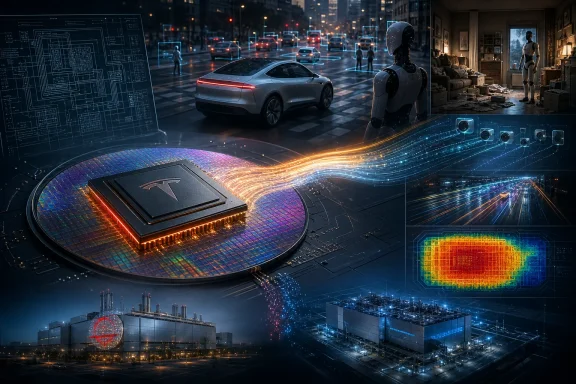 Tape-Out Is a Milestone, Not a Miracle
The phrase tape-out carries a strange glamour in semiconductor circles because it marks the point where ambition becomes expensive. A chip design has been completed, verified enough to send to manufacturing, and committed to masks and silicon. It is not the same thing as mass production, and it is certainly not the same thing as thousands of vehicles or robots using the part in the field.That distinction matters because Tesla news has a way of collapsing future tense into present tense. A taped-out AI5 chip is not a deployed fleet computer. It is a serious engineering checkpoint on the way to samples, validation, automotive qualification, production ramp, and finally integration into products that must survive heat, vibration, cost pressure, and regulators.
Still, tape-out is not trivial. For Tesla, it says the company has moved beyond marketing slides and boardroom aspiration for its next inference platform. If the design works as advertised, AI5 becomes the hardware bridge between Tesla’s existing driver-assistance business and the more radical vision of machines that perceive, decide, and act locally in the physical world.
That is why Musk’s description of the effort as one of the company’s most critical projects should be read less as hype than as a map of Tesla’s bottleneck. The company can collect video, train neural networks, and sell a narrative about autonomy. But without efficient onboard compute, those models cannot run where Tesla needs them most: inside a car moving through traffic or a robot standing in someone’s kitchen.
Tesla’s Real Product Is Becoming the Feedback Loop
The old version of Tesla’s competitive advantage was easy to describe: attractive electric cars, over-the-air updates, charging infrastructure, battery management, and a brand that turned software into part of the driving experience. The new version is harder to evaluate because it depends on whether Tesla can turn its installed base into a self-reinforcing AI machine.In that model, cars are not just products. They are sensors, data gatherers, model-test platforms, and eventually revenue-generating autonomous agents. Optimus robots, if they ever scale beyond staged demonstrations and narrow deployments, would extend the same loop into factories, warehouses, homes, and other physical spaces.
AI5 sits at the center of that loop because inference is where AI meets reality. Training can happen in data centers, but the decisive moment for a robotaxi is not in a server rack; it is at an intersection when a cyclist swerves, a pedestrian hesitates, and the system must choose. The decisive moment for a humanoid robot is not in a demo video; it is when the machine encounters an unfamiliar object, a cluttered room, or a human standing in the wrong place.
This is what investors mean, sometimes too casually, when they say Tesla is becoming an AI company. The better version of the claim is narrower and more interesting: Tesla is trying to become a physical AI company, where the product is not a chatbot or a dashboard assistant but a machine that must act safely in messy, unpredictable environments.
The chip matters because physical AI punishes latency, power waste, and reliance on remote connectivity. A vehicle cannot outsource every judgment to the cloud. A robot cannot pause every few seconds to ask a data center what a chair is. If Tesla wants autonomy at fleet scale, local inference is not a feature; it is the foundation.
The 40x Claim Is the Part to Watch Closely
Musk has claimed AI5 offers a dramatic performance leap over AI4, including references to a 40-times improvement in some contexts. That number is attention-grabbing, but it deserves careful handling. Semiconductor performance comparisons are often shaped by workload, precision, memory bandwidth, software stack, and whether the comparison is peak theoretical throughput or useful real-world inference.Even if the headline number proves selective, Tesla does not need AI5 to be magic for it to matter. It needs the chip to run larger neural networks more efficiently, reduce power draw per useful decision, and leave enough thermal and cost headroom for mass-produced vehicles and robots. In automotive hardware, the best chip is not simply the fastest; it is the one that can be built, cooled, paid for, and trusted.
There is also a timing issue. Tesla’s current AI4 hardware is already deployed in vehicles, and customers who bought into Full Self-Driving promises have long memories. A step-change in hardware may strengthen Tesla’s future products while simultaneously sharpening questions about the limits of the existing fleet.
That is the uncomfortable side of rapid silicon progress. Every new generation enables better models, but it can also make prior hardware look less future-proof than buyers expected. For a phone, that is annoying. For a car sold with expensive autonomy-related software, it becomes a trust problem.
Tesla has been here before. The company’s autonomy story has repeatedly mixed real technical progress with missed timelines and shifting definitions. AI5 may be the most important chip Tesla has designed, but it will also become another test of whether the company can align its promises with what customers actually receive.
The Robotaxi Dream Runs Through Silicon
Tesla’s Cybercab and broader robotaxi ambitions depend on more than a good neural network. They require a hardware platform that can support high-confidence perception, planning, redundancy, energy efficiency, and fleet economics. AI5 is important because it is the first Tesla inference chip that appears explicitly aimed at this next phase rather than merely improving supervised driver assistance.A robotaxi business is brutally sensitive to unit economics. Every watt matters because energy use affects range and operating cost. Every dollar of compute matters because the vehicle must be cheap enough to deploy at scale. Every failure matters because one highly visible incident can reshape public and regulatory tolerance.
This is where Tesla’s vertical integration argument becomes strongest. If the company can design the car, the sensor suite, the inference computer, the neural network, the fleet software, and the charging ecosystem together, it can optimize trade-offs that competitors must negotiate across suppliers. That does not guarantee success, but it explains why Tesla keeps pulling more of the stack inside.
The trouble is that robotaxis are not won on hardware alone. Waymo’s slower, more constrained approach has shown that autonomy can be commercially deployed, but usually with expensive sensors, mapped service areas, and cautious operational design. Tesla is attempting a broader, camera-heavy, fleet-learning strategy that promises lower cost and wider deployment, but also carries more uncertainty.
AI5 may help close the gap between ambition and deployment. It will not erase the hard parts of autonomy: edge cases, validation, liability, municipal politics, weather, construction zones, emergency vehicles, and human unpredictability. The chip is necessary for Tesla’s preferred path, but it is not sufficient.
Optimus Makes the Chip Bet Even Bigger
The most speculative part of Tesla’s AI story is not robotaxis. It is Optimus. Humanoid robots require autonomy in an environment far less structured than roads, and unlike cars, they must manipulate objects, balance, interpret human intent, and operate safely near people at arm’s length.That makes the onboard compute challenge even more demanding. A robot needs perception, motion control, language or instruction understanding, scene interpretation, and real-time response. It also needs to do all of that within a power envelope that does not make the machine too hot, too heavy, too expensive, or too short-lived between charges.
This is why AI5 should be understood as a shared platform bet. Tesla is not designing a chip merely for cars. It is designing a silicon brain for a family of machines that, in Musk’s telling, could eventually outnumber humans and transform the company’s value. That is a staggering claim, but the engineering direction is coherent: one inference architecture, many physical products, continuous model improvement.
The risk is that humanoid robotics has historically been where timelines go to die. Demos can look spectacular while the gap to useful, reliable, affordable deployment remains enormous. A factory robot that performs a narrow task all day is one thing. A general-purpose humanoid robot that can justify mass production is another.
AI5 gives Tesla a better chance to attempt that leap. It does not prove the leap is possible.
Terafab Reveals the Scale of Musk’s Compute Anxiety
The reported Terafab effort, involving Tesla and Musk’s broader empire of companies, is the most revealing part of the story because it says something profound about how Musk sees the next bottleneck. He is not merely worried about designing chips. He is worried about securing enough compute manufacturing capacity for cars, robots, AI models, and potentially space-based systems.That anxiety is not unique to Tesla. The AI boom has turned advanced semiconductors into strategic infrastructure. Nvidia’s data-center GPUs dominate headlines, but inference at the edge is becoming just as important for companies trying to put AI into devices, vehicles, industrial equipment, and robots.
Tesla’s current reliance on TSMC and Samsung is logical. They are among the few companies capable of manufacturing the advanced chips Tesla wants. But dependence on external foundries means Tesla must compete for capacity with smartphone giants, cloud providers, AI accelerators, automotive suppliers, and national industrial policy.
Terafab, as described by Musk and reported by others, is the natural endpoint of Tesla’s vertical integration philosophy. If batteries were too important to leave entirely to suppliers, and software was too important to outsource, then perhaps advanced AI compute is too important as well. The question is whether chip fabrication is a mountain even Tesla should hesitate to climb.
Modern fabs are among the most complex industrial systems humans build. They require extreme capital, rare expertise, precision supply chains, chemicals, lithography equipment, process know-how, yield management, packaging, and relentless iteration. Designing a chip is hard. Manufacturing it competitively at scale is a different order of difficulty.
Vertical Integration Is Powerful Until It Becomes Overreach
Tesla’s history gives both sides of the argument ammunition. The company has repeatedly benefited from doing hard things in-house: power electronics, software integration, battery packs, charging networks, manufacturing automation, and vehicle architecture. It has also repeatedly stumbled when ambition outran execution, whether in timelines, production complexity, or customer-facing promises.AI5 belongs to the first category if it gives Tesla a durable cost and performance advantage. It belongs to the second if it becomes another technology that is perpetually “almost ready” while the business continues to depend on conventional car sales. The tape-out narrows the uncertainty, but it does not eliminate it.
The competitive landscape is also shifting. Traditional automakers are not standing still, though they move with different incentives and cultures. Ford and General Motors have both signaled continued interest in more advanced driver-assistance and autonomous capabilities, even after the industry’s broader robotaxi exuberance cooled.
But Tesla’s rivals face a strategic dilemma. If they rely on suppliers for compute, software, sensors, and autonomy stacks, they may move more safely but less distinctively. If they try to internalize too much, they risk duplicating Tesla’s capital intensity without Tesla’s software culture or investor patience.
Tesla’s advantage is that it has already convinced the market to value it partly on future optionality. That gives it room to fund long-horizon bets that would terrify a conventional automaker. The danger is that valuation can become a narcotic, making every ambitious roadmap look inevitable until execution says otherwise.
Windows Readers Should Care Because Edge AI Is Becoming the New PC War
At first glance, a Tesla vehicle chip might seem far outside the usual WindowsForum lane. But the AI5 story is part of the same broader transition reshaping PCs, workstations, servers, and endpoint management: AI is moving from centralized cloud systems into local machines that need specialized inference hardware.Microsoft’s Copilot+ PC push, NPUs in laptops, GPU acceleration in developer workstations, and on-device AI features all reflect the same directional truth. The next era of computing is not just about faster CPUs. It is about where inference happens, how much power it consumes, what data stays local, and which software stacks can exploit the hardware.
Tesla’s version is more extreme because the endpoint has wheels, motors, brakes, cameras, and safety-critical obligations. But the underlying architecture debate is familiar to IT pros. Do you trust the cloud, the edge, or a hybrid? Do you buy commodity hardware or specialized accelerators? Do you accept vendor lock-in for performance and integration?
AI5 is a reminder that the most important computing platforms of the next decade may not look like computers. A robotaxi is a mobile edge server with liability insurance. A humanoid robot is an embodied endpoint. A smart factory full of autonomous machines is an IT environment where patch management and safety engineering collide.
For sysadmins and enterprise architects, the lesson is not that Tesla’s chip will show up in a data center rack. It is that every serious AI company is now thinking like a platform company, and every platform company wants tighter control over silicon, software, telemetry, and deployment.
The Regulatory Shadow Has Not Gone Away
The chip story also lands in a world where autonomy is under scrutiny. Driver-assistance systems, crash investigations, marketing language, and software updates have become recurring points of tension between Tesla, regulators, safety advocates, and customers. Better hardware can improve safety margins, but it can also encourage more aggressive claims.If AI5 enables richer models and faster inference, Tesla will be tempted to present it as a step toward unsupervised autonomy. That may be technically reasonable in the long run, but regulators will want evidence, not adjectives. The public will want systems that behave predictably in dull, ugly, ordinary situations, not merely spectacular demos.
Automotive validation is also slower than social media. A model can improve weekly, but proving safety at scale is a statistical and operational challenge. Tesla’s fleet gives it data advantages, yet regulators may still ask whether the company’s deployment approach is conservative enough for public roads.
This is where Tesla’s dual identity becomes awkward. As an AI company, it wants to iterate quickly. As an automaker, it sells machines that can injure people when software fails. AI5 intensifies that tension because it may give Tesla the capability to move faster precisely where society may demand more proof.
The Stock-Market Story Is Cleaner Than the Engineering Story
The Motley Fool framing captures why investors care: AI5 offers a narrative in which Tesla escapes the valuation limits of the auto industry. Automakers trade on margins, production volumes, cyclicality, labor costs, and competition. AI platform companies trade on scale, software leverage, data moats, and optionality.Tesla wants to be valued as the latter while still generating much of its revenue from the former. That creates a constant tug-of-war in how the company is discussed. Weak EV demand, price cuts, warranty costs, and competition from Chinese manufacturers pull Tesla back toward the auto multiple. Robotaxis, Optimus, AI chips, and energy products push the story toward something bigger.
AI5 is valuable to the bull case because it is concrete. Unlike an aspirational market-size estimate for humanoid robots, a taped-out chip is an engineering artifact. It suggests Tesla is investing in the infrastructure needed to make its AI claims less dependent on third-party silicon roadmaps.
But investors should be wary of treating tape-out as de-risking the entire thesis. The chain from chip design to robotaxi profits is long. It includes fabrication yield, software performance, vehicle integration, regulatory clearance, manufacturing scale, consumer trust, insurance, service operations, and competitive response.
The clean stock-market story says Tesla is transforming from carmaker to AI giant. The messier engineering story says Tesla has completed one important step in a brutally difficult multi-step transition. The second story is less exciting, but it is more useful.
AI5 Makes Tesla’s Timeline More Believable and More Exposed
The most important thing AI5 changes is not that Tesla suddenly has autonomy solved. It is that Tesla’s future claims will become easier to test. Once hardware samples exist, once vehicles or robots begin using the platform, and once software releases target the new compute budget, observers can compare promise with performance.That is a healthier situation than pure speculation. If AI5 is as efficient and powerful as Musk suggests, we should see it in model capability, inference latency, energy use, and product roadmaps. If it is delayed, constrained, or reserved for limited deployments, that will say something too.
The chip may also create segmentation pressure inside Tesla’s product line. Future vehicles equipped with AI5 could have capabilities that AI4 vehicles cannot match. Cybercab may receive priority. Optimus may compete for the same supply. Customers trying to decide whether to buy now or wait will face the same question PC buyers face during every architecture transition: how much future software will require future hardware?
That is not a minor issue. Tesla has often sold the idea that cars improve over time through software. AI5 complicates that message by reminding everyone that software can only stretch hardware so far. In the AI era, the ceiling is increasingly set by accelerators, memory, and power efficiency.
The AI5 Moment Separates the Signal From the Musk Noise
There is always a temptation to reduce Tesla stories to a referendum on Elon Musk. That is understandable, because Musk’s public claims, timelines, feuds, and cross-company entanglements shape the company’s perception. But the AI5 tape-out deserves to be examined as an industrial signal rather than just another personality-driven headline.The signal is that Tesla believes inference hardware is strategic enough to design in-house. It believes physical AI is important enough to build around custom silicon. It believes cars, robots, and perhaps other machines can share a common compute roadmap. And it believes supply constraints are serious enough to justify exploring deeper control over manufacturing capacity.
That is a coherent strategy. It is also a high-risk strategy. It asks Tesla to compete not only with automakers but with chip designers, robotics firms, AI labs, cloud companies, and foundry ecosystems.
The best case is extraordinary. Tesla becomes the company that combines data, hardware, manufacturing, software, and deployment into a machine intelligence platform for the physical world. In that scenario, AI5 is remembered as one of the turning points.
The base case is more modest. AI5 improves Tesla’s future vehicles and robotics prototypes, strengthens the autonomy roadmap, and helps maintain investor confidence while the company works through the harder problems. That would still matter.
The bear case is equally clear. AI5 arrives late, costs too much, benefits only future products, and becomes another example of Tesla needing new hardware to deliver promises attached to old hardware. In that scenario, tape-out was real progress, but not the transformation investors were sold.
The Silicon Has Finally Caught Up With the Story Enough to Be Judged
Tesla’s AI5 tape-out gives the company a more credible foundation for its autonomy and robotics ambitions, but it also creates sharper tests for the next two years. The milestone should neither be dismissed as routine nor inflated into proof that Tesla has already crossed from automaker to AI titan.- Tesla has completed a major design milestone for AI5, but tape-out is still several steps away from broad deployment in customer vehicles or robots.
- AI5 matters most because it targets onboard inference, the local decision-making capability required for robotaxis and humanoid robots.
- The claimed performance leap over AI4 could be significant, but real-world gains will depend on workloads, software, power efficiency, cost, and integration.
- Tesla’s reliance on TSMC and Samsung shows the company still depends on the global semiconductor ecosystem even as it talks about deeper vertical integration.
- The chip strengthens Tesla’s AI narrative, but autonomy, robotics, regulation, validation, and manufacturing remain the harder tests.
- Existing Tesla owners may eventually face a widening gap between what AI4 vehicles can support and what future AI5-equipped platforms can do.
References
- Primary source: The Motley Fool
Published: Tue, 16 Jun 2026 23:08:00 GMT
Tesla's AI5 Chip Recently Completed Tape-Out. Here's Why This Could Be the Most Important Development in the Company's Transition From Automaker to AI Giant. | The Motley Fool
The electric vehicle manufacturer's newest semiconductor chip could help it bring its AI ambitions to fruition.www.fool.com - Related coverage: fullstackevolved.com
Tesla Tapes Out AI5 Chip — Nearly Two Years Late, Volume Production Not Until Mid-2027 | FullStackEvolved
Elon Musk confirmed that Tesla completed the AI5 chip tape-out on April 15. The chip delivers roughly 5x the compute of Tesla's current dual AI4 configuration, but production vehicles won't carry it until at least mid-2027.www.fullstackevolved.com - Related coverage: techbytes.app
Tesla AI5 Chip: 2,500 TOPS "H100 Killer" Tape-Out | Tech Bytes
Tesla's AI5 chip taped out at a claimed 2,500 TOPS, an 'H100 killer' for FSD and Dojo. Inside the benchmarks, architecture, and what it means for AI compute.techbytes.app - Related coverage: harianbasis.co
Tesla Tapes Out AI5 Self Driving Chip Following Two Year Delay
Tesla CEO Elon Musk confirmed the AI5 chip has reached the tape-out milestone, though volume production for the self-driving hardware remains a year away.www.harianbasis.co - Related coverage: tech-insider.org
Tesla AI5 Tape-Out: 5x AI4 Power, Optimus Pivot [2026]
Tesla AI5 chip just taped out with 5x the AI4 compute. Inside the Optimus pivot, TSMC vs Samsung fab split, and what it means for FSD in 2026.tech-insider.org - Related coverage: technode.com
Tesla completes AI5 chip tape-out, to be manufactured by TSMC and Samsung · TechNode
Tesla CEO Elon Musk said the company has completed the tape-out of its next-generation AI chip, AI5. He also thanked TSMC and Samsung, which will betechnode.com
- Related coverage: nextbigfuture.com
Tesla AI5 Chip Tapeout | NextBigFuture.com
The Tesla_AI chip design team has taped out the AI5 chip.www.nextbigfuture.com - Related coverage: touchlab.jp
【自社設計】テスラ、次世代チップ「AI5」のテープアウトを完了〜現行AI4の5倍の性能 | Touch Lab - タッチ ラボ
テスラが自社設計の次世代チップ「AI5」のテープアウトを完了 touchlab.jp
- Related coverage: wetalktesla.com
Tesla AI5 Chip Just Taped Out — And Elon Says It’s “Stunning” | We Talk Tesla
Tesla’s next-generation AI chip just hit one of the biggest milestones in silicon — and Elon Musk is not holding back on the hype. Musk ... Read morewetalktesla.com - Related coverage: electrek.co
Tesla taped out AI5 chip, Musk says — nearly 2 years behind schedule | Electrek
Elon Musk says Tesla has taped out its AI5 self-driving chip, with AI6 and Dojo3 in the works — but volume production is still more than a year away.electrek.co - Related coverage: tweaktown.com
Tesla AI5 AI chip taped out in partnership with Samsung and TSMC
Elon Musk says it will be 'one of the most produced AI chips ever', and that AI6, Dojo3, and other exciting chips are in the works. www.tweaktown.com
- Related coverage: tomshardware.com
Elon Musk demonstrates first sample of Tesla AI5 processor, accidentally thanks TSC rather than TSMC — claims 40X performance boost over the predecessor | Tom's Hardware
AI6 and Dojo 3 enroute too.www.tomshardware.com - Related coverage: techradar.com
Elon Musk reveals Tesla’s powerful new AI5 chip — but don't expect it to improve Full Self-Driving anytime soon | TechRadar
Tesla bets all of its chips on the future of autonomywww.techradar.com - Related coverage: axios.com
Musk unveils record chip-building plan, Terafab
He says he needs his own chips for AI, robots and space.www.axios.com
- Related coverage: elpais.com
- Related coverage: ashgabattimes.com
Tesla and Samsung have concluded a contract for the supply of chips for $ 16.5 billion
PDF documentashgabattimes.com
- Related coverage: ir.tesla.com
- Related coverage: news.synopsys.com
AI-designed Chips Reach Scale with First 100 Commercial Tape-outs Using Synopsys Technology - Feb 7, 2023
PDF documentnews.synopsys.com
