

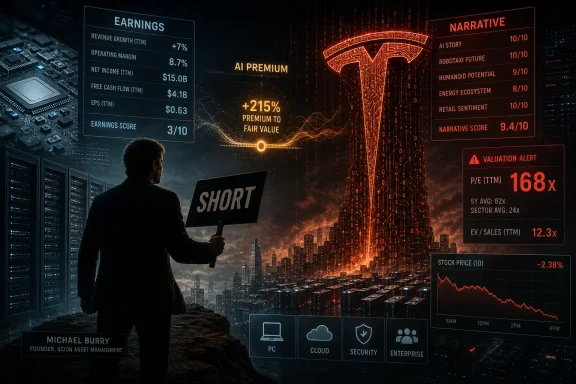
Michael Burry disclosed on June 30, 2026, that he had opened a short position against Tesla at $416.22 per share, placing Elon Musk’s automaker inside a broader bearish wager against companies benefiting from artificial-intelligence and semiconductor enthusiasm. The trade matters less because Burry is always right — he is not — than because it captures the market’s most uncomfortable question: how much of today’s AI premium is earnings, and how much is narrative? Tesla is no longer being valued as a car company, but the proof that it deserves to be valued as an AI platform remains uneven. That gap is where short sellers hunt.
The narrow version of the news is simple: Michael Burry, the investor made famous by The Big Short, has disclosed a new short position in Tesla through his paid newsletter, Cassandra Unchained. GuruFocus reported the entry price at $416.22 and framed the position as part of a larger bet against what Burry sees as stretched valuations across artificial intelligence and semiconductors.
The broader version is more interesting. Tesla has spent years trying to persuade investors that it is not merely an electric-vehicle manufacturer but a vertically integrated machine-learning, robotics, energy storage, autonomous driving, and infrastructure company. That pitch has worked extraordinarily well in the stock market, even as the operating business remains tethered to vehicle deliveries, pricing pressure, regulatory scrutiny, and the slow grind of manufacturing.
Burry’s short is therefore not simply a wager that Tesla shares will fall. It is a wager that the market has once again paid too much, too soon, for a technological future that is plausible but not yet financially settled. That is a familiar Burry theme, and it is also the central argument now dividing Wall Street’s AI trade.
Tesla is a particularly charged target because it sits at the intersection of several bubbles, booms, and genuine technological shifts. It is an EV company with auto margins, an AI company with autonomous-driving ambitions, a robotics story with limited commercial proof, and a cult stock whose valuation often seems to move on belief before balance-sheet confirmation.
A P/E ratio near 386 is not a normal auto-industry multiple. It is not even a normal high-growth industrial multiple. It is the kind of valuation that says investors are not buying current profits so much as they are buying optionality: robotaxis, Full Self-Driving, Optimus, energy storage, software margins, data advantages, and the possibility that Tesla becomes one of the physical-world winners of the AI era.
That is precisely why Burry’s position resonates beyond Tesla. The AI trade has been built on a chain of assumptions: cloud providers will spend massively on chips, semiconductor companies will keep expanding margins, power and infrastructure demand will surge, software platforms will monetize new capabilities, and a small group of dominant firms will capture enough value to justify today’s prices. Tesla adds another layer: that real-world autonomy and robotics will convert AI enthusiasm into recurring, high-margin revenue.
The problem for investors is not that any one of these assumptions is impossible. The problem is that many of them need to be true at the same time, and on a timeline aggressive enough to support current market capitalizations. Short sellers do not need the future to fail completely. They only need the market to realize it has been impatient.
But the car business is also where the valuation argument becomes uncomfortable. Automakers are capital-intensive, cyclical, exposed to interest rates and consumer credit, vulnerable to regional competition, and often punished for margin compression. Tesla has long escaped conventional auto comparisons because it grew faster, commanded investor loyalty, and presented itself as a technology platform. Yet every quarter still begins with the same blunt questions: how many cars did it sell, at what average price, and at what margin?
That tension is not new, but it becomes sharper when the stock trades as though the next business model has already arrived. If Tesla is valued like a software-style AI platform, investors need evidence that software-style economics are becoming material. If it is valued like a carmaker with optionality, the multiple is harder to defend.
This is where Burry’s skepticism finds an opening. The bull case depends on the market looking past today’s income statement. The bear case says the income statement is not a distraction; it is the only proven business large enough to anchor the valuation.
The semiconductor boom has obvious fundamentals behind it. AI models require enormous compute. Data centers require chips, networking, memory, power, cooling, buildings, land, and financing. The buildout is not imaginary, and dismissing it as pure hype would be lazy.
But markets do not merely price what is happening. They price what investors believe will happen next, and then the next thing after that. By the time capital flows through chipmakers, equipment suppliers, energy providers, industrial firms, and AI-adjacent platform companies, the same broad narrative can inflate very different businesses at once.
That is how a boom becomes fragile. If any part of the chain disappoints — cloud returns, model economics, regulatory approvals, chip supply, energy constraints, consumer adoption, enterprise budgets — the premium can compress across companies that appear unrelated on paper. Burry’s basket is a bet against that shared premium.
That is a useful contradiction, because it mirrors the market debate. Tesla is not a failing company being priced like a failing company. It is a major company with genuine strengths being priced as though those strengths will expand into much larger markets with far better economics. The argument is not quality versus junk; it is quality versus price.
Investors often treat valuation metrics as if they deliver verdicts. They do not. A high multiple can be justified if earnings grow fast enough, margins expand enough, and capital intensity falls enough. A stock can look absurdly expensive for years before the business grows into the price — or before the market gives up waiting.
Tesla has lived in that tension for most of its public life. Bears have often been early, and early can be indistinguishable from wrong when losses compound. Bulls have repeatedly been rewarded for ignoring conventional valuation warnings, but that history can itself become dangerous if it teaches investors that price never matters.
Burry’s move reopens a question Tesla holders have heard for a decade: is this the rare company that deserves a permanently unconventional multiple, or is it simply another growth stock whose story has outpaced its numbers?
Still, in a stock priced for perfection, optics matter. When outside investors are asked to pay hundreds of times trailing earnings, they naturally look for signs that insiders share the same appetite. The absence of insider buying does not prove executives lack confidence, but it also does nothing to reassure investors worried that expectations have become stretched.
The more important point is cumulative. A very high P/E ratio, a proprietary fair-value estimate well below the market price, heavy dependence on future AI monetization, and insider selling together form a narrative that short sellers can sell. None of those elements alone proves Tesla is overvalued. Together, they make the bearish case easier to explain.
Markets often move first on stories and only later on spreadsheets. Burry is trying to tell a simpler story than Tesla’s bulls: great company, excessive price, crowded AI trade, poor risk-reward.
That matters because Burry’s public reputation sometimes obscures the mechanics of the trade. A short position is not a research note. It has timing risk, borrow costs, volatility exposure, and the possibility of sudden rallies driven by product announcements, delivery beats, macro shifts, or simple momentum. Tesla is one of the worst stocks in the market for anyone who wants a quiet bearish thesis.
There is also the problem of selective memory. Burry’s housing-market call was spectacular, but his later warnings have had mixed timing and reception. That does not make him wrong here. It does mean investors should resist the temptation to treat his disclosure as a prophecy.
The useful signal is not “Burry is short, therefore Tesla falls.” The useful signal is that a prominent valuation skeptic sees Tesla as part of a broader AI excess. That framing deserves attention even from investors who would never follow him into the trade.
The AI boom is now embedded in the Windows ecosystem. Copilot PCs, NPUs, cloud inference, developer tooling, AI-assisted security operations, and enterprise productivity features all depend on a belief that customers will pay for AI capabilities at scale. Microsoft, Nvidia, OEMs, and chip suppliers are each pushing a version of the same proposition: AI is not an add-on but the next platform shift.
If Burry is right that the market has overcapitalized the AI story, the consequences will not stop at traders’ screens. A valuation reset could slow hardware refresh assumptions, make CFOs more skeptical of AI software premiums, and force vendors to prove productivity gains with harder numbers. Enterprise buyers already know the difference between a demo that dazzles and a deployment that survives procurement, security review, compliance testing, and user adoption.
That does not mean AI disappears. It means AI gets audited. The first phase of the boom rewarded companies for attaching themselves to the theme. The next phase may reward only those that can show durable usage, measurable savings, defensible margins, and products that customers renew without being pushed.
Those are enormous possibilities. They are also different from realized earnings. Investors can believe in the direction of travel while still questioning the price being paid today.
That distinction is increasingly relevant across the AI sector. The industry is full of platform promises: agents that replace workflows, copilots that rewrite productivity, data centers that become factories of intelligence, chips that become strategic assets, and autonomous systems that convert software into labor. Some of these promises will become real businesses. Some will become features. Some will become expensive footnotes.
Tesla is not unique in asking investors to bridge a gap between present economics and future platform value. It is simply one of the most visible and emotionally charged examples. That makes it a useful stress test for the whole AI market.
A business can grow while its multiple contracts. A company can remain strategically important while its stock underperforms. A technological breakthrough can arrive later than expected and still punish investors who paid as if it had already arrived. This is the arithmetic of high expectations.
That is the core of Burry’s apparent argument. Tesla does not need to be fraudulent, doomed, or obsolete for the short thesis to work. It only needs to disappoint relative to a valuation that assumes extraordinary outcomes.
This is also why the AI bubble debate is so difficult. Many of the technologies are real. Many of the use cases are real. Many of the companies involved are excellent. But bubbles do not require fake products; they require prices that outrun the cash flows those products can reasonably produce.
Tesla’s timeline is especially contested. Vehicle deliveries can be measured quarterly. Margins can be measured immediately. Robotaxi adoption, autonomous safety validation, regulatory approval, robotics commercialization, and AI software monetization take longer. The market is trying to price all of those clocks at once.
That creates opportunities for both sides. A strong delivery report, credible autonomy milestone, or margin recovery could squeeze shorts quickly. A missed target, safety controversy, regulatory delay, or weaker-than-expected profitability could make the valuation look exposed overnight.
Burry’s position says the market has been too generous with time. Tesla bulls say the market is finally appreciating the scale of the opportunity. The next year will not settle the philosophical debate, but it may clarify how much patience investors still have.
Investors need to separate three things that are often blended together: whether Tesla is an important company, whether its future markets are large, and whether the stock is attractive at a specific price. The first can be true while the third is false. That is the uncomfortable space where many high-growth stocks eventually end up.
For WindowsForum readers watching the wider AI economy, the same discipline applies to the companies selling the next platform shift. AI features in Windows, cloud services, security tooling, developer environments, and endpoint hardware may be useful and inevitable. But usefulness is not the same as unlimited pricing power.
Here is the cleanest read on the moment:
 Burry Is Betting Against the Story, Not Just the Stock
The narrow version of the news is simple: Michael Burry, the investor made famous by The Big Short, has disclosed a new short position in Tesla through his paid newsletter, Cassandra Unchained. GuruFocus reported the entry price at $416.22 and framed the position as part of a larger bet against what Burry sees as stretched valuations across artificial intelligence and semiconductors.The broader version is more interesting. Tesla has spent years trying to persuade investors that it is not merely an electric-vehicle manufacturer but a vertically integrated machine-learning, robotics, energy storage, autonomous driving, and infrastructure company. That pitch has worked extraordinarily well in the stock market, even as the operating business remains tethered to vehicle deliveries, pricing pressure, regulatory scrutiny, and the slow grind of manufacturing.
Burry’s short is therefore not simply a wager that Tesla shares will fall. It is a wager that the market has once again paid too much, too soon, for a technological future that is plausible but not yet financially settled. That is a familiar Burry theme, and it is also the central argument now dividing Wall Street’s AI trade.
Tesla is a particularly charged target because it sits at the intersection of several bubbles, booms, and genuine technological shifts. It is an EV company with auto margins, an AI company with autonomous-driving ambitions, a robotics story with limited commercial proof, and a cult stock whose valuation often seems to move on belief before balance-sheet confirmation.
Tesla’s Valuation Has Become a Referendum on AI Itself
GuruFocus put Tesla’s trailing price-to-earnings ratio at 385.87, far above its stated five-year median of 107.46. In another version of its write-up, GuruFocus said its GF Value metric showed Tesla trading 46 percent above fair value, with a calculated value of $288.10 against a current price around $420.60. Even allowing for the quirks of proprietary valuation models, the direction of the signal is hard to miss.A P/E ratio near 386 is not a normal auto-industry multiple. It is not even a normal high-growth industrial multiple. It is the kind of valuation that says investors are not buying current profits so much as they are buying optionality: robotaxis, Full Self-Driving, Optimus, energy storage, software margins, data advantages, and the possibility that Tesla becomes one of the physical-world winners of the AI era.
That is precisely why Burry’s position resonates beyond Tesla. The AI trade has been built on a chain of assumptions: cloud providers will spend massively on chips, semiconductor companies will keep expanding margins, power and infrastructure demand will surge, software platforms will monetize new capabilities, and a small group of dominant firms will capture enough value to justify today’s prices. Tesla adds another layer: that real-world autonomy and robotics will convert AI enthusiasm into recurring, high-margin revenue.
The problem for investors is not that any one of these assumptions is impossible. The problem is that many of them need to be true at the same time, and on a timeline aggressive enough to support current market capitalizations. Short sellers do not need the future to fail completely. They only need the market to realize it has been impatient.
The Car Business Still Has to Carry the Dream
Tesla delivered nearly 1.64 million vehicles globally in 2025, according to the GuruFocus summaries, and remains one of the defining companies of the battery-electric era. Its Supercharger network, battery know-how, brand recognition, software stack, and manufacturing scale are real advantages. The bullish case is not built from nothing.But the car business is also where the valuation argument becomes uncomfortable. Automakers are capital-intensive, cyclical, exposed to interest rates and consumer credit, vulnerable to regional competition, and often punished for margin compression. Tesla has long escaped conventional auto comparisons because it grew faster, commanded investor loyalty, and presented itself as a technology platform. Yet every quarter still begins with the same blunt questions: how many cars did it sell, at what average price, and at what margin?
That tension is not new, but it becomes sharper when the stock trades as though the next business model has already arrived. If Tesla is valued like a software-style AI platform, investors need evidence that software-style economics are becoming material. If it is valued like a carmaker with optionality, the multiple is harder to defend.
This is where Burry’s skepticism finds an opening. The bull case depends on the market looking past today’s income statement. The bear case says the income statement is not a distraction; it is the only proven business large enough to anchor the valuation.
The AI Boom Has Turned Every Infrastructure Story Into a Momentum Trade
Burry reportedly shorted not only Tesla but also names tied more directly to AI and semiconductor infrastructure, including Nvidia, Applied Materials, Caterpillar, and a semiconductor ETF. That basket matters. It suggests he is not treating Tesla as an isolated overvaluation but as part of a broader market structure in which AI capital expenditure has become the story that justifies almost everything.The semiconductor boom has obvious fundamentals behind it. AI models require enormous compute. Data centers require chips, networking, memory, power, cooling, buildings, land, and financing. The buildout is not imaginary, and dismissing it as pure hype would be lazy.
But markets do not merely price what is happening. They price what investors believe will happen next, and then the next thing after that. By the time capital flows through chipmakers, equipment suppliers, energy providers, industrial firms, and AI-adjacent platform companies, the same broad narrative can inflate very different businesses at once.
That is how a boom becomes fragile. If any part of the chain disappoints — cloud returns, model economics, regulatory approvals, chip supply, energy constraints, consumer adoption, enterprise budgets — the premium can compress across companies that appear unrelated on paper. Burry’s basket is a bet against that shared premium.
GuruFocus’ Own Signals Capture the Market’s Split Personality
One of the stranger parts of the GuruFocus write-ups is that Tesla looks both strong and expensive. The GF Score is listed at 85 out of 100, which GuruFocus presents as a sign of strong overall performance. Tesla scores well on growth and financial strength, less impressively on profitability and valuation.That is a useful contradiction, because it mirrors the market debate. Tesla is not a failing company being priced like a failing company. It is a major company with genuine strengths being priced as though those strengths will expand into much larger markets with far better economics. The argument is not quality versus junk; it is quality versus price.
Investors often treat valuation metrics as if they deliver verdicts. They do not. A high multiple can be justified if earnings grow fast enough, margins expand enough, and capital intensity falls enough. A stock can look absurdly expensive for years before the business grows into the price — or before the market gives up waiting.
Tesla has lived in that tension for most of its public life. Bears have often been early, and early can be indistinguishable from wrong when losses compound. Bulls have repeatedly been rewarded for ignoring conventional valuation warnings, but that history can itself become dangerous if it teaches investors that price never matters.
Burry’s move reopens a question Tesla holders have heard for a decade: is this the rare company that deserves a permanently unconventional multiple, or is it simply another growth stock whose story has outpaced its numbers?
Insider Selling Adds Noise, Not a Smoking Gun
GuruFocus noted that Tesla insiders sold $21.7 million worth of shares over the prior three months and reported no insider purchases during that period. That detail will attract attention, but it should be handled carefully. Insider selling can reflect tax planning, diversification, scheduled trading plans, compensation structures, or personal liquidity needs. It is not automatically a confession of bearishness.Still, in a stock priced for perfection, optics matter. When outside investors are asked to pay hundreds of times trailing earnings, they naturally look for signs that insiders share the same appetite. The absence of insider buying does not prove executives lack confidence, but it also does nothing to reassure investors worried that expectations have become stretched.
The more important point is cumulative. A very high P/E ratio, a proprietary fair-value estimate well below the market price, heavy dependence on future AI monetization, and insider selling together form a narrative that short sellers can sell. None of those elements alone proves Tesla is overvalued. Together, they make the bearish case easier to explain.
Markets often move first on stories and only later on spreadsheets. Burry is trying to tell a simpler story than Tesla’s bulls: great company, excessive price, crowded AI trade, poor risk-reward.
Shorting Tesla Remains a Dangerous Way to Be Right
If there is one lesson from Tesla’s history, it is that being bearish on the fundamentals does not guarantee a profitable trade. Tesla has repeatedly punished short sellers who underestimated retail enthusiasm, index flows, liquidity conditions, Elon Musk’s promotional power, and the market’s willingness to value distant possibilities. The stock can remain expensive longer than a short seller can remain solvent.That matters because Burry’s public reputation sometimes obscures the mechanics of the trade. A short position is not a research note. It has timing risk, borrow costs, volatility exposure, and the possibility of sudden rallies driven by product announcements, delivery beats, macro shifts, or simple momentum. Tesla is one of the worst stocks in the market for anyone who wants a quiet bearish thesis.
There is also the problem of selective memory. Burry’s housing-market call was spectacular, but his later warnings have had mixed timing and reception. That does not make him wrong here. It does mean investors should resist the temptation to treat his disclosure as a prophecy.
The useful signal is not “Burry is short, therefore Tesla falls.” The useful signal is that a prominent valuation skeptic sees Tesla as part of a broader AI excess. That framing deserves attention even from investors who would never follow him into the trade.
The Windows and Enterprise Angle Is the AI Spending Hangover
At first glance, a Tesla short position might seem far removed from the world of Windows users, sysadmins, and enterprise IT. It is not. The same AI investment cycle that lifts semiconductor stocks and AI-adjacent equities is reshaping PC hardware, cloud budgets, software licensing, data-center strategy, and the expectations Microsoft and its partners place on customers.The AI boom is now embedded in the Windows ecosystem. Copilot PCs, NPUs, cloud inference, developer tooling, AI-assisted security operations, and enterprise productivity features all depend on a belief that customers will pay for AI capabilities at scale. Microsoft, Nvidia, OEMs, and chip suppliers are each pushing a version of the same proposition: AI is not an add-on but the next platform shift.
If Burry is right that the market has overcapitalized the AI story, the consequences will not stop at traders’ screens. A valuation reset could slow hardware refresh assumptions, make CFOs more skeptical of AI software premiums, and force vendors to prove productivity gains with harder numbers. Enterprise buyers already know the difference between a demo that dazzles and a deployment that survives procurement, security review, compliance testing, and user adoption.
That does not mean AI disappears. It means AI gets audited. The first phase of the boom rewarded companies for attaching themselves to the theme. The next phase may reward only those that can show durable usage, measurable savings, defensible margins, and products that customers renew without being pushed.
Tesla Shows the Difference Between Platform Promise and Platform Proof
Tesla’s AI argument has always had a physical-world grandeur that software companies envy. If autonomy works at scale, the company could transform cars from depreciating assets into revenue-generating machines. If humanoid robotics works, Tesla could address labor markets far beyond transportation. If energy storage scales profitably, it could become a major infrastructure player in a grid increasingly shaped by electrification and compute demand.Those are enormous possibilities. They are also different from realized earnings. Investors can believe in the direction of travel while still questioning the price being paid today.
That distinction is increasingly relevant across the AI sector. The industry is full of platform promises: agents that replace workflows, copilots that rewrite productivity, data centers that become factories of intelligence, chips that become strategic assets, and autonomous systems that convert software into labor. Some of these promises will become real businesses. Some will become features. Some will become expensive footnotes.
Tesla is not unique in asking investors to bridge a gap between present economics and future platform value. It is simply one of the most visible and emotionally charged examples. That makes it a useful stress test for the whole AI market.
The Bear Case Does Not Require Tesla to Fail
One reason Tesla debates become unproductive is that both sides often argue in extremes. Bulls accuse bears of missing the company’s technological ambition. Bears accuse bulls of treating ambition as revenue. The stock, however, can fall without Tesla failing as a company.A business can grow while its multiple contracts. A company can remain strategically important while its stock underperforms. A technological breakthrough can arrive later than expected and still punish investors who paid as if it had already arrived. This is the arithmetic of high expectations.
That is the core of Burry’s apparent argument. Tesla does not need to be fraudulent, doomed, or obsolete for the short thesis to work. It only needs to disappoint relative to a valuation that assumes extraordinary outcomes.
This is also why the AI bubble debate is so difficult. Many of the technologies are real. Many of the use cases are real. Many of the companies involved are excellent. But bubbles do not require fake products; they require prices that outrun the cash flows those products can reasonably produce.
The Trade Is Really About Time
Every high-growth valuation is a negotiation with time. Bulls buy the future at today’s price and hope the business catches up. Bears sell the present price and hope the future arrives too slowly, too expensively, or too unevenly to justify it.Tesla’s timeline is especially contested. Vehicle deliveries can be measured quarterly. Margins can be measured immediately. Robotaxi adoption, autonomous safety validation, regulatory approval, robotics commercialization, and AI software monetization take longer. The market is trying to price all of those clocks at once.
That creates opportunities for both sides. A strong delivery report, credible autonomy milestone, or margin recovery could squeeze shorts quickly. A missed target, safety controversy, regulatory delay, or weaker-than-expected profitability could make the valuation look exposed overnight.
Burry’s position says the market has been too generous with time. Tesla bulls say the market is finally appreciating the scale of the opportunity. The next year will not settle the philosophical debate, but it may clarify how much patience investors still have.
The Cassandra Trade Leaves Investors With Fewer Excuses
The practical lesson from Burry’s Tesla short is not that ordinary investors should mimic a professional short seller. Most should not. The practical lesson is that Tesla’s valuation now demands a more disciplined conversation than slogans about EVs, AI, or Elon Musk can provide.Investors need to separate three things that are often blended together: whether Tesla is an important company, whether its future markets are large, and whether the stock is attractive at a specific price. The first can be true while the third is false. That is the uncomfortable space where many high-growth stocks eventually end up.
For WindowsForum readers watching the wider AI economy, the same discipline applies to the companies selling the next platform shift. AI features in Windows, cloud services, security tooling, developer environments, and endpoint hardware may be useful and inevitable. But usefulness is not the same as unlimited pricing power.
Here is the cleanest read on the moment:
- Burry’s disclosed Tesla short is best understood as part of a wider bet against AI-inflated valuations, not as a narrow call on electric vehicles.
- Tesla’s current multiple implies that investors are paying heavily for autonomy, robotics, software, and energy optionality that still needs more financial proof.
- GuruFocus’ own scoring captures the contradiction: Tesla can have strong growth characteristics while still looking expensive on valuation.
- Insider selling is not definitive evidence of trouble, but it adds to a bearish narrative when the stock is already priced for exceptional execution.
- The enterprise AI market faces a similar test, because customers will increasingly demand measurable returns rather than platform-shift rhetoric.
- Shorting Tesla remains risky even when the valuation case looks stretched, because timing and sentiment have repeatedly overwhelmed traditional analysis.
References
- Primary source: GuruFocus
Published: 2026-07-01T01:20:20.587260
Michael Burry Establishes Tesla (TSLA) Short Position Amidst AI
On June 30, 2026, investor Michael Burry (Trades, Portfolio), renowned for his role in "The Big Short," announced a new short position in Tesla Inc (TSLA) at awww.gurufocus.com - Related coverage: stockanalysis.com
Tesla (TSLA) Stock Price & Overview
A detailed overview of Tesla, Inc. (TSLA) stock, including real-time price, chart, key statistics, news, and more.stockanalysis.com - Related coverage: electrek.co
Big Short's Michael Burry discloses new Tesla (TSLA) position | Electrek
Michael Burry disclosed a new short position on Tesla (TSLA) at $416.22, part of a bearish basket targeting the AI and semiconductor bubble.electrek.co - Related coverage: investing.com
Burry shorts Caterpillar on valuation concerns, also shorts NVDA, TSLA, AMAT By Investing.com
Burry shorts Caterpillar on valuation concerns, also shorts NVDA, TSLA, AMATwww.investing.com - Related coverage: m.nl.investing.com
Michael Burry zet in op koersdalingen Tesla en Nvidia met nieuwe short-posities in AI-bubbel Door Investing.com
Michael Burry zet in op koersdalingen Tesla en Nvidia met nieuwe short-posities in AI-bubbelm.nl.investing.com - Related coverage: tallacoptions.com
TSLA (Tesla Inc.) Stock Price | Tallac Options
TSLA (Tesla Inc.) Real Time, Historical Intraday, Historical Options Data with key Stats and Technicals.tallacoptions.com
- Related coverage: macrotrends.net

Tesla PE Ratio 2012-2026 | TSLA | MacroTrends
<p>Current and historical p/e ratio for Tesla (TSLA) from 2012 to 2026. The price to earnings ratio is calculated by taking the latest closing price and dividing it by the most recent earnings per share (EPS) number. The PE ratio is a simple way to assess whether a stock is over or under...
www.macrotrends.net
- Related coverage: marketbeat.com
Tesla (TSLA) Short Interest & Short Float | Updated Jul 2026
Are hedge funds shorting Tesla (NASDAQ:TSLA) stock? View the latest TSLA short interest ratio, short volume, and more at MarketBeat.www.marketbeat.com
- Related coverage: techi.com
Tesla Inc. (TSLA) Stock Dashboard, Price, Forecast & Financials | TECHi
Tesla Inc. (TSLA) NASDAQ / Consumer Discretionary / Auto Manufacturers stock dashboard with price, forecast, earnings, financials, news, and valuation risk.www.techi.com - Related coverage: statmuse.com
Tsla Stock | StatMuse Money
The closing price for Tesla (TSLA) yesterday was $420.47. It was up 3.5% for the day (up 2.1% from previous close).www.statmuse.com - Related coverage: financecharts.com
- Related coverage: gcalhoun.wordpress.com
- Related coverage: barchart.websol.barchart.com

