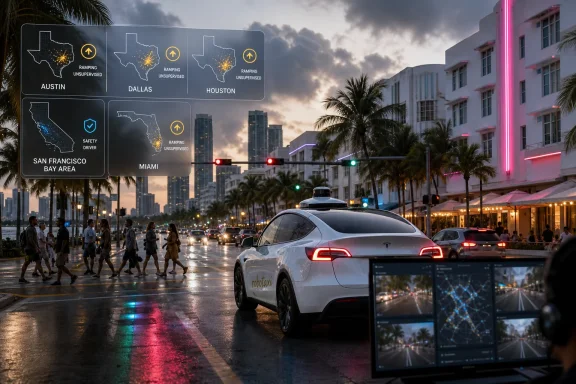
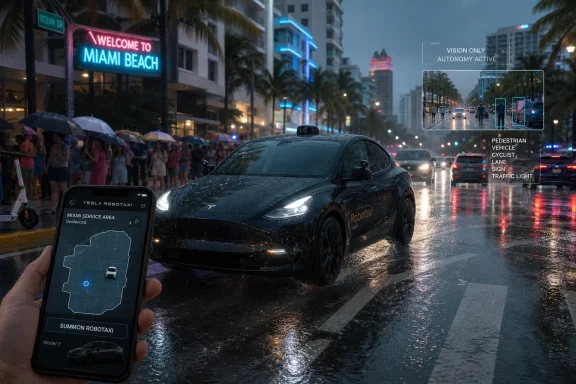
On July 3, 2026, Tesla began offering Robotaxi rides in Miami using unsupervised Model Y vehicles, with early ride footage and local reports showing the service operating in rainy South Florida conditions on its first commercial day. The launch matters less because Miami is another dot on Tesla’s map than because it puts the company’s camera-first autonomy strategy into one of America’s messiest driving laboratories. Rain, glare, flooding, tourists, scooters, aggressive lane changes, and ambiguous curb space are not edge cases in Miami. They are Tuesday.
The first reports came through Tesla’s own Robotaxi account on X and were quickly amplified by Reuters, Blockchain.News, Refresh Miami, Not a Tesla App, and Tesla-focused social media accounts posting early rider footage. That source mix is worth stating plainly: the launch is real, but many of the most specific details about fleet size, route boundaries, and operating rules are still coming from Tesla-adjacent observers rather than a full regulatory dossier or detailed company briefing. In other words, Miami is both a milestone and a disclosure problem.
Tesla wants investors and riders to see the moment as proof that its long-promised autonomy business is leaving the demo stage. The harder reading is more interesting: Miami turns Robotaxi from a controlled expansion story into a public test of whether Tesla can make vision-only autonomy look boring in bad weather, at urban scale, under regulatory scrutiny, and against competitors that have spent years building slower, more sensor-heavy systems.
Tesla has staged autonomy announcements before, but commercial availability changes the texture of the argument. A product that customers can hail is judged differently from a keynote video, an investor slide, or a supervised beta feature. It is judged by pickup reliability, awkward merges, wet pavement behavior, cancellations, pricing, customer support, and whether people feel safe enough to recommend it to someone who does not own Tesla stock.
That is why Miami is a sharper test than a sunny proving-ground narrative. The city is dense enough to be meaningful, chaotic enough to be unforgiving, and weather-prone enough to challenge the neat assumptions of machine perception. Heavy rain can reduce contrast, smear camera lenses, hide lane markings, distort reflections, and turn curbside pickup into a negotiation between map data and lived reality.
The symbolism is obvious. Tesla has spent years arguing that autonomous driving can be solved primarily through cameras and neural networks trained on vast real-world driving data. Miami’s first rainy-day service gives that thesis a visible, commercial stage.
But symbolism cuts both ways. If the rides look smooth, Tesla gets a powerful marketing clip: driverless Model Ys calmly navigating a wet city while rivals still talk about staged rollouts. If the system struggles, Miami becomes a reminder that autonomy is not a software feature in the ordinary consumer-tech sense. It is a public-safety system deployed into a city that did not pause for the launch.
That matters because “available in Miami” can mean several different things. It can mean a meaningful transportation network with short waits across a large service area. It can mean a tightly geofenced pilot with a handful of vehicles. It can mean something in between: impressive for a launch day, but not yet disruptive to Uber, Lyft, taxis, or private car ownership.
Autonomy companies have learned to use geography as both product and public relations. A service-area map can imply scale even when vehicle density is low. A city name can imply coverage even when the actual usable zone excludes airports, beaches, bridges, nightlife corridors, or the neighborhoods where demand is highest.
Tesla is especially exposed to this ambiguity because its valuation story increasingly depends on the idea that autonomy can scale faster and cheaper than competitors’ systems. If a Model Y can become a robotaxi largely through software, Tesla’s installed hardware and manufacturing base become a strategic weapon. If the service still requires tight geofencing, heavy remote support, meticulous operational oversight, and slow city-by-city tuning, the business starts to look less magical and more like everyone else’s.
A wet Miami street can turn ordinary driving assumptions into traps. Lane markings fade under sheen. Pedestrians make sudden dashes. Standing water changes stopping distances. Other drivers behave less predictably, sometimes slowing abruptly and sometimes doing the opposite. Human drivers compensate with caution, local intuition, and a tolerance for ambiguity; an autonomous vehicle has to convert that ambiguity into policy.
Tesla’s bet is that end-to-end neural networks can learn enough from real-world driving data to generalize across these conditions. The company’s supporters argue that this is exactly where Tesla’s data advantage should show up: millions of miles of varied customer driving feeding models that learn the statistical grammar of roads. Critics counter that a camera-only approach gives the system fewer independent ways to verify what it thinks it sees.
Miami does not settle that debate in a day. It does, however, move the debate from theory into passenger experience. If riders encounter smooth, cautious driving in rain, the perception argument becomes harder to dismiss. If the vehicles hesitate excessively, avoid too many routes, or require invisible human intervention, the operational reality will leak through the branding.
The attraction of Tesla’s strategy is cost and speed. Cameras are already on production vehicles, the Model Y is already manufactured in volume, and software updates can theoretically improve the same fleet over time. A Tesla robotaxi network, if it works, does not require a bespoke pod vehicle to appear before the service becomes economically relevant.
That is why the Miami launch has implications beyond Florida. Tesla is not merely adding another city; it is trying to prove that its autonomy stack can be productized across different urban environments without rebuilding the whole system from scratch. Dallas, Houston, Austin, the Bay Area, and Miami are not interchangeable driving environments, and that is exactly the point.
The risk is that “generalization” becomes a word doing too much work. Real cities contain unusual signage, temporary construction, police direction, flooded intersections, double-parked delivery vehicles, emergency scenes, and human behavior that violates the rules but defines the road. For a consumer driver-assistance feature, occasional weirdness can be patched over with driver supervision. For a paid driverless ride, the weirdness belongs to Tesla.
The classic promise is simple. Remove the human driver, keep the vehicle moving for more hours per day, and the cost per mile falls. If Tesla can use existing Model Y production and software-defined autonomy, it could attack ride-hailing economics from a different angle than companies that operate expensive purpose-built vehicles in slower deployments.
But ride-hailing is a brutal operations business. Vehicles need cleaning, charging, maintenance, customer support, incident response, insurance, routing, demand balancing, and local compliance. Rainy Miami adds another operational wrinkle: vehicles may need more frequent sensor cleaning, more conservative driving profiles, and better procedures for pickup points where passengers do not want to wait in a downpour.
Tesla’s advantage is that it understands vehicles, software, charging, and vertical integration better than almost any transportation entrant. Its weakness is that it often prefers product drama to operational transparency. Robotaxi customers may tolerate novelty once; a mobility network needs reliability every day.
Waymo has built its public reputation through methodical expansion, visible sensor redundancy, and a service model that has gradually normalized driverless rides in selected markets. Zoox, backed by Amazon, has pursued a more purpose-built vehicle strategy, aiming less at adapting consumer cars and more at designing autonomy into the service from the beginning. Tesla, by contrast, is trying to turn mass-market EVs into autonomous revenue machines.
If Tesla is right, the competitors are overbuilding. Lidar domes, bespoke vehicles, and slow mapping cycles could look like expensive scaffolding once neural driving systems become sufficiently capable. In that world, Tesla’s Model Y fleet is not a stopgap but the bridge to a cheaper network.
If Tesla is wrong, the shortcut becomes a liability. The very thing that makes the company’s approach elegant — fewer specialized sensors, faster deployment, less visible infrastructure — also leaves less margin when perception fails. Miami’s rain makes that trade-off visible to ordinary riders, not just autonomy engineers.
The regulatory questions are practical. What operating domain has Tesla declared internally? What weather thresholds stop service? How are incidents reported? What remote assistance is available? Are vehicles empty between rides treated differently from vehicles with passengers? How does Tesla handle police direction, emergency vehicles, flooded streets, or road closures?
Tesla has historically pushed regulators by moving quickly and forcing institutions to catch up. That can accelerate innovation, but it also creates distrust when the company’s public language outruns verifiable detail. Robotaxi deployment is the wrong place for ambiguity to become a brand habit.
For IT pros and systems-minded readers, the analogy is obvious. You would not accept a production rollout of a critical service without observability, rollback plans, incident reporting, and clear service boundaries. A robotaxi fleet is a distributed cyber-physical system running in public space. The fact that it has wheels does not make the operational discipline optional.
That shift changes the relationship between automaker and customer. In a traditional sale, Tesla recognizes much of the value when the car leaves the lot. In a robotaxi network, value accrues through utilization, software improvement, fleet orchestration, and local market density. The company is no longer just competing with Ford, GM, Hyundai, or BYD. It is competing with Uber’s marketplace, Waymo’s autonomy stack, municipal transit, and the economics of personal ownership.
Subscription models may become part of that picture, but the more immediate business model is paid rides. The more rides each vehicle completes safely, the more Tesla can argue that autonomy deserves a services-style multiple. That is the financial subtext behind every launch-day clip.
The catch is that services businesses are judged by service metrics. Availability, uptime, response time, support quality, incident rates, and customer retention will matter as much as neural-network sophistication. Tesla can win the demo with AI; it has to win the market with operations.
That raises privacy questions that should not be dismissed as academic. What video is stored? What is uploaded? How long is it retained? How is it anonymized? Who can review it? How are law-enforcement requests handled? A robotaxi network operating at scale could become one of the most detailed street-level sensing systems in any city.
There is also the question of uneven performance. Autonomous systems can behave differently across neighborhoods depending on infrastructure quality, road markings, lighting, pedestrian behavior, and the density of training data. If a service works beautifully in one part of Miami but struggles in another, the consequences are not merely technical. They shape who gets reliable mobility and who gets a cautious, unavailable, or expensive version of the future.
Tesla’s supporters may argue that more data solves these problems. Sometimes it does. But data alone is not governance. Public trust will require policies, audits, reporting, and a willingness to explain failures without hiding behind the mystique of AI.
Miami’s rain makes ordinary predictability harder. A safe robotaxi must be cautious without being paralyzing. It must yield without inviting rear-end collisions. It must choose pickup spots that do not strand riders in dangerous or inconvenient places. It must know when not to drive.
The phrase “unsupervised” deserves special scrutiny. To the public, it suggests no human safety driver in the vehicle. It does not necessarily mean no human support anywhere in the loop. Remote assistance, fleet monitoring, operational constraints, and geofencing may all remain part of the system, and Tesla should be clearer about where machine autonomy ends and fleet operations begin.
This distinction is not pedantry. A vehicle that can complete most trips independently with occasional remote guidance is still impressive. But it is not the same operational claim as a system that needs no meaningful human backstop. The market will eventually price the difference.
Miami adds weather, tourism, multilingual streets, aggressive driving norms, flooding risk, and a civic culture that is both tech-curious and skeptical of disruption that makes daily life harder. A robotaxi that works there earns a different kind of credibility.
The city also magnifies the pickup-and-drop-off problem. In ride-hailing, the last 30 feet can be more annoying than the last three miles. In rain, those 30 feet matter even more. A human driver can improvise, wave, call, pull forward, or understand that a passenger is trying to avoid a flooded curb. A driverless car has to make those micro-decisions through policy.
That is where autonomy becomes less like a chess engine and more like a hospitality business. The ride is not just the route. It is the entire interaction between passenger, vehicle, street, weather, app, and expectation.
Miami should cool both extremes. It is neither proof that Tesla has solved all of autonomy nor evidence that the company is merely staging another illusion. A paid, unsupervised launch in rain is a real achievement. It is also the beginning of the hard part.
The hard part is repetition. Can the service run tomorrow, next month, and through hurricane-season weirdness? Can it handle degraded roads, construction, nightlife surges, airport demand, and passengers who treat the car badly? Can it scale without a hidden army of support staff erasing the cost advantage?
That is the difference between a technology breakthrough and a transportation business. The former can be shown in a clip. The latter shows up in margins, safety reports, customer retention, and the absence of drama.
The same report says Waymo has registered 577 automated vehicles in Texas, more than 13 times Tesla’s disclosed Texas robotaxi count. That comparison sharpens the competitive context: Tesla may be expanding city-by-city, but Waymo’s registered fleet footprint in at least one key state remains far larger.
Invezz also notes that Elon Musk has cautioned Tesla’s robotaxi network is unlikely to generate meaningful revenue this year. That tempers the near-term business readout from Miami. For WindowsForum readers tracking this as an AI platform story, the practical takeaway is that deployment breadth and public visibility are not the same as utilization, fleet density, or material revenue.
The first reports came through Tesla’s own Robotaxi account on X and were quickly amplified by Reuters, Blockchain.News, Refresh Miami, Not a Tesla App, and Tesla-focused social media accounts posting early rider footage. That source mix is worth stating plainly: the launch is real, but many of the most specific details about fleet size, route boundaries, and operating rules are still coming from Tesla-adjacent observers rather than a full regulatory dossier or detailed company briefing. In other words, Miami is both a milestone and a disclosure problem.
Tesla wants investors and riders to see the moment as proof that its long-promised autonomy business is leaving the demo stage. The harder reading is more interesting: Miami turns Robotaxi from a controlled expansion story into a public test of whether Tesla can make vision-only autonomy look boring in bad weather, at urban scale, under regulatory scrutiny, and against competitors that have spent years building slower, more sensor-heavy systems.
 Miami Turns the Robotaxi Story From Promise Into Exposure
Tesla has staged autonomy announcements before, but commercial availability changes the texture of the argument. A product that customers can hail is judged differently from a keynote video, an investor slide, or a supervised beta feature. It is judged by pickup reliability, awkward merges, wet pavement behavior, cancellations, pricing, customer support, and whether people feel safe enough to recommend it to someone who does not own Tesla stock.That is why Miami is a sharper test than a sunny proving-ground narrative. The city is dense enough to be meaningful, chaotic enough to be unforgiving, and weather-prone enough to challenge the neat assumptions of machine perception. Heavy rain can reduce contrast, smear camera lenses, hide lane markings, distort reflections, and turn curbside pickup into a negotiation between map data and lived reality.
The symbolism is obvious. Tesla has spent years arguing that autonomous driving can be solved primarily through cameras and neural networks trained on vast real-world driving data. Miami’s first rainy-day service gives that thesis a visible, commercial stage.
But symbolism cuts both ways. If the rides look smooth, Tesla gets a powerful marketing clip: driverless Model Ys calmly navigating a wet city while rivals still talk about staged rollouts. If the system struggles, Miami becomes a reminder that autonomy is not a software feature in the ordinary consumer-tech sense. It is a public-safety system deployed into a city that did not pause for the launch.
The Fleet Size Silence Is the Loudest Part of the Launch
The most important missing number is the simplest one: how many cars are actually operating. Reuters reported that Tesla said Robotaxi was available in Miami, but public reporting at launch did not include a clear fleet count. Blockchain.News framed fleet scale as a critical unknown, while Tesla-focused outlets and rider posts confirmed availability without settling the question of how broad the service really is.That matters because “available in Miami” can mean several different things. It can mean a meaningful transportation network with short waits across a large service area. It can mean a tightly geofenced pilot with a handful of vehicles. It can mean something in between: impressive for a launch day, but not yet disruptive to Uber, Lyft, taxis, or private car ownership.
Autonomy companies have learned to use geography as both product and public relations. A service-area map can imply scale even when vehicle density is low. A city name can imply coverage even when the actual usable zone excludes airports, beaches, bridges, nightlife corridors, or the neighborhoods where demand is highest.
Tesla is especially exposed to this ambiguity because its valuation story increasingly depends on the idea that autonomy can scale faster and cheaper than competitors’ systems. If a Model Y can become a robotaxi largely through software, Tesla’s installed hardware and manufacturing base become a strategic weapon. If the service still requires tight geofencing, heavy remote support, meticulous operational oversight, and slow city-by-city tuning, the business starts to look less magical and more like everyone else’s.
Rain Is Not a Publicity Detail; It Is the Product Test
Rainy launch-day footage is not just a flourish for social media. For a camera-heavy system, rain is one of the cleanest public demonstrations of whether the perception stack can handle degraded visual input. The challenge is not merely seeing a car ahead; it is understanding the whole driving scene when the world becomes lower contrast, reflective, and dynamically obscured.A wet Miami street can turn ordinary driving assumptions into traps. Lane markings fade under sheen. Pedestrians make sudden dashes. Standing water changes stopping distances. Other drivers behave less predictably, sometimes slowing abruptly and sometimes doing the opposite. Human drivers compensate with caution, local intuition, and a tolerance for ambiguity; an autonomous vehicle has to convert that ambiguity into policy.
Tesla’s bet is that end-to-end neural networks can learn enough from real-world driving data to generalize across these conditions. The company’s supporters argue that this is exactly where Tesla’s data advantage should show up: millions of miles of varied customer driving feeding models that learn the statistical grammar of roads. Critics counter that a camera-only approach gives the system fewer independent ways to verify what it thinks it sees.
Miami does not settle that debate in a day. It does, however, move the debate from theory into passenger experience. If riders encounter smooth, cautious driving in rain, the perception argument becomes harder to dismiss. If the vehicles hesitate excessively, avoid too many routes, or require invisible human intervention, the operational reality will leak through the branding.
Tesla’s Camera-First Gamble Now Has Paying Passengers
Tesla’s approach differs philosophically from the robotaxi orthodoxy built around lidar, radar, high-definition maps, and dense operational control. Waymo’s method has been to make the vehicle’s world knowable through redundant sensing and carefully mapped operating domains. Tesla’s method has been to make the vehicle learn driving more like a human does, by interpreting visual input at scale.The attraction of Tesla’s strategy is cost and speed. Cameras are already on production vehicles, the Model Y is already manufactured in volume, and software updates can theoretically improve the same fleet over time. A Tesla robotaxi network, if it works, does not require a bespoke pod vehicle to appear before the service becomes economically relevant.
That is why the Miami launch has implications beyond Florida. Tesla is not merely adding another city; it is trying to prove that its autonomy stack can be productized across different urban environments without rebuilding the whole system from scratch. Dallas, Houston, Austin, the Bay Area, and Miami are not interchangeable driving environments, and that is exactly the point.
The risk is that “generalization” becomes a word doing too much work. Real cities contain unusual signage, temporary construction, police direction, flooded intersections, double-parked delivery vehicles, emergency scenes, and human behavior that violates the rules but defines the road. For a consumer driver-assistance feature, occasional weirdness can be patched over with driver supervision. For a paid driverless ride, the weirdness belongs to Tesla.
The Business Case Depends on Utilization, Not Just Autonomy
A robotaxi is not valuable because it can drive itself once. It is valuable because it can drive itself repeatedly, cheaply, safely, and with high uptime. That means the Miami launch should be read through fleet economics as much as AI achievement.The classic promise is simple. Remove the human driver, keep the vehicle moving for more hours per day, and the cost per mile falls. If Tesla can use existing Model Y production and software-defined autonomy, it could attack ride-hailing economics from a different angle than companies that operate expensive purpose-built vehicles in slower deployments.
But ride-hailing is a brutal operations business. Vehicles need cleaning, charging, maintenance, customer support, incident response, insurance, routing, demand balancing, and local compliance. Rainy Miami adds another operational wrinkle: vehicles may need more frequent sensor cleaning, more conservative driving profiles, and better procedures for pickup points where passengers do not want to wait in a downpour.
Tesla’s advantage is that it understands vehicles, software, charging, and vertical integration better than almost any transportation entrant. Its weakness is that it often prefers product drama to operational transparency. Robotaxi customers may tolerate novelty once; a mobility network needs reliability every day.
Waymo and Zoox Make Tesla’s Shortcut Look Both Brilliant and Risky
The competitive landscape is no longer hypothetical. Reuters noted that Tesla’s move comes as Waymo and Zoox continue expanding their autonomous ride efforts. That context matters because Tesla is entering a field where the leading rivals have made different technical and regulatory trade-offs.Waymo has built its public reputation through methodical expansion, visible sensor redundancy, and a service model that has gradually normalized driverless rides in selected markets. Zoox, backed by Amazon, has pursued a more purpose-built vehicle strategy, aiming less at adapting consumer cars and more at designing autonomy into the service from the beginning. Tesla, by contrast, is trying to turn mass-market EVs into autonomous revenue machines.
If Tesla is right, the competitors are overbuilding. Lidar domes, bespoke vehicles, and slow mapping cycles could look like expensive scaffolding once neural driving systems become sufficiently capable. In that world, Tesla’s Model Y fleet is not a stopgap but the bridge to a cheaper network.
If Tesla is wrong, the shortcut becomes a liability. The very thing that makes the company’s approach elegant — fewer specialized sensors, faster deployment, less visible infrastructure — also leaves less margin when perception fails. Miami’s rain makes that trade-off visible to ordinary riders, not just autonomy engineers.
Regulation Will Decide Whether This Is a Launch or a Loophole
Florida has generally been friendlier to autonomous-vehicle testing and deployment than some more restrictive jurisdictions, which helps explain why Miami would be attractive. But permissive rules are not the same as a settled public mandate. Once unsupervised vehicles are carrying passengers in rain, local officials, insurers, plaintiffs’ attorneys, and safety advocates all have a stake in the details.The regulatory questions are practical. What operating domain has Tesla declared internally? What weather thresholds stop service? How are incidents reported? What remote assistance is available? Are vehicles empty between rides treated differently from vehicles with passengers? How does Tesla handle police direction, emergency vehicles, flooded streets, or road closures?
Tesla has historically pushed regulators by moving quickly and forcing institutions to catch up. That can accelerate innovation, but it also creates distrust when the company’s public language outruns verifiable detail. Robotaxi deployment is the wrong place for ambiguity to become a brand habit.
For IT pros and systems-minded readers, the analogy is obvious. You would not accept a production rollout of a critical service without observability, rollback plans, incident reporting, and clear service boundaries. A robotaxi fleet is a distributed cyber-physical system running in public space. The fact that it has wheels does not make the operational discipline optional.
Autonomy Is Becoming a Cloud Service With Tires
The Miami launch also shows how the car business is converging with the logic of cloud platforms. Tesla is not merely selling vehicles; it is trying to convert hardware into recurring service revenue. The vehicle becomes an endpoint, the autonomy stack becomes the platform, and mobility becomes the application layer.That shift changes the relationship between automaker and customer. In a traditional sale, Tesla recognizes much of the value when the car leaves the lot. In a robotaxi network, value accrues through utilization, software improvement, fleet orchestration, and local market density. The company is no longer just competing with Ford, GM, Hyundai, or BYD. It is competing with Uber’s marketplace, Waymo’s autonomy stack, municipal transit, and the economics of personal ownership.
Subscription models may become part of that picture, but the more immediate business model is paid rides. The more rides each vehicle completes safely, the more Tesla can argue that autonomy deserves a services-style multiple. That is the financial subtext behind every launch-day clip.
The catch is that services businesses are judged by service metrics. Availability, uptime, response time, support quality, incident rates, and customer retention will matter as much as neural-network sophistication. Tesla can win the demo with AI; it has to win the market with operations.
The Privacy and Bias Questions Ride Along in the Back Seat
Robotaxis are data machines. They observe streets, passengers, pickup points, nearby pedestrians, license plates, homes, businesses, and patterns of movement. Tesla’s camera-first approach makes data central not only to driving but to improvement.That raises privacy questions that should not be dismissed as academic. What video is stored? What is uploaded? How long is it retained? How is it anonymized? Who can review it? How are law-enforcement requests handled? A robotaxi network operating at scale could become one of the most detailed street-level sensing systems in any city.
There is also the question of uneven performance. Autonomous systems can behave differently across neighborhoods depending on infrastructure quality, road markings, lighting, pedestrian behavior, and the density of training data. If a service works beautifully in one part of Miami but struggles in another, the consequences are not merely technical. They shape who gets reliable mobility and who gets a cautious, unavailable, or expensive version of the future.
Tesla’s supporters may argue that more data solves these problems. Sometimes it does. But data alone is not governance. Public trust will require policies, audits, reporting, and a willingness to explain failures without hiding behind the mystique of AI.
The Safety Debate Will Be Won in Boring Metrics
Autonomy companies often want to debate safety in grand comparisons: machine versus human, miles per intervention, accidents per million miles, or the moral cost of delaying automation. Those metrics matter, but public acceptance usually arrives through a less dramatic channel. People begin to trust the system when it behaves predictably in ordinary situations.Miami’s rain makes ordinary predictability harder. A safe robotaxi must be cautious without being paralyzing. It must yield without inviting rear-end collisions. It must choose pickup spots that do not strand riders in dangerous or inconvenient places. It must know when not to drive.
The phrase “unsupervised” deserves special scrutiny. To the public, it suggests no human safety driver in the vehicle. It does not necessarily mean no human support anywhere in the loop. Remote assistance, fleet monitoring, operational constraints, and geofencing may all remain part of the system, and Tesla should be clearer about where machine autonomy ends and fleet operations begin.
This distinction is not pedantry. A vehicle that can complete most trips independently with occasional remote guidance is still impressive. But it is not the same operational claim as a system that needs no meaningful human backstop. The market will eventually price the difference.
Miami Is a Weather Test, but It Is Also a Culture Test
Every city teaches autonomy a different lesson. San Francisco taught robotaxi companies about dense urban edge cases, activists, emergency responders, and the politics of curb space. Phoenix taught them about wide roads, heat, and planned expansion. Austin gave Tesla a friendly stage with strong brand resonance and a tech-forward audience.Miami adds weather, tourism, multilingual streets, aggressive driving norms, flooding risk, and a civic culture that is both tech-curious and skeptical of disruption that makes daily life harder. A robotaxi that works there earns a different kind of credibility.
The city also magnifies the pickup-and-drop-off problem. In ride-hailing, the last 30 feet can be more annoying than the last three miles. In rain, those 30 feet matter even more. A human driver can improvise, wave, call, pull forward, or understand that a passenger is trying to avoid a flooded curb. A driverless car has to make those micro-decisions through policy.
That is where autonomy becomes less like a chess engine and more like a hospitality business. The ride is not just the route. It is the entire interaction between passenger, vehicle, street, weather, app, and expectation.
The Hype Cycle Finally Meets the Operations Cycle
Tesla’s autonomy story has always been unusually entangled with investor belief. Elon Musk has repeatedly positioned self-driving and robotaxis as central to Tesla’s future, sometimes more central than the sale of cars themselves. That has made every incremental deployment feel like a referendum on the company’s valuation.Miami should cool both extremes. It is neither proof that Tesla has solved all of autonomy nor evidence that the company is merely staging another illusion. A paid, unsupervised launch in rain is a real achievement. It is also the beginning of the hard part.
The hard part is repetition. Can the service run tomorrow, next month, and through hurricane-season weirdness? Can it handle degraded roads, construction, nightlife surges, airport demand, and passengers who treat the car badly? Can it scale without a hidden army of support staff erasing the cost advantage?
That is the difference between a technology breakthrough and a transportation business. The former can be shown in a clip. The latter shows up in margins, safety reports, customer retention, and the absence of drama.
The Miami Launch Gives Tesla a Bigger Burden of Proof
The concrete lesson from July 3 is not that every city is now ready for driverless Teslas. It is that Tesla has chosen to expose its autonomy system to a more demanding public test, and the next evidence must be operational rather than promotional.- Tesla’s Miami Robotaxi launch appears to have begun on July 3, 2026, with unsupervised Model Y vehicles available through the company’s service and early footage showing rides in rainy conditions.
- The size of the Miami fleet and the exact boundaries of the service area remain unclear in public reporting, which makes claims about scale premature.
- Rain gives Tesla a valuable demonstration environment because wet roads directly challenge camera perception, prediction, braking policy, and pickup logistics.
- The launch strengthens Tesla’s argument that existing production vehicles can become revenue-generating autonomous assets, but only if utilization, maintenance, support, and safety performance scale with the software.
- Competitors such as Waymo and Zoox still represent a different autonomy philosophy, and Miami will help test whether Tesla’s faster, leaner approach is an advantage or an exposed flank.
- Regulators and the public should press for clearer reporting on incidents, weather limits, remote assistance, data retention, and operational design domains as the service expands.
Update: Texas filings put Tesla’s robotaxi scale in sharper perspective (July 4, 2026)
Invezz adds a concrete fleet-size datapoint that was missing from the initial Miami coverage: under Texas reporting requirements that took effect in May, Tesla has registered 42 robotaxis in Texas. That does not answer how many vehicles are operating in Miami, but it gives admins, investors, and autonomy watchers a clearer benchmark for how limited Tesla’s current deployed scale may still be.The same report says Waymo has registered 577 automated vehicles in Texas, more than 13 times Tesla’s disclosed Texas robotaxi count. That comparison sharpens the competitive context: Tesla may be expanding city-by-city, but Waymo’s registered fleet footprint in at least one key state remains far larger.
Invezz also notes that Elon Musk has cautioned Tesla’s robotaxi network is unlikely to generate meaningful revenue this year. That tempers the near-term business readout from Miami. For WindowsForum readers tracking this as an AI platform story, the practical takeaway is that deployment breadth and public visibility are not the same as utilization, fleet density, or material revenue.
References
- Primary source: blockchain.news
Published: 2026-07-03T21:00:55.038526
Tesla Robotaxis debut in rainy Miami | AI News Detail
According to SawyerMerritt, Tesla launched unsupervised Model Y robotaxis in rainy Miami on day one of service, sparking questions on fleet size.blockchain.news - Related coverage: investing.com
Tesla rolls out robotaxi service in Miami By Reuters
Tesla rolls out robotaxi service in Miamiwww.investing.com - Related coverage: techtimes.com
Tesla Robotaxi Arrives in Miami: Florida's Rain Is the Hardest Test Yet for Camera-Only FSD
Tesla Robotaxi launched in Miami on July 3, 2026 — the first driverless ride-hailing service outside Texas and California. The zone covers 10 to 14 square miles in western Miami-Dade, excludingwww.techtimes.com - Related coverage: refreshmiami.com
Welcome, Tesla! Its robotaxis are rolling in Miami - well, at least part of it - Refresh Miami
Tesla announced on X that its Robotaxis have begun offering rides in a section of Miami just in time for the holiday weekend. For Tesla, Florida refreshmiami.com
- Related coverage: basenor.com
Tesla Robotaxi Launches in Miami: What You Need to Know
📌 UPDATE — July 4, 2026 A Tesla Cybercab has been spotted on the streets of Miami, Florida, just one day after the unsupervised Robotaxi service went live in the city. This marks the first confirmed sighting of the dedicated Cybercab vehicle in the Miami fleet, suggesting Tesla is moving quickly... www.basenor.com
- Related coverage: learnmyev.com
Tesla Robotaxi Just Launched in Miami — City #4 Goes Live as National Expansion Accelerates | Learn My EV
Miami is now the fourth US city with active Tesla Robotaxi service as of July 3, 2026. Here's the full story: how we got here, where it's live today, and which cities are next.www.learnmyev.com
- Related coverage: teslahubs.com
Tesla Launches Unsupervised Robotaxi Rides in Miami – Hub
Tesla is accelerating its autonomous ride-hailing rollout by entering Miami, one of the country’s largest tourist and transit markets. Florida residents can now request a vehicle that arrives with no one inside. This expansion comes just days after Tesla marked the first full year of its... teslahubs.com
- Related coverage: hoodline.com
Tesla Launches Robotaxi Service In Miami | What To Know
Tesla rolled out Robotaxi rides in Miami on July 3, 2026. The phased, app-based launch comes amid reliability and safety questions.hoodline.com - Related coverage: eletric-vehicles.com
Tesla Launches Robotaxi in Miami, Its First Market Beyond Texas and California | EV
Tesla launched its robotaxi service in Miami on Friday, extending the autonomous ride-hailing programme to a third state and opening the first of five cities whose rollout had slipped past the company's own first-half deadline.eletric-vehicles.com - Related coverage: ir.tesla.com