

Tesla Finally Puts the Missing Steering Wheel on Trial
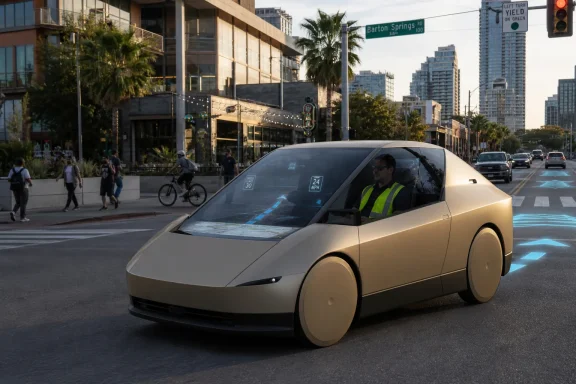
The Cybercab has always been less a car than a declaration of intent. By deleting the steering wheel and pedals, Tesla is not merely hiding manual controls behind a futuristic cabin design; it is saying that human fallback is no longer part of the product thesis. That is a much larger claim than “our driver assistance system is improving,” and it deserves to be treated as such.
The Austin tests appear to be engineering trials rather than a commercial launch. The presence of a safety monitor in the passenger seat matters because it places the vehicle in a transitional category: visually radical, operationally cautious. Tesla is testing the world it wants to sell while still carrying a human witness to the world it has not yet conquered.
That distinction will be easy to blur, especially because Tesla’s public communications tend to compress prototypes, pilots, and product roadmaps into a single story of inevitable progress. But for regulators, insurers, city officials, and the people crossing Austin streets, the difference between autonomous-looking and fully autonomous is everything. A car without controls concentrates responsibility in the software stack, the remote support system, the validation process, and the company that chose to remove the fallback.
The Cybercab’s arrival also changes the optics of Tesla’s robotaxi push. Modified Model Ys, even when operating with limited or no conventional driver intervention, still look like cars that could be rescued by a human. The Cybercab looks like the rescue option has been designed out.
The Regulatory Door Is Opening Just as Tesla Reaches for the Handle
The timing is not accidental. Days before the Austin reports, the National Highway Traffic Safety Administration began a rulemaking process aimed at removing a federal requirement for manual brake pedals in vehicles designed to be driven exclusively by automated driving systems. That proposal does not legalize every futuristic pod overnight, but it signals that Washington is preparing safety rules for vehicles that do not assume a human driver exists.
For Tesla, this is a potentially enormous tailwind. A purpose-built Cybercab with no steering wheel and no pedals cannot scale nationally if federal motor vehicle standards still treat human controls as mandatory hardware. If the rule is finalized, the vehicle’s most controversial design choice becomes less of a regulatory exception and more of a category the government has explicitly contemplated.
That does not mean approval is guaranteed. Federal rulemaking can define the shape of compliant vehicles, but it cannot certify that a particular company’s autonomy system is safe in every operating domain. Tesla still must convince regulators, states, municipalities, and ultimately riders that its vehicles can behave predictably without a human driver.
The proposed change also exposes the central tension in autonomous vehicle policy. Regulators want rules that do not freeze innovation around a 20th-century cockpit. Yet removing controls also removes the most intuitive emergency backup the public understands. If a vehicle has no brake pedal, the question shifts from “Can the human stop it?” to “Who, or what, can stop it when the machine is wrong?”
Austin Becomes the Lab for Tesla’s Cheapest and Riskiest Autonomy Thesis
Tesla’s confidence rests on vertical integration and sensor minimalism. The company builds the car, writes the autonomy software, owns the data pipeline, and can theoretically tune the entire system as one product. That is a real strategic advantage if the underlying perception and planning system works well enough.
It is also a large bet against the direction taken by much of the autonomous vehicle industry. Waymo, Zoox, and other robotaxi developers have leaned on lidar, radar, detailed mapping, and layered redundancy to compensate for the brutality of public roads. Tesla’s camera-first approach assumes that vision, neural networks, fleet data, and compute can eventually do what humans do with eyes alone, only more consistently.
The economic attraction is obvious. Lidar-rich robotaxis are expensive machines, and their hardware suites can make scaling a fleet capital-intensive. A Cybercab designed around cameras, simplified controls, and high-volume manufacturing could have lower unit costs if Tesla can manufacture it at scale and avoid expensive retrofits.
But cheap autonomy that is not safe enough is not a disruption; it is a liability engine. The market does not merely reward the company that removes the most hardware. It rewards the company that can operate the most miles, in the most conditions, with the fewest interventions, incidents, and regulatory headaches.
Austin therefore becomes more than a city where Tesla can collect data. It becomes the proving ground for a theory of autonomy that has divided engineers, investors, safety advocates, and Tesla fans for years. If cameras are enough, Tesla’s cost structure could pressure the entire robotaxi sector. If they are not, the Cybercab’s elegant empty cockpit becomes a very expensive admission that the missing hardware mattered.
The Passenger-Seat Monitor Is the Most Important Person in the Car
The safety monitor’s presence undercuts the most breathless interpretation of the test, but it also makes the trial more serious. Tesla is not simply showing that a Cybercab can move through Austin. It is gathering evidence about how often the vehicle hesitates, misreads, routes awkwardly, needs remote support, or encounters edge cases that do not appear in clean launch videos.
In a conventional test vehicle, a safety driver can grab the wheel or hit the brake. In a vehicle designed without those controls, the supervision model becomes more abstract. The fallback might be an emergency stop button, a remote-assistance workflow, a preplanned minimal-risk maneuver, or a combination of all three. Each layer must be tested not only for technical function but for timing, clarity, and operational discipline.
That matters because autonomy failures are rarely cinematic. They are often mundane: a confusing construction zone, a blocked lane, a poorly marked turn, a cyclist behaving unpredictably, a pedestrian hesitating at the curb, a police officer directing traffic by hand. A safe robotaxi must handle not only the rules of the road but the improvisational social contract that makes roads work when the rules run out.
The monitor’s role also reveals the gap between engineering confidence and public trust. Tesla may believe its system is approaching commercial readiness. But the public will judge the Cybercab by the moment it does something strange in front of a dashcam, a cyclist, or a local news crew.
Tesla’s Robotaxi Story Has Moved from Promise to Exposure
For a decade, Tesla’s autonomy narrative benefited from distance. The company could promise a coming network in which owners would send cars out to earn money, margins would expand, and the installed fleet would become a rolling software platform. The idea was intoxicating because it transformed Tesla from a carmaker into a transportation network without requiring it to own every vehicle in the network.
The Cybercab is a different kind of promise. It is not an owner’s Model 3 moonlighting after dinner. It is a dedicated robotaxi whose business case depends on high utilization, low cost, low maintenance, and very high confidence in unsupervised operation. That makes it a purer product and a harsher test.
The earlier Model Y robotaxi pilots gave Tesla a way to ease into service with familiar hardware. The Cybercab removes that ambiguity. If the vehicle is visibly built around a world without drivers, every intervention, pause, awkward pickup, or reported incident carries more symbolic weight.
That is both Tesla’s opportunity and its danger. The company has always been unusually skilled at turning public experiments into brand theater. But robotaxis are not consumer gadgets where early adopters can tolerate weirdness as the price of novelty. A ride-hailing vehicle is part of the public transportation fabric, and the tolerance for failure is lower because the risk is shared with everyone nearby.
Waymo Is Not Just a Rival; It Is the Control Group
The obvious comparison is Waymo, and Tesla invites it. Waymo’s approach is expensive, sensor-heavy, and methodical. Tesla’s is cheaper, camera-centric, and rhetorically impatient. One looks like a robotics company operating a transportation service; the other looks like a car company trying to convert manufacturing scale into autonomy scale.
Waymo’s advantage is that it has already normalized the sight of driverless vehicles in several markets. Its vehicles are not perfect, and they have faced scrutiny, but the company has accumulated the operational experience that only comes from running a service in public. That experience includes handling pickup zones, rider behavior, emergency vehicles, weather variability, fleet cleaning, dispatch systems, and the thousand dull details that separate a demo from a business.
Tesla’s advantage, if it materializes, is cost and speed. A cheaper purpose-built vehicle could let Tesla deploy far more robotaxis if regulators allow it and if the autonomy stack can keep up. The company’s massive consumer fleet has also given it a data story that rivals cannot easily copy, though the relevance of driver-assistance data to fully driverless operation remains a matter of debate.
The Cybercab’s Austin tests will not settle that debate by themselves. But they will sharpen it. Every mile becomes a referendum on whether Tesla can skip some of the expensive redundancy its rivals consider essential, or whether that redundancy is precisely what makes commercial autonomy credible.
The WindowsForum Angle Is Infrastructure, Not Just Cars
It may seem odd for a Windows-focused community to care about a gold two-seat robotaxi rolling through Texas. But the Cybercab is fundamentally an edge-computing, safety-critical, network-managed machine in the same way that modern factories, hospitals, and campuses are becoming fleets of managed endpoints. The vehicle is the visible object; the operational stack is the real story.
For IT pros, the relevant questions are familiar even if the wheels are new. How is the fleet updated? How are incidents logged? What telemetry is retained? How are remote-support actions authenticated and audited? What happens when connectivity drops, a certificate expires, a backend service fails, or a software rollout behaves differently in one city than in another?
Autonomous vehicles also turn cybersecurity into physical safety. A compromised laptop leaks data; a compromised robotaxi can block traffic, endanger passengers, or become a tool for surveillance and disruption. That does not mean Tesla’s Cybercab is uniquely vulnerable, but it means the security model must be judged like critical infrastructure, not like a phone app.
There is also a software governance lesson here. Tesla’s culture prizes rapid iteration, but safety-critical transportation demands disciplined release management, regression testing, incident response, and a sober relationship with telemetry. The closer the Cybercab gets to commercial deployment, the more it resembles a rolling version of the enterprise systems administrators already know: always updating, always monitored, always one bad assumption away from a major incident.
The Brake Pedal Debate Is Really About Accountability
The proposed federal brake-pedal change will likely be framed as a common-sense modernization. If no human is intended to drive, why require a human-operated brake pedal? On paper, that logic is clean. In practice, the brake pedal is a symbol of accountability as much as a mechanical device.
When a human sits behind a wheel, society knows how to assign blame. The driver, the manufacturer, the road designer, the mechanic, the insurer, and the regulator each occupy recognizable roles. In a Cybercab, those roles blur. The passenger is not the driver, the monitor may not have traditional controls, and the software is the actor that made the decision.
That shift is manageable only if the surrounding system becomes more transparent. Regulators will need access to reliable incident data. Cities will need clear channels for reporting unsafe behavior. Riders will need to know what level of human oversight exists. Investigators will need logs that explain not just what the vehicle did, but what it perceived and why it chose a particular maneuver.
The industry should not pretend that deleting pedals deletes responsibility. It concentrates responsibility upstream. The company that designs the vehicle, trains the system, validates the software, and operates the fleet becomes the driver in every meaningful institutional sense.
The Commercial Dream Still Depends on Boring Operational Details
Tesla’s robotaxi business case is often discussed in grand terms: software margins, asset utilization, fleet scale, and the possibility that cars become revenue-generating robots. Those are real financial stakes. But the Cybercab will live or die by details that sound much less glamorous.
A robotaxi must be available when riders need it. It must find safe pickup and drop-off points. It must handle spilled drinks, vandalism, confused passengers, blocked doors, lost items, emergency stops, and route changes. It must be cleaned, charged, repaired, inspected, and removed from service when something is wrong.
These details matter because autonomy alone is not a transportation service. Waymo’s years of operational work show that the hard part is not just getting a vehicle to drive; it is making the entire system boring enough that people stop thinking about it. Tesla’s challenge is to reach that boring state while moving faster, using fewer sensors, and carrying the burden of its own very public promises.
The Cybercab’s stripped-down design may help. A purpose-built two-seater could be simpler to clean, cheaper to maintain, and easier to deploy in dense service zones than a converted consumer SUV. But it also gives Tesla less room to hide. If a vehicle exists only to be a robotaxi, then every failure is a robotaxi failure.
Austin Will Tell Us Whether the Cybercab Is a Product or a Prop
The next phase will be measured less by flashy videos than by operational texture. How many vehicles are testing? How often do they disengage or require assistance? What routes are included? Do they operate at night, in rain, near schools, through construction, around emergency scenes, and in dense entertainment districts? The answers will matter more than the fact that a steering-wheel-free vehicle can complete a curated drive.
Tesla’s public style tends to reward believers and frustrate skeptics because it often reveals just enough to make both sides feel vindicated. Fans see acceleration toward a long-promised future. Critics see another staged milestone with unresolved safety questions. The Cybercab will make that ambiguity harder to sustain.
A real service will need real boundaries. If Tesla limits the Cybercab to carefully geofenced areas, favorable weather, low-speed routes, or supervised operation, that does not make the project meaningless. It makes it a pilot. The danger is pretending that a pilot is proof of a generalized autonomous network.
The most honest reading is that Tesla has crossed an important engineering threshold without yet crossing the commercial one. A vehicle with no steering wheel and no pedals is now in public-road testing. That is news. Whether it is the beginning of a transportation revolution or another expensive autonomy lesson remains unproven.
The Practical Read for WindowsForum Readers Is Cautious Fascination
The Cybercab’s Austin debut is the kind of moment that rewards neither blind enthusiasm nor reflexive dismissal. Tesla has put a radical vehicle architecture onto public roads at the same time federal regulators are preparing rules that could make such vehicles easier to certify. That combination deserves attention because it may define the next phase of automated transportation.
- Tesla has moved the Cybercab from concept theater into public-road engineering tests, but the presence of a safety monitor means this is not yet a fully unsupervised commercial service.
- The federal brake-pedal rulemaking could remove a major design barrier for purpose-built autonomous vehicles, but it does not prove Tesla’s software is ready for broad deployment.
- Tesla’s camera-only strategy could create a major cost advantage if it works, while sensor-heavy rivals such as Waymo remain the benchmark for operational maturity.
- The missing steering wheel shifts responsibility away from occupants and toward Tesla’s software, validation, remote support, and fleet-management systems.
- The real test will be sustained public operation across messy conditions, not isolated videos of a Cybercab successfully navigating Austin streets.
The Cybercab is now entering the phase where Tesla’s autonomy claims become harder to abstract away. Regulators are moving, rivals are operating, and Austin is becoming a live proving ground for whether a car with no steering wheel can be more than a symbol of confidence. If Tesla can turn these engineering tests into a safe, boring, scalable service, it will have changed the economics of urban mobility; if it cannot, the empty cockpit will stand as a reminder that removing the human driver is easy only in hardware.