

Tesla briefly showed passengers using the Robotaxi app to aim Cybercab’s air vents, then replaced the video with an edit that removed the roughly six-second sequence. The interaction appeared around the 31-second mark in footage announcing fully autonomous employee rides at Gigafactory Texas.
The direct takeaway: the footage showed app-based vent aiming, and the replacement omitted it. It does not confirm that the feature will ship to employees, public riders, or owners of consumer Teslas.
In the original Cybercab video, passengers appeared to open the Robotaxi app on their phones and adjust the direction of cabin airflow. Tesla subsequently replaced the video with an altered version that excluded approximately six seconds containing that interaction.
On July 11, 2026, an account posting as Deus Ex Machina, or @nishkidoonoo, shared a preserved copy of the original and questioned why Tesla had deleted the footage. The supplied material does not include an explanation from Tesla.
The edit is therefore confirmed; its motivation is not.
Tesla may have removed the sequence because it exposed an unannounced feature, showed an unfinished interface, represented a staged interaction, or distracted from the video’s focus on employee rides. Those are possible explanations rather than established facts.
Promotional footage is also not a release note. A control shown in a video may come from a prototype, development build, design mock-up, or demonstration prepared to illustrate an intended experience. The clip alone cannot establish whether the vent responded to a live command, whether the feature is production-ready, or whether Tesla plans to release it in the same form.
What the footage does provide is a narrow but concrete look at one possible Cybercab interaction: a passenger using a phone to control airflow direction from inside the vehicle.
Observers should distinguish between another visual appearance and an actual product commitment. Repeated footage would strengthen the case that this is an intended Cybercab feature, but it still would not establish availability until Tesla describes or releases it.
Another useful signal would be a change to the Robotaxi app itself. Screenshots, release notes, or rider instructions could clarify whether the phone is intended to provide active cabin controls during a trip. Until then, the deleted sequence remains evidence of a depicted interface—not proof of deployment.
That suggests one possible division of interface responsibilities: Cybercab’s 21-inch display could provide a shared cabin surface, while the Robotaxi app could present selected controls directly to an individual rider. The clip supports the existence of the depicted vent interaction, but not a complete passenger-control architecture.
The distinction is especially relevant in a two-seat vehicle. A central display is visible to both occupants, while a phone is operated by one person. App-based vent aiming could therefore offer a direct way to make a comfort adjustment without navigating a shared interface.
Anything beyond that is design analysis. The video does not demonstrate separate passenger profiles, independent climate zones, synchronized phone and vehicle displays, accessibility behavior, or rules for resolving conflicting commands. It also does not show that Tesla is systematically transferring a human driver’s service responsibilities to software.
The reasonable conclusion is limited: Tesla depicted the phone as an in-cabin control surface for one specific comfort function. Whether that interaction is an isolated feature or part of a broader Robotaxi design remains unknown.
This separation avoids turning the Cybercab’s sparse interior into evidence for features the footage did not demonstrate. A large display and limited visible physical hardware may influence Tesla’s interface choices, but they do not reveal the function of every component.
One possibility is simple editorial cleanup. Tesla may have wanted a shorter video or a tighter focus on autonomous employee rides. Another is product-message control: viewers could interpret a briefly shown app function as a promise, even if Tesla considered it experimental or unfinished.
The underlying interaction may also have been illustrative rather than operational. Promotional videos commonly combine real products with development interfaces and staged sequences. Nothing in the supplied material establishes whether the app sent a command to the Cybercab or whether the shot merely represented how Tesla wanted the experience to look.
The replacement edit reduces what can responsibly be claimed. It confirms that Tesla chose not to continue showing the interaction in that video. It does not turn the removed footage into proof of a secret launch plan.
At the same time, the original sequence should not be dismissed. It depicted a specific action rather than a vague graphical concept: passengers used the Robotaxi app to change airflow direction. That makes it relevant evidence when evaluating Tesla’s possible approach to Cybercab comfort controls, provided the evidence is described with its limitations intact.
The footage does not support a broader feature-parity analysis. It does not establish that the two apps use the same controls, vehicle interfaces, authorization model, or development roadmap.
Watch for an explicit app update, release note, support page, or Tesla demonstration involving a consumer vehicle. Until one appears, the main-app connection is speculation rather than a likely next step.
Employee footage could nevertheless answer some of the open questions. A clear demonstration might show whether passengers actually use the Robotaxi app after boarding, whether vent movement corresponds to the phone interaction, and whether the same control also appears on the 21-inch display.
Even then, availability to employees would not automatically mean availability to the public. An employee program may use limited routes, controlled accounts, development software, or vehicles configured differently from a future commercial service. Those possibilities should not be stated as Tesla’s implementation unless the company confirms them.
The central question is therefore not whether the deleted clip “proves” Tesla’s larger Robotaxi strategy. It is whether Tesla shows the same interaction again under conditions that make its status clearer.
For now, administrators can:
That is the confirmed news.
The footage offers a credible glimpse of app-based cabin control, but it is not confirmation that the feature is complete, operational, or scheduled for release. It does not prove availability for Gigafactory Texas employees, future public riders, or consumer Tesla owners. It also does not establish a broader suite of phone-based Cybercab controls.
The next meaningful evidence must come from Tesla documentation, app release information, rider instructions, or a clearer demonstration. Until then, the deleted interaction is best understood as an unannounced interface caught in a promotional edit—and then deliberately left out of the replacement.
The direct takeaway: the footage showed app-based vent aiming, and the replacement omitted it. It does not confirm that the feature will ship to employees, public riders, or owners of consumer Teslas.
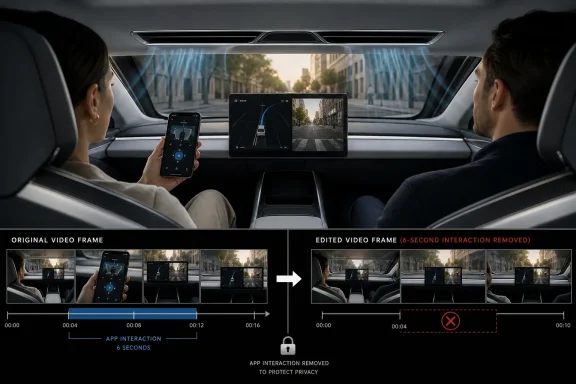 Six Deleted Seconds Show an Unannounced Interface
In the original Cybercab video, passengers appeared to open the Robotaxi app on their phones and adjust the direction of cabin airflow. Tesla subsequently replaced the video with an altered version that excluded approximately six seconds containing that interaction.On July 11, 2026, an account posting as Deus Ex Machina, or @nishkidoonoo, shared a preserved copy of the original and questioned why Tesla had deleted the footage. The supplied material does not include an explanation from Tesla.
The edit is therefore confirmed; its motivation is not.
Tesla may have removed the sequence because it exposed an unannounced feature, showed an unfinished interface, represented a staged interaction, or distracted from the video’s focus on employee rides. Those are possible explanations rather than established facts.
Promotional footage is also not a release note. A control shown in a video may come from a prototype, development build, design mock-up, or demonstration prepared to illustrate an intended experience. The clip alone cannot establish whether the vent responded to a live command, whether the feature is production-ready, or whether Tesla plans to release it in the same form.
What the footage does provide is a narrow but concrete look at one possible Cybercab interaction: a passenger using a phone to control airflow direction from inside the vehicle.
What the Clip Confirms, What It Does Not Confirm, and What to Watch Next
What the clip confirms
- Tesla published Cybercab footage that depicted passengers adjusting vent direction through the Robotaxi app.
- The interaction appeared around 31 seconds into the original video.
- Tesla replaced the video with an edit that omitted the roughly six-second sequence.
- Cybercab has two seats and a 21-inch central display.
- The supplied material identifies one physical door button on each side.
- The main Tesla app does not currently offer phone-based airflow-direction adjustment.
What the clip does not confirm
- That app-based vent aiming will be available during employee rides.
- That the depicted interface was connected to production hardware or a live vehicle command.
- That the feature has completed validation.
- That public Robotaxi passengers will receive the same controls.
- That the feature will reach Tesla’s consumer vehicles or main Tesla app.
- Why Tesla removed the sequence.
- How a rider would be identified or authorized to control the vehicle.
- Whether two passengers could control separate vents or cabin zones.
- What alternatives would exist if a passenger could not use the app.
- Which other Cybercab functions, if any, would be available from a passenger’s phone.
What to watch next
The strongest confirmation would be a Tesla product announcement, support document, app release note, or repeat demonstration in which the function is explicitly identified. Future employee-ride footage may also show whether vent aiming appears in the working cabin interface.Observers should distinguish between another visual appearance and an actual product commitment. Repeated footage would strengthen the case that this is an intended Cybercab feature, but it still would not establish availability until Tesla describes or releases it.
Another useful signal would be a change to the Robotaxi app itself. Screenshots, release notes, or rider instructions could clarify whether the phone is intended to provide active cabin controls during a trip. Until then, the deleted sequence remains evidence of a depicted interface—not proof of deployment.
A Small Control With a Larger Design Implication
Airflow direction is normally adjusted through a physical vent control or an in-vehicle interface. The deleted Cybercab footage instead placed that interaction on the passenger’s phone.That suggests one possible division of interface responsibilities: Cybercab’s 21-inch display could provide a shared cabin surface, while the Robotaxi app could present selected controls directly to an individual rider. The clip supports the existence of the depicted vent interaction, but not a complete passenger-control architecture.
The distinction is especially relevant in a two-seat vehicle. A central display is visible to both occupants, while a phone is operated by one person. App-based vent aiming could therefore offer a direct way to make a comfort adjustment without navigating a shared interface.
Anything beyond that is design analysis. The video does not demonstrate separate passenger profiles, independent climate zones, synchronized phone and vehicle displays, accessibility behavior, or rules for resolving conflicting commands. It also does not show that Tesla is systematically transferring a human driver’s service responsibilities to software.
The reasonable conclusion is limited: Tesla depicted the phone as an in-cabin control surface for one specific comfort function. Whether that interaction is an isolated feature or part of a broader Robotaxi design remains unknown.
Confirmed Cybercab Details Versus Open Questions
The supplied material supports only a small set of cabin details. Claims about additional controls or their functions should not be inferred from the minimalist appearance alone.| Item | Supported by the supplied material | Not established |
|---|---|---|
| Seating | Cybercab has two seats | How controls are assigned when two passengers are present |
| Central display | Cybercab has a 21-inch display | Every function handled by that display |
| Physical controls | One physical door button is present on each side | Whether that button can request a pull-over or perform other software actions |
| Vent interaction | The original video depicted phone-based vent-direction adjustment | Whether the command was live, final, or production-ready |
| Video change | The replacement omitted the roughly six-second interaction | Tesla’s reason for making the edit |
| Employee rides | The video concerned fully autonomous employee rides at Gigafactory Texas | Whether the vent feature will be enabled for those riders |
| Consumer app | The main Tesla app does not currently provide phone-based vent aiming | Whether Tesla plans to add it |
| Wider passenger controls | No broader set was confirmed by the clip | Entertainment, door, destination, or ride-management functions available through the phone |
The Deletion Is Newsworthy, but It Is Not a Product Announcement
The most defensible interpretation is that Tesla’s first edit revealed an interface the company was not prepared to leave in the final video. The decision to remove it may indicate sensitivity around the feature, but it does not explain the reason for that sensitivity.One possibility is simple editorial cleanup. Tesla may have wanted a shorter video or a tighter focus on autonomous employee rides. Another is product-message control: viewers could interpret a briefly shown app function as a promise, even if Tesla considered it experimental or unfinished.
The underlying interaction may also have been illustrative rather than operational. Promotional videos commonly combine real products with development interfaces and staged sequences. Nothing in the supplied material establishes whether the app sent a command to the Cybercab or whether the shot merely represented how Tesla wanted the experience to look.
The replacement edit reduces what can responsibly be claimed. It confirms that Tesla chose not to continue showing the interaction in that video. It does not turn the removed footage into proof of a secret launch plan.
At the same time, the original sequence should not be dismissed. It depicted a specific action rather than a vague graphical concept: passengers used the Robotaxi app to change airflow direction. That makes it relevant evidence when evaluating Tesla’s possible approach to Cybercab comfort controls, provided the evidence is described with its limitations intact.
Robotaxi App and Main Tesla App: Keep the Comparison Narrow
The supplied material supports one direct app comparison: the Robotaxi footage showed phone-based vent aiming, while the main Tesla app does not currently offer airflow-direction adjustment.| Question | Robotaxi app in the original footage | Main Tesla app |
|---|---|---|
| Was phone-based vent aiming shown? | Yes | Not currently offered |
| Is release status confirmed? | No | Not applicable because the feature is not currently available |
| Is the interaction tied to Cybercab? | It was depicted inside a Cybercab | No Cybercab connection is established |
| Is wider climate-function parity established? | No | No comparison can be made from the supplied facts |
| Is a future crossover confirmed? | No | No |
Consumer-app watch item
Phone-based vent aiming could eventually become relevant to the main Tesla app, but the supplied evidence provides no rollout path. Cybercab may use different hardware or software, and Tesla may consider the interaction specific to Robotaxi passengers.Watch for an explicit app update, release note, support page, or Tesla demonstration involving a consumer vehicle. Until one appears, the main-app connection is speculation rather than a likely next step.
Employee Rides May Provide the Next Useful Evidence
Tesla framed the video around plans for fully autonomous Cybercab rides for employees at Gigafactory Texas. The supplied material does not confirm whether the removed vent control will be part of those rides.Employee footage could nevertheless answer some of the open questions. A clear demonstration might show whether passengers actually use the Robotaxi app after boarding, whether vent movement corresponds to the phone interaction, and whether the same control also appears on the 21-inch display.
Even then, availability to employees would not automatically mean availability to the public. An employee program may use limited routes, controlled accounts, development software, or vehicles configured differently from a future commercial service. Those possibilities should not be stated as Tesla’s implementation unless the company confirms them.
The central question is therefore not whether the deleted clip “proves” Tesla’s larger Robotaxi strategy. It is whether Tesla shows the same interaction again under conditions that make its status clearer.
Timeline
The supplied material does not provide enough information to build a precise chronology around every event. In particular, “yesterday” lacks a calendar date and should not be positioned as definitively before or after the July 11 post.- Undated in the supplied material: Tesla posted a video announcing plans for fully autonomous Cybercab rides for employees at Gigafactory Texas. The original version included roughly six seconds depicting Robotaxi-app vent control.
- After the original appeared: Tesla replaced the video with an edit that omitted that interaction. The supplied facts do not provide an exact replacement time.
- July 11, 2026: Deus Ex Machina, posting as @nishkidoonoo, shared a preserved copy and publicly questioned why the footage had been removed.
Action Checklist for Admins
Organizations evaluating Cybercab or another app-mediated transportation service should avoid building mobile-device policy around the deleted footage. No enterprise requirements or technical dependencies can be established from the clip.For now, administrators can:
- Treat app-based vent aiming as an unconfirmed feature rather than a deployment requirement.
- Wait for Tesla to publish supported-device, operating-system, account, and app-version requirements.
- Ask whether essential ride functions remain available without a passenger’s personal phone.
- Request documentation identifying which controls are available in the app, on the 21-inch display, and through physical hardware.
- Confirm accessibility options only through official product documentation or a supervised demonstration.
- Separate observations made in promotional footage from features included in an employee pilot or commercial service.
- Record the exact app and vehicle software versions used in any future organizational evaluation.
- Avoid attributing a failed interaction to mobile management, connectivity, authentication, or Tesla infrastructure without diagnostic evidence.
- Define a support boundary only after Tesla explains whether passenger-device problems are handled by the transportation operator, the organization, or another provider.
- Revisit mobile-device policies if Tesla confirms that a personal or managed phone is required for particular in-cabin controls.
The Bottom Line
Tesla briefly published Cybercab footage showing passengers aiming air vents through the Robotaxi app. It then replaced the video with an edit that removed the roughly six-second sequence.That is the confirmed news.
The footage offers a credible glimpse of app-based cabin control, but it is not confirmation that the feature is complete, operational, or scheduled for release. It does not prove availability for Gigafactory Texas employees, future public riders, or consumer Tesla owners. It also does not establish a broader suite of phone-based Cybercab controls.
The next meaningful evidence must come from Tesla documentation, app release information, rider instructions, or a clearer demonstration. Until then, the deleted interaction is best understood as an unannounced interface caught in a promotional edit—and then deliberately left out of the replacement.
References
- Primary source: Not a Tesla App
Published: Sat, 11 Jul 2026 21:23:00 GMT
Tesla Cybercab Will Let You Change Air Vent Direction From the App - Not a Tesla App
Tesla may have just accidentally revealed a pretty slick software feature designed for its upcoming purpose-built robotaxi vehiclewww.notateslaapp.com - Related coverage: techcrunch.com
Tesla starts testing Cybercab without pedals or a steering wheel in Austin | TechCrunch
The company may finally be ready to try to deliver on Elon Musk's years-long promise of launching a robotaxi network of its own.techcrunch.com - Related coverage: autoblog.com
- Related coverage: blazetrends.com
Tesla Cybercab Hits Austin Streets: Steering-Wheel-Less Vehicles Begin Public Road Tests
Tesla has officially begun public road tests of its 1,412 kg steering-wheel-less Cybercab in Austin using human safety monitors. blazetrends.com
- Related coverage: dps.texas.gov
- Related coverage: electrek.co
Tesla rolls first steering wheel-less Cybercab unit off the line before solving autonomy | Electrek
Tesla shared today that the first Cybercab production unit has rolled off the assembly line at Gigafactory Texas. The vehicle...electrek.co
- Related coverage: expressnews.com
- Related coverage: techeblog.com
Tesla's Steering-Wheel-Less Cybercab Rolls Out in Austin - TechEBlog
On December 18th, a gleaming new Tesla Cybercab slowly emerged from an underground parking lot in downtown Austin, Texas, and...www.techeblog.com - Related coverage: techspot.com
Tesla moves Cybercab from concept to factory floor, but lowers expectations for robotaxis | TechSpot
The compact two-seat EV is designed from the ground up to operate without human controls, with no steering wheel, pedals, mirrors, or conventional driver interface in the...www.techspot.com - Related coverage: thenextweb.com
Tesla starts testing its production Cybercab without steering wheel or pedals in Austin
Tesla has begun engineering tests of its production Cybercab in Austin with no steering wheel or pedals, a safety monitor riding in the passenger seat.thenextweb.com - Related coverage: eweek.com
Elon Musk’s Driverless Cybercab Finally Hits Public Roads | eWeek
Tesla is testing its steering-wheel-free Cybercab in Austin as new federal rules could ease the deployment of autonomous vehicles without manual controls. www.eweek.com
- Related coverage: eletric-vehicles.com
Tesla Begins Engineering Tests of First Production Cybercab in Austin | EV
Tesla said on Tuesday it had begun engineering tests of its first production Cybercab on public roads in Austin.eletric-vehicles.com - Related coverage: tesla.com
- Related coverage: ir.tesla.com
- Related coverage: techradar.com
Tesla hails the arrival of its first Cybercab – meanwhile, its Robotaxis are crashing four times more than human drivers | TechRadar
The Robotaxi has clocked up 14 incidents since it launchedwww.techradar.com - Related coverage: time.com
What to Know About Tesla’s ‘Robotaxis’
The company began a test run of the driverless cabs in Austin on Sunday, years after CEO Elon Musk vowed they would be on the road.time.com - Related coverage: lemonde.fr
Tesla's new horizon: The robotaxi
With the Cybercab, Elon Musk aims to outline a new future for the US carmaker, which is currently struggling.www.lemonde.fr - Related coverage: x.com
Not a Tesla App on X: "First Tesla Cybercab Rolls Off Production Line at Giga Texas https://t.co/Vkpjjgs1h9 https://t.co/fW4GoZW1AZ" / X
First Tesla Cybercab Rolls Off Production Line at Giga Texas https://t.co/Vkpjjgs1h9x.com
