

Tesla’s Full Self-Driving software was tested in Los Angeles on June 14, 2026, in a 2026 Model 3 Premium AWD, with Forbes reporting a no-intervention drive through freeway congestion, Burbank surface streets, and a truck-lane-drift near-miss. The result is not proof that Tesla has solved autonomy, but it is evidence that the company’s consumer system is entering a politically awkward middle zone: legally supervised, behaviorally chauffeur-like, and increasingly difficult for ordinary drivers to categorize. That gap between what the car does and what the label permits may become the next great fight in automated driving. Tesla is not merely improving a driver-assistance feature; it is stress-testing the language regulators, insurers, rivals, and customers use to describe control.
The Forbes test matters because it describes something more consequential than a clean demo route. Los Angeles traffic is not a proving-ground ballet; it is a hostile mix of lane changes, distracted humans, unpredictable merging, faded road markings, and impatient drivers who treat turn signals as classified information. A system that can handle that environment without intervention feels qualitatively different from adaptive cruise control with lane centering.
That is precisely why the language around Tesla Full Self-Driving has become so strained. Tesla still calls the feature Full Self-Driving (Supervised), and its own user-facing materials continue to say the driver must remain attentive and ready to take over. In SAE terms, that keeps it in the Level 2 family: the human is driving, even when the car is doing the steering, braking, acceleration, navigation, and many of the tactical decisions.
But the experience described by Forbes is not how Level 2 was originally sold to the public. The traditional mental model for Level 2 was a feature that made highway driving less tiring: the car stayed centered, kept distance, maybe changed lanes when asked, and complained when the driver’s hands left the wheel. The newest Tesla experience, as described in this test, is point-to-point driving in mixed traffic where the human increasingly becomes a monitor rather than a pilot.
That distinction sounds academic until something goes wrong. If the car feels like a robotaxi but the legal responsibility remains with the driver, the product has crossed into an uncomfortable zone. The software may be improving faster than the social contract around it.
For years, critics could point to the gap between Tesla’s name and Tesla’s reality. “Full Self-Driving” was not full self-driving. It required supervision, made mistakes, and could occasionally behave in ways that demanded immediate human correction. That critique remains technically correct, but it is no longer sufficient on its own.
The Forbes account describes a system that did not merely stay in lane on a clean freeway. It navigated congestion, downtown Burbank, and an apparent side-swipe risk from a drifting truck. The human driver reportedly prepared to take over, but the car made the evasive steering decision first. That is the kind of moment that changes a user’s trust model.
One successful anecdote does not equal statistical safety. Still, consumer perception is built out of anecdotes, especially when the anecdote happens from the driver’s seat. A thousand miles of boring competence can do more to reshape user behavior than a thousand pages of safety taxonomy.
SAE Level 2 means the system can control steering and speed, but the driver must supervise continuously. Level 4 means the automated system performs the driving task within its operating domain, and the human does not need to supervise. The gap is not about whether the car can make a left turn or avoid a drifting truck. It is about who is responsible for the driving task when the system is engaged.
This is where Tesla’s progress creates a paradox. The better FSD becomes, the more the driver’s supervisory role becomes both easier and harder. Easier, because the car may handle long stretches without requiring input. Harder, because humans are notoriously bad at monitoring a system that usually works and then suddenly demands rapid intervention.
Airline pilots train for automation management. Consumer drivers do not. They subscribe to a feature, watch it work, and gradually adapt their attention to the system’s apparent competence. The legal disclaimer says “supervise,” but the seat-of-the-pants experience says “ride.”
That is why the transition from supervised to unsupervised autonomy is not a simple software release. It is a liability transfer. It is a regulatory claim. It is a safety case. And for Tesla, it is the difference between selling a powerful ADAS package and operating something that regulators can treat as an automated driving system.
Waymo’s model is cautious, expensive, and geographically constrained. Its vehicles operate in defined areas, with a stack designed from the outset for driverless service. That approach frustrates people who want autonomy everywhere, but it gives regulators and passengers a clearer accountability model. If a Waymo ride goes wrong, there is no driver in the front seat for the company to point to.
Tesla’s model is the inverse. It scales broadly because the human remains part of the safety architecture. That makes the system more available, more affordable to deploy, and more visible in everyday traffic. It also means the boundary between product capability and user responsibility is constantly negotiated in real time.
The Forbes test captures the reason Tesla’s approach has survived so much skepticism. If a privately owned Model 3 can complete a difficult Los Angeles drive with no intervention, the public will not care much about operational design domains or sensor philosophy. They will see a car doing robotaxi-like work.
But “like” is the operative word. A de facto robotaxi is not the same as a certified robotaxi. The former is a user impression; the latter is a legal and operational status. Tesla may be narrowing the experiential gap, but the institutional gap remains large.
Yet that same example cuts both ways. The moment demonstrates capability, but it also demonstrates the speed at which responsibility can become ambiguous. If the car had reacted late, was the driver expected to have already taken over? If the driver looked away for a moment because the system had been performing well, how should that be judged? If the system avoided the crash, does that encourage the next driver to trust it more than they should?
These are not anti-Tesla questions. They are automation questions. Every high-performing driver-assistance system faces the same problem once it becomes good enough to lull the human out of active participation. The better the machine is, the more dramatic the rare failure becomes.
Tesla’s supporters often frame the issue as a comparison with distracted human drivers. That is a fair comparison in one sense: human driving kills at a scale that should make society eager for better systems. But it is not the only comparison that matters. The correct policy question is not whether FSD can outperform a bad driver in a viral clip; it is whether the combined human-machine system is safer, more predictable, and more accountable across millions of trips.
Rivian has reasons to move carefully. Its brand depends on trust, adventure, and premium execution rather than maximalist software bravado. But it also cannot ignore the market Tesla has created. If buyers begin to expect point-to-point supervised autonomy in premium EVs, highway-only systems will feel dated, no matter how polished they are.
General Motors’ Super Cruise remains one of the most trusted hands-free systems in the United States, particularly because it emphasizes mapped roads and driver monitoring. Ford’s BlueCruise follows a similar highway-first logic. These systems trade breadth for clarity. They are not trying to drive everywhere, and that restraint is part of their safety pitch.
Tesla has forced a harder question: what if the broader, messier system becomes good enough before the cautious systems expand beyond their comfort zones? If that happens, competitors will face a marketing problem even if their safety cases are cleaner. Consumers often reward the feature that feels magical, not the feature that is easiest to explain to a regulator.
The latest performance improvements make that contradiction more visible, not less. When FSD was obviously imperfect, critics could say the name was misleading because the product did not drive well enough. As it improves, a different critique emerges: the name may become misleading because the product drives well enough to make supervision feel optional.
That is a more subtle and more dangerous problem. A bad system reminds you to distrust it. A very good system invites you to relax. The driver-monitoring system can mitigate that risk, but it cannot rewrite human psychology.
Tesla’s challenge is that its marketing ambition and safety disclaimers point in opposite directions. The company wants customers, investors, and the press to see a road to robotaxis. It also wants regulators and courts to understand that today’s consumer product requires human responsibility. Those positions can coexist only while everyone agrees that supervised FSD is not actually driverless.
The Forbes test pushes against that compromise. “De facto robotaxi” is a powerful phrase because it captures what users feel rather than what lawyers certify. Once that feeling spreads, Tesla may find that its biggest communications problem is no longer convincing people FSD works. It may be convincing them that they are still driving.
That is the same story enterprise IT has lived through with cloud management, endpoint security, patch orchestration, identity governance, and AI-assisted coding. A system that usually does the right thing can reduce toil and improve consistency. It can also create brittle complacency if operators stop understanding the process it automates.
Tesla FSD is a physical-world version of that same operational dilemma. The car is not merely giving recommendations; it is executing decisions with kinetic consequences. The human is still the accountable operator, but the machine is increasingly the active agent.
This makes driver monitoring the equivalent of observability. It is not enough for the system to perform well under normal conditions. It must also know when the human is disengaged, when the environment is outside expected parameters, and when control needs to be transferred in a way the human can realistically handle.
The lesson from IT is that automation without a clean escalation model eventually fails in surprising ways. Tesla’s supervised FSD may be technically impressive, but its long-term safety will depend on whether the handoff between machine confidence and human responsibility is engineered as carefully as the driving policy itself.
That is not unique to Tesla, but Tesla’s software cadence makes it especially acute. A traditional vehicle defect is tied to a component or a model year. A software-defined driving feature is tied to version numbers, fleet configuration, camera hardware, monitoring policies, and neural-network behavior that may evolve repeatedly over the life of the vehicle.
The Forbes test mentions FSD v14.3.3 and notes that v14.3.4 is already reaching some users. That small version-step detail matters. The public debate tends to talk about “FSD” as if it were one thing. In practice, it is a moving target.
For regulators, the question becomes whether oversight should focus on feature names, capabilities, incident data, or deployment conditions. A static approval model struggles with a system that changes behavior over the air. A pure self-certification model asks the public to trust the company that benefits from rapid deployment.
The most likely future is a more data-driven regime: reporting requirements, standardized disengagement or intervention metrics, clearer definitions for supervised versus unsupervised operation, and tighter scrutiny of marketing claims. Tesla may dislike that direction, but a system that feels like a robotaxi while legally remaining driver assistance is exactly the kind of product that forces regulators to sharpen definitions.
That turns vehicle telemetry into legal evidence. Tesla vehicles already collect extensive data, and modern cars increasingly resemble rolling forensic platforms. The more capable FSD becomes, the more important those logs become for assigning responsibility.
This is another area where the robotaxi comparison becomes uncomfortable. In a true driverless service, the operator owns the driving system. In supervised FSD, the customer owns the car, activates the feature, monitors it, and remains responsible for intervention. That structure may be legally coherent, but it will feel strange to a driver who spent the trip watching the vehicle make nearly every decision.
Liability pressure could shape behavior faster than regulation. If insurers begin distinguishing between types of automation use, or if court cases clarify what counts as reasonable supervision, the practical boundaries of FSD could become more concrete. Tesla’s software may decide when to merge, but insurers may decide how expensive it is to trust the merge.
The deeper issue is that responsibility cannot remain permanently vague. Either Tesla’s system is supervised driver assistance, in which case the driver must remain meaningfully engaged, or it is an automated driving system, in which case Tesla must accept a larger share of operational accountability. The gray zone is useful for product rollout, but it is a poor foundation for mass adoption.
The public needs better data than isolated videos, owner testimonials, and company-selected metrics. It needs version-specific performance, context about road types, exposure by miles and scenarios, intervention frequency, crash severity, and comparisons against relevant human baselines. It also needs to separate supervised miles from unsupervised miles, highway miles from urban miles, and ordinary driving from edge cases.
Tesla has often argued from fleet scale, and fleet scale is a legitimate advantage. A company with millions of vehicles can encounter more real-world variability than a tightly geofenced robotaxi fleet. But scale alone does not settle the safety question. Data has to be interpretable, auditable, and specific enough to support public claims.
The danger is that both sides retreat into slogans. Supporters say FSD is already safer than humans. Critics say it is just Level 2 and therefore not autonomous. Neither statement is adequate. The meaningful question is where, when, under what supervision assumptions, and compared with which drivers.
The Forbes test adds a useful datapoint because it is concrete: a route, a version, a city, and a no-intervention outcome. But it should be treated as a field report, not a verdict. The next phase of the autonomy debate needs fewer vibes and more denominators.
That is why the phrase “de facto robotaxi” has strategic weight. If owners increasingly experience their cars as privately operated robotaxis with a human safety monitor, Tesla gains a cultural advantage before it gains full regulatory approval. People become accustomed to the behavior before the legal category catches up.
But there is a trap here. A supervised consumer system can tolerate some ambiguity because a human is present. A robotaxi cannot. The operational standard for taking paying passengers without a driver is different from the standard for assisting an attentive owner.
Tesla’s engineering challenge, then, is not simply to make FSD smoother. It must prove that the system can identify and handle its own limits without relying on a human in the driver’s seat. That includes weather, construction, emergency vehicles, unusual road users, sensor obstruction, map uncertainty, and ambiguous human behavior.
The consumer fleet may accelerate learning, but it cannot erase the last-mile problem of accountability. A robotaxi is not just a car that usually does not need help. It is a car that is designed, approved, insured, and operated on the premise that help from the passenger is not part of the plan.
Professional safety drivers are trained for that task. They learn how to maintain vigilance, anticipate system failures, and take over quickly without overcorrecting. Tesla customers receive warnings, manuals, interface prompts, and experience, but they are still consumers in a retail product.
That mismatch becomes more important as FSD improves. When intervention is frequent, the driver remains mentally engaged because the system demands it. When intervention becomes rare, the driver’s skill at rapid takeover may decay even as confidence increases.
This is the classic automation irony: reliability can breed inattention, and inattention can make rare failures more severe. The solution is not to freeze automation at a less capable state. It is to design the human-machine relationship honestly.
If Tesla wants supervised FSD to remain a consumer product, it must keep supervision real rather than ceremonial. If it wants to move to unsupervised autonomy, it must remove the driver from the safety case. The middle ground can be commercially useful, but it is not psychologically stable.
The concrete implications are now hard to ignore.
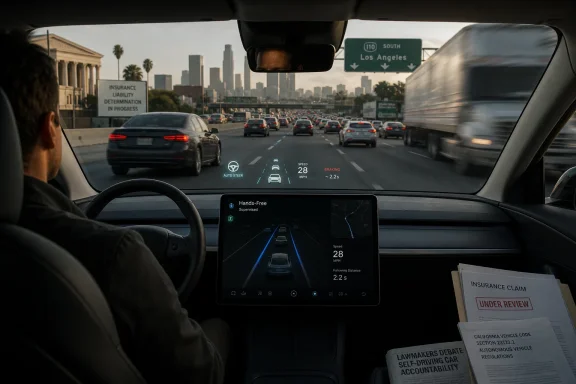 Tesla’s Most Dangerous Competitor Is Now the Definition of “Driving”
The Forbes test matters because it describes something more consequential than a clean demo route. Los Angeles traffic is not a proving-ground ballet; it is a hostile mix of lane changes, distracted humans, unpredictable merging, faded road markings, and impatient drivers who treat turn signals as classified information. A system that can handle that environment without intervention feels qualitatively different from adaptive cruise control with lane centering.That is precisely why the language around Tesla Full Self-Driving has become so strained. Tesla still calls the feature Full Self-Driving (Supervised), and its own user-facing materials continue to say the driver must remain attentive and ready to take over. In SAE terms, that keeps it in the Level 2 family: the human is driving, even when the car is doing the steering, braking, acceleration, navigation, and many of the tactical decisions.
But the experience described by Forbes is not how Level 2 was originally sold to the public. The traditional mental model for Level 2 was a feature that made highway driving less tiring: the car stayed centered, kept distance, maybe changed lanes when asked, and complained when the driver’s hands left the wheel. The newest Tesla experience, as described in this test, is point-to-point driving in mixed traffic where the human increasingly becomes a monitor rather than a pilot.
That distinction sounds academic until something goes wrong. If the car feels like a robotaxi but the legal responsibility remains with the driver, the product has crossed into an uncomfortable zone. The software may be improving faster than the social contract around it.
The No-Intervention Drive Is the Story Tesla Wanted All Along
Tesla’s autonomy strategy has always rested on a bet that broad deployment would beat narrow perfection. Waymo fenced itself into carefully mapped operating areas, layered its vehicles with sensor redundancy, and built a service around removing the driver. Tesla pushed software to customer cars, leaned hard on cameras and neural networks, and kept the driver in the loop while collecting real-world exposure at enormous scale.For years, critics could point to the gap between Tesla’s name and Tesla’s reality. “Full Self-Driving” was not full self-driving. It required supervision, made mistakes, and could occasionally behave in ways that demanded immediate human correction. That critique remains technically correct, but it is no longer sufficient on its own.
The Forbes account describes a system that did not merely stay in lane on a clean freeway. It navigated congestion, downtown Burbank, and an apparent side-swipe risk from a drifting truck. The human driver reportedly prepared to take over, but the car made the evasive steering decision first. That is the kind of moment that changes a user’s trust model.
One successful anecdote does not equal statistical safety. Still, consumer perception is built out of anecdotes, especially when the anecdote happens from the driver’s seat. A thousand miles of boring competence can do more to reshape user behavior than a thousand pages of safety taxonomy.
Level 2 Is Becoming a Legal Category, Not a User Experience
The most important sentence in the Tesla autonomy debate is not “the car drove itself.” It is “the driver is still responsible.” That sentence separates Tesla’s consumer FSD from a true robotaxi, and it is the sentence that every user must keep in mind no matter how convincing the software becomes.SAE Level 2 means the system can control steering and speed, but the driver must supervise continuously. Level 4 means the automated system performs the driving task within its operating domain, and the human does not need to supervise. The gap is not about whether the car can make a left turn or avoid a drifting truck. It is about who is responsible for the driving task when the system is engaged.
This is where Tesla’s progress creates a paradox. The better FSD becomes, the more the driver’s supervisory role becomes both easier and harder. Easier, because the car may handle long stretches without requiring input. Harder, because humans are notoriously bad at monitoring a system that usually works and then suddenly demands rapid intervention.
Airline pilots train for automation management. Consumer drivers do not. They subscribe to a feature, watch it work, and gradually adapt their attention to the system’s apparent competence. The legal disclaimer says “supervise,” but the seat-of-the-pants experience says “ride.”
That is why the transition from supervised to unsupervised autonomy is not a simple software release. It is a liability transfer. It is a regulatory claim. It is a safety case. And for Tesla, it is the difference between selling a powerful ADAS package and operating something that regulators can treat as an automated driving system.
Waymo Still Owns the Cleaner Robotaxi Argument
Comparing Tesla FSD with Waymo is tempting because both can produce the same passenger feeling: the car is moving through the city without your hands or feet doing anything. But the resemblance hides a structural difference. Waymo is a service built around driverless operation; Tesla FSD is a consumer feature built around supervised automation.Waymo’s model is cautious, expensive, and geographically constrained. Its vehicles operate in defined areas, with a stack designed from the outset for driverless service. That approach frustrates people who want autonomy everywhere, but it gives regulators and passengers a clearer accountability model. If a Waymo ride goes wrong, there is no driver in the front seat for the company to point to.
Tesla’s model is the inverse. It scales broadly because the human remains part of the safety architecture. That makes the system more available, more affordable to deploy, and more visible in everyday traffic. It also means the boundary between product capability and user responsibility is constantly negotiated in real time.
The Forbes test captures the reason Tesla’s approach has survived so much skepticism. If a privately owned Model 3 can complete a difficult Los Angeles drive with no intervention, the public will not care much about operational design domains or sensor philosophy. They will see a car doing robotaxi-like work.
But “like” is the operative word. A de facto robotaxi is not the same as a certified robotaxi. The former is a user impression; the latter is a legal and operational status. Tesla may be narrowing the experiential gap, but the institutional gap remains large.
The Truck Incident Shows Why Good Automation Is Not the Same as Safe Deployment
The near-miss described in the Forbes test is the kind of example Tesla supporters will seize on, and understandably so. A truck drifted toward the Model 3’s lane, the driver prepared to intervene, and FSD reportedly steered around it without needing help. In isolation, that is exactly what advanced driver assistance should do: compensate for a human mistake and reduce crash risk.Yet that same example cuts both ways. The moment demonstrates capability, but it also demonstrates the speed at which responsibility can become ambiguous. If the car had reacted late, was the driver expected to have already taken over? If the driver looked away for a moment because the system had been performing well, how should that be judged? If the system avoided the crash, does that encourage the next driver to trust it more than they should?
These are not anti-Tesla questions. They are automation questions. Every high-performing driver-assistance system faces the same problem once it becomes good enough to lull the human out of active participation. The better the machine is, the more dramatic the rare failure becomes.
Tesla’s supporters often frame the issue as a comparison with distracted human drivers. That is a fair comparison in one sense: human driving kills at a scale that should make society eager for better systems. But it is not the only comparison that matters. The correct policy question is not whether FSD can outperform a bad driver in a viral clip; it is whether the combined human-machine system is safer, more predictable, and more accountable across millions of trips.
Rivian’s Imitation Is the Industry’s Confession
One of the more revealing details in the Forbes piece is not about Tesla at all. Rivian CEO RJ Scaringe has described the company’s future Autonomy+ direction as something that will “look and feel” similar to Tesla’s FSD. That is not a minor admission from a rival. It is a signal that Tesla’s approach has become the reference point for consumer autonomy, even among companies that prefer different engineering paths.Rivian has reasons to move carefully. Its brand depends on trust, adventure, and premium execution rather than maximalist software bravado. But it also cannot ignore the market Tesla has created. If buyers begin to expect point-to-point supervised autonomy in premium EVs, highway-only systems will feel dated, no matter how polished they are.
General Motors’ Super Cruise remains one of the most trusted hands-free systems in the United States, particularly because it emphasizes mapped roads and driver monitoring. Ford’s BlueCruise follows a similar highway-first logic. These systems trade breadth for clarity. They are not trying to drive everywhere, and that restraint is part of their safety pitch.
Tesla has forced a harder question: what if the broader, messier system becomes good enough before the cautious systems expand beyond their comfort zones? If that happens, competitors will face a marketing problem even if their safety cases are cleaner. Consumers often reward the feature that feels magical, not the feature that is easiest to explain to a regulator.
The Name Still Does Tesla No Favors
Tesla’s naming problem has never gone away. “Full Self-Driving” suggests autonomy to ordinary consumers, while “Supervised” pulls the claim back toward driver assistance. The phrase contains its own contradiction, and Tesla has spent years living inside it.The latest performance improvements make that contradiction more visible, not less. When FSD was obviously imperfect, critics could say the name was misleading because the product did not drive well enough. As it improves, a different critique emerges: the name may become misleading because the product drives well enough to make supervision feel optional.
That is a more subtle and more dangerous problem. A bad system reminds you to distrust it. A very good system invites you to relax. The driver-monitoring system can mitigate that risk, but it cannot rewrite human psychology.
Tesla’s challenge is that its marketing ambition and safety disclaimers point in opposite directions. The company wants customers, investors, and the press to see a road to robotaxis. It also wants regulators and courts to understand that today’s consumer product requires human responsibility. Those positions can coexist only while everyone agrees that supervised FSD is not actually driverless.
The Forbes test pushes against that compromise. “De facto robotaxi” is a powerful phrase because it captures what users feel rather than what lawyers certify. Once that feeling spreads, Tesla may find that its biggest communications problem is no longer convincing people FSD works. It may be convincing them that they are still driving.
For IT Pros, the Autonomy Lesson Looks Familiar
WindowsForum readers may not spend their days tuning neural networks for autonomous vehicles, but the underlying pattern is familiar to anyone who has administered complex systems. Automation almost always arrives first as assistance, then becomes dependency, and finally becomes infrastructure. The dangerous phase is the middle one, where humans still own the outcome but no longer perform most of the task.That is the same story enterprise IT has lived through with cloud management, endpoint security, patch orchestration, identity governance, and AI-assisted coding. A system that usually does the right thing can reduce toil and improve consistency. It can also create brittle complacency if operators stop understanding the process it automates.
Tesla FSD is a physical-world version of that same operational dilemma. The car is not merely giving recommendations; it is executing decisions with kinetic consequences. The human is still the accountable operator, but the machine is increasingly the active agent.
This makes driver monitoring the equivalent of observability. It is not enough for the system to perform well under normal conditions. It must also know when the human is disengaged, when the environment is outside expected parameters, and when control needs to be transferred in a way the human can realistically handle.
The lesson from IT is that automation without a clean escalation model eventually fails in surprising ways. Tesla’s supervised FSD may be technically impressive, but its long-term safety will depend on whether the handoff between machine confidence and human responsibility is engineered as carefully as the driving policy itself.
Regulators Are Chasing a Product That Changes Every Few Weeks
Automated driving regulation has a timing problem. Agencies move through investigations, rulemaking, data requests, and enforcement actions. Tesla moves through over-the-air updates. By the time a regulator has formed a view of one version, owners may already be running another.That is not unique to Tesla, but Tesla’s software cadence makes it especially acute. A traditional vehicle defect is tied to a component or a model year. A software-defined driving feature is tied to version numbers, fleet configuration, camera hardware, monitoring policies, and neural-network behavior that may evolve repeatedly over the life of the vehicle.
The Forbes test mentions FSD v14.3.3 and notes that v14.3.4 is already reaching some users. That small version-step detail matters. The public debate tends to talk about “FSD” as if it were one thing. In practice, it is a moving target.
For regulators, the question becomes whether oversight should focus on feature names, capabilities, incident data, or deployment conditions. A static approval model struggles with a system that changes behavior over the air. A pure self-certification model asks the public to trust the company that benefits from rapid deployment.
The most likely future is a more data-driven regime: reporting requirements, standardized disengagement or intervention metrics, clearer definitions for supervised versus unsupervised operation, and tighter scrutiny of marketing claims. Tesla may dislike that direction, but a system that feels like a robotaxi while legally remaining driver assistance is exactly the kind of product that forces regulators to sharpen definitions.
Insurance and Liability Will Notice Before the Average Buyer Does
The first mainstream battle over FSD may not happen in a showroom or a safety hearing. It may happen in claims handling. When a crash occurs with supervised automation engaged, insurers need to know who did what, when warnings appeared, whether the driver was attentive, and how the software behaved.That turns vehicle telemetry into legal evidence. Tesla vehicles already collect extensive data, and modern cars increasingly resemble rolling forensic platforms. The more capable FSD becomes, the more important those logs become for assigning responsibility.
This is another area where the robotaxi comparison becomes uncomfortable. In a true driverless service, the operator owns the driving system. In supervised FSD, the customer owns the car, activates the feature, monitors it, and remains responsible for intervention. That structure may be legally coherent, but it will feel strange to a driver who spent the trip watching the vehicle make nearly every decision.
Liability pressure could shape behavior faster than regulation. If insurers begin distinguishing between types of automation use, or if court cases clarify what counts as reasonable supervision, the practical boundaries of FSD could become more concrete. Tesla’s software may decide when to merge, but insurers may decide how expensive it is to trust the merge.
The deeper issue is that responsibility cannot remain permanently vague. Either Tesla’s system is supervised driver assistance, in which case the driver must remain meaningfully engaged, or it is an automated driving system, in which case Tesla must accept a larger share of operational accountability. The gray zone is useful for product rollout, but it is a poor foundation for mass adoption.
The Safety Debate Needs Better Numbers Than Viral Drives
A successful Los Angeles drive is compelling journalism. It is not a safety study. That distinction matters even when the anecdote is favorable to Tesla.The public needs better data than isolated videos, owner testimonials, and company-selected metrics. It needs version-specific performance, context about road types, exposure by miles and scenarios, intervention frequency, crash severity, and comparisons against relevant human baselines. It also needs to separate supervised miles from unsupervised miles, highway miles from urban miles, and ordinary driving from edge cases.
Tesla has often argued from fleet scale, and fleet scale is a legitimate advantage. A company with millions of vehicles can encounter more real-world variability than a tightly geofenced robotaxi fleet. But scale alone does not settle the safety question. Data has to be interpretable, auditable, and specific enough to support public claims.
The danger is that both sides retreat into slogans. Supporters say FSD is already safer than humans. Critics say it is just Level 2 and therefore not autonomous. Neither statement is adequate. The meaningful question is where, when, under what supervision assumptions, and compared with which drivers.
The Forbes test adds a useful datapoint because it is concrete: a route, a version, a city, and a no-intervention outcome. But it should be treated as a field report, not a verdict. The next phase of the autonomy debate needs fewer vibes and more denominators.
The Consumer Version May Be Training the Robotaxi Business
Tesla’s robotaxi ambitions have always depended on the idea that consumer FSD and commercial autonomy are not separate worlds. The more the consumer fleet improves, the stronger the argument that Tesla can eventually remove the driver, restrict the operating domain where necessary, and launch a service at scale.That is why the phrase “de facto robotaxi” has strategic weight. If owners increasingly experience their cars as privately operated robotaxis with a human safety monitor, Tesla gains a cultural advantage before it gains full regulatory approval. People become accustomed to the behavior before the legal category catches up.
But there is a trap here. A supervised consumer system can tolerate some ambiguity because a human is present. A robotaxi cannot. The operational standard for taking paying passengers without a driver is different from the standard for assisting an attentive owner.
Tesla’s engineering challenge, then, is not simply to make FSD smoother. It must prove that the system can identify and handle its own limits without relying on a human in the driver’s seat. That includes weather, construction, emergency vehicles, unusual road users, sensor obstruction, map uncertainty, and ambiguous human behavior.
The consumer fleet may accelerate learning, but it cannot erase the last-mile problem of accountability. A robotaxi is not just a car that usually does not need help. It is a car that is designed, approved, insured, and operated on the premise that help from the passenger is not part of the plan.
The Driver Is Becoming a Safety Driver Without the Training
The most uncomfortable truth about supervised FSD is that it turns ordinary owners into something resembling safety drivers. They monitor an experimental-feeling automation stack in public traffic, ready to intervene when the system makes an error or encounters a situation beyond its competence.Professional safety drivers are trained for that task. They learn how to maintain vigilance, anticipate system failures, and take over quickly without overcorrecting. Tesla customers receive warnings, manuals, interface prompts, and experience, but they are still consumers in a retail product.
That mismatch becomes more important as FSD improves. When intervention is frequent, the driver remains mentally engaged because the system demands it. When intervention becomes rare, the driver’s skill at rapid takeover may decay even as confidence increases.
This is the classic automation irony: reliability can breed inattention, and inattention can make rare failures more severe. The solution is not to freeze automation at a less capable state. It is to design the human-machine relationship honestly.
If Tesla wants supervised FSD to remain a consumer product, it must keep supervision real rather than ceremonial. If it wants to move to unsupervised autonomy, it must remove the driver from the safety case. The middle ground can be commercially useful, but it is not psychologically stable.
The Practical Reading of Tesla’s Los Angeles Moment
The newest FSD reports should not be dismissed as fan enthusiasm, nor should they be inflated into a declaration that the robotaxi era has fully arrived. The careful read is more interesting: Tesla appears to be making supervised autonomy feel increasingly driverless, and that creates both a competitive advantage and a governance problem.The concrete implications are now hard to ignore.
- Tesla’s current consumer FSD remains a supervised system, even when it completes complex drives without human intervention.
- A no-intervention urban drive in Los Angeles is a meaningful sign of progress, but it is not a substitute for fleet-wide, version-specific safety data.
- The gap between Level 2 legal responsibility and Level 4 user experience is becoming the central tension in Tesla’s autonomy story.
- Rivian and other automakers now have to respond not only to Tesla’s EV efficiency and charging ecosystem, but to its software-defined driving experience.
- Driver monitoring, liability rules, and insurance evidence may become as important to the future of FSD as neural-network performance.
- The consumer trust problem may flip from “drivers do not believe the system works” to “drivers believe it works well enough to stop supervising.”
References
- Primary source: Forbes
Published: Sun, 14 Jun 2026 14:36:12 GMT
Tested: Tesla FSD Is Evolving Into A De Facto Robotaxi
Tesla Full Self-Driving is getting harder and harder to distinguish from a driverless vehicle. My latest drive required no intervention.www.forbes.com - Related coverage: autos.yahoo.com
Tested: Tesla FSD Is Evolving Into A De Facto Robotaxi
Tesla Full Self-Driving is getting harder and harder to distinguish from a driverless vehicle. My latest drive required no intervention.autos.yahoo.com - Related coverage: tesla.com
- Related coverage: teslarati.com
Tesla Full Self-Driving v14.3.3 driver monitoring: We tested it
Tesla Full Self-Driving v14.3.3 driver monitoring was reportedly scaled back in recent releases, but a new version that was released in the early hours of June 3 aimed to do a better job of keeping those in control of their cars honest, according to release notes. The release notes for FSD...www.teslarati.com - Related coverage: tesla.cn
- Related coverage: teslanorth.com
Tesla Rolls Out FSD V14.3.3 with Spring Update and Faster Smart Summon | TeslaNorth.com
Tesla has begun rolling out its highly anticipated Full Self-Driving (FSD) Supervised V14.3.3 software update, which includes the company's major Spring Update, according to the company. FSD 14.3.3 comes in software version 2026.14.6.6, and includes key performance refinements to the... teslanorth.com
- Related coverage: techradar.com
Elon Musk says Tesla is 'almost ready' to allow texting when behind the wheel with its Full Self-Driving system | TechRadar
More shareholder meeting comments cause a stirwww.techradar.com
